
Crypto is easy to start and hard to learn well, mostly because people learn it in the wrong order: they buy before they understand custody, and chase yields before they understand risk. This free curriculum from Learning Crypto fixes the order. It takes 63 of our guides and arranges them into eight stages, from why Bitcoin exists to how crypto is taxed, with a checkpoint at the end of each so you know when you are ready to move on.
It is written for complete beginners and for anyone who has already bought some crypto and realised they skipped the foundations. Learning Crypto is run by Heidi Chakos and Toby Cunningham, who have taught crypto on the CryptoTips YouTube channel since 2016 and built Learning Crypto in 2019. Everything linked below is free to read.
This is education, not financial advice. Nothing here recommends buying any particular asset, and the practical steps are designed to be done with small amounts you could afford to lose.
What is the best way to learn crypto?
In order, one idea at a time, and with small practical steps alongside the reading. Crypto is a stack of ideas that depend on each other. Wallets make no sense until you understand keys, stablecoins make no sense until you understand what holds a peg, and market indicators mean nothing until you understand what the market is made of.
Three choices shape this curriculum, and they differ from most beginner guides:
- It starts with why, not how to buy. Our experience across four market cycles is that people who understand the problem Bitcoin was built to solve make calmer decisions when prices move.
- Custody comes before buying. Most permanent losses in crypto come from lost keys, phishing and failed platforms rather than from bad investments, so you learn to hold crypto safely before you acquire any.
- Risk comes before analysis. Reading charts is the last skill, not the first. Knowing how scams and pump-and-dumps work protects you far more than any indicator.
If you are unsure whether you can manage it at all, our guide to whether crypto is hard to learn is a gentle place to begin.
The curriculum at a glance
Eight stages, taken in order. Each is a short collection of guides with a clear goal.
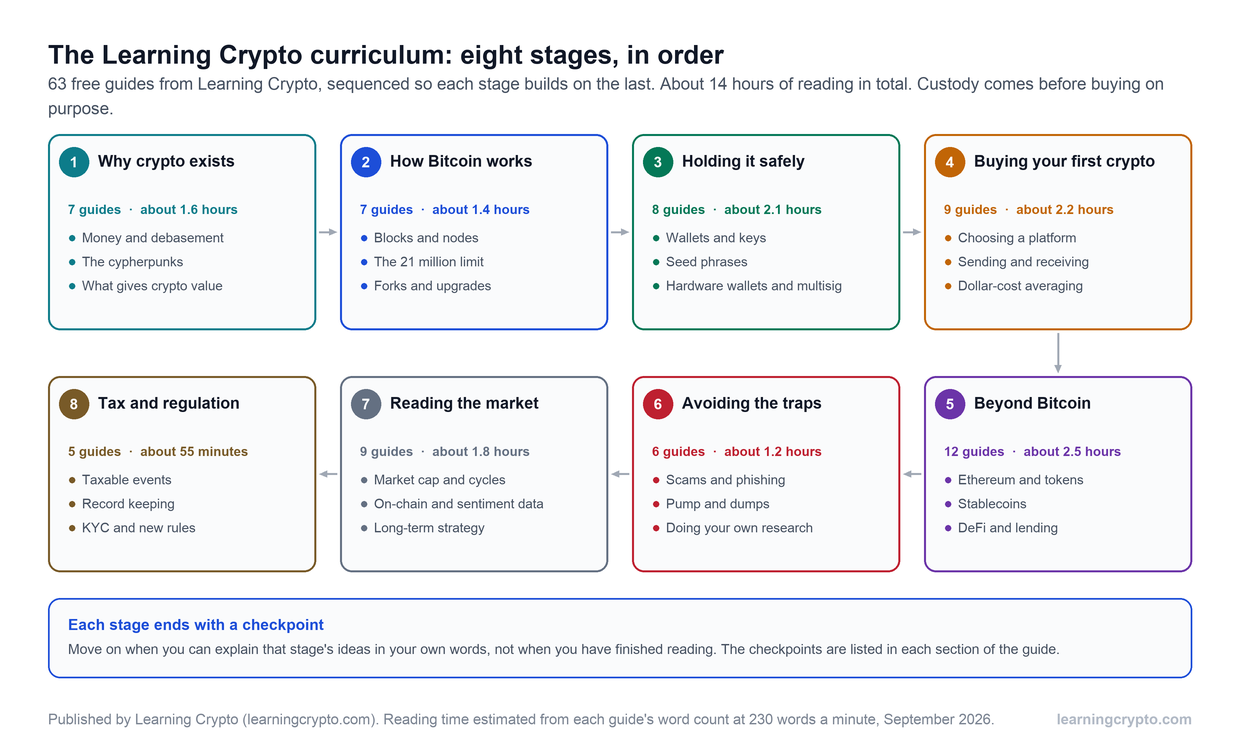
Custody comes before buying, and risk comes before market analysis. The order is the point: each stage assumes the one before it.
| Stage | Focus | Guides | Reading time | What it covers |
|---|---|---|---|---|
| 1 | Why crypto exists | 7 | about 1.6 hours | Money and debasement, The cypherpunks, What gives crypto value |
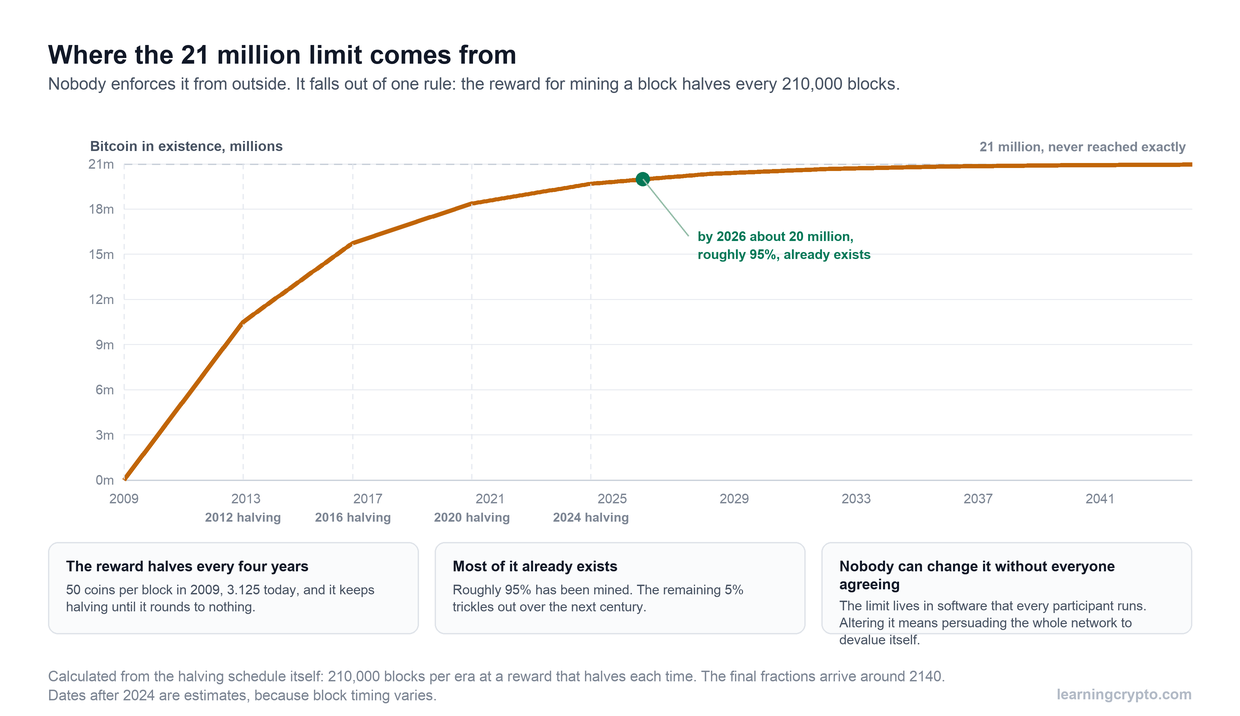
| 2 | How Bitcoin works | 7 | about 1.4 hours | Blocks and nodes, The 21 million limit, Forks and upgrades |
| 3 | Holding it safely | 8 | about 2.1 hours | Wallets and keys, Seed phrases, Hardware wallets and multisig |
| 4 | Buying your first crypto | 9 | about 2.2 hours | Choosing a platform, Sending and receiving, Dollar-cost averaging |
| 5 | Beyond Bitcoin | 12 | about 2.5 hours | Ethereum and tokens, Stablecoins, DeFi and lending |
| 6 | Avoiding the traps | 6 | about 1.2 hours | Scams and phishing, Pump and dumps, Doing your own research |
| 7 | Reading the market | 9 | about 1.8 hours | Market cap and cycles, On-chain and sentiment data, Long-term strategy |
| 8 | Tax and regulation | 5 | about 55 minutes | Taxable events, Record keeping, KYC and new rules |
How long does it take to learn crypto?
Reading this curriculum takes about 14 hours, which is roughly 4 weeks at half an hour a day. Most people will want as much time again for the practical checkpoints, so a realistic plan is one to two months at a comfortable pace. That is enough to understand crypto well and to avoid the mistakes that cost beginners most. It is not enough to become an expert, and nobody honest will tell you otherwise.
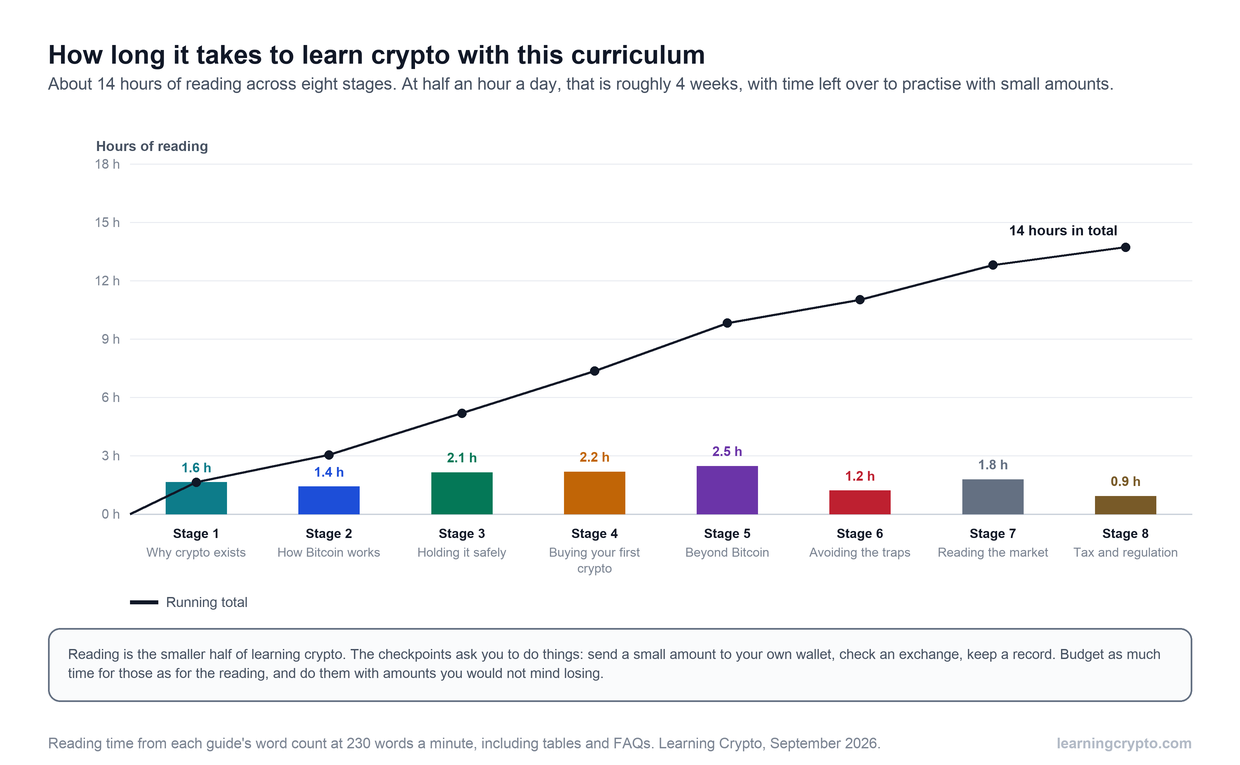
About 14 hours of reading in total. The checkpoints add practical steps on top, which are worth at least as much time as the reading.
Two tips from teaching this for a decade. First, do not skip ahead to the market stage because it looks exciting; it will make far more sense later. Second, keep a note of questions as you go. Most of them will be answered two stages on, and the ones that are not are exactly what our Ask Crypto research assistant is for.
Stage 1: Why does crypto exist?
Start with the problem, not the product. Bitcoin only makes sense once you understand what its creators thought was wrong with the money you already use, and every later stage builds on that. This stage is 7 guides, about 1.6 hours of reading.
- What is the purpose of cryptocurrency?: What cryptocurrency is actually for, and what it is not
- Why Bitcoin was created: The 2008 backdrop and the problem Satoshi set out to solve
- The cypherpunk movement: The privacy movement that shaped Bitcoin's design
- Crypto explained simply: A plain-English overview of how cryptocurrency works
- What backs up cryptocurrency?: What, if anything, stands behind a coin's value
- Bitcoin vs Gold: Bitcoiner, Gold Bug, or Still Deciding?: How Bitcoin compares with the oldest store of value
- CBDCs vs Cryptocurrency: Central Control vs Financial Freedom: Why central bank digital currencies are a different idea entirely
When you finish these guides, read the source: Satoshi Nakamoto's nine-page Bitcoin whitepaper from 2008. After this stage it is far more readable than its reputation suggests.
Checkpoint: you are ready for the next stage when you can explain in your own words what problem Bitcoin was built to solve, and name one thing it does that a bank account cannot.
Stage 2: How does Bitcoin actually work?
Now the mechanics. You do not need to write code, but you do need to understand blocks, nodes and the supply schedule well enough that no one can mislead you about them. This stage is 7 guides, about 1.4 hours of reading.
- What Is Bitcoin? A Complete Guide for Beginners: The complete beginner's guide to Bitcoin
- How Does Blockchain Work? A Beginner's Guide: Blocks, hashes and consensus without the jargon
- Blockchain for beginners: The wider picture: types of blockchain and where they are used
- What Are Nodes in Crypto and How Do They Power Blockchain Networks?: Who runs the network, and why that matters
- What Happens When All The Bitcoin Is Mined?: The supply schedule and what happens after the last coin
- What Is a Fork in Crypto? Hard Forks vs. Soft Forks Explained: How blockchains change, and what a fork means for holders
- How long does it take to send Bitcoin?: Confirmations, fees and why some transactions wait
Checkpoint: you are ready for the next stage when you can describe what happens between pressing send and a transaction being final, and explain where the 21 million limit comes from.
Stage 3: How do you hold crypto safely?
This stage comes before buying, on purpose. Most losses in crypto are custody mistakes rather than bad investments, and it is far easier to set up safely from the start than to fix it later. This stage is 8 guides, about 2.1 hours of reading.
- Crypto wallets for beginners: The types of wallet and how to choose your first one
- Cold Wallet vs Hot Wallet: Key Differences Explained: When to keep crypto online and when to keep it offline
- What Is a Seed Phrase and Why It's Critical to Crypto Security: The twelve or twenty-four words that are your money
- How to use a cold wallet: Setting up and using a hardware wallet step by step
- Trezor vs Ledger: Which Hardware Wallet Should You Choose?: Comparing the two best-known hardware wallets
- Crypto security best practices: A security checklist for accounts, devices and backups
- Multisig wallets explained: Why serious holders spread control across several keys
- Crypto Inheritance: How to Pass On Your Crypto Safely: Making sure your crypto can be passed on
Checkpoint: you are ready for the next stage when you can explain the difference between a hot and a cold wallet, say where your recovery phrase should and should not live, and describe what your family would need if something happened to you.
Stage 4: How do you buy your first crypto?
With custody understood, buying is the easy part. The skill is choosing a safe platform, moving coins without mistakes, and deciding how much to invest before emotion decides for you. This stage is 9 guides, about 2.2 hours of reading.
- How to start investing in crypto: The first steps, in order
- Starting crypto with $100: What starting small actually looks like
- Crypto terms every beginner should know: The vocabulary you will meet on every platform
- Centralized vs Decentralized Exchanges: Which is Best for Your Crypto?: Centralised and decentralised exchanges compared
- How to Tell If a Crypto Exchange or Wallet Is Safe: Eight checks before you leave money anywhere
- What Is a BTC Wallet Address?: Reading an address and avoiding costly mistakes
- How to Send Bitcoin to Another Wallet: A Step-by-Step Guide: Moving Bitcoin between wallets safely
- What Is DCA in Crypto? Your Complete Guide to Dollar Cost Averaging: Buying on a schedule instead of guessing the moment
- How much to invest in crypto each month: Setting a monthly amount you can stick to
Checkpoint: you are ready for the next stage when you can check whether an exchange is safe, send a small amount to your own wallet and confirm it arrived, and write down how much you will invest each month.
Stage 5: What is there beyond Bitcoin?
Ethereum, tokens, stablecoins and decentralised finance are where most of crypto's complexity and most of its risk live. Take this stage slowly and in order. This stage is 12 guides, about 2.5 hours of reading.
- Difference Between Bitcoin & Ethereum: Breaking Down the Basics: How Ethereum differs from Bitcoin
- Smart contracts explained: The programs that run on a blockchain
- What Is ERC-20? The Standard Behind Ethereum Tokens: The standard behind most tokens
- Tokenomics explained: How a token's supply and design shape its value
- What Is a Stablecoin? How They Work and the Risks: Dollar tokens, how they hold their value and their risks
- USDT vs USDC Compared: Reserves, Risks, and Which Is Safer: The two largest stablecoins compared
- Stablecoin Depegs: Why Pegs Break and What to Do: Why pegs break and which ones come back
- What Is DeFi? A Complete Guide to Decentralised Finance: Decentralised finance explained from the ground up
- What is Aave?: How the largest lending protocol works
- Stablecoin Lending Explained: How the Rates Work and What Can Go Wrong: Where lending yield comes from and what can go wrong
- What Is Crypto Bridging and How Do Blockchain Bridges Work?: Moving assets between blockchains, and the risks
- What is liquid staking?: Earning staking rewards while keeping tokens usable
Checkpoint: you are ready for the next stage when you can explain what a smart contract does, what keeps a stablecoin at a dollar, and where the yield in a DeFi lending pool comes from.
Stage 6: How do you avoid the common traps?
Every stage so far has mentioned risk. This one is about the people who create it deliberately, and about the habit of checking claims for yourself. This stage is 6 guides, about 1.2 hours of reading.
- A No-Nonsense Guide to Spotting Crypto Scams: The main scam patterns and how to spot them
- Token Approval Phishing: How Wallet Drainers Empty Wallets: How wallet drainers work, and how to revoke approvals
- Fake Crypto Support Scams: How the Con Works: Why real support never contacts you first
- Pump and Dump Schemes in Crypto: How to Spot and Avoid Them: How coordinated price schemes work
- What Is Exit Liquidity in Crypto and Why You Should Care: How to avoid being the buyer someone else sells to
- How to do your own research: A repeatable process for researching any project
Checkpoint: you are ready for the next stage when you can recognise the four moves of a fake support contact, explain what signing a token approval allows, and run a basic check on a new project.
Stage 7: How do you read the crypto market?
Only now does analysis make sense. These guides explain how cycles work and how to read the measures that have described them, including the five that make up the Satoshi Indicator. This stage is 9 guides, about 1.8 hours of reading.
- What Is Market Cap in Crypto: A Complete Guide: What market cap measures, and its blind spots
- What Is a Crypto Bull Run and When Is the Next One Coming?: How crypto cycles have unfolded
- On-Chain Analysis: Reading Blockchain Data to Understand Markets: Reading blockchain data to understand the market
- MVRV Z-Score Explained: How to Read Bitcoin's Most Watched Valuation Metric: Bitcoin's most watched valuation measure
- The Pi Cycle Top Indicator: How It Works, What It Caught and What It Missed: The moving-average signal, its hits and its misses
- Bitcoin Weekly RSI: What It Shows About Cycle Tops and Bottoms: Momentum at cycle tops and bottoms
- Crypto Fear and Greed Index: What It Measures and What Its Record Shows: What market sentiment has and has not predicted
- Bitcoin ETF Flows Explained: What the Daily Numbers Mean for Price: What the daily ETF numbers mean for price
- A long-term crypto strategy: Putting it together into a plan you can hold
Checkpoint: you are ready for the next stage when you can explain what market cap does and does not tell you, describe where Bitcoin sits in its cycle using at least two measures, and say why no single indicator is enough.
Stage 8: What do tax and regulation mean for you?
The final stage is the one people regret skipping. Good records cost almost nothing at the time and are close to impossible to rebuild later. This stage is 5 guides, about 55 minutes of reading.
- A complete guide to crypto taxes: How crypto is taxed, and the events that count
- Crypto Record Keeping: What to Track for Tax: What to record for every transaction
- What Is KYC in Crypto? Know Your Customer Explained: Why platforms verify identity, and what it means for privacy
- MiCA: Europe's Crypto Regulation Framework Explained: Europe's crypto rulebook explained
- The GENIUS Act explained: The US stablecoin law and what it changes
Checkpoint: you are ready for the next stage when you can list the events that create a tax record in your country, and keep a record of your next transaction the day you make it.
Is crypto hard to learn?
Not if you take it in order. The vocabulary is unfamiliar and some of the ideas are genuinely new, but none of them needs a technical background. What makes crypto feel hard is learning it from social media, where people start with price predictions and never explain the foundations. The curriculum above deliberately avoids that, and the crypto terms guide in stage four is worth keeping open as a glossary throughout.
The parts people find hardest are custody and DeFi, which is why those stages are the longest. Take them slowly, and practise every step with a trivial amount before you do it with money that matters.
How do you keep learning after the curriculum?
By applying what you know to the market as it moves. Understanding crypto is a foundation; staying oriented through a cycle is a separate, ongoing skill. That is what the Learning Crypto membership is for.
- Standard membership adds weekday analyst briefs, the Ask Crypto research assistant, portfolio and wallet tracking, and a weekly newsletter. See the Daily Brief for what a morning briefing covers.
- Navigator membership adds the Satoshi Indicator, the daily Bitcoin market temperature built from the stage seven measures, plus midweek updates, the team portfolio and a private community with direct access to the team.
- The book, Why Crypto, covers the same ground as stages one to eight in six chapters, from the problem with money to regulation, in paperback, ebook and audiobook.
Both memberships are described on the plans page and come with a 30-day money-back guarantee. If you would rather compare options first, our list of crypto learning resources covers free and paid alternatives, and the Fundamentals hub collects every beginner guide we publish.
Frequently asked questions
How do I start learning crypto from scratch?
Start with why cryptocurrency exists, then learn how Bitcoin works, then how to hold crypto safely, before you buy anything. After that, move on to Ethereum and stablecoins, common scams, reading the market, and tax. The Learning Crypto curriculum sets out that order in eight stages with free guides for each step.
How long does it take to learn crypto?
The Learning Crypto curriculum is about 14 hours of reading across 63 guides, which is roughly 4 weeks at half an hour a day. Allow as much time again for practical steps such as setting up a wallet. That is enough to understand crypto well and avoid common mistakes, though not to become an expert.
Can I learn crypto for free?
Yes. Every guide in the Learning Crypto curriculum is free to read, and so is the CryptoTips YouTube channel. Paid options, including the Learning Crypto membership and the Why Crypto book, add ongoing analysis, tools and a structured read, but you do not need them to learn the fundamentals.
What should I learn first about crypto?
Learn why Bitcoin was created and what problem it was meant to solve. Everything else, from wallets to DeFi, is easier to understand once you know that. The second priority is custody: how keys, seed phrases and wallets work, because most permanent losses come from mistakes there rather than from bad investments.
Do I need to buy crypto to learn about it?
No. The first three stages of the curriculum need no money at all. When you do reach the practical steps, a very small amount is enough to practise sending, receiving and storing crypto. Learning with money you could lose entirely is the safest way to make your first mistakes.
Is Learning Crypto free?
The guides on learningcrypto.com, including this curriculum, are free to read. Learning Crypto also offers paid Standard and Navigator memberships with daily analyst briefs, an AI research assistant, portfolio tools and the Satoshi Indicator, with a 30-day money-back guarantee. Details are on the plans page.
Who runs Learning Crypto?
Learning Crypto was founded in 2019 by Heidi Chakos and Toby Cunningham, who have taught crypto on the CryptoTips YouTube channel since 2016. The platform is independent and ad-free, and publishes free guides, daily analysis and member tools at learningcrypto.com for more than 8,700 investors.
Keep learning
- Best Cryptocurrency Learning Resources To Know [A Complete Guide]
- Is Cryptocurrency Hard to Learn? A Beginner’s Guide to Mastering Crypto in 2025
- What Is Bitcoin? A Complete Guide for Beginners
- Must Cryptocurrency Terms To Know In 2026 [A Complete Guide]
- Learning Crypto membership plans
- More beginner guides in the Fundamentals hub