
Ever watched Bitcoin climb and then convinced yourself it's going higher, only to buy at the peak? Or waited for the "perfect dip" that somehow never feels quite deep enough, so you end up never buying at all?
Most of us have been there; it's no secret that crypto investing can feel like a game you're destined to lose.
DCA investing is somewhat closer to a more Zen approach: You set an amount, pick your schedule, and stop thinking about it. Let time do the heavy lifting, and watch your stack grow without all the drama.
What You'll Learn in This Guide
How DCA strips crypto investing down to its simplest form.
Why the psychology behind DCA matters more than the math, and how it stops you from panic-selling during crashes or FOMO-buying at peaks.
The practical steps to set up automated recurring purchases that run in the background.
Which exchanges actually make DCA easy
When DCA makes sense versus when you'd be better off with a lump-sum approach or more advanced strategies
What Does DCA Mean in Crypto? The Fundamentals
Dollar Cost Averaging is one of the easiest concepts to grasp in Crypto. You strip investing down to its most basic form: the same amount, same schedule, repeat.
These simple mechanics turn crypto investing from what can be a nerve-wracking guessing game for some into a steady habit.
It’s not so much about finding the perfect moment to buy and more about showing up consistently, a trait that often beats luck in the long run.
With DCA, you invest the same amount of money on a regular schedule, regardless of whether the market is soaring, crashing, or moving sideways. Instead of stressing over entry points, you buy consistently and let the law of averages work for you.
The idea isn’t new. Traditional stock investors have been using DCA for decades through workplace retirement plans or monthly investment contributions.
But crypto trades 24/7. There's no closing bell, no weekend break. A regulatory announcement in Asia at 2 AM can move prices 15% before you wake up. Someone with a large following can send out a cryptic tweet that triggers chaos.
DCA takes the sting out of this unpredictability. Rather than scrambling to react to every headline or overnight candle, you’re already in the market but on a schedule.
And unlike spot trading, where you're actively making buy and sell decisions based on current conditions, DCA removes the timing question entirely.
Let’s say you put $100 into crypto every week for a year. Sometimes you’d be buying when it’s expensive, other times when it’s cheap. Over time, your average cost per coin smooths out, leaving you less exposed to unlucky timing compared to a lump-sum “all-in” buy.
DCA Math in Action
DCA is typically discussed as a long-term strategy, something you adhere to for years, not weeks. It could span market cycles, multiple bull and bear phases, or just steady accumulation through sideways trading.
For now, here's a 12-week hypothetical scenario of how it might play out if you have $100 to invest in Bitcoin every week for three months:
Week 1: Bitcoin is at $200,000. Your $100 gets you 0.0005 BTC.
Week 2: Bitcoin drops to $185,000. Your $100 gets you 0.00054 BTC.
Week 4: Bitcoin continues down to $160,000. Your $100 gets you 0.000625 BTC.
Week 6: Bitcoin bounces to $175,000. Your $100 gets you 0.00057 BTC.
Week 8: Bitcoin rallies to $210,000. Your $100 gets you 0.000476 BTC.
Week 10: Bitcoin corrects to $190,000. Your $100 gets you 0.000526 BTC.
Week 12: Bitcoin stabilizes at $195,000. Your $100 gets you 0.000513 BTC.
You've invested a total of $1,200 over twelve weeks and accumulated 0.006444 BTC. Your average cost per Bitcoin is $186,220 despite prices ranging from $160,000 to $210,000. You automatically bought more during the dip to $160,000 and less during the peak at $210,000, without trying to predict any of these moves.
Setting Up Your First DCA Strategy

Now that you've seen how DCA works on paper, let's talk about making it work in real life. The good news is that setting this up takes about as much effort as subscribing to Netflix. The hard part isn't the setup - it's sticking with it when Bitcoin drops 30% and your group chat is screaming about the end times.
Choosing Your DCA Parameters
You really only need to answer two questions.
How much?
Only invest money you can afford to lose. This isn't a cliché. If you're calculating how much ramen you can survive on to free up more cash for DCA, you're doing it wrong.
How much to invest in crypto per month depends heavily on your personal financial situation. Some people DCA $20 weekly. Others do $1,000 monthly. Neither is "right"; what matters is that the amount fits your budget without causing stress.
How often?
Weekly, bi-weekly, or monthly all work fine.
Weekly gives you more price points to average across, which matters more during volatile periods. Monthly is simpler and often matches how people get paid. Bi-weekly splits the difference.
The honest truth? The difference in long-term results between these frequencies is usually marginal. Pick whichever feels easiest to maintain. A $400 monthly DCA you actually stick with beats a $100 weekly plan you abandon after two months.
Picking Your Crypto
This is where it’s easy to overcomplicate things.
Bitcoin and Ethereum are the safest starting points. They have the longest track records, the most institutional adoption, and the highest likelihood of still being in existence in five years.
If you want to explore blue-chip cryptocurrencies, do that after you've been DCA'ing into the big two for at least a few months.
The temptation to diversify into six different coins will be strong. Resist it. Bear in mind, some altcoins from the last cycle don't exist anymore.
Start simple, learn how the markets work, then expand if it makes sense.
Platform Selection
You’ll need an exchange that supports recurring purchases. Most major platforms do. We’ll run a deeper comparison later, but for now, look for:
Low fees on recurring buys (ACH/bank transfer usually beats cards).
Flexible schedules (weekly/monthly options at a minimum).
Easy withdrawals to your own wallet if/when you want to self-custody.
Solid security (2FA, device approvals, clear account-recovery flow).
Actually Setting It Up
The setup process varies by platform, but generally follows the same pattern:
Link your bank account for funding (ACH transfers are usually free, credit card purchases come with fees)
Navigate to recurring purchases (usually under "Buy," "Trade," or "Recurring" in the menu)
Select your cryptocurrency (start with Bitcoin or Ethereum)
Choose your frequency (weekly, bi-weekly, monthly)
Set your dollar amount (the fixed amount you're investing each time)
Confirm and forget (seriously, set it and stop thinking about it)
Most platforms will send you a confirmation email each time a purchase executes. You can disable these if they're causing you to check prices more often than you should.
One practical note: Make sure you maintain enough balance in your linked bank account to cover your recurring purchases. Missing purchases because of insufficient funds defeats the purpose of consistency.
The Most Important Step
After you set everything up, do something radical: stop checking your portfolio every day.
DCA works best when you treat it like a utility bill, something that happens automatically in the background. The more you watch the daily price movements, the more likely you are to make emotional decisions that undermine the strategy.
Set a calendar reminder to review your DCA strategy once a quarter. Not weekly. Not monthly. Quarterly. That's often enough to make sure everything's working, but not so often that you're constantly second-guessing yourself.
DCA Psychology and Behavioral Benefits
If you've ever opened a trading app and felt your stomach tighten, you already know that investing isn't just about numbers; it's about psychology. Crypto's constant volatility will always push our buttons, and we're terrible at making rational decisions when money is involved.
The real reason DCA works has less to do with mathematics and more to do with how human brains handle uncertainty and risk. When prices swing wildly and headlines scream conflicting messages, inexperienced traders end up either paralyzed or acting on impulse.
DCA doesn't make you smarter or fix these tendencies; it just removes most of the decisions where they'd trip you up.
Why DCA Works for Your Brain
Every time you make an investment decision, you're creating an opportunity to second-guess yourself. Did I buy too high? Should I have waited? What if it drops tomorrow? These questions don't just cause stress, but often lead to bad decisions.
DCA eliminates most of these decision points.
You decided once: invest X dollars every Y days. Now you're done deciding. The price drops 20%? Not your problem, your next purchase happens on schedule. The price jumps 30%? Also, not your problem; you're still buying on schedule.
Building a Long-Term Mindset
The hardest part of investing isn’t getting started; it’s staying committed when the market isn’t rewarding you immediately. DCA helps you zoom out.
Instead of obsessing over the day-to-day noise, you learn to focus on the bigger picture: steady accumulation, patience, and wealth that grows over years rather than weeks.
It’s not flashy, but it works.
DCA vs. Other Crypto Investment Strategies
When people hear about dollar-cost averaging, the first question is usually: “So how does this compare to other ways of investing in crypto?”
DCA vs. Lump-Sum Investing
A lump sum means you invest everything at once. Got $10,000? Buy $10,000 of Bitcoin today. Done. It’s even simpler than DCA in that respect.
On paper, a lump sum usually wins if prices go up. Having more money in the market earlier means greater exposure to potential gains. If Bitcoin climbs from $100,000 to $200,000 over two years, you're better off buying at $100,000 than spreading purchases across 24 months.
The catch is that most people can't execute it. They sit on that $10,000 waiting for the "right" moment, which never feels quite right. Or they invest it all, watch it drop 30%, and panic-sell at a loss.
DCA gives up some theoretical upside for a strategy you'll actually stick with.
Use a lump sum strategy if you have a windfall and can stomach watching it swing wildly. Use DCA if you're building a position from regular income.
DCA vs. Active Trading
Active trading means constantly buying and selling based on price action, news, or technical signals. It requires monitoring markets, making swift decisions, and competing against professionals who do this for a living.
Don’t get us wrong, crypto trading can be very profitable if you know what you are doing; however, many inexperienced traders lose money after fees and taxes.
DCA vs. Market Timing
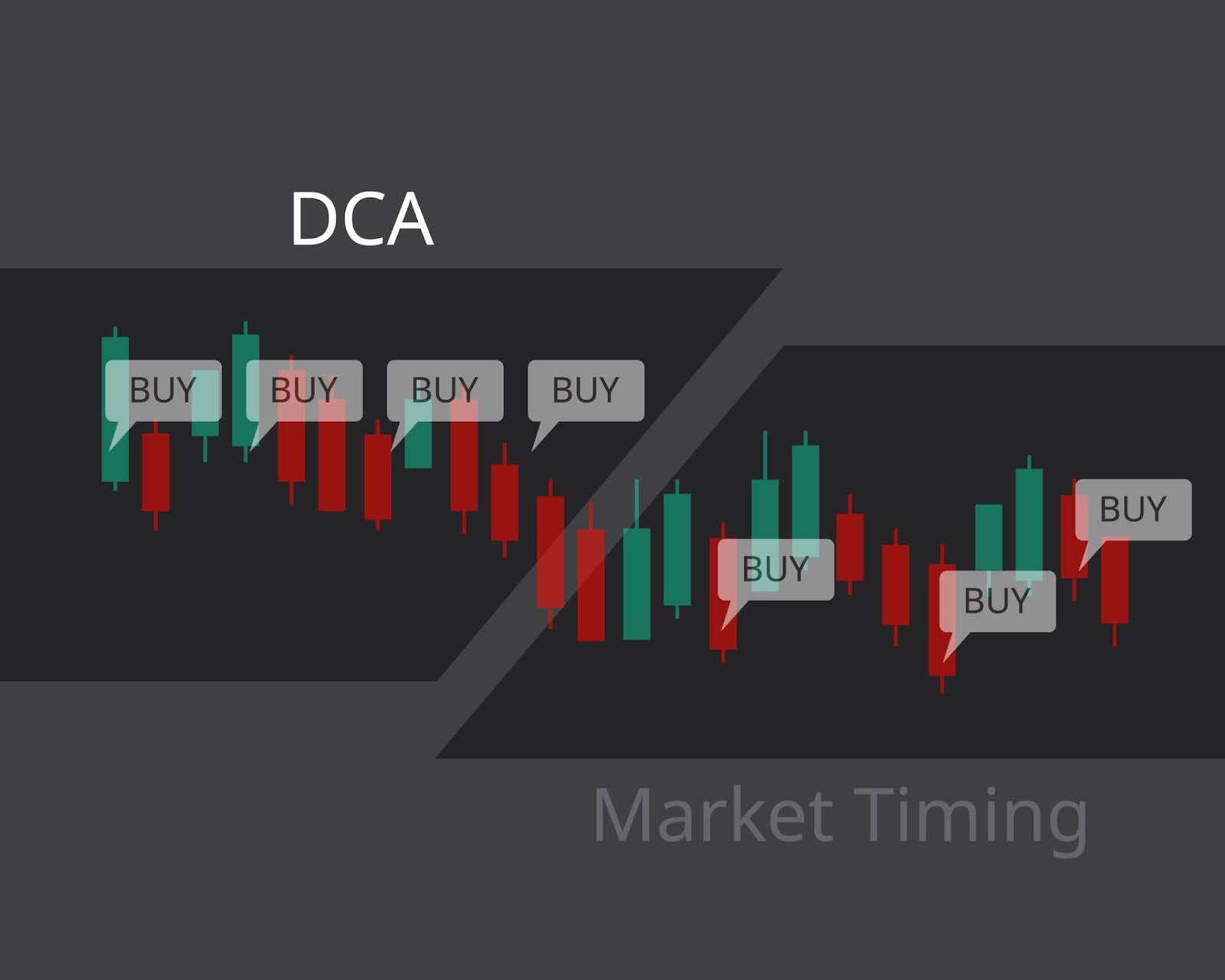
Market timing is trying to buy at the bottom and sell at the top, which is almost impossible to execute consistently.
Crypto trades 24/7. Major moves occur during random weekends or while you're asleep. Even if you nail one cycle, the next one might wreck you.
DCA accepts that you can't time markets reliably. You'll never catch the absolute bottom, but you'll never buy the absolute top either. Your entry price averages out somewhere in the middle, which beats waiting forever for perfect timing that doesn't exist.
Pros and Cons of DCA in Crypto
Pros | Cons |
✓ Removes emotional decision-making from investing ✓ Eliminates the need to time the market ✓ Automatically buys more when prices are low ✓ Reduces the risk of investing everything at a peak ✓ Easy to automate and maintain ✓ Builds consistent investing habits ✓ Lower barrier to entry, can start with small amounts ✓ Works well with volatile assets like crypto | ✗ May miss out on gains if you had invested a lump sum during a bull run ✗ Requires discipline to maintain during long bear markets ✗ Trading fees add up with frequent small purchases ✗ More complex tax reporting with multiple purchase dates ✗ Can create a false sense of security, so still need to research what you're buying |
Platform Comparison for DCA Investing
Platform | Fees | Ease of Use | Best For |
Coinbase | High | Very easy | Beginners, broad exposure |
Kraken | Low | Moderate | Cost-conscious investors |
Gemini | Medium/Low (ActiveTrader) | Easy | U.S.-based, regulated users |
Binance.US | Low | Moderate | Users with some experience, altcoin buyers |
Swan Bitcoin | Low | Easy | Bitcoin-focused investors |
River | Low | Easy | Security-conscious BTC users |
Strike | Very low | Easy | Small, frequent BTC buys |
Best Exchanges for Automated DCA
Coinbase makes DCA dead simple. The interface is intuitive, setting up recurring buys takes about two minutes, and they support a wide range of cryptocurrencies.
The tradeoff is higher fees than most competitors, which can eat into your returns over time. Good for beginners who value simplicity over optimization.
For those new to exchanges, check out our Coinbase guide for beginners
Kraken offers lower fees and a decent recurring purchase feature. The interface is more complex than Coinbase, but nothing overwhelming. Weekly recurring buys are straightforward once you're set up.
Better choice if you're willing to spend a few extra minutes learning the platform to save money long-term.
Gemini focuses on regulatory compliance and security. Their basic interface has limited automation, but ActiveTrader (their advanced interface) offers lower fees.
Best for people who prioritize regulatory compliance and are comfortable with a slightly more technical platform.
Binance.US has competitive fees and an extensive coin selection, but the interface is complex, and regulatory concerns pop up periodically. Not the best choice for beginners, but experienced users might appreciate the lower costs.
Bitcoin-Only DCA Services
Swan Bitcoin is built entirely around Bitcoin DCA. They provide educational resources, automatic withdrawals to your own wallet (crucial for long-term security), and an excellent user experience. Higher fees than some alternatives, but the education and automatic self-custody features have value.
River combines low fees with research tools and institutional-grade security. They focus on making Bitcoin accumulation simple while providing market analysis and educational content. Good middle ground between cost and features.
Strike integrates Lightning Network technology for the lowest fees on small purchases. If you're DCA'ing small amounts (under $100 per purchase), Strike's fee structure makes more sense than traditional exchanges. The interface is mobile-first and extremely simple.
Advanced DCA Strategies and Variations
Standard DCA works fine for most people. But once you've been running a basic strategy for six months or a year, you might want more control without abandoning the systematic approach entirely.
These variations add complexity. They require more active management and can backfire if executed poorly.
Value Averaging Strategy
Value averaging takes the DCA concept and adds a twist. Instead of always investing the same amount, you adjust based on how the market is performing. This means buying aggressively during crashes and easing off during pumps, which is theoretically optimal.
If prices fall below your average, you increase your investment to scoop up more at a discount.
If prices rise above your average, you invest less, locking in the fact that you’ve already captured some gains.
This method is more hands-on, so practically harder. You’ll need to track performance closely and be ready to allocate more capital when markets drop.
DCA with Technical Analysis
Purists will say this defeats the purpose of DCA. They're partly right. But some people combine systematic investing with light technical awareness. For example:
Increasing your buy frequency when prices touch long-term support levels.
Pausing DCA if the market enters an obvious bubble phase.
Using sentiment indicators to guide small adjustments.
Multi-Asset DCA Approaches
Instead of DCA'ing into a single crypto, split your investment across multiple assets.
You can adjust your allocation as the market cycle shifts (heavier Bitcoin weighting in uncertain times, more altcoin exposure in bull runs).
Rebalancing every quarter keeps your portfolio aligned with your risk tolerance.
The main benefit is reducing exposure to the failure of any single project.
Of course, diversification only works if the assets you pick have staying power. Many altcoins don’t survive full market cycles, so keep your base in BTC and ETH.
DCA Exit Strategies
At some point, you’ll want to take profits or reduce exposure.
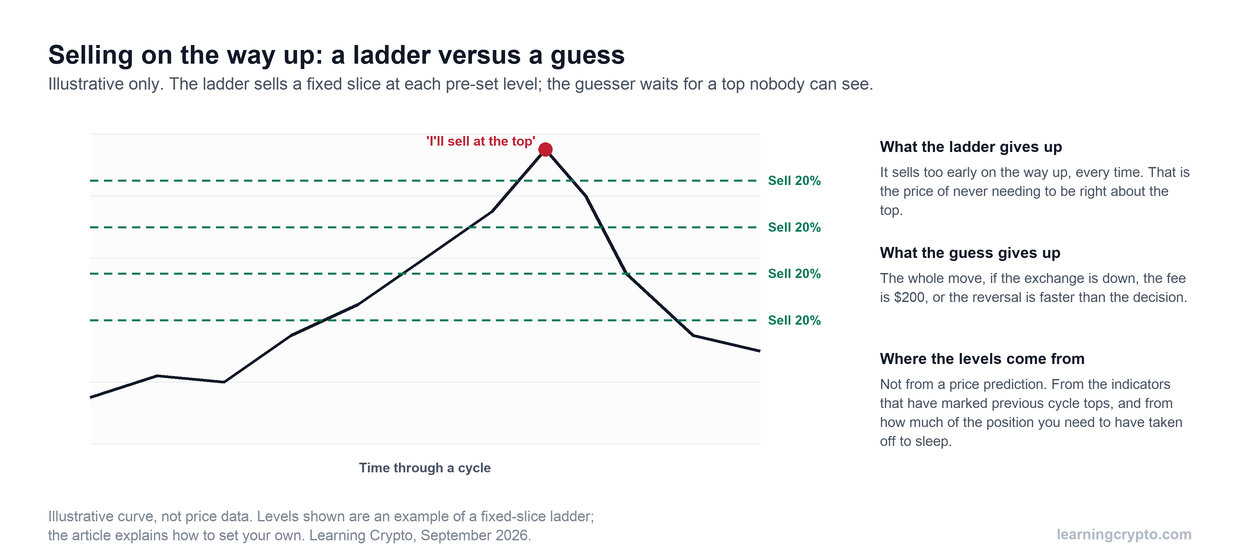
One approach: reverse DCA during major bull markets. Instead of buying $100 weekly, sell $100 weekly when prices have multiplied several times. This locks in gains gradually without trying to time the top.
Another option: reduce DCA amounts rather than stopping completely. If you've been investing $200 monthly and your position is now significant, drop to $50 monthly. You're still accumulating but with less new capital at risk.
Tax Implications of DCA Investing
Dollar-cost averaging keeps investing simple until tax season rolls around. Because you’re buying crypto at regular intervals, you’ll end up with dozens (or more) small purchases spread across different prices. That creates a more complex cost basis than if you’d just gone all-in once.
Most countries treat crypto as property, not currency. That means every time you sell, swap, or spend your crypto, it’s a taxable event. To calculate gains or losses, you’ll need accurate records of:
Purchase dates
Purchase amounts (in fiat)
The cost basis for each lot
DCA doesn’t change your tax liability, but it does make bookkeeping more important.
Many exchanges provide CSV exports, and tools like CoinTracker, Koinly, or Accointing can automate the process and generate tax reports.
One overlooked benefit of DCA is tax-loss harvesting opportunities. Since you’re accumulating over time, you might hold some positions at a loss while others are in profit.
Selling the losing lots strategically can offset gains elsewhere, reducing your tax bill.
Tax rules vary widely by country. In some places, holding crypto for more than a year reduces capital gains rates; in others, it doesn’t matter. When in doubt, check your local regulations or consult a tax professional before making big moves.
Building Wealth Through Consistent Action
DCA is the simplest on-ramp into crypto investing. Set your amount, pick your schedule, stick with the majors like Bitcoin and Ethereum, and give it time. That's the foundation.
But most people who start with DCA don't stop there. Crypto has a way of pulling you deeper. Into the tech, the communities, the rabbit hole of what's actually being built on these networks. That curiosity is valuable, but it needs direction.
You need reliable information from people who've been through multiple market cycles and understand both the opportunities and the pitfalls.
That's where Learning Crypto comes in. We provide in-depth guides, AI-powered education tools that answer your specific questions, and market analytics that cut through the noise.
Whether you're three weeks into your first DCA strategy or three years deep and exploring advanced concepts, we're building the resources you actually need.
DCA gets you started. Education keeps you moving forward intelligently.
Ready to go deeper?
Frequently asked questions
Is DCA better than lump sum investing in crypto?
On paper, a lump sum usually wins when prices rise, because more money is in the market earlier. In practice most people cannot execute it: they wait for a perfect entry that never comes, or invest everything, watch it drop 30 percent, and panic-sell. DCA gives up some theoretical upside for a plan you will actually follow. Use a lump sum for a windfall you can stomach swinging; use DCA when building from regular income.
How often should you DCA into Bitcoin?
Weekly, bi-weekly, or monthly all work. Weekly gives you more price points to average across, which helps in volatile stretches; monthly is simpler and matches most paychecks. The long-term difference between frequencies is usually marginal, so pick whichever you will maintain. A $400 monthly buy you stick with beats a $100 weekly plan abandoned after two months. Review the strategy quarterly, not daily.
Does dollar-cost averaging make crypto taxes harder?
It does not change what you owe, but it complicates the bookkeeping. Every purchase creates a separate lot with its own date, fiat amount, and cost basis, and most countries treat crypto as property, so each sale, swap, or spend is a taxable event. Exchange CSV exports and tools like CoinTracker or Koinly can automate reports. Holding losing lots can also create tax-loss harvesting opportunities. Rules vary by country, so check yours or ask a tax professional.
Which cryptocurrency should I DCA into as a beginner?
Bitcoin and Ethereum. They have the longest track records, the most institutional adoption, and the best odds of still existing in five years. Resist the urge to spread across six coins from the start; many altcoins from the last cycle no longer exist. Run a simple DCA into the big two for at least a few months, learn how the market behaves, then consider other blue chips only if it makes sense.
This guide is part of stage 4 of 8, buying your first crypto, in the free Learning Crypto curriculum. Next: How much to invest in crypto each month.
Keep learning
- MVRV Z-score explained
- Genius Act Full Guide: Control, Not Freedom, in the Digital Dollar Era
- Smart Contracts Explained Simply (Beginner Guide for 2025)
- What Is Yield Farming in Crypto? A Complete Beginner’s Guide
- More guides in the Fundamentals hub
- Members: Ask Crypto AI, ask it any beginner question, privately