
Everyone in publishing is arguing about what AI assistants are doing to search traffic, mostly without data. We happen to have some. Bing's index is what Microsoft Copilot searches, and Bing sends this site several times more clicks than Google does, so our Bing query export is a reasonable window onto how people phrase questions when an assistant is involved.
So we exported the lot: every query that put one of our pages in front of someone through Bing in the three months to 15 September 2026. That is 1,043 distinct questions, 84,985 impressions and 1,273 clicks. The full file is free to download, and everything below can be recalculated from it.
Nobody else has published this, as far as we can tell. Site owners see their own query data and keep it. We would rather it was useful, so take it, check our arithmetic and cite it if it helps.
Where this data comes from
It is our own Search Performance report from Bing Webmaster Tools, covering learningcrypto.com for the three months ending 15 September 2026. Each row is a query, the number of times one of our pages appeared for it, the number of clicks it produced, and our average position.
These are real queries typed by real people, aggregated by Microsoft and stripped of anything identifying. We removed five rows before publishing: four were blocks of text someone had pasted rather than questions, and one read like private correspondence. Everything else is exactly as exported.
One caveat worth stating at the top. Bing reports queries that reached a website. It does not tell us what happened inside Copilot, whether an assistant answered without showing anyone a link, or which of these people were talking to a chatbot rather than a search box. What it does show is the shape of the questions, and the shape has changed.
People write sentences, not keywords
The median query in this dataset is 5 words long. 53.7% of them run to five words or more, and only 13.7% are the one or two word fragments that search engines trained us all to type for twenty years.
Almost four in ten (38.5%) begin with a question word: what, how, is, can, why, where. Those questions account for 74.0% of all impressions. Read a sample and the register is unmistakable:
- "how to set up a cold vault for defi tokens"
- "can i earn defi yield on usdt and usdc at the same time"
- "if i withdraw from my second metamask account and it's a scam, do i risk losing the funds in my first account as well?"
- "does a pump and dump mean on crpto when the coin doesnt strucure to a basic level just goes high then drops to worthless ?"
Those last two are not search queries in any sense that would have made sense in 2015. They are someone talking, typos and all, to something they expect to talk back. Whether the person opened Copilot or Bing barely matters; they have learned to ask in sentences, and the query log records it.
The assistant answers "what is". The click comes for "how to"
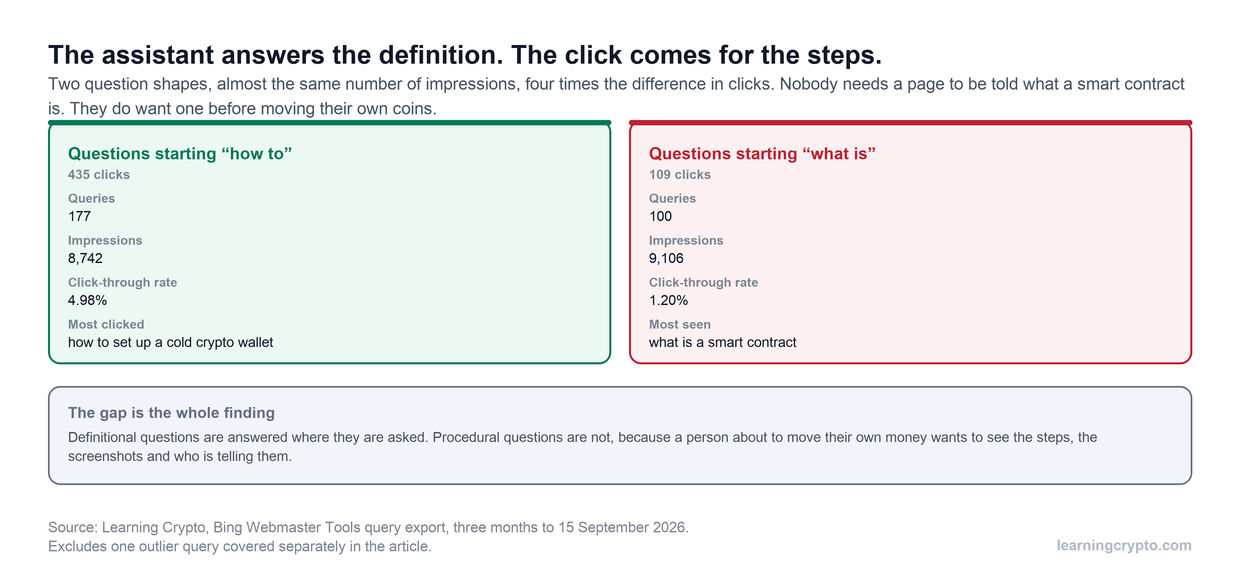
Near-identical impressions. Four times the clicks. The difference is whether the person needs to do something afterwards.
This is the clearest finding in the data, and it surprised us. Questions beginning "what is" or "what are" earned 9,106 impressions and 109 clicks, a 1.2% click-through rate. Questions beginning "how to", "how do" or "how can" earned a very similar 8,742 impressions and 435 clicks, a 4.98% rate.
Same visibility. Four times the clicks. The obvious reading is that a definition is a complete answer, and an assistant can give it. Nobody needs to visit a page to be told what a smart contract is once something has already told them. A procedure is different. Someone about to move their own coins into cold storage wants the steps, the screenshots, the warnings and some sense of who is telling them.
If that holds beyond our site, the implication for anyone publishing explainers is uncomfortable but simple. The glossary page is now competing with a machine that answers instantly and for free. The page that walks someone through doing the thing is not.
The longest questions get the most clicks
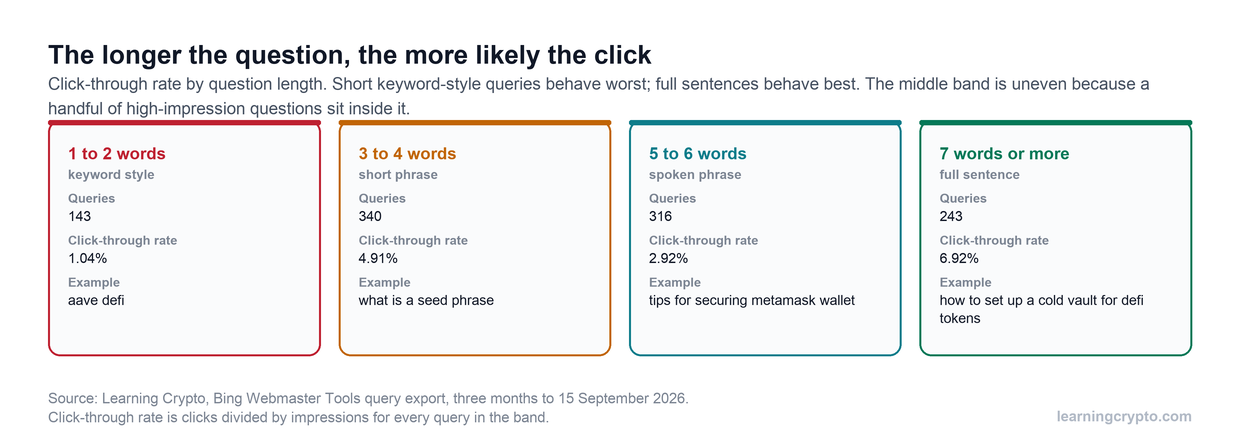
Keyword-style fragments perform worst. Full sentences perform best. The five to six word band is dragged down by a few very high impression questions.
Conventional search wisdom says short head terms are the prize and the long tail is scraps. Our data says the opposite. Queries of seven words or more converted at 6.92%. One and two word fragments converted at 1.04%, nearly seven times worse.
We should be honest that the curve is not clean: the five to six word band sits at 2.92% because a handful of very high impression questions fall inside it and drag the average down. The two ends of the range are unambiguous, though, and they point the same way.
Why would longer be better? A long question carries its own qualification. Somebody who types "how to set up a cold vault for defi tokens" has told you their asset, their goal and their experience level in eight words. A page that matches all three is worth opening. "aave defi", by contrast, could mean anything, and usually means the person is still deciding what they want.
Half of these questions never produced a visit
Of the 1,043 queries, 520 of them (49.9%) produced exactly zero clicks. Our pages were shown, often in the first handful of results, and not one person clicked through.
Some of that is ordinary. Plenty of queries only ever generate a few impressions, and a 0% rate on three impressions means nothing. But the pattern concentrates in exactly the place the previous two sections predict: definitional questions, at good positions, answered before anyone needed to leave.
One question, 44,675 impressions, not a single click
The single strangest row deserves its own section. The query "what is a soft fork" generated 44,675 impressions, which is 52.6% of every impression in the dataset. Our average position for it was 7.6. It produced 0 clicks. None. Not one, in three months.
A page ranking seventh for a term with that volume should collect thousands of visits. Instead the number is zero, which tells you the result was visible to a machine and effectively invisible to a person, or that the answer was delivered above our listing and the question closed there. We have excluded this one query from the percentages elsewhere in this article, because leaving it in would swamp everything else. It is worth sitting with on its own.
We cannot prove the mechanism from our side of the glass. What we can say is that impressions and attention have come apart, and that anyone still reporting "visibility" from impression counts is measuring something that no longer converts into readers.
What the clicks are actually about
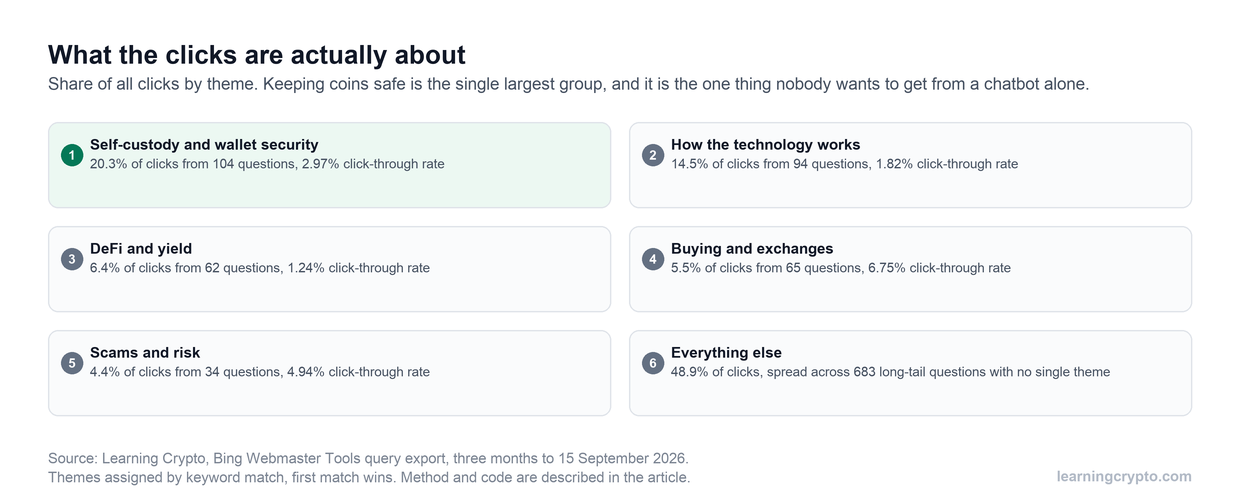
Keeping coins safe is the largest single theme, and it is the one people are least willing to take from a chatbot alone.
Grouping the queries by subject, self-custody and wallet security takes 20.3% of all clicks from 104 questions, the largest identifiable theme in the set. Explanations of how the technology works follow at 14.5%, then DeFi and yield at 6.4%, buying and exchanges at 5.5% and scams at 4.4%.
Look at what individually earned the most clicks and the theme sharpens further. "how to set up a cold crypto wallet". "how to set up cold storage for ethereum". "setting up a multi-sig wallet step by step". "tips for securing metamask wallet". Every one of them is a procedure with money at the end of it, which is why basic security practice outranks everything else we publish.
That is a rational way for people to behave. Asking an assistant to define a seed phrase costs nothing if it gets the answer slightly wrong. Following an assistant's instructions to set up a multi-signature wallet without checking a source is how people lose coins permanently. The stakes decide where the click goes.
What we think this means for anyone publishing
Three things follow from this, and we are applying all three to our own work rather than just writing them down.
First, a page whose entire job is defining a term now has a competitor that answers faster and never asks for a click. That does not make definitions worthless, since they still feed the assistants, but it does mean they will stop showing up as traffic. Judge them on citations and brand searches instead.
Second, write the way people ask. Not "cold storage setup" but "how to set up cold storage for ethereum", because that is what is in the log. Our own most-clicked pages are the ones whose headings happen to match a full spoken question, and that looks less like luck the longer we stare at this file.
Third, procedural, first-hand, checkable content is where the remaining clicks are. Anything that involves someone's own money, their own keys or their own risk still sends people looking for a human who has done it. That is the part of learning crypto properly a chatbot cannot finish for you, and it is the part we intend to keep writing. The rest of our data work sits in the Analysis hub, alongside our guides to reading on-chain data and building a long-term strategy.
Use the data
The cleaned dataset is here as a CSV, 1,043 rows, with the query, its length in words, impressions, clicks, click-through rate and our average position. It is free to use, including commercially, with attribution to Learning Crypto and a link to this page.
Journalists, researchers and anyone modelling AI search behaviour are welcome to it. If you want the method double-checked, the cleaning and the calculations are described in the next section precisely enough to reproduce. Should you find an error in our arithmetic, tell us and we will correct the page and say so.
Method, and what this data cannot tell you
Every figure above comes from that CSV. Queries were deduplicated, with impressions summed and position weighted by impressions. Click-through rate is clicks divided by impressions. Themes were assigned by keyword match with the first match winning, which is crude and will misfile some rows; the categories are in the file so you can re-cut them differently. The outlier query is excluded from the click-through comparisons and included in the totals, and we have flagged which is which each time.
Now the limits, because a dataset this small deserves them stated plainly. It is one site, in one niche, from one search engine. Our own rankings shape which questions we see at all, so this describes the questions crypto-education pages get shown for, not all crypto questions everywhere. Bing's raw volumes are smaller than Google's. And the export gives no demographic or device detail, so we cannot tell you who these people were.
What it does support is the directional claim: the questions are longer, they are phrased as speech, definitional ones increasingly resolve without a visit, and procedural ones still send people to a page. If you have comparable data from another niche, we would genuinely like to see whether it holds. Our reading of what it means for portfolios rather than publishers goes out in the daily brief.
Frequently asked questions
Is this data from ChatGPT or Copilot directly?
No, and we are careful about that claim. It is Bing Webmaster Tools data for our own site. Bing's index is what Microsoft Copilot searches, so assistant-driven queries pass through it, but Microsoft does not label which rows came from a chatbot rather than a search box. We are showing you the shape of the questions reaching a website, not a log of conversations with an assistant.
Why is Bing worth studying when Google is so much bigger?
Because for this site Bing sends several times the clicks Google does, at roughly ten times the click-through rate, so it is where our readers actually come from. It is also the index behind Copilot, which makes it a better early-warning system for assistant-driven search than Google's data. Anyone whose traffic mix differs should treat these numbers as a signal to check their own.
Can I use this dataset in my own article or research?
Yes, free of charge, including commercially. We ask for attribution to Learning Crypto and a link to this page, which is the only thing we get out of publishing it. No permission request is needed and there is no licence to sign. If you would like the raw uncleaned export or a cut we have not published, ask and we will send it.
What does a 1,043-query dataset actually prove?
On its own, not very much, and we would rather say so than oversell it. One site in one niche cannot establish how search behaves generally. What it can do is show a pattern clearly enough to test elsewhere: long spoken questions, definitional queries resolving without clicks, procedural ones still converting. Treat it as a hypothesis with evidence attached rather than a settled finding.
Does this mean explainer content is finished?
Not finished, but no longer a traffic strategy. Definitions still matter because assistants have to learn from something, and being the source a model quotes has value even when nobody clicks. What changes is the measurement: judge that content on citations, brand searches and mentions rather than sessions, and put the effort that used to go into the twentieth "what is blockchain" page into procedures instead.
How often will you update this?
We plan to re-export and republish every quarter, keeping the same method so the numbers stay comparable, with the next one due in December 2026. If the definitional gap widens or closes, that trend will be more interesting than this single snapshot. The dataset link on this page will always point at the most recent file, and older files stay available if you want the series.
Keep learning
- On-Chain Analysis: Reading Blockchain Data to Understand Markets
- Crypto Security Best Practices: Comprehensive Guide to Secure Crypto Assets in 2025
- How to Use Cold Wallets for Crypto Like a Pro (Step-by-Step)
- How to Learn Crypto: A Free, Step-by-Step Curriculum
- More guides in the Analysis hub
- Free headlines: the Learning Crypto news feed on Telegram