
Want to grasp how smart contract technology is transforming agreements and transactions? This guide explains what a smart contract is in plain language, how smart contracts work, their benefits, their security problems, and their impact on various industries. It is written for beginners, but it goes deep enough to be useful if you already know the basics.
Key takeaways
- Smart contracts are self-executing digital agreements that automate the enforcement of terms, reducing the need for intermediaries and enhancing security and transparency.
- The evolution of smart contracts has been significantly influenced by blockchain technology, particularly through platforms like Ethereum, allowing for programmable and complex digital agreements.
- Despite their advantages, smart contracts face challenges including regulatory uncertainty, scalability issues, and the potential for human error and coding bugs that necessitate rigorous testing and auditing.
What is a smart contract? Smart contracts explained simply
A smart contract is a program stored on a blockchain that automatically carries out the terms of an agreement when its conditions are met, with no bank, lawyer or platform in the middle. Think of a vending machine: you put in the coins, you pick the item, and the machine hands it over without a shopkeeper, except that a smart contract can handle money, property records and votes rather than snacks.
In slightly more formal terms, smart contracts are self-executing digital agreements with the contract's terms directly written into code, ensuring that the terms are automatically enforced when predefined conditions are met. Picture a transaction between a consumer and a business where payment is automatically made, and shipment is initiated without any manual intervention. This automation not only reduces costs by eliminating third-party intermediaries but also enhances security and transparency in digital transactions.
Smart contracts are also used to manage and trade digital assets, such as non-fungible tokens (NFTs) and reputational data, treating these assets like physical ones and ensuring fair distribution and privacy.
The primary purpose of smart contracts is to automate specific business processes, fundamentally altering the landscape of digital interactions and agreements. Introduced by Nick Szabo in 1996, the concept of smart contracts has evolved significantly, especially with the advent of blockchain technology and platforms like Ethereum, which made their practical use possible.
These digital contracts are now pivotal in the Web3 revolution, enabling more seamless and secure digital interactions.
What makes a contract smart?
What distinguishes a smart contract from a traditional one is its ability to automate actions based on predefined conditions, making it self-executing and efficient. According to Nick Szabo, a smart contract should be automatic, observable, verifiable, and enforceable. Essentially, smart contracts function as digital "if-then" statements, ensuring precise and automatic execution of the contract's terms. Once deployed, the smart contract's code is immutable (unless set up otherwise), meaning it cannot be changed or tampered with, which enhances security.
The transparency provided by smart contracts is another critical feature. The code is publicly accessible on the blockchain, which not only enhances accountability but also allows participants to independently verify the contract terms and outcomes. This decentralized execution reduces reliance on a central authority and significantly increases trust among parties.
However, it is essential to note that detailed recording of the smart contract's terms, including specific elements such as payouts, process flow, and dispute resolutions, is necessary to ensure proper execution and avoid potential risks.
How do smart contracts work?
Smart contracts work through simple "if/when... then..." statements: when a condition the code can check is true, the contract carries out the action it was written to perform, and the blockchain records the result. Every computer running the network executes the same code and must agree on the outcome, which is what stops any one party from cheating.
These contracts contain a set of rules that automatically enforce the agreement once the predefined conditions are met. For example, a smart contract for a rental agreement might automatically transfer the rental payment to the landlord's account once the tenant's payment is received. This automation ensures that the contract execution is precise and timely.
Once a smart contract is executed, the blockchain is updated with the new records, ensuring data integrity and transparency. Participants or systems can interact with the smart contract by sending transactions that invoke its functions.
These transactions are trackable and irreversible, providing a reliable and tamper-proof record of all actions taken. This level of transparency and accountability is one of the significant benefits of using smart contracts in various applications.
For beginners, the important limits are these: a smart contract can only act on data it can see on the blockchain (outside information needs an "oracle" to feed it in), it cannot undo a transaction once it has run, and it does exactly what its code says, which is not always what its author intended.
Smart contract security: how do smart contract scams and hacks happen?
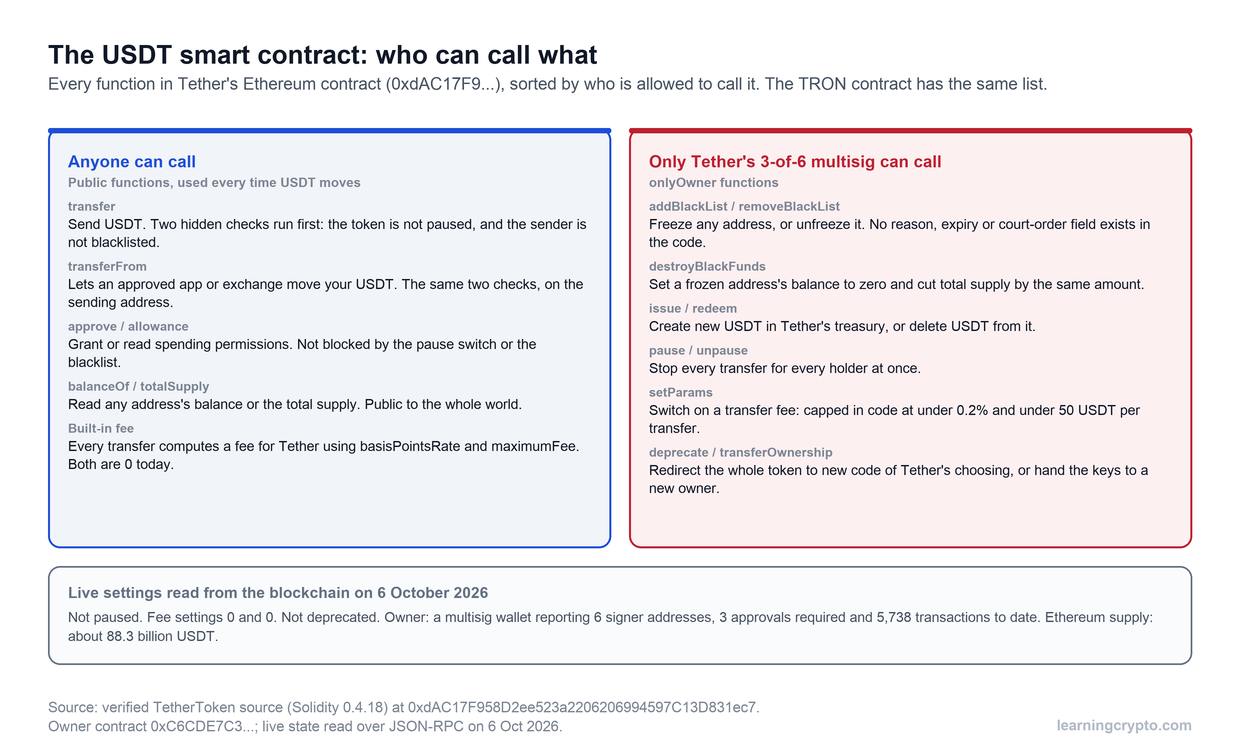
Most smart contract losses come from one of three places: a bug in honest code, a contract deliberately written to trap users, or a user signing a transaction they did not understand. Because transactions are irreversible, the protection has to happen before you click confirm, not after.
The common patterns to recognise:
- Bugs and exploits in legitimate contracts. The 2016 attack on Ethereum's DAO drained around $60 million through a reentrancy flaw, and DeFi protocols have lost billions since to similar coding errors. Audits reduce this risk but do not remove it.
- Honeypot tokens. A contract that lets you buy a token but quietly blocks selling, or charges a 99% "tax" on sales. The chart goes up because nobody can exit.
- Hidden owner functions. Code that lets the deployer mint unlimited tokens, pause trading, or withdraw the liquidity pool. This is the mechanism behind most rug pulls.
- Malicious approvals. A fake airdrop or minting site asks you to "approve" a contract, and the approval grants it permission to move every token of that type in your wallet.
- Address poisoning and fake contracts. Scammers deploy tokens with the same name as a real one, or send dust from addresses that look like ones you have used before, hoping you copy the wrong address.
Practical defences: check that a contract's source is verified on a block explorer and matches the project's official links, look for a recent audit from a named firm, be wary of any token whose owner can still change the rules, use a separate wallet with small balances for new sites, and review or revoke token approvals regularly. None of this requires reading code; it requires slowing down.
The history and evolution of smart contracts
The concept of smart contracts was first introduced in the 1990s by Nick Szabo, a pioneer in the field of digital currency and decentralized systems. Szabo envisioned digital agreements that could execute themselves when specific conditions were met, reducing the need for intermediaries and minimizing the risk of non-compliance. His work laid the foundation for the history of smart contracts, which would later become a fundamental technology in the blockchain era.
The practical implementation of smart contracts gained significant traction with the introduction of blockchain platforms like Ethereum. Ethereum's whitepaper proposed a programmable blockchain that could execute complex decentralized applications, revolutionizing how smart contracts work. This innovation allowed developers to create diverse smart contracts with minimal coding, demonstrating their viability and opening the door to numerous applications across various industries.
Early concepts by Nick Szabo
Nick Szabo was the first to coin the term "smart contracts" and describe their potential as digital transaction mechanisms that implement a contract's terms. He envisioned these contracts as a way to automate and enforce agreements without relying on external parties. Szabo also conceptualized Bit Gold, an early form of digital currency that laid the groundwork for later developments in blockchain technology and cryptocurrencies.
Some regions have legally recognized smart contracts, allowing them to function as valid agreements. This legal recognition underscores the growing acceptance and potential of smart contracts in various sectors.
Szabo's early work continues to influence the development and adoption of smart contracts, highlighting the enduring relevance of his ideas.
Blockchain technology and smart contracts
Blockchain technology serves as the foundational infrastructure that makes the practical application of smart contracts possible. The Ethereum whitepaper introduced the concept of a programmable blockchain, which separated the programming of smart contracts from the blockchain network that processes them. This separation was crucial in enabling the creation of diverse and complex smart contracts with minimal coding effort.
A significant difference between blockchains that support smart contracts and those that do not is the ability to execute and store arbitrary logic. Ethereum's success demonstrated the viability of smart contracts, paving the way for their adoption in various applications, from decentralized finance to supply chain management. If the underlying mechanics are new to you, our guide to how blockchain works covers the basics.
The launch of Ethereum marked a turning point, showcasing how blockchain technology could revolutionize digital transactions and agreements.
Types of smart contracts
Smart contracts can be grouped into three main types: legal contracts, decentralized autonomous organizations (DAOs), and application logic contracts (ALCs). Each type serves distinct purposes and use cases, highlighting the versatility of smart contracts in various domains. Legal smart contracts represent traditional agreements that can be digitized and automated through blockchain technology.
Decentralized Autonomous Organizations (DAOs) leverage smart contracts to enable collective decision-making and governance without centralized control.
Application Logic Contracts (ALCs) facilitate interactions between different systems and devices, particularly in the realm of the Internet of Things (IoT). These types of smart contracts showcase the broad range of applications and potential of this technology.
Legal smart contracts
Legal smart contracts are designed to be self-executing when specific conditions are met, ensuring compliance and transparency in various legal agreements. For instance, in the insurance industry, smart contracts can automatically process claims and release funds upon proof submission, reducing delays and enhancing efficiency. In real estate, they facilitate fractional ownership, allowing multiple investors to buy tokens representing shares of a property.
Certain regions of North America have authorized smart contracts for formal agreements, showcasing their legal recognition and potential to replace traditional legal processes. In California, marriage and birth certificates can be issued as smart contracts, representing a significant shift in how formal documentation is handled.
These examples highlight the transformative potential of smart contracts in the legal industry.
Decentralized Autonomous Organizations (DAOs)
Decentralized Autonomous Organizations (DAOs) are platforms governed by smart contracts, allowing collective decision-making and governance without centralized control. These organizations operate without central leadership, relying on rules embedded within the governing smart contract, which empowers members to vote on decisions. An example of a DAO is VitaDAO, which showcases how these organizations can function effectively without traditional hierarchical structures.
DAOs represent a significant shift in organizational governance, enabling more democratic and transparent decision-making processes. The use of smart contracts ensures that all actions and decisions are recorded on the blockchain, providing a tamper-proof record and enhancing accountability among members.
Application logic contracts
Application Logic Contracts (ALCs) facilitate interactions between different systems and devices, particularly in the realm of the Internet of Things (IoT). These contracts are not signed by individuals; instead, they function between machines, automating complex interactions. For example, an ALC might automate the process of replenishing inventory in a smart warehouse, ensuring that orders are placed automatically when stock levels fall below a certain threshold.
Given the growing interconnectedness of devices, ALCs are essential for achieving efficient automated processes. They play a crucial role in enabling seamless communication and operations among devices in IoT ecosystems, highlighting their importance in modern technology.
Creating smart contracts
Creating smart contracts involves several steps, starting with identifying the agreement's terms and the parties involved. A basic requirement is preliminary knowledge of smart contract development, including familiarity with programming languages such as Solidity, Vyper, or Rust. Developers typically test their smart contract code on test networks (testnets) before they deploy smart contracts on the blockchain.
The deployment process involves uploading the code to the blockchain network and validating the contract's validity. Once deployed, the smart contract automatically executes when the set conditions are met, ensuring that all parties adhere to the agreed terms. This process underscores the importance of thorough testing and validation to ensure the contract functions as intended.
Writing the smart contract code
Writing the smart contract code is a critical step in smart contract development. Solidity is the most widely used programming language for Ethereum smart contracts, resembling languages like Python, C++, and JavaScript. Other notable languages include Vyper and Rust, each offering unique features and security benefits. Tools such as Remix and Ethereum Studio provide user-friendly environments for coding, testing, and deploying smart contracts.
Frameworks like OpenZeppelin offer safe, community-reviewed smart contracts that developers can use as templates. It is crucial to secure the compiler version used and understand the main functions of the smart contract code, as these specify the exact steps for execution upon condition fulfillment.
Best practices in coding, such as defining clear terms, functions, and execution rules, help prevent errors and ensure the contract's reliability.
Testing and deployment
Testing a smart contract before deployment is essential to identify potential errors or malfunctions. Developers typically use test networks (testnets) to simulate real-world conditions and ensure that the contract functions correctly. Tools like Ethcode and OpenZeppelin provide environments for text editing, troubleshooting, and unit testing, helping developers to refine and validate their smart contracts before deployment.
Once the testing phase is complete, the deployment process involves uploading the smart contract code to the blockchain network. This step requires careful validation to ensure the contract's terms are correctly implemented and will execute as intended.
Upon successful deployment, the smart contract is ready to be used, automatically executing when the predefined conditions are met. This rigorous process ensures that smart contracts operate reliably and securely in real-world applications.
Auditing smart contracts
Auditing smart contracts is crucial for ensuring their security and reliability. Regular audits help evaluate the effectiveness of the contract code and identify potential vulnerabilities that could be exploited. Tools like Octopus are used for auditing smart contracts, offering features such as symbolic execution, call flow analysis, and control flow analysis to thoroughly examine the contract's source code.
Security auditing is essential to build trust in the smart contract and prevent potential attacks. By rigorously testing and validating the code, developers can ensure that the smart contract performs as expected and maintains the integrity of the agreement. This process not only enhances security but also boosts confidence among users and stakeholders, making smart contracts a reliable tool for various applications.
Benefits and uses of smart contracts
Smart contracts offer numerous benefits, enhancing trust, security, and efficiency in digital transactions. They reduce costs, save time, and minimize the risk of errors and fraud by eliminating third parties. The immutability and transparency of smart contracts ensure that once terms are set, they cannot be altered, providing a reliable and tamper-proof record of all transactions.
These contracts transform transactions by enforcing immutable terms and maintaining transparency. They are particularly beneficial in industries such as supply chain management, finance, and real estate, where streamlined processes and enhanced security are crucial.
The advantages of smart contracts are driving their adoption across various sectors, highlighting their potential to revolutionize digital agreements and interactions.
Efficiency and cost savings
One of the key benefits of smart contracts is their ability to eliminate intermediaries, significantly improving efficiency and reducing costs. Traditional contracts often require the involvement of third parties such as lawyers, brokers, or banks, which can be time-consuming and expensive. Smart contracts streamline these processes by automating the execution of terms, resulting in faster and more cost-effective transactions.
The replication of transactions in smart contracts ensures that all parties have the same information, promoting accuracy and transparency. This feature not only saves time and money but also enhances the reliability of transactions, making smart contracts a valuable tool for various applications.
The efficiency and cost savings provided by smart contracts are significant factors driving their adoption in multiple industries.
Security and trust
Smart contracts enhance security and trust by utilizing blockchain technology to encrypt documents and safeguard them against tampering. Features such as encryption, digital signatures, and hashing ensure that the contract's terms and conditions are secure and verifiable. The immutable nature of smart contracts means that once they are deployed, the code cannot be altered, adding an extra layer of security.
By eliminating counterparty risk, smart contracts enhance trust between parties, as there is no need for a trusted intermediary to enforce the terms. This trustless system is particularly beneficial in decentralized finance (DeFi), where transactions are conducted without intermediaries.
Security auditing by entities like OpenZeppelin is essential to ensure the integrity and reliability of smart contracts, preventing potential attacks and building confidence among users.
Transparency and accountability
Smart contracts provide unparalleled transparency by making all transactions visible on the blockchain. This visibility ensures that all parties involved can verify the terms and conditions, promoting accountability and reducing the risk of disputes. In decentralized finance (DeFi) applications, the trustless, immutable, and transparent nature of smart contracts is key to ensuring accountability and maintaining the integrity of transactions.
The transparency offered by smart contracts is particularly beneficial in voting systems, where it helps prevent voter manipulation and ensures data integrity. By providing a clear and tamper-proof record of all actions, smart contracts enhance trust and accountability in various applications, from financial transactions to governance and beyond.
Challenges and limitations of smart contracts
Despite their many benefits, smart contracts also face several challenges and limitations. One significant challenge is the skills shortage in software engineering, which complicates the development and adoption of smart contracts. Additionally, the immutable nature of smart contracts means that once deployed, they cannot be easily upgraded or fixed, posing risks if issues arise.
Inadequate support for developers further exacerbates these challenges, making it difficult to create and maintain secure and reliable smart contracts. Developers must meticulously test smart contracts before deployment to identify and address potential defects or malfunctions.
Ethical challenges also arise due to potential loopholes in the code, which may lead to unintended violations in the contract's execution.
Human error and bugs
Human error and coding bugs pose significant risks to the security and functionality of smart contracts. Defects or exploits in the smart contract's code can lead to undesirable outcomes if the programming contains flaws. Potential code exploits or flaws can lead to substantial financial losses and undermine trust in the system. Ambiguous terms in the contract can complicate enforcement and increase the likelihood of human errors during drafting.
However, smart contracts inherently decrease the opportunities for human error and manipulation by automating processes and eliminating manual input. Regular updates and rigorous testing are essential to identify and fix errors, enhance user experience, and ensure the secure execution of smart contracts.
Utilizing pre-written code and prioritizing simplicity in contract design can help mitigate execution errors and save development time. These measures are crucial for maintaining the reliability and security of smart contracts in various applications.
Regulatory and legal issues
The lack of regulatory clarity surrounding smart contracts poses significant challenges for their adoption and enforcement. Not all contracts can be enforced through code, which raises concerns about the legal enforceability of smart contracts in certain jurisdictions. Stakeholders who fail to comply with smart legal contracts may face severe legal repercussions, further complicating their use.
A notable security concern related to smart contracts is the attack on Ethereum's DAO in 2016, which highlighted vulnerabilities in the system and underscored the importance of rigorous security measures. Addressing these regulatory and legal issues is crucial for the widespread adoption and acceptance of smart contracts in various industries.
Scalability concerns
Scalability concerns for smart contracts primarily arise from network congestion and performance issues. Ethereum's base layer, for example, processes only around 15 to 30 transactions per second, while Visa can handle up to 24,000 transactions per second. This disparity has been a significant barrier to the widespread adoption of smart contracts for large-scale applications.
To address these scalability issues, layer-2 networks that batch transactions and settle to Ethereum, and alternative blockchain architectures, now carry much of the load. Additionally, the inability to access external data without an oracle limits the full utilization of smart contracts in real-world scenarios.
Developing solutions to these scalability challenges is essential for the future growth and adoption of smart contracts across various sectors.
Real-world applications of smart contracts
The market for smart contracts is growing rapidly, with projections suggesting it could reach $73 billion by 2030.
Smart contracts are being increasingly utilized in sectors such as:
- healthcare
- real estate
- supply chain management
- voting systems
These applications showcase the versatility and transformative potential of smart contracts in various industries.
From automating supply chain processes to streamlining real estate transactions and enabling decentralized finance (DeFi), smart contracts are changing how we conduct digital transactions and interactions. Their ability to provide secure, transparent, and efficient solutions is driving their adoption across diverse sectors. Our topic hubs collect our DeFi guides in one place.
Supply chain management
Smart contracts play a crucial role in supply chain management by tracking and verifying goods movement, ensuring product authenticity, and streamlining logistics. They automate every transaction step in the supply chain, from ordering to delivery, with specified product and shipping information. Money in a smart contract is typically held in escrow until the supplier certifies delivery of products, ensuring secure and transparent transactions.
By providing complete visibility and transparency for both parties, smart contracts enhance the efficiency and security of supply chains. The lack of intermediaries reduces the risk of fraud and errors, making smart contracts an effective tool for managing supply chains in global trade.
This automation and transparency are key factors driving the adoption of smart contracts in supply chain management.
Real estate transactions
Smart contracts can streamline real estate transactions by replacing brokers, ensuring security, and reducing the time and cost involved in the house transfer process. For example, in the sale of a house, a smart contract can hold the deed in escrow until the buyer's funds are submitted, ensuring a secure and transparent transaction. This automation reduces the need for intermediaries, making the process more efficient and cost-effective.
By digitizing and automating real estate transactions, smart contracts provide a reliable and tamper-proof record of all actions taken, enhancing transparency and accountability. This approach not only simplifies the transaction process but also reduces the risk of disputes, making smart contracts a valuable tool in the real estate industry.
Decentralized Finance (DeFi)
Smart contracts are fundamental for enabling financial transactions in decentralized finance (DeFi), allowing for operations such as instant loans and asset exchanges. DeFi is a financial system that operates without intermediaries, using blockchain technology and smart contracts to facilitate transactions. This approach increases efficiency, transparency, and accessibility for users worldwide, making financial services more inclusive.
Examples of operations enabled by smart contracts in the DeFi space include yield farming, lending platforms, and decentralized exchanges. These applications demonstrate the transformative potential of smart contracts in the financial industry, providing secure, transparent, and efficient solutions for various financial transactions.
The integration of smart contracts into DeFi is driving the growth and adoption of decentralized financial services globally.
Future trends in smart contracts
The future trends for smart contracts include continued growth and a reshaping of multiple industries. As blockchain technology evolves, the applications and use cases of smart contracts will expand further, driving innovation and efficiency across various sectors. The outlook for smart contracts in Web3 is bright, with numerous opportunities for growth and development.
Smart contracts are being tested in real-world scenarios, indicating that they will become an integral part of everyday life. Their ability to automate and secure transactions is expected to drive significant advancements in industries such as finance, healthcare, and supply chain logistics.
Integration with AI and IoT
The combination of smart contracts with artificial intelligence (AI) and the Internet of Things (IoT) allows for real-time automation and management of data from connected devices. AI can make smart contracts more adaptive, enabling real-time adjustments based on dynamic conditions. This integration significantly improves operational efficiency and reduces the risk of human error, making processes more reliable and effective.
In a smart home, IoT devices equipped with smart contracts can automatically adjust energy usage based on real-time data, optimizing efficiency and reducing costs. This integration of AI and IoT with smart contracts is expected to drive significant innovation and efficiency in various applications, from supply chain management to healthcare and beyond.
Expansion across industries
The expected growth in smart contract applications indicates a shift toward automating and securing transactions across numerous sectors.
Industries such as:
- finance
- real estate
- healthcare
- supply chain logistics
are increasingly exploring the use of smart contracts to enhance efficiency, reduce costs, and improve security.
The efficiency, cost savings, and improved security offered by smart contracts contribute significantly to their adoption by various industries.
Smart contracts are expected to become further integrated into mainstream processes, aligning with technological advancements and industry needs. As more sectors recognize the benefits of smart contracts, their applications will continue to expand, driving innovation and transforming how transactions and agreements are conducted.
Summary
Smart contracts are changing how we conduct digital transactions and agreements, offering numerous benefits such as enhanced security, transparency, and efficiency. However, they also face challenges and limitations that must be addressed to ensure their widespread adoption. By understanding the essentials of smart contracts, their history, types, security risks and real-world applications, we can better appreciate their transformative potential and prepare for a future where smart contracts become an integral part of our digital interactions.
Learn how to build, deploy, and monetize smart contracts with our expert-led crypto learning community. Join today to gain exclusive resources and connect with like-minded learners. Take the first step toward your Web3 success.
Frequently asked questions
What are smart contracts?
Smart contracts are self-executing digital agreements coded to automatically enforce terms when specific conditions are met. This technology enhances efficiency and trust in transactions.
How do smart contracts work?
Smart contracts function through "if/when... then..." statements, allowing them to automatically execute on the blockchain when predefined conditions are satisfied. This automation ensures that contractual agreements are enforced without the need for intermediaries.
What are the benefits of smart contracts?
Smart contracts offer enhanced security, transparency, and efficiency, while also providing cost savings by eliminating intermediaries and automating processes. These advantages contribute significantly to streamlined operations and reduced risks in transactions.
What are the challenges of smart contracts?
Smart contracts face several challenges, such as a shortage of skilled software engineers, regulatory and legal hurdles, and issues with scalability due to network congestion. Addressing these obstacles is crucial for the successful implementation of smart contracts.
What are some real-world applications of smart contracts?
Smart contracts are effectively utilized in supply chain management, real estate transactions, and decentralized finance (DeFi). These applications enhance transparency and efficiency in various sectors.
How do I know if a smart contract is a scam?
Check whether the contract's source code is verified on a block explorer and linked from the project's official site, whether a named auditing firm has reviewed it, and whether the deployer still holds powers to mint tokens, pause trading or drain liquidity. Test with a tiny amount first and confirm you can sell as well as buy. If a site asks you to approve unlimited token spending, or the project only exists on social media, treat it as a scam until proven otherwise.
Are smart contracts secure?
The blockchain underneath is very hard to tamper with, but the contract code itself is only as secure as the people who wrote and audited it. Immutable code means bugs are permanent, which is why exploits like the 2016 DAO hack and many DeFi drains since were possible. Audited, widely used contracts with a long track record are far safer than new ones; treat anything unaudited as experimental.
This guide is part of stage 5 of 8, beyond bitcoin, in the free Learning Crypto curriculum. Next: What Is ERC-20? The Standard Behind Ethereum Tokens.
Keep learning
- What they're hiding in the Tether smart contract: every function explained
- How AI & Bots Are Reshaping Crypto Trading in 2025
- Must Cryptocurrency Terms To Know In 2025 [A Complete Guide]
- 8 Best Crypto Movies to Watch in 2025
- More guides in the Fundamentals hub
- Members: Ask Crypto AI, ask it any beginner question, privately