
: DYOR (Do Your Own Research) is the foundational habit that separates informed crypto participants from those who get burned by hype and scams. It's not a vague disclaimer; it's a structured process you can learn and apply to any project. |
Every week, somewhere in the crypto world, someone loses money they couldn't afford to lose. Not because they were reckless or uninformed in a general sense, but because they trusted a tweet, a YouTube comment, or a Discord server instead of doing the work themselves.
The project looked legitimate. The community seemed genuine. The returns sounded transformative. And then it wasn't, didn't, and weren't.
This is the environment crypto operates in. It's fast, it's global, it's largely unregulated, and it attracts a staggering volume of both genuine innovation and sophisticated deception.
For a newcomer trying to figure out which projects are worth paying attention to, it can feel like trying to read a map in a foreign language while someone shouts directions in your ear.
"Do your own research" is often thrown around as a legal disclaimer by influencers who've just finished promoting something to their audience.
That's not what it means. Real DYOR is a discipline. It has structure. It's learnable. And by the end of this guide, you'll have a DYOR framework you can actually use.
What You'll Learn
What DYOR actually means - the real definition behind the acronym and why it matters more than most people realize
Why skipping research is so costly - the specific risks that DYOR protects you from in today's market
A six-step research framework - a structured, repeatable process for evaluating any crypto project
Red flags to watch for - the warning signs that show up in bad projects, often hiding in plain sight
How to use communities and tools without outsourcing your thinking — why DYOR doesn't mean researching in isolation
What Does DYOR Mean in Crypto? Unpacking the Acronym

DYOR: Do Your Own Research - your shield against market hype and scams.
DYOR stands for Do Your Own Research. In crypto, it refers to the practice of independently investigating a project, asset, or protocol before committing any capital or attention to it. The goal is straightforward: form your own informed view rather than relying on what someone else tells you to think.
The phrase has become so common in crypto circles that it risks losing its meaning entirely. It gets appended to promotional posts as a kind of legal hand-washing. A way for influencers and projects to avoid accountability while still nudging you toward a decision.
But the concept underneath it is genuinely important, and it predates crypto by decades. Serious investors in any market, be it equities, real estate, or private equity, have always understood that the quality of your decisions depends on the quality of your research.
What makes DYOR particularly critical in crypto is the combination of factors that don't exist at the same intensity in most other markets: near-zero barriers to launching a project, anonymous or pseudonymous teams, limited regulatory oversight, extreme price volatility, and an information ecosystem that rewards hype over accuracy.
In that environment, outsourcing your thinking is genuinely dangerous.
Understanding the DYOR meaning isn't just about knowing the acronym. It's about recognizing that in a market where almost anyone can publish a whitepaper, create a token, and run a sophisticated marketing campaign in a matter of weeks, your own careful judgment is one of the few reliable filters you have.
Why DYOR is Non-Negotiable for Every Crypto Investor
Let's be direct about what happens when people skip this step.
Rug pulls - where developers abandon a project and drain its liquidity have cost investors hundreds of millions of dollars across multiple market cycles.
Pump-and-dump schemes target new investors who arrive during periods of hype, buying near the top just before coordinated sellers exit.
Projects with technically legal but deliberately misleading tokenomics have enriched insiders while leaving retail holders with steadily depreciating assets.
None of these outcomes are inevitable. Most of them leave evidence if you know what to look for and where to find it.
The risks of skipping DYOR break down into several categories.
There are outright scams: projects designed from the start to extract money.
There are well-intentioned failures: teams that genuinely believed in their product but couldn't execute.
And there's the subtler risk of sound technology with poor token design, where the underlying protocol works, but the economics ensure that most token holders don't benefit.
Thorough research doesn't guarantee you'll avoid all of these, but it dramatically improves your odds of identifying which category a project falls into before you're exposed to it.
The benefits go beyond risk avoidance. When you understand why you're interested in something - what problem it solves, how the token functions, what the realistic adoption path looks like- you're far less vulnerable to panic selling during drawdowns or to chasing pumps based on someone else's excitement.
Informed conviction is a different psychological state than speculative hope. It changes how you respond when markets move against you.
DYOR is also cumulative. The more projects you research properly, the faster and sharper your pattern recognition becomes.
You start to notice what legitimate teams look like versus those performing legitimacy. You develop a calibrated sense of what's genuinely novel versus what's recycled with new branding. That's not something you can shortcut by following someone else's conclusions.
The Learning Crypto DYOR Framework: Your Step-by-Step Guide

What follows is a structured process for evaluating any crypto project. It won't tell you whether something is a good investment; that's a judgment only you can make, and it's one you should make after completing the research, not before.
What the framework does is give you a consistent set of questions to ask and a reliable sequence for asking them.
Step 1: Understand the Project's Fundamentals (The "What" and "Why")
Always start with the whitepaper - it's the project's blueprint.
Before you look at price charts, community sentiment, or anything else, start with the basics: what does this project actually do, and why does it need to exist?
The whitepaper is your primary document. A serious project will have one that clearly explains the problem it's solving, the proposed solution, the technical architecture, and the reasoning behind its design choices. Read it critically. You don't need a computer science degree to judge whether the writing is coherent and specific, or whether it's vague and full of buzzwords. Vagueness in a whitepaper is a signal worth taking seriously.
Beyond the whitepaper, look at the official website and any published documentation. Ask yourself: Is the problem this project claims to solve real and significant?
Is the solution genuinely better than existing alternatives, including centralized ones?
Does the project actually require a blockchain, or would a conventional database serve the same purpose more efficiently? That last question filters out a surprising number of projects that use crypto aesthetics without crypto substance.
Also, look for the project's unique selling proposition. In a market with thousands of active projects, "we're building a decentralized version of X" isn't enough. What specifically makes this approach different, and why would users and developers choose it over established competitors?
Step 2: Evaluate the Team and Community (The "Who")
Crypto is full of brilliant technology attached to teams that can't execute, and mediocre technology executed brilliantly by teams that can. The people building a project are often more predictive of outcomes than the technical design itself.
Start with the team page.
Are the founders and core developers named?
Do their claimed backgrounds check out on LinkedIn or through other verifiable sources?
Have they built or contributed to anything significant before?
Some of the most important infrastructure in crypto was built by pseudonymous developers, but anonymity raises the stakes on everything else you find. Without reputational accountability, the only check on bad behavior is the code itself.
Look at the advisors. Advisor lists are often inflated for credibility, so verify that listed advisors have actually engaged with the project publicly. A name on a website means little if the person has no public connection to the project's work.
Community is a separate signal. A healthy community asks hard questions, debates design decisions, and holds the team accountable.
A community that aggressively silences critics, bans dissenting voices, or exists primarily to hype price is a warning sign regardless of how large it is. Check the project's Discord, Telegram, and social channels. What are people actually talking about? Is there substantive discussion about the technology, or is it mostly price speculation and memes?
Step 3: Analyze the Tokenomics (The "Numbers")
Tokenomics - the economic design of a token is where many investors' eyes glaze over, which is exactly why it's where a lot of damage gets done. The mechanics aren't complicated once you know what to look for.
Start with supply. What is the total supply, the circulating supply, and the maximum supply?
The gap between circulating and total supply tells you how much selling pressure could enter the market as locked tokens unlock over time.
A project with 10% of its tokens in circulation today but 90% vesting over the next two years has a lot of future sell pressure baked in, regardless of current price action.
Vesting schedules are critical. Who holds the locked tokens? Is it the team, early investors, or a foundation?
How long until they can sell?
Short vesting periods for large insider allocations are a well-established warning sign. If a team can liquidate most of their allocation within six to twelve months of launch, their incentives after that point are worth questioning.
Token utility is the other side of this. What does the token actually do within the ecosystem?
Is it used to pay for services, to participate in governance, to secure the network? Or is it primarily a speculative vehicle with no genuine demand driver?
Tokens with real utility built into protocol mechanics are structurally different from tokens that exist mainly to be bought and sold. Neither is automatically good or bad, but understanding which category you're looking at matters for how you assess the project's long-term economics.
Step 4: Assess the Technology and Roadmap (The "How")
You don't need to audit smart contract code to form a useful view of a project's technical credibility. But you do need to ask the right questions.
Start with the roadmap. Is it specific? Does it include milestones with dates and deliverables that can be verified, or is it aspirational language with no measurable commitments?
Then check the history: has the team actually shipped what they said they would?
A pattern of missed milestones or quietly revised timelines is informative. It doesn't necessarily mean the project is a scam, but it tells you something about execution capacity and how the team communicates when things don't go to plan.
GitHub activity is a useful proxy for technical progress. Repositories with consistent recent commits, active pull requests, and meaningful contributor activity suggest ongoing development.
A repository that hasn't been touched in months on a project claiming active development is worth questioning. You don't need to read the code; you just need to see whether anyone is writing it.
Also, look for third-party audits of smart contracts. Reputable DeFi projects typically commission security audits from established firms and publish the results.
No audit isn't automatically fatal. Early-stage projects sometimes haven't reached that stage yet, but that affects your risk calculus considerably.
Step 5: Check On-Chain Data and Market Activity (The "Receipts")
One of the genuinely transformative things about public blockchains is that the data is there for anyone to read. Marketing claims can say anything. On-chain data just says what happened.
Wallet concentration is a starting point.
If a handful of wallets control a large percentage of the total token supply, those holders have the capacity to move the market significantly with a single transaction. That's a concentration risk worth understanding. Tools like Etherscan for Ethereum-based tokens allow you to look at the top holders of any token directly.
Trading volume relative to market capitalization can flag unusual patterns.
Volume that seems disproportionately high for a project's size, particularly on obscure exchanges, can indicate wash trading - artificial volume generated to create the appearance of activity. Genuine organic volume tends to be more consistent and correlated with actual project news and development.
Liquidity depth matters too, particularly for smaller tokens.
A thin order book means that even modest selling pressure can cause big price moves. Platforms like DeFiLlama provide useful data on total value locked across DeFi protocols, which gives you a sense of how much genuine capital is actually committed to a project's ecosystem rather than just flowing through it speculatively. Dune Analytics goes even deeper into on-chain analytics if you want to dig further.
Step 6: Cross-Reference and Stress-Test Your Conclusions (The "Challenge")
By this point, you'll have a preliminary view of the project. Step six is to deliberately challenge it.
Find the critics. Not the anonymous accounts spreading fear without reasoning, but people who have made specific, substantive arguments against the project.
Where do you find them? Independent crypto researchers sometimes publish on Substack or Mirror.
Technical forums, such as crypto-specific subreddits, occasionally host serious debate.
Developer communities on GitHub sometimes surface concerns in issue threads.
The goal isn't to be swayed by every critique but to expose your thinking to the best available counterarguments and see whether they change your assessment.
Ask yourself: if this project fails, what's the most likely reason?
Is it technical risk, competitive pressure, regulatory exposure, team execution, or token economics?
Work through the failure modes explicitly rather than assuming success. This isn't pessimism - it's how you build a realistic picture of what you're evaluating.
Finally, remember that DYOR is a process, not a checklist you complete once and file away.
Projects change. Teams change. Market conditions shift. Regulatory environments evolve. A project that looked solid six months ago might now face meaningful new risks, and one that looked uncertain might have since demonstrated real progress. Good researchers revisit their conclusions.
Red Flags Every Researcher Should Know
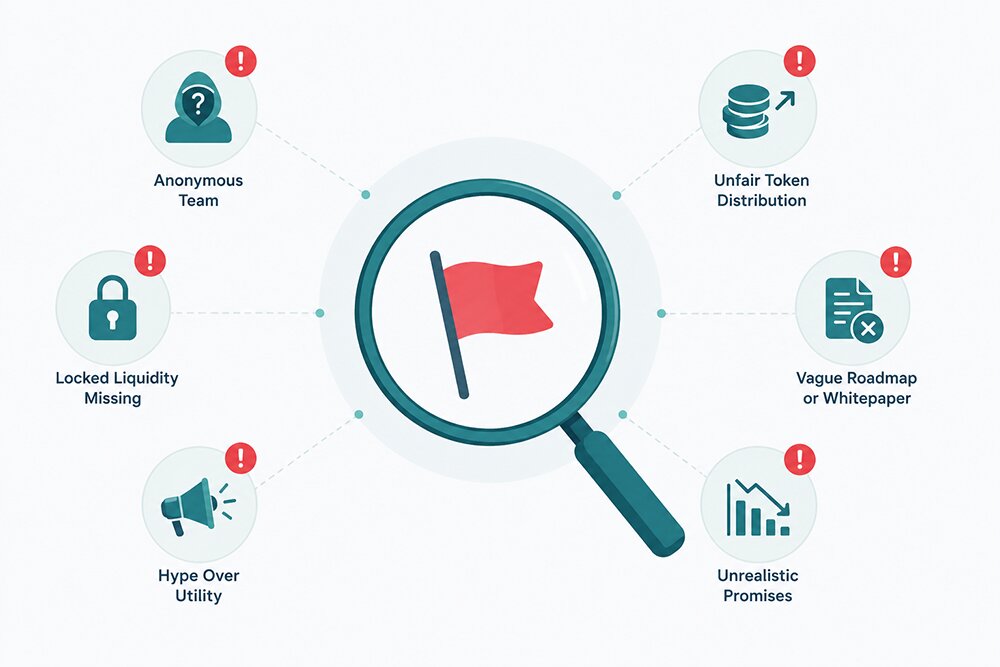
Research tends to surface certain warning signs repeatedly across bad projects. Here's what to watch for:
Anonymous teams with no verifiable history. Pseudonymity can be legitimate, but when you can't verify that the team has any track record of building anything real, the risk profile changes substantially.
Whitepapers that are vague, jargon-heavy, or plagiarized. A whitepaper that doesn't clearly explain the technical approach, or that borrows heavily from other projects without attribution, tells you something about the team's honesty and capability.
Tokenomics that heavily favor insiders. Large team and investor allocations, short vesting periods, or supply mechanics that systematically transfer value from late buyers to early holders warrant careful scrutiny.
Promises of guaranteed or unusually high returns. No legitimate project can guarantee returns. The language of certainty in a volatile market is always a signal worth questioning.
Aggressive influencer campaigns with no organic community underneath them. Paid promotion can manufacture the appearance of interest. An authentic community is one where people engage substantively with the project's ideas, not just its price.
Roadmaps that never get updated. A static roadmap on a project claiming active development suggests either the team isn't communicating or isn't progressing. Neither is good.
Pressure to act quickly. Legitimate opportunities don't disappear in 24 hours. Urgency is a manipulation tactic. Any project or community that pushes you to decide before you've had time to research properly is telling you something important about itself.
DYOR Doesn't Mean Going It Alone
There's a misreading of DYOR that treats it as an instruction to distrust everyone and research in complete isolation. That's not what it means, and it's not how experienced researchers actually work.
DYOR means don't outsource your conclusions. It means that when someone, an influencer, a friend, a community moderator, tells you a project is great, you use that as a starting point for your own investigation, not as the endpoint.
The research community, the tools, and the resources available to you are assets. The requirement is that you verify what you find, think critically about what you're told, and reach your own informed view.
Communities can be genuinely valuable when they're approached critically. Engaging with other researchers who ask hard questions, sharing findings, and pressure-testing ideas together can sharpen your thinking considerably - as long as you're not simply adopting the group consensus without examining it yourself.
At Learning Crypto, we offer several resources designed to support this kind of independent, informed research.
The AI Copilot can help you work through complex concepts, our on-chain analytics tools give you direct access to blockchain data, and the Discord community is a place to discuss projects and findings with other people who take the research process seriously.
These aren't shortcuts around DYOR, they're tools for doing it better.
Frequently Asked Questions
What does DYOR mean in crypto slang?
DYOR stands for Do Your Own Research. In crypto, it's used to encourage independent investigation before making any investment decisions. While it's sometimes used as a disclaimer by influencers, its real meaning is to develop your own informed view of a project rather than rely on others' conclusions.
How long should DYOR take for a new project?
There's no fixed time, but a meaningful first pass on a project, reading the whitepaper, checking the team, reviewing tokenomics, and looking at on-chain data typically takes several hours. Ongoing monitoring as a project develops is a separate, continuous commitment. Don't compress this process because of price pressure or FOMO.
Do I need technical knowledge to do proper crypto research?
Not extensively. You can assess whitepapers for clarity and logic, evaluate team credibility, read tokenomics breakdowns, and interpret on-chain data using available tools without being a developer. Technical understanding helps with deeper analysis, but the foundational research framework in this guide is accessible to anyone willing to put in the time.
Where should I look for credible critics of a project?
Independent researchers on platforms like Substack, Mirror, and X sometimes publish substantive critical analysis. Crypto-specific forums, developer discussions on GitHub, and communities focused on security research can also surface well-reasoned dissenting views. Look for specific, evidenced arguments rather than anonymous negativity.
Can I rely on third-party research reports instead of doing my own?
Third-party reports can be a useful input to your research, particularly from independent analysts with no financial stake in the outcome. But treat them as one source among several, not as a substitute for your own investigation. Many crypto research reports are produced by parties with conflicts of interest that aren't always disclosed.
What is a rug pull, and how does DYOR help avoid it?
A rug pull is when developers abandon a project and withdraw liquidity, leaving holders with worthless tokens. DYOR helps you identify warning signs before exposure. Anonymous teams, concentrated token holdings, unaudited contracts, thin liquidity, and aggressive promotion without substance are all patterns that careful research can surface before you're affected.
This guide is part of stage 6 of 8, avoiding the traps, in the free Learning Crypto curriculum. Next: What Is Market Cap in Crypto: A Complete Guide.
Keep learning
- MiCA: Europe's Crypto Regulation Framework Explained
- What Are Crypto Prediction Markets? How Polymarket and Onchain Betting Work
- How to Read a Crypto Whitepaper
- More guides in the Fundamentals hub
- Members: Ask Crypto AI, ask it any beginner question, privately