
Self-custody solves one problem and creates another. You remove the bank, the frozen account and the arbitrary reversal, and in exchange you accept that nobody can help you or your family if the keys are lost. This guide is for people who already hold crypto properly and now need to make sure it survives them.
This is educational information, not legal, tax or estate-planning advice. Estate law is specific to where you live and to your circumstances. Use this to have a better conversation with a qualified professional, not to replace one.
Why is crypto inheritance different from a bank account?
Because there is no institution on the other end. When someone dies holding a bank account, the executor produces a death certificate and a grant of probate, and the bank transfers the money. That process exists because the bank is the custodian and the law can compel it to act.
A self-custodied wallet has no custodian. There is no support desk to compel, no password reset and no override. The keys either pass to someone who can use them or the coins sit visible on a public ledger forever, provably there and permanently unreachable. A meaningful amount of Bitcoin is already stranded this way, in wallets that stopped moving years ago and never will again. Nobody can produce an exact figure, which is rather the point: the losses are silent.
There is a second, subtler failure. Your heirs may not know the crypto exists at all. Exchange accounts leave a paper trail that an executor can follow, but a hardware wallet in a drawer looks like a USB stick. If nobody knows to look, nobody looks.
Why should a seed phrase never go in your will?
Because in most jurisdictions a will becomes a public document once it is admitted to probate. Anyone who asks can read it, and in several countries the text is searchable online. Writing twelve or twenty-four words into that document publishes the keys to your money.
The same logic rules out anything the will incorporates by reference and anything stored with the will in a lawyer's file that gets copied during administration. The rule is simple and worth stating plainly: the will points to the plan, it never contains the secret. The will can say that digital assets exist, name who inherits them and name the person responsible for retrieving them. The seed phrase stays somewhere else entirely.
What does a working crypto inheritance plan contain?
Three parts, and a plan missing any one of them fails. Most people build the first part and stop, which is why so many heirs end up holding a device they cannot open.
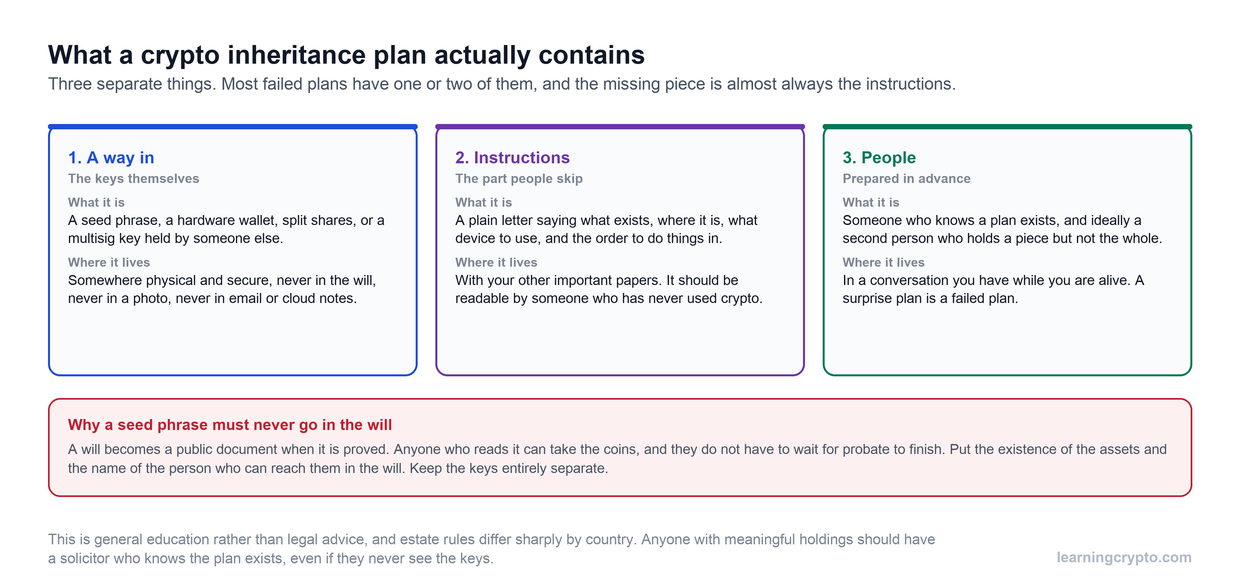
Most failed plans have one or two of these. The missing piece is almost always the instructions, because the person who wrote the plan could not imagine needing to explain what a hardware wallet is.
- The access method. The mechanism by which your heir comes to control the keys. This is the part people think is the whole problem.
- The instructions. A plain-language document explaining what exists, where it is, what to do first and what never to do. Written for someone who does not know what a blockchain is.
- The legal wrapper. The will or trust that establishes who is actually entitled to the assets, so that your executor is acting lawfully and your heirs are not fighting each other.
Get all three and the plan works even when the person executing it is grieving, distracted and unfamiliar with the technology, which is exactly the condition they will be in.
Which access method should you use?
There is no option that is safe now and easy later. Every method trades present security against future recoverability, and the right answer depends on how much you hold and who you have to work with.
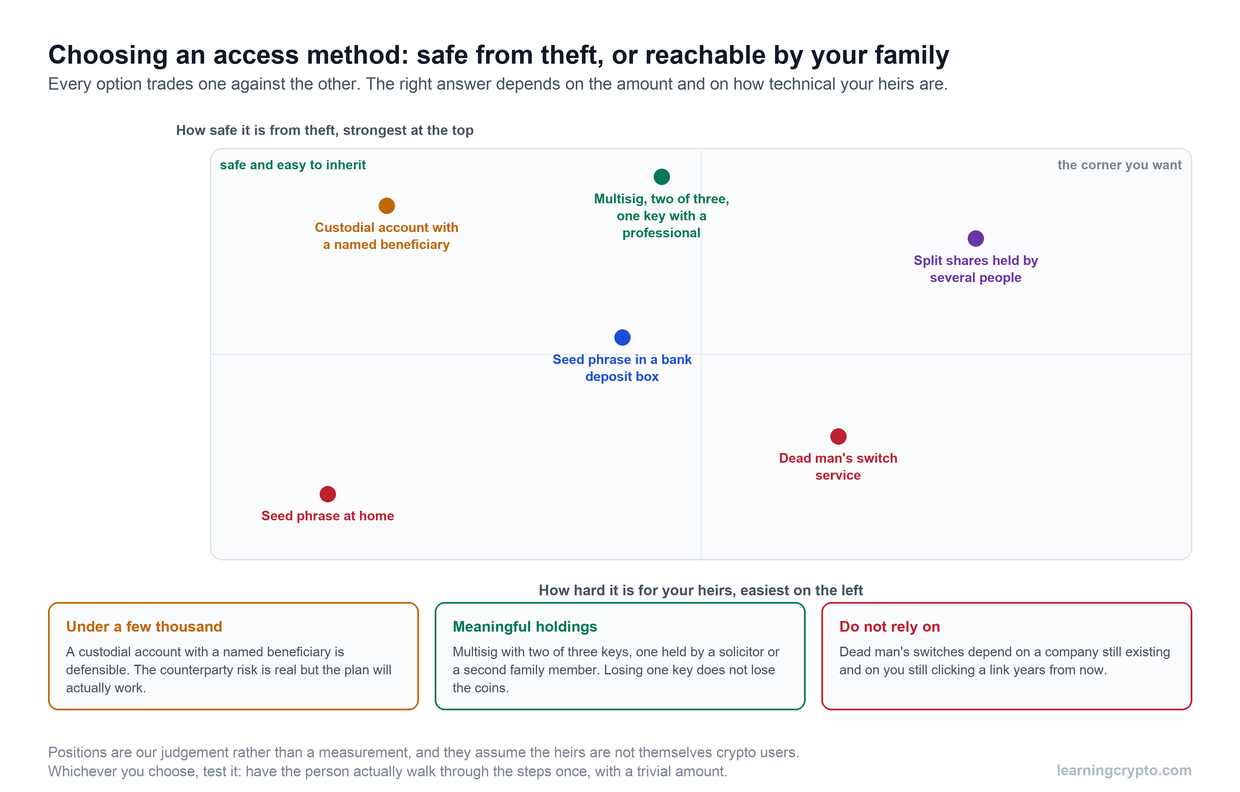
Every option trades safety from theft against reachability by your family. The top left corner is what you want, and the right choice depends on the amount involved and how technical your heirs actually are.
| Method | How it works | Trade-off |
|---|---|---|
| Sealed backup with a trusted person | The seed backup goes to a family member or a lawyer, sealed, to be opened on death | Simple and free. Requires total trust in one person, and creates a single point of theft while you are alive |
| Split seed (Shamir, SLIP-39) | The seed is split into shares, a set number of which reconstruct it, using the SLIP-39 standard supported natively on some Trezor models | No single holder can steal it. More moving parts, and heirs must understand that shares must be combined |
| Multisig | Funds need multiple keys to move. Your heir holds one key, you hold others, optionally a third party holds one | Strongest option and no single point of failure. Setup and documentation take real effort |
| Named beneficiary on a custodial account | The exchange or custodian transfers on presentation of legal documents | Genuinely easy for heirs. You are trusting a third party with the coins in the meantime |
| Specialist inheritance service | A provider holds a key or a backup and releases it under defined conditions | Designed for the problem. Introduces a company that must still exist and behave when the time comes |
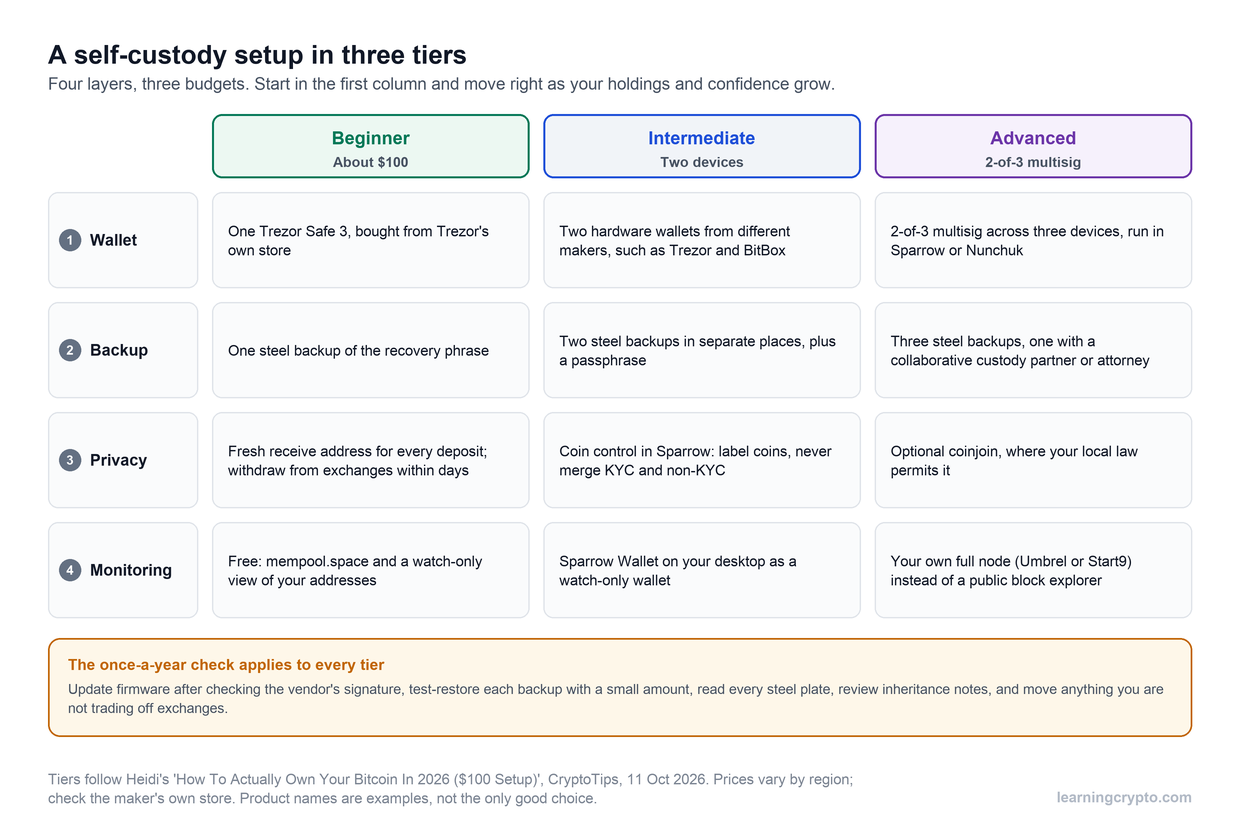
For most people holding a meaningful amount, a split backup or a multisig arrangement is the honest answer. For smaller amounts, a sealed backup with one reliable person and a good letter of instruction beats an elaborate scheme nobody will execute correctly.
Why is multisig the strongest option for larger holdings?
Because it removes the single point of failure in both directions. In a two-of-three arrangement, no individual key can move funds, so a stolen backup is not a loss and a dishonest helper cannot act alone. When you die, your heir already holds a key and only needs one more to recover everything.
The cost is operational. Multisig has to be documented properly, the keys must live in genuinely separate places, and somebody has to test recovery before it matters. Our multisig operational playbook covers signer roles, backup procedure and recovery rehearsal, and the general guide to multisig wallets covers the concept if this is new. Do not put a multisig arrangement in place and leave the recovery untested. An untested recovery is a guess.
How do you write a letter of instruction?
Write it for a specific person who knows nothing about crypto, and assume they will read it on the worst week of their life. Plain language, numbered steps, no jargon, no assumptions.
It should contain:
- What exists and roughly how much, so they know whether this is worth pursuing at all
- Where each thing lives: which wallets, which devices, which exchanges, which physical locations
- What to do first, in order, with the very first step being "do nothing until you have read all of this"
- Who to ask for competent help, named if possible, and how to verify that person is who they claim to be
- An explicit warning, in bold: nobody legitimate will ever ask for the recovery words. Anyone who does is stealing. Never type them into a website, never photograph them, never send them to anyone offering to help
That last point matters more than any of the technical detail. A grieving non-technical person searching online for help with a hardware wallet is exactly the target profile for crypto scams, and the impersonators are good. Say it in the document, in blunt language.
What the letter must never contain is the seed phrase itself. It is a map to the plan, not the plan's contents.
Who should you choose, and how do you prepare them?
Pick for reliability and discretion rather than technical skill, because the technical part can be outsourced and trustworthiness cannot. Then do the thing almost nobody does: tell them.
The most common failure we see is not a broken cryptographic scheme. It is an heir who had no idea any of this existed, holding a device with no context, or a backup they did not recognise as important. Tell your chosen person that a plan exists, where the instructions are, and that they should do nothing except read the instructions when the time comes. If your setup is a multisig or a split seed, walk them through a dry run with a trivial amount so the first time they attempt a recovery is not the real one.
If a professional executor or lawyer is involved, check whether they have handled digital assets before. Many have not, and one who is willing to say so is more useful than one who improvises.
Do dead man's switches and timelocks work?
They can, and they add a failure mode of their own. A dead man's switch releases information if you stop checking in. A timelock makes coins spendable by a second key only after a defined period. Both are real tools and both introduce a dependency: a service that must stay online for decades, or a script that must keep running, or a check-in you must never forget while travelling or in hospital.
Treat them as a supplement rather than the backbone. If the switch fails and there is no other route, the plan fails silently and you will not be around to notice. A documented human process, tested once, is usually more durable than an automated one nobody maintains.
What will your heirs face on tax and legal grounds?
It varies significantly by country, which is the honest answer and the reason to involve a professional. Broadly, an estate may owe inheritance or estate tax on the value of the assets at death, and the heir may inherit a cost basis that determines what they owe when they eventually sell. Some jurisdictions reset the basis at the date of death and some do not, and that single difference can change the eventual tax bill substantially.
Practical consequences worth planning for: your estate may need a defensible valuation at the date of death, so a record of what was held and where is genuinely useful. Our guide to cryptocurrency taxes covers the general framework of taxable events, and keeping an ongoing record of holdings makes the estate's job far easier. Members can use the Portfolio Tracker to keep a current view of what is held and where, which is exactly the summary an executor needs and rarely gets.
How often should you review the plan?
Once a year, and immediately after anything changes. The annual review is short: confirm the backups are still where you think they are and still readable, confirm your chosen person is still willing and still contactable, and confirm the instructions still describe reality.
Anything on this list should trigger an update straight away: a new wallet or a new device, moving significant funds, opening or closing an exchange account, a change of executor or heir, a house move, a divorce, or upgrading hardware. Plans do not usually fail because the cryptography broke. They fail because the plan describes a setup you stopped using two years ago. If you are reorganising storage as part of this, our guides on cold and hot wallets, using a cold wallet and choosing between Trezor and Ledger cover the mechanics. There is more on securing what you hold in our wallets and custody hub.
Frequently asked questions
What happens to my crypto if I die without a plan?
If nobody can access the keys, the coins stay at that address permanently. They remain visible on the blockchain and provably unspent, but no court order, exchange or developer can move them. Your estate may still be considered to own assets it cannot reach, which can complicate valuation and tax, so the absence of a plan creates legal problems as well as lost money.
Can I put my seed phrase in my will?
No. In most jurisdictions a will becomes a public record once it is admitted to probate, so anything written in it can be read by anyone who requests the document. Reference the existence of digital assets and name who inherits them, but keep the recovery words in a separate arrangement that the will points to without disclosing.
Is a hardware wallet enough for inheritance planning?
No, a hardware wallet solves storage, not succession. The device protects your keys while you are alive, but on its own it leaves your heir with a locked object and no PIN, no recovery words and no context. Pair the device with a documented access method and a letter of instruction that explains what it is and what to do with it.
Should I tell my family how much crypto I own?
You should at minimum tell them it exists and where the instructions are, because a plan nobody knows about is not a plan. Sharing the exact amount is a personal judgement, though giving a rough sense of scale helps an heir decide how much effort and professional help the recovery justifies.
Is multisig or a split seed better for inheritance?
Multisig is generally stronger because keys stay independent and spending requires a live signature from multiple devices, so no single share is ever a complete secret. A split seed is simpler to set up and is often the better fit for smaller holdings or heirs who would struggle with multisig tooling. Both beat a single backup held by one person.
Can a lawyer or executor hold my crypto keys?
Some can, and you should ask directly whether they have done it before and what their storage practice is. Many estate professionals have no secure procedure for key material, and an honest one will say so. Where a professional is involved, a multisig key or one share of a split seed is usually safer than handing over a complete backup.
This guide is part of stage 3 of 8, holding it safely, in the free Learning Crypto curriculum. Next: How to start investing in crypto.
Keep learning
- Multisig explained: how to split your keys and why it matters
- Lost or stolen hardware wallet: what happens to your crypto
- Ledger Recover explained, and why we don't use it
- Multisig Operational Playbook for Shared Crypto Custody
- What Is a Seed Phrase? Your Crypto Wallet's Master Key
- Cold Wallet vs Hot Wallet: Differences and Which to Use
- More guides in the Wallets & Custody hub