
Stablecoins are the plumbing of crypto. Most trading is priced in them, most DeFi positions are denominated in them, and for a lot of people in countries with weak currencies they are the actual product. This guide explains what they are, how they hold their value, and what you are trusting when you hold one.
What is a stablecoin?
A stablecoin is a crypto token designed to hold a steady value, almost always one US dollar. It gives you a unit that moves on a blockchain at blockchain speed while behaving like cash rather than like a volatile asset. The largest issuers publish their reserve composition, such as Circle and Tether, and reading those documents is the single most useful thing a holder can do.
The important thing to understand is that a stablecoin is not stable by nature. It is stable because something makes it so, and that something is either assets held in reserve, collateral locked in a contract, or a mechanism written in code. The label on the token tells you nothing; the backing does.
Practically, holding a stablecoin means holding a claim on an issuer rather than owning the dollars themselves. That is a meaningful difference from a bank deposit and it is where the risk lives.
How do stablecoins hold their value?
Through a redemption mechanism plus arbitrage. The issuer promises to exchange one token for one dollar of the underlying asset. When the token trades below a dollar, anyone able to redeem buys it cheaply and redeems at par for a profit, and their buying pushes the price back up. When it trades above, they mint new tokens and sell.
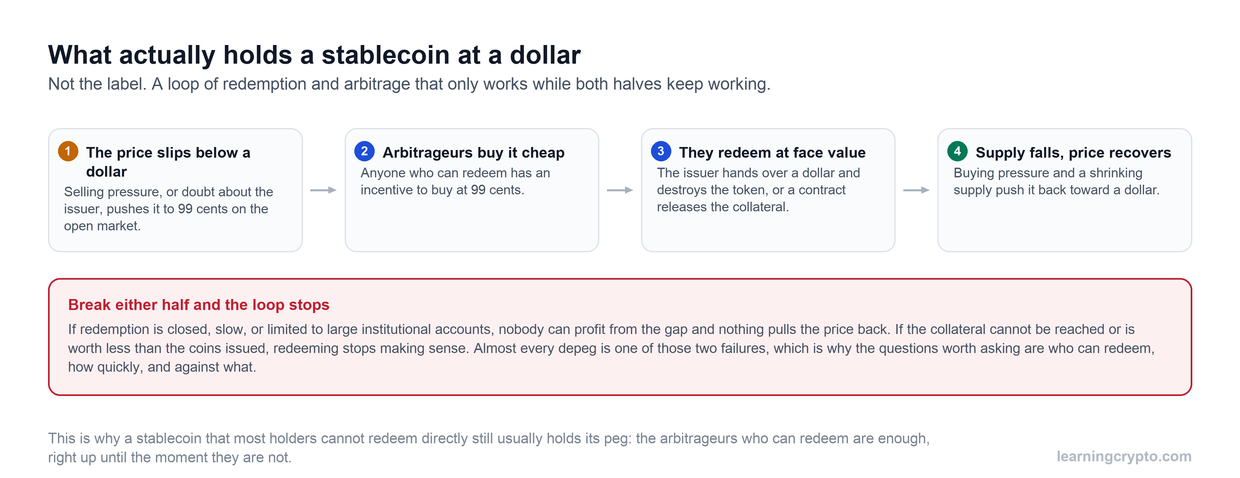
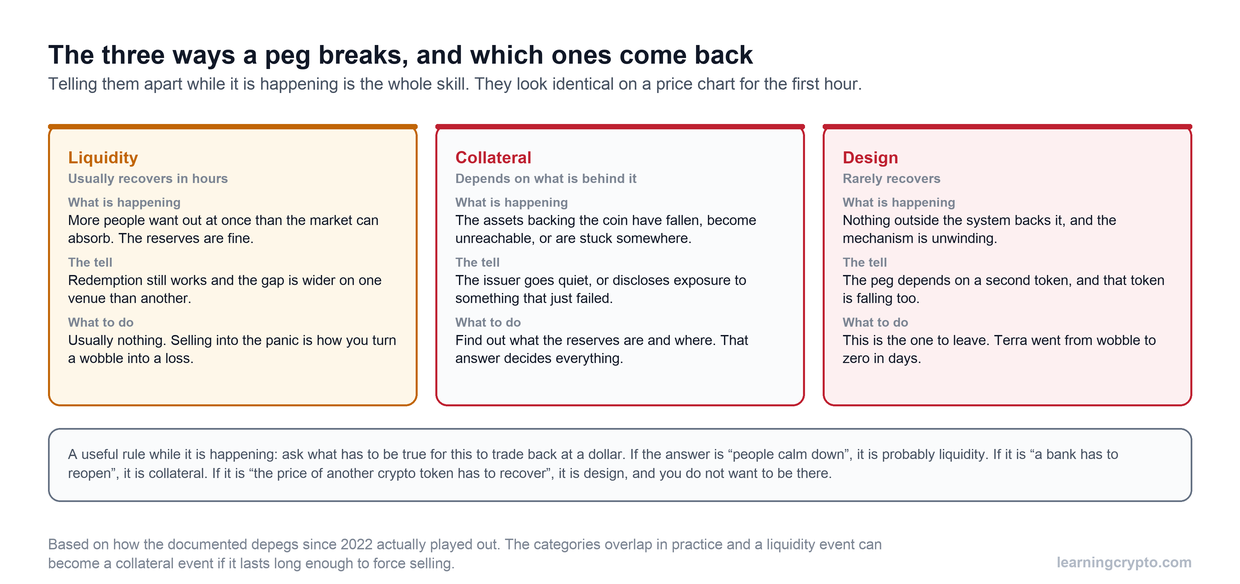
The peg is held by a loop, not by a label. Break either half, redemption or the ability to profit from the gap, and nothing pulls the price back. Almost every depeg is one of those two failures.
The peg holds while that loop stays open and credible. Close it, slow it, or make the market doubt it, and the arbitrage stops working. Our guide to what pegging means in crypto covers the mechanism in detail, and why stablecoins depeg covers what happens when it breaks.
One detail catches retail holders out: for most large stablecoins, direct redemption is only available to verified institutional partners above a minimum size. You are not the arbitrageur. You depend on someone else's ability to be one.
What types of stablecoin are there?
| Type | How it holds the peg | Examples | Main risk |
|---|---|---|---|
| Fiat-collateralised | Cash and short-dated government bills held by the issuer | USDT, USDC | Issuer and custodian risk; are the reserves real and reachable |
| Crypto-collateralised | Over-collateralised with crypto locked in contracts | DAI | Collateral crashes faster than the system can liquidate |
| Commodity-backed | Redeemable for a physical asset, usually gold | PAXG, XAUT | Custody and audit of the physical holdings |
| Algorithmic | Supply expands and contracts by code, with no external backing | Terra's UST, historically | Reflexive collapse. This model has repeatedly failed |
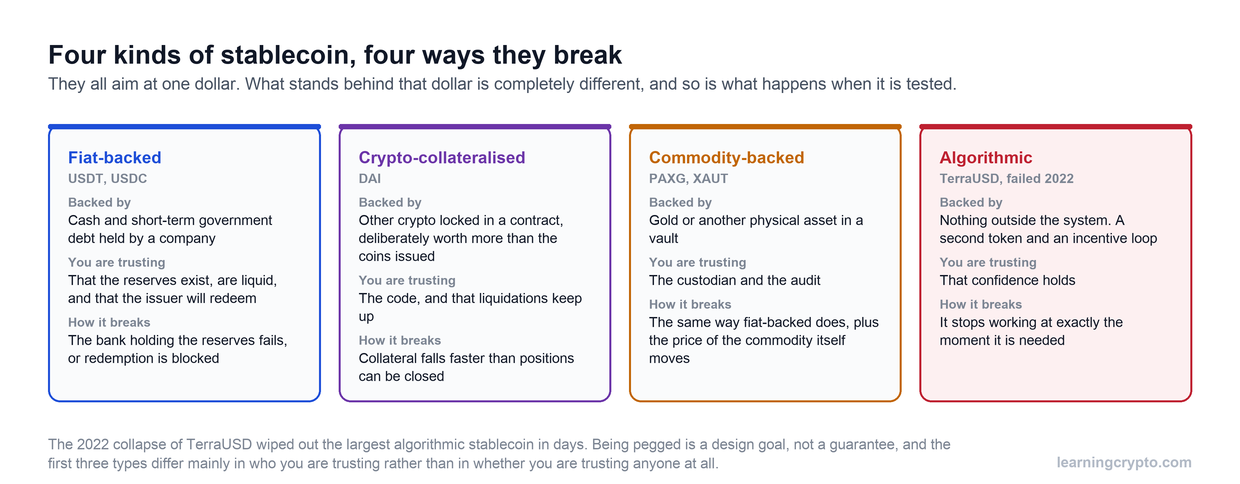
They all aim at one dollar and what stands behind that dollar is completely different. The first three differ mainly in who you are trusting; the fourth trusts nobody outside the system, which is why it failed.
Our guide to the different types of stablecoins goes deeper, and USDT versus USDC compares the two that dominate the market.
What are stablecoins actually used for?
- Trading. Most crypto pairs are priced in stablecoins, so they are the base currency of the market rather than an asset most people set out to buy.
- Sitting out volatility. Moving into a stablecoin lets you leave a position without leaving the crypto system or waiting on a bank.
- Payments and remittances. Sending dollars across a border in minutes, at the weekend, for a small fee is something the traditional system still does badly.
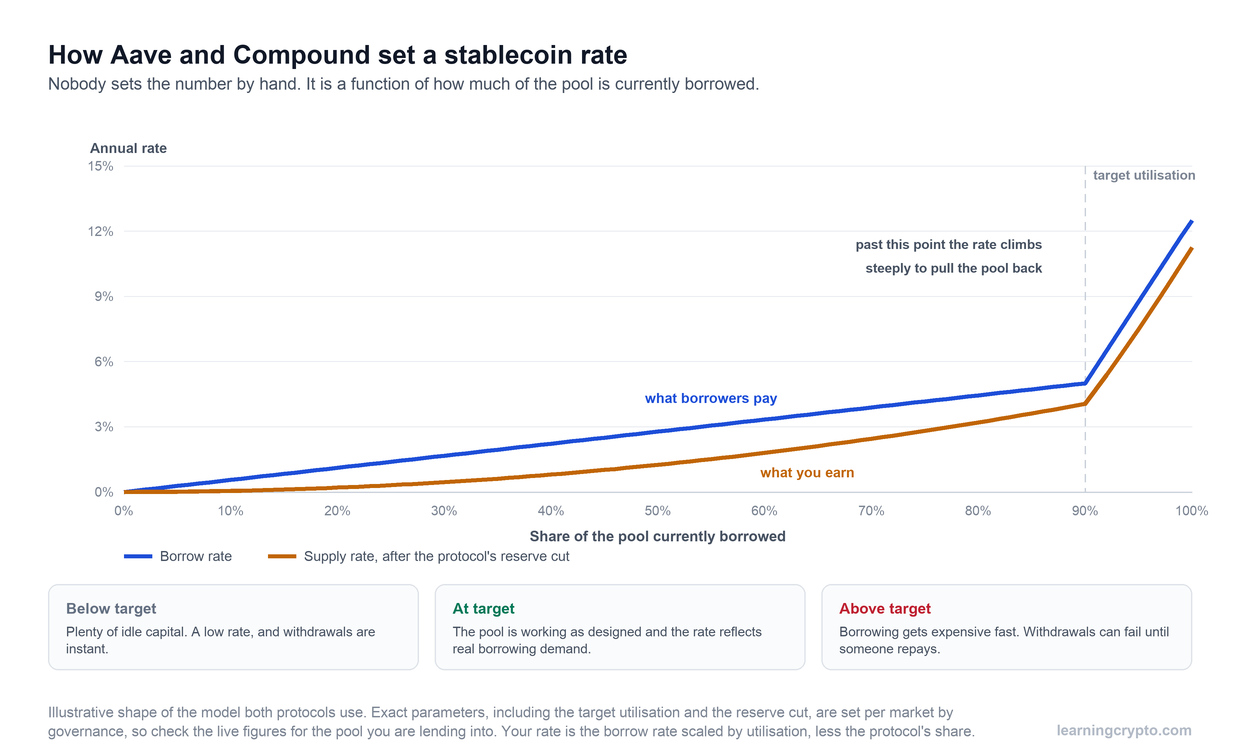
- Earning yield. Lending stablecoins is the most common income strategy in crypto, covered in stablecoin interest rates and yield-bearing stablecoins.
- Dollar access. In countries with capital controls or high inflation, a dollar-denominated token available from a phone is the whole use case.
Who actually uses stablecoins, and why does it matter?
Far more people than the trading narrative suggests, and the reasons vary sharply by region. In developed markets stablecoins are mostly infrastructure: the base pair for trading, the settlement layer for DeFi, and a way to move value between platforms without touching a bank.
Elsewhere the use case is the product itself. In countries with high inflation or capital controls, a dollar-denominated token accessible from a phone is a savings account that the local currency cannot erode and the local banking system cannot restrict. That demand is not speculative and it does not go away in a bear market, which is a large part of why stablecoin supply has proved far more durable than crypto trading volume.
It matters for your risk assessment because it explains where the pressure comes from in a crisis. A token used mainly by traders sees redemption pressure when the market falls. A token used as everyday money in a stressed economy behaves differently, and its liquidity on the venues you use may not reflect the demand actually holding it together.
What are the risks?
Four, and they are genuinely different from each other.
Issuer risk. You hold a claim on a company. If its reserves are not what it claims, or it becomes insolvent, the token is worth what the market thinks the claim is worth. Custodian risk is the layer beneath: reserves held at a bank inherit that bank's problems, which is exactly what happened to USDC during the Silicon Valley Bank failure in March 2023.
Design risk applies to algorithmic models, where the stabilising mechanism can accelerate a collapse instead of preventing it, as Terra's UST demonstrated in May 2022. Regulatory risk is the slow one: rules on reserves, licensing and who may issue are tightening in major jurisdictions, covered in our MiCA guide.
Worth stating plainly: stablecoins are not bank deposits. There is no deposit insurance, no central bank backstop and, for most retail holders, no direct right of redemption. A comparison with holding the underlying asset instead is in stablecoins versus Bitcoin.
This is educational information, not investment advice. Stablecoins carry issuer, counterparty and regulatory risk.
How do stablecoins compare with a bank account?
| Bank deposit | Stablecoin | |
|---|---|---|
| What you hold | A claim on a regulated bank | A claim on an issuer |
| Protection if it fails | Deposit insurance up to a limit in most countries | None |
| Who can freeze it | The bank, a court | The issuer can blacklist an address on most fiat-backed tokens |
| Settlement | Business hours, days for international | Minutes, any day, final |
| Yield | Paid by the bank, if any | Only if you lend it out, which adds risk |
| Access | Requires an approved account | Any wallet, anywhere |
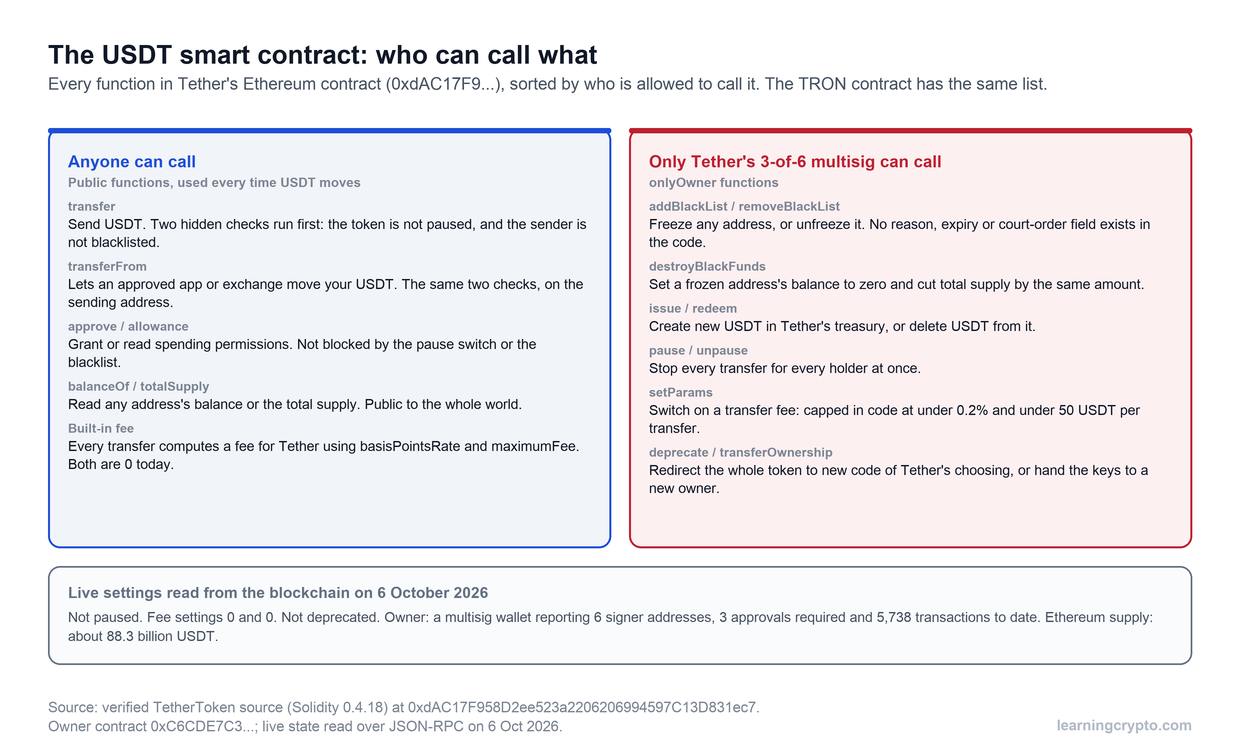
The freezing row surprises people, and our line-by-line guide to Tether's contract shows exactly how the switch works. Most large fiat-backed stablecoins include an administrative function letting the issuer blacklist addresses, and it has been used, typically in response to law enforcement requests. That is a reasonable compliance feature and it is also a centralisation most holders are unaware they have accepted.
What happens if a stablecoin issuer fails?
It depends entirely on whether real assets exist and who has a claim on them. With a properly reserved token, an insolvency becomes a question of how quickly holders can be made whole from segregated assets, and how the courts treat their claim relative to other creditors. That process can take a long time even when the outcome is eventually good.
With an under-reserved or algorithmic token there may be nothing to distribute at all, which is what made Terra's collapse in May 2022 final rather than temporary. The practical lesson is that the reserve question is not a technicality to skim past; it determines whether a bad week is a bad week or a total loss.
This is also the argument for not holding your entire cash position in one issuer. Spreading across two well-reserved tokens costs you nothing and removes a single point of failure.
How do you choose one?
Six questions, all answerable from public sources in about fifteen minutes: what backs it, who holds the reserves, who verifies them and how often, whether redemption is open, which chains it lives on, and how deep its liquidity is on the venues you use.
Two rules of thumb on top. An attestation is not an audit; it confirms a figure on a date rather than examining the business, so treat regular attestation as a good sign and its complete absence as disqualifying. And if a stablecoin pays a yield far above what short-dated government debt pays, that excess is compensation for a risk somebody has chosen not to emphasise. There is more across our stablecoins hub, and members get liquidity and funding context each weekday in the Daily Brief.
Frequently asked questions
What is a stablecoin in simple terms?
A stablecoin is a crypto token designed to stay worth about one dollar, so you can hold and move value on a blockchain without the price swinging. It stays stable because assets are held in reserve or collateral is locked in a contract, not because of anything inherent to the token itself.
Are stablecoins safe?
The large fiat-backed ones have operated reliably for years, but they are not risk-free and they are not bank deposits. You are holding a claim on an issuer, with no deposit insurance and no central bank backstop. The practical risks are the issuer's reserves, the banks holding those reserves, and the regulatory environment.
What is the difference between USDT and USDC?
Both are fiat-collateralised dollar stablecoins. USDT is larger and more widely traded, particularly outside the United States, while USDC has historically emphasised regulatory engagement and reserve disclosure. The meaningful differences are reserve composition, the quality and frequency of attestations, and which venues and chains you actually use.
Can a stablecoin lose its peg?
Yes, and several have. A brief dip caused by thin liquidity usually recovers within hours. A depeg caused by reserves being unavailable depends entirely on whether those assets come back. A depeg caused by a broken algorithmic design generally does not recover at all, because there is no external collateral to restore confidence.
Do stablecoins pay interest?
The token itself normally does not. Interest comes from lending it out, either through a centralised platform or a DeFi protocol, and that yield is payment for credit and smart-contract risk. Some newer tokens pass through returns earned on their reserves, which is a different and generally lower-risk source of yield.
Are stablecoins regulated?
Increasingly, though it varies widely by country. Europe's MiCA framework brings issuers into a licensing regime with reserve and redemption requirements, and other major jurisdictions are moving the same way. Regulation improves disclosure and accountability but does not make a stablecoin risk-free or equivalent to an insured bank deposit.
This guide is part of stage 5 of 8, beyond bitcoin, in the free Learning Crypto curriculum. Next: USDT vs USDC Compared: Reserves, Risks, and Which Is Safer.
Keep learning
- The CLARITY Act explained: what it does and where it stands
- What they're hiding in the Tether smart contract: every function explained
- Different Types of Stablecoins Explained: Fiat, Crypto, Gold
- USDT vs USDC: Reserves, Risks, and Which Is Safer
- Stablecoin Depeg: Why Pegs Break and What to Do
- More guides in the Stablecoins hub