
You made money in crypto. Or maybe you lost some. Either way, your tax authority wants to hear about it.
The rules aren't always intuitive, they differ by country, and they're changing fast. We're not accountants or tax professionals, and nothing here is financial advice.
This is the big picture of how crypto taxation works across six major jurisdictions as of early 2026. Your situation is yours alone, so do your own research and talk to a qualified professional before filing anything.
That said, knowing what triggers a tax bill (and what doesn't) might save you some nasty surprises down the line.
What You'll Learn
→ What triggers a tax bill and what doesn't, regardless of where you live
→ Country-specific rules for the US, UK, Germany, Portugal, Australia, and Canada, including rates, thresholds, and common traps
→ How DeFi, staking, and NFTs create tax headaches that most guides ignore
→ The global crackdown on unreported crypto through CARF, DAC8, and the new US 1099-DA
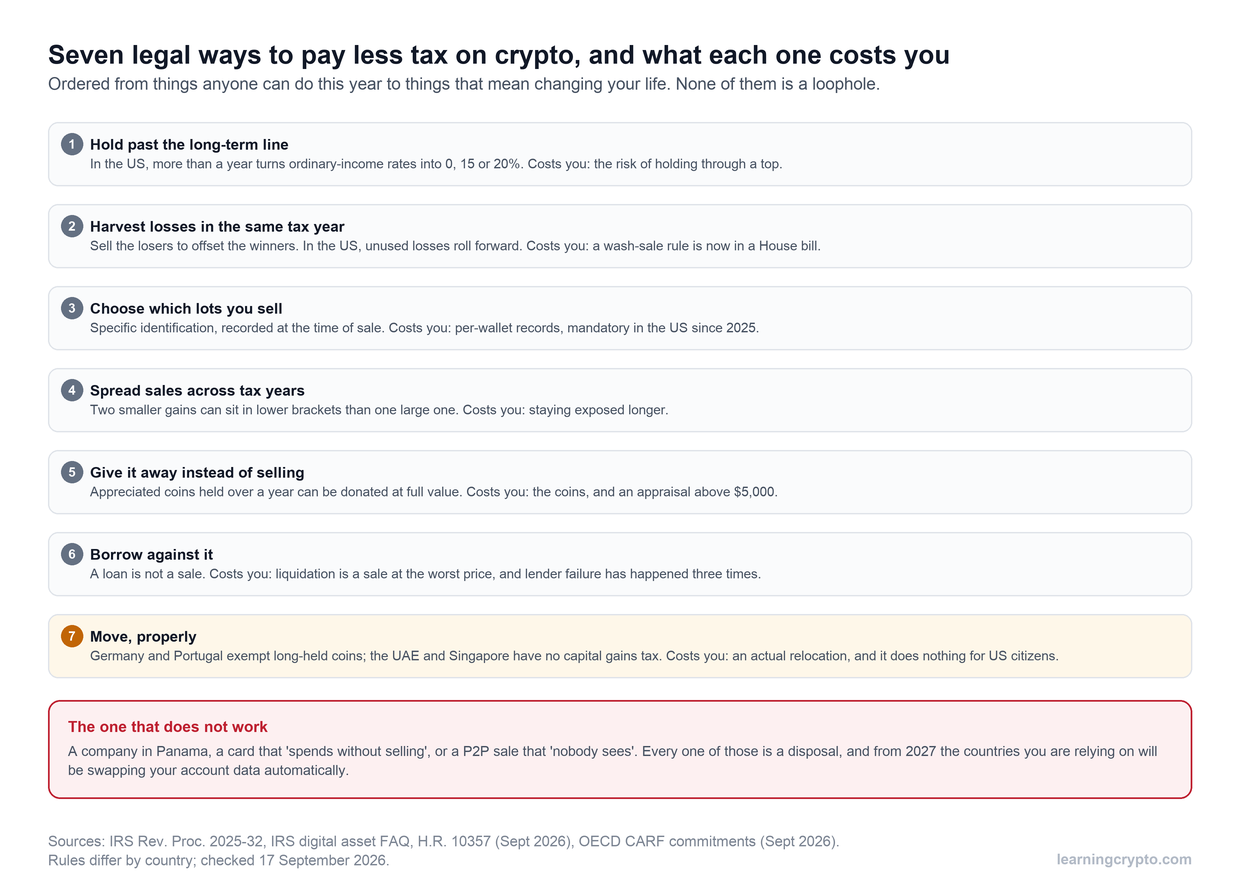
→ Tax-loss harvesting and why crypto still has a legal advantage that most traditional assets don't
→ Record-keeping tools that work specifically for crypto.
What Gets Taxed and What Doesn't
Before getting into country-specific rates, the good news is that taxable events are almost identical everywhere. The bad news is that most of them catch people off guard.
Taxable Events
Selling for fiat. You sell BTC for USD, GBP, EUR, AUD, or CAD. That's a disposal. You owe tax on any gain.
Swapping one crypto for another. Trading ETH for SOL? That's treated as selling ETH at fair market value and buying SOL. Two events in one transaction. This is the one most people miss.
Spending crypto. Buying a coffee with Bitcoin is a sale of Bitcoin in the eyes of every tax authority listed here.
Earning crypto. Mining rewards, staking income, airdrops, and salary paid in crypto. All taxable as income the moment you receive it.
Non-Taxable Events
Buying and holding. Purchasing crypto with fiat and sitting on it triggers nothing, no matter how much it appreciates.
Wallet-to-wallet transfers. Moving your own assets between your own wallets is not a disposal. No change in ownership, no tax.
Gifting (with limits). Most jurisdictions let you gift crypto without triggering tax for the donor, though annual limits apply.
Country-by-Country Breakdown
United States
The IRS treats crypto as property under Notice 2014-21. Every disposal triggers a capital gains calculation. If you're specifically interested in how the IRS handles mining income, that's a rabbit hole of its own.
As of March 2026, the seven federal income tax brackets (10% to 37%) are now permanent following the One Big Beautiful Bill Act signed in July 2025. Short-term gains (held 12 months or less) are taxed at those ordinary income rates.
Long-term gains (held over 12 months) get preferential rates:
Filing Status | 0% Rate | 15% Rate | 20% Rate |
Single | Up to $48,350 | $48,351 to $533,400 | Over $533,400 |
Married Filing Jointly | Up to $96,700 | $96,701 to $600,050 | Over $600,050 |
High earners may also owe the 3.8% Net Investment Income Tax on top of these rates.
Cost basis methods: FIFO is the default, but Specific Identification (including HIFO) is allowed if you can document which units you're selling. Pick one method and stay consistent across all exchanges.
The 1099-DA shift: Starting in 2025, centralized exchanges must report gross proceeds to the IRS via Form 1099-DA. By 2026, they'll also report cost basis and acquisition dates. The days of voluntary reporting are over.
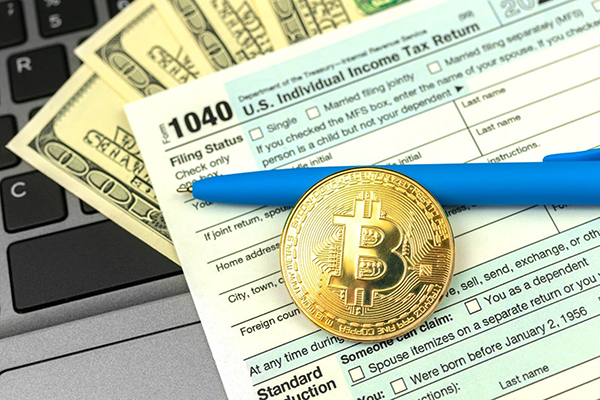
Watch out for: The digital asset question on Form 1040. It asks whether you received, sold, or disposed of digital assets. Answering incorrectly is considered perjury.
Also, the wash sale rule currently does not apply to crypto (it's property, not a security), but multiple legislative proposals aim to close this gap. Don't assume it will last.
United Kingdom
HMRC classifies crypto as "cryptoassets," not currency. Disposals are subject to Capital Gains Tax.
CGT rates for 2025/26 tax year:
Tax Band | Rate |
Basic rate (taxable income up to £50,270) | 18% |
Higher/Additional rate (above £50,270) | 24% |
These rates apply to all asset disposals from 30 October 2024 onwards, following the Autumn Budget changes. The income tax thresholds are frozen until April 2028.
The annual tax-free allowance for capital gains is just £3,000 for 2025/26, down from £12,300 in 2022/2023. That's a massive reduction that catches a lot of people out.
Cost basis rules: HMRC uses a strict ordering system. Same-day purchases match first, then any purchases within 30 days after the sale (the "bed and breakfasting" rule, designed to prevent artificial loss claims), and finally the average cost of your pooled holdings (Section 104 pool).
Income Tax (20% to 45%) applies to mining rewards, staking rewards, and crypto received as salary. Airdrops are generally not income unless received for services, but they have a £0 cost basis for future CGT.
Watch out for: The bed and breakfasting rule. If you sell at a loss and rebuy within 30 days, the loss is matched against the repurchase, not your pool. This effectively blocks the kind of quick wash-and-rebuy that's still possible in the US.
CARF implementation: The UK begins enforcing the OECD's Crypto-Asset Reporting Framework from January 1, 2026. Crypto service providers must report user activity to HMRC, with the first international data exchanges expected in 2027.
Germany
Germany takes a unique approach. Crypto is classified as a "private asset," not a capital asset. This distinction matters.
The 12-month rule: If you hold crypto for more than one year, gains are completely tax-free. No cap. No limit. This makes Germany one of the most attractive countries in the world for long-term holders.
Short-term gains (held under one year) are taxed as "other income" at your personal income tax rate, up to 45% plus a 5.5% solidarity surcharge. However, there's a €1,000 annual exemption. If your total short-term crypto gains for the year stay below that, you owe nothing.
Staking and mining rewards are taxed as income when received. A 2022 clarification from the Federal Ministry of Finance confirmed that staking does not extend the holding period to 10 years. The standard 12-month rule still applies.
Watch out for: Record retention. Germany requires you to keep tax records for 10 years. If you're planning to take advantage of the 12-month exemption, you need airtight proof of your acquisition dates.
Portugal
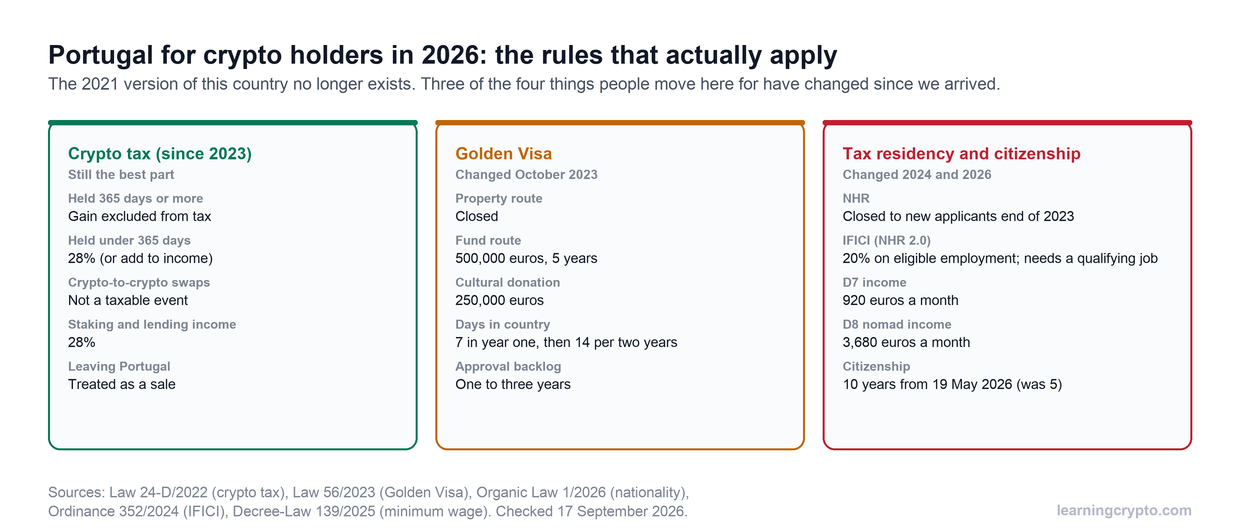
Portugal was once a crypto tax haven for individuals. That changed with the 2023 State Budget.
The current system (2025/2026):
Holding Period | Tax Treatment |
Less than 365 days | 28% flat capital gains tax |
More than 365 days | Tax-free |
Staking and mining income is taxed at progressive rates from 13% to 48% as professional or entrepreneurial income.
Watch out for: Portugal's tax authority (Autoridade Tributária) is increasingly sophisticated and aligned with EU-wide transparency rules. The "fly under the radar" era is over.
Australia
The Australian Taxation Office treats all digital assets, including stablecoins and NFTs, as property subject to Capital Gains Tax.
The 50% CGT discount: If you hold a crypto asset for more than 12 months, only half the gain is added to your taxable income. That's then taxed at your marginal rate (0% to 45%).
Income | Tax Rate |
$0 to $18,200 | 0% |
$18,201 to $45,000 | 16% |
$45,001 to $135,000 | 30% |
$135,001 to $190,000 | 37% |
Over $190,000 | 45% |
The personal use exemption (and why it barely applies): Australia technically exempts crypto acquired for under $10,000 and used directly to purchase goods or services. In practice, the ATO almost always denies this. If you held the crypto for any meaningful period, converted to fiat first, or treated it as an investment at any point, the exemption doesn't apply.
Watch out for: Crypto-to-crypto swaps. Every swap is a taxable disposal in Australia. The ATO has made this very clear, and it's the most common audit trigger for crypto investors.
Canada
The Canada Revenue Agency classifies crypto as a commodity, taxed under either capital gains or business income rules.
The 50% inclusion rate: The capital gains inclusion rate in Canada is 50%. Only half of your net capital gain is added to your taxable income. A proposed increase to 66.67% on gains above $250,000 was announced in the 2024 federal budget, deferred to 2026, and then cancelled entirely by Prime Minister Carney on March 21, 2025. The rate stays at 50% for individuals, corporations, and trusts.
The included portion is then taxed at your marginal federal rate. For 2026, the lowest federal bracket is 14% (reduced from 15% effective July 1, 2025), with the top rate at 33% on income over $258,482. Provincial rates stack on top.
Trader vs. investor: This distinction matters in Canada more than almost anywhere else. If the CRA decides you're a "trader" based on frequency, holding periods, and business-like conduct, 100% of your profits are taxable as business income. No inclusion rate benefit at all. Professional-scale mining and staking almost always fall into the business category.
Watch out for: Form T1135. If you hold crypto on foreign exchanges or in certain self-custody setups with a total cost exceeding $100,000 CAD at any point during the year, you must file this Foreign Income Verification Statement. Penalties for missing it are steep.
DeFi, Staking, and NFTs: The Grey Areas

DeFi is where crypto taxes get genuinely complicated.
Liquidity pools: Depositing tokens into a liquidity pool and receiving LP tokens in return is generally treated as a disposal of the original assets and the acquisition of a new one. That means a potential capital gain at the point of deposit, not just when you withdraw.
Wrapped tokens: Converting BTC to WBTC is widely interpreted as a taxable swap in the US. You're exchanging one form of property for another.
Staking and mining: Universally treated as income at the moment you gain control of the rewards. The cost basis for future sales is the fair market value at the time of receipt.
NFTs in the US: If an NFT is classified as a "collectible" (rare digital art, sports cards), it may face a higher maximum capital gains rate of 28%.
The beneficial ownership question: In the UK and Australia, tax authorities focus on whether you've transferred "beneficial ownership" when depositing into a DeFi protocol. If the protocol can use your assets, that may count as a disposal. This is still being debated, but the default position from HMRC and the ATO is aggressive.
The Global Crackdown: CARF, DAC8, and 1099-DA
The single biggest shift in crypto taxation isn't a new rate or threshold. It's information sharing.
Framework | Scope | First Reporting |
CARF (OECD) | 48+ countries | 2026/2027 |
DAC8 (EU) | European Union | July 2026 |
1099-DA (US) | United States | 2025/2026 |
The OECD's Crypto-Asset Reporting Framework requires crypto service providers to collect and share user transaction data with tax authorities across borders. The EU's DAC8 directive enforces the same within Europe.
Combined with the US 1099-DA, this means that by 2027, most tax authorities worldwide will have access to detailed records of their citizens' crypto activity, regardless of which exchange was used or where it's based.
Using an "offshore" exchange is no longer a viable strategy for avoiding domestic tax obligations.
Tax-Loss Harvesting: One Legal Advantage Crypto Still Has
Tax-loss harvesting means selling assets that have dropped in value to realize a loss, then using that loss to offset gains.
If you are in the US and your losses exceed your gains, you can deduct up to $3,000 against ordinary income per year, with the remainder carried forward indefinitely.
What makes crypto unique (for now) is the wash sale rule gap. In the US, because crypto is classified as property rather than securities, the rule that prevents you from claiming a loss if you rebuy within 30 days does not currently apply. You can sell at a loss and immediately rebuy the same asset.
This is widely expected to change. Multiple legislative proposals are in play. Treat this as a closing window, not a permanent feature.
Record-Keeping and Crypto Tax Software
Poor records are the number one reason people get hit with penalties. Every jurisdiction expects you to track the date, time, and fair market value in fiat for every transaction.
What to track: Every trade, swap, spend, and receipt. Label wallet-to-wallet transfers explicitly so your software doesn't treat them as disposals. Track gas fees and transaction costs, as these can often be added to your cost basis or deducted from proceeds.
How long to keep records: Germany requires 10 years. Most other jurisdictions expect at least 5 to 7 years. Keep everything.
Crypto Tax Software Comparison
Software | Best For | Standout Feature |
Koinly | Global compliance | 800+ integrations, HMRC/ATO-specific reports |
CoinTracker | US / Coinbase users | SOC 1 & 2 certified, TurboTax integration |
Blockpit | Germany / DACH region | Direct German Anlage SO imports |
CoinLedger | NFTs and DeFi | Native mobile tracking, strong DeFi support |
Divly | European users | Human tax experts for local EU law |
These tools import data via API keys or CSV files, reconcile transfers between wallets to prevent double-counting, and generate country-specific forms like the US 8949 or UK SA108.
Even Satoshi Would File
Benjamin Franklin said, "The only certainties in life are death and taxes." Took a while, but that adage has officially caught up with crypto.
It was always going to happen. The moment crypto started generating real wealth, governments were never going to sit on the sidelines. That's not an endorsement of how they tax it, or an argument that every rule makes sense. Some of these frameworks are clumsy, some are punitive, and some are still being written on the fly. But pretending they don't exist is a losing strategy.
The people who get wrecked by crypto taxes aren't the ones who planned for them. They're the ones who assumed it was someone else's problem.
Learning Crypto members don't get caught off guard. Sovereign portfolio management. Uncensored market analytics. Daily on-chain briefs. A private community of independent thinkers who play the long game.
FAQs
Do I owe tax if I just buy and hold crypto?
No. Buying crypto with fiat and holding it in a wallet is not a taxable event in any of the jurisdictions covered here. Tax is only triggered when you dispose of it through selling, swapping, or spending.
Is transferring crypto between my own wallets taxable?
No. Moving assets between wallets you own is not a disposal. Make sure to label these transfers clearly in your records so they aren't mistakenly treated as sales.
What if I lost money on crypto? Can I use those losses?
Yes. Capital losses can offset capital gains in every jurisdiction covered. In the US, excess losses can offset up to $3,000 of ordinary income per year. In other countries, unused losses typically carry forward to future years.
Do I need to report crypto if I didn't sell anything?
In the US, you still need to answer the digital asset question on Form 1040. In Canada, holdings over $100,000 CAD on foreign exchanges require a T1135 filing. Other countries generally don't require reporting until a disposal occurs, but rules are changing fast.
Are staking rewards taxed?
Yes. In every jurisdiction covered, staking rewards are treated as income at the moment you receive them, based on their fair market value at that time.
Disclaimer: This article is for educational purposes only and does not constitute tax, financial, or legal advice. Tax laws change frequently and vary by jurisdiction. Always consult a qualified tax professional for guidance on your specific situation.
Sources
United States
United Kingdom
Germany
Portugal
Australia
Canada
CRA: Reporting Income from Crypto-Asset Mining and Staking Activities
Government of Canada: Cancellation of Capital Gains Inclusion Rate Increase (March 21, 2025)
Global Reporting Frameworks
This guide is part of stage 8 of 8, tax and regulation, in the free Learning Crypto curriculum. Next: Crypto Record Keeping: What to Track for Tax.
Watch: Heidi on crypto taxes
Heidi's April 2025 overview of taxable events, holding periods, loss harvesting and relocation, our most-watched video of the last two years. Watch it on our CryptoTips channel.
Keep learning
- How to legally reduce your crypto taxes
- Strategic Bitcoin Reserve: Everything Explained
- Will Quantum Computers Break Bitcoin? Battle of the Mathematical Titans
- The Cypherpunk Movement: Origins, Manifesto & Enduring Legacy
- More guides in the Bitcoin hub
- Members: Satoshi Indicator, a daily Bitcoin DCA signal for members