
This guide is general education, not financial advice. Exchange features, fees and the rules for buying crypto differ by country and change often, so check them on the exchange and your regulator's website before you buy.
If you are buying Bitcoin for the first time, or you bought some years ago and it is still sitting on an exchange, this guide is for you. By the end you will know where to buy, how to check the exchange is real and registered, the account settings to change before you deposit a penny, and how to move the coins into a wallet only you control.
What is the safest way to buy Bitcoin?
The safest way to buy Bitcoin is through a large, registered exchange in your own country, paid for by bank transfer, and then withdrawn to your own wallet. That combination keeps your money inside regulated payment systems on the way in and out of the company's hands as soon as the purchase is done.
History explains the last step. When Mt. Gox collapsed in February 2014 and FTX in November 2022, customers' coins were stuck inside a failed company, and recovery took years. An exchange balance is a promise by the exchange to give you bitcoin. A wallet you control holds the bitcoin itself. Coins customers had already withdrawn to their own wallets were never part of either bankruptcy.
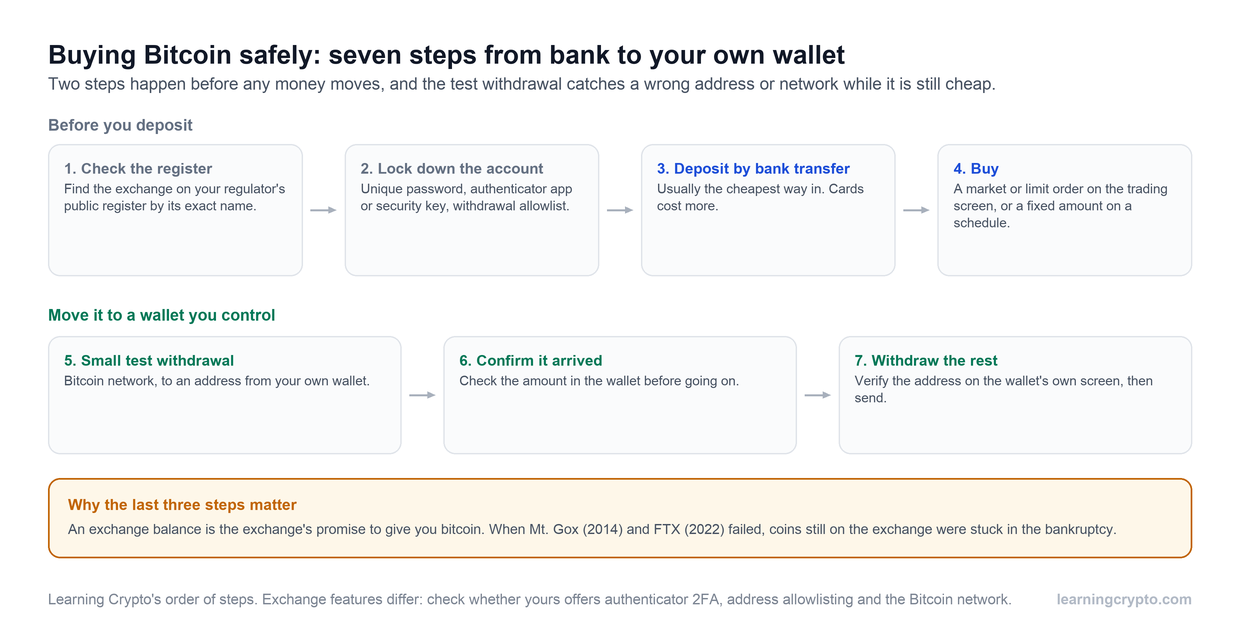
Seven steps, two of them before any money moves. The test withdrawal is the step most people skip, and the one that catches a wrong address or network.
Where can you buy Bitcoin?
You can buy Bitcoin on a crypto exchange, through a broker or payments app, from a Bitcoin ATM, or directly from another person. For a first purchase, a registered exchange is usually the best mix of price, protection and the ability to withdraw.
| Where | Good for | Watch out for |
|---|---|---|
| Registered crypto exchange | Most buyers. Lower fees, a choice of payment methods, and you can withdraw to your own wallet. | Identity checks, and the exchange holds the coins until you withdraw them. |
| Broker or payments app | Small amounts on an app you already use. | Some apps charge wide spreads, and some limit or do not allow withdrawals to your own wallet. Check before you buy. |
| Bitcoin ETF in a brokerage account | Price exposure inside a pension or brokerage account. | You own fund shares, not bitcoin. You cannot withdraw coins or self-custody them. |
| Bitcoin ATM | Paying cash. | Fees are usually far higher than an exchange. Anyone telling you to pay them through a Bitcoin ATM is scamming you. |
| Peer to peer | Privacy-minded buyers who know what they are doing. | Counterparty and payment fraud. Our guide to no-KYC Bitcoin covers the safer routes. |
Whichever you choose, you do not need to buy a whole bitcoin. Each bitcoin divides into 100 million units called satoshis, so you can buy as little as the exchange allows.
How do you check a crypto exchange is legitimate?
You check a crypto exchange by finding it on your financial regulator's public register under its exact legal name, then reaching its website by typing the address yourself. A fake exchange can copy a real one's design perfectly; it cannot copy the register entry.
- Look it up on the register. In the US, crypto exchanges register with FinCEN as money services businesses, searchable on the FinCEN MSB registrant search, and many also hold state licences. In the UK, firms must appear on the FCA Register. Other countries publish similar lists.
- Type the address, then bookmark it. Never reach an exchange through a search advert, a social media link or an email. Lookalike sites buy ads above the real one.
- Install the app from the official store listing linked from the exchange's own website, and check the publisher's name.
- Be wary of anyone who recommends a platform to you. A stranger, a new online friend or an "account manager" pointing you to an exchange is the opening of a scam, as our guides to crypto scams and AI trading bot scams explain.
Our checklist for checking whether an exchange is safe goes further, and our comparison of Coinbase and Kraken covers two of the largest in detail.
How do you buy Bitcoin step by step?
You buy Bitcoin by opening an account, verifying your identity, securing the account, depositing money and placing an order. The whole process usually takes under an hour, plus however long identity checks and your first bank transfer take.
- Open the account and verify your identity. Registered exchanges are required to check who you are under anti-money-laundering rules, so expect to upload ID and sometimes proof of address. Our explainer on KYC in crypto covers what they collect and why.
- Secure the account before you deposit. Use a unique password from a password manager and switch two-factor authentication to an authenticator app or a hardware security key, not text messages. Turn on withdrawal address allowlisting if the exchange offers it.
- Deposit money. A bank transfer is usually the cheapest method. Cards are faster but usually cost more.
- Place the order. A simple "buy" button is easy but often includes a spread. The exchange's trading screen with a market or limit order is usually cheaper. Buying a fixed amount on a schedule, known as dollar-cost averaging, takes the timing decision away.
- Record it. Note the date, amount, price and fees for tax. Exchanges can close accounts or delete history, so keep your own copy.
Once the coins are in your account, do not leave them there longer than you need to.
How do you move Bitcoin from an exchange to your own wallet?
You move Bitcoin to your own wallet by copying a receive address from the wallet, pasting it into the exchange's withdrawal page on the Bitcoin network, sending a small test amount, and sending the rest once the test arrives. Check the address on the wallet's own screen every time, because malware can swap a copied address for the thief's.
- Set up the wallet first. A hardware wallet is the right home for savings; a reputable mobile wallet is fine for small amounts. Our guide to self-custody Bitcoin walks through the setup and the seed phrase backup.
- Get a receive address from the wallet. Bitcoin addresses usually start with bc1, 3 or 1. Our explainer on what a BTC wallet address is covers the formats.
- Choose the Bitcoin network on the withdrawal page. Some exchanges offer other networks or wrapped versions of bitcoin. For a Bitcoin wallet, pick Bitcoin.
- Send a small test first. Withdraw a small amount, wait for it to appear in the wallet, and check the amount. The extra network fee is cheap insurance.
- Verify the address on the device, then send the rest. Compare the address on the hardware wallet's screen with the one pasted into the exchange, character by character at the start and end at least. Bitcoin transactions cannot be reversed.
Our step-by-step guide to sending Bitcoin to another wallet covers fees and confirmation times in more detail.
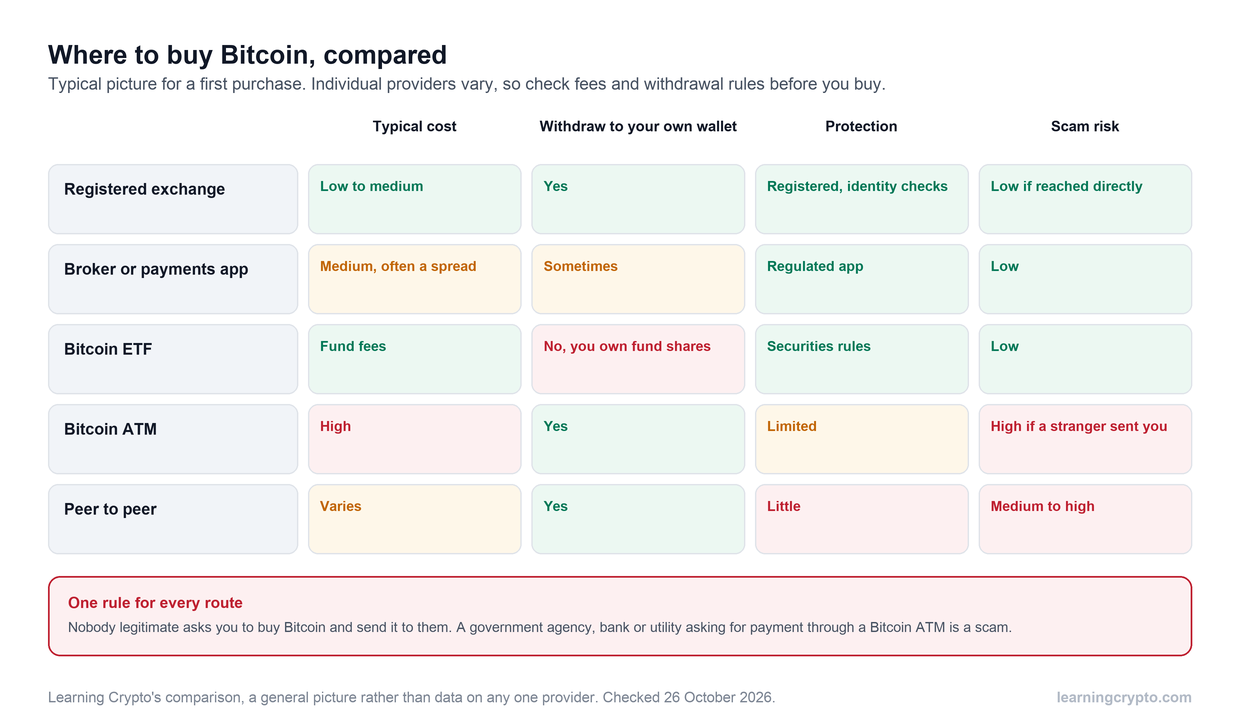
A registered exchange plus a withdrawal is the usual best combination for a first purchase. An ETF gives price exposure but never coins you can hold.
What mistakes do people make when buying Bitcoin?
The costly mistakes are nearly always the same five, and none of them is about picking the wrong day to buy.
- Leaving everything on the exchange. Convenient until the exchange freezes withdrawals or fails.
- Using text-message two-factor codes. A thief who takes over your phone number receives them too.
- Following someone else's platform. Romance scammers, fake account managers and "investment groups" steer people to fake exchanges that show balances nobody can withdraw.
- Paying a stranger through a Bitcoin ATM. No government agency, bank or utility company asks to be paid that way.
- Skipping the test withdrawal. A wrong network or an altered address is only fixable before the big transaction.
Keep track of what you hold across exchanges and wallets with our portfolio tracker, and find more guides in the Bitcoin hub.
Frequently asked questions
What is the safest way to buy Bitcoin for a beginner?
Use a large exchange that appears on your financial regulator's public register, reached by typing its address yourself. Secure the account with an authenticator app before depositing, pay by bank transfer, and buy a small amount first. Then withdraw the bitcoin to a wallet you control, sending a small test first and checking the address on the wallet's own screen before sending the rest.
Can I buy less than one bitcoin?
Yes. Each bitcoin divides into 100 million units called satoshis, so you can buy a fraction as small as your exchange allows, often the equivalent of a few dollars or pounds. Many people buy a fixed small amount every week or month rather than a single large purchase. The fees on very small purchases can be high as a share of the amount, so check them first.
Should I keep my Bitcoin on the exchange?
Not for long. Coins on an exchange are a claim on that company, and when exchanges such as Mt. Gox in 2014 and FTX in 2022 failed, customers waited years to be repaid. Keep only what you are actively trading on an exchange, and move savings to a wallet where you hold the keys, ideally a hardware wallet with a seed phrase backup.
Do I need ID to buy Bitcoin?
On a registered exchange, yes. Anti-money-laundering rules require exchanges to verify your identity before you can deposit or withdraw, usually with a photo ID and sometimes proof of address. Peer-to-peer trades and some Bitcoin ATMs ask for less, but they carry more risk and often cost more. Never send ID to anyone who contacts you first claiming to be an exchange.
Is it safe to buy Bitcoin with a credit card?
It works on most exchanges, but it usually costs more than a bank transfer, and some card issuers can treat it as a cash advance with extra fees and interest from day one. Buying crypto on credit also means paying interest on an asset that can fall sharply. If you use a card, use a debit card, and check the exchange's card fee first.
What happens if I send Bitcoin to the wrong address?
Almost always, it is gone. Bitcoin transactions cannot be reversed, and nobody, including the exchange, can pull coins back from an address they do not control. That is why you send a small test transaction first, choose the Bitcoin network on the withdrawal page, and check the receiving address on your wallet's own screen before sending the full amount.
Keep learning
- How to Self-Custody Bitcoin in 2026: The $100 Setup and the Next Steps Up
- How to Send Bitcoin to Another Wallet: A Step-by-Step Guide
- What Is DCA in Crypto? Your Complete Guide to Dollar Cost Averaging
- How to Tell If a Crypto Exchange or Wallet Is Safe
- What Is KYC in Crypto? Know Your Customer Explained
- More guides in the Bitcoin hub
- Free headlines: the Learning Crypto news feed on Telegram