

USDT (Tether) and USDC (Circle) are the two dominant dollar-pegged stablecoins, together holding over 84% of a $320 billion market.
They're both pegged to $1. They're both described as "stablecoins." But USDT and USDC are built on different philosophies, operate in different regulatory environments, and carry meaningfully different risk profiles.
If you're holding either one for more than a day's trading, you should understand what's actually behind that $1 peg.
What You'll Learn
What backs USDT and USDC, and how each issuer proves it
How their reserve compositions differ and why it matters under stress
The MiCA and GENIUS Act impact in plain terms
Historical depeg incidents for both tokens
How to decide which to use based on your situation
The Basics
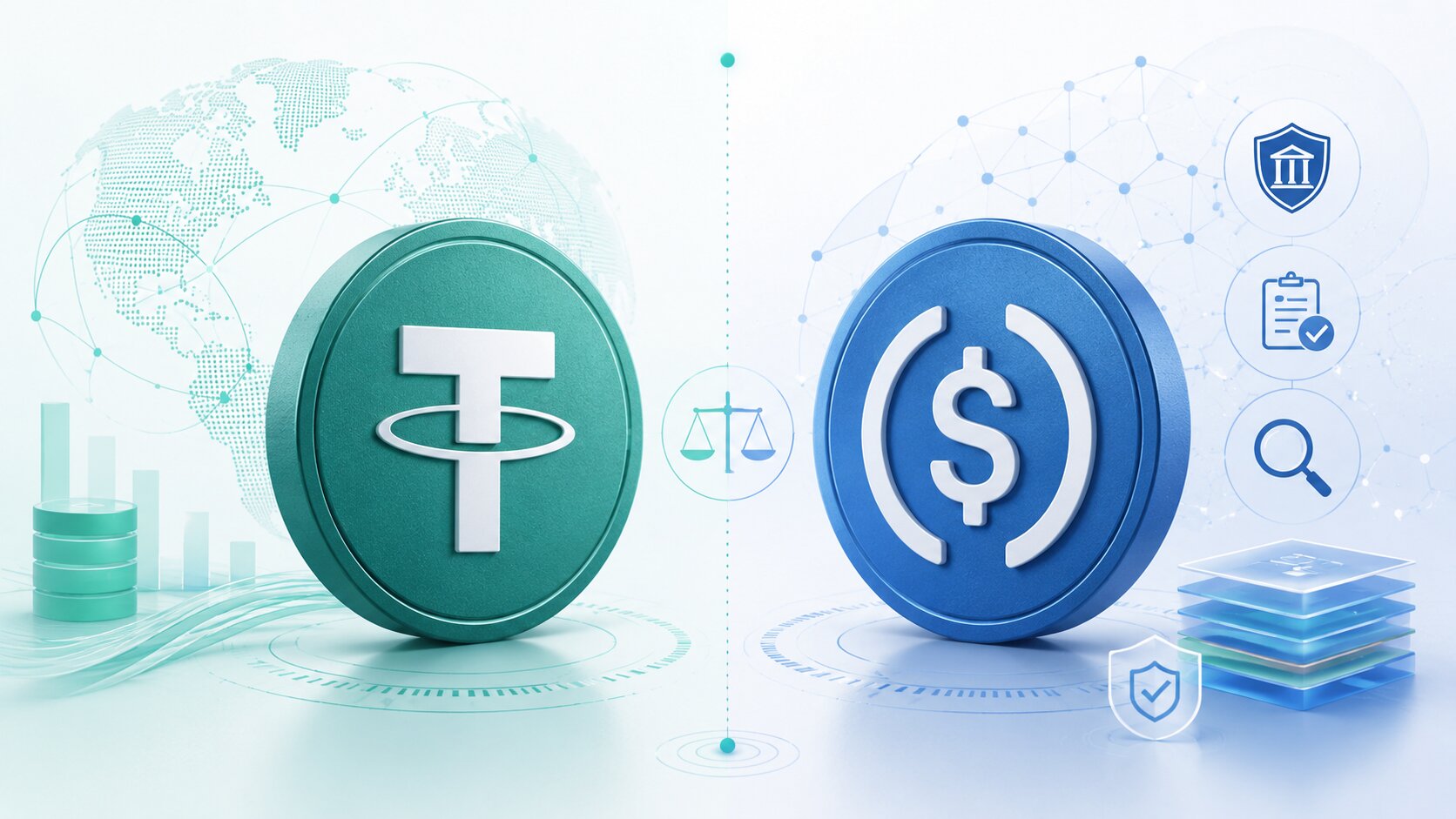
Both USDT and USDC are fiat-collateralized stablecoins, meaning each token is meant to be backed 1:1 by real-world assets, primarily US dollars and dollar-equivalent instruments. You can read more about how stablecoins work and their role in crypto markets as background.
Tether (USDT) was launched in 2014, issued by Tether Limited, a company incorporated in the British Virgin Islands and led by CEO Paolo Ardoino. As of May 2026, USDT supply sits at approximately $143 billion across Ethereum, Tron, Solana, and dozens of other chains. Tron carries the largest USDT float.
USD Coin (USDC) was launched in 2018 by Circle, a Boston-based fintech founded in 2013. Circle went public on the NYSE in June 2025. USDC supply sits at approximately $78 billion as of May 2026, concentrated on Ethereum, Base, Solana, and Arbitrum. USDC grew 73% in 2025 versus USDT's 36% growth, its second consecutive year of faster growth.
Reserves: What's Actually Behind the Peg

USDT
Tether publishes quarterly attestations produced by BDO, a global accounting network. The reserve breakdown includes:
US Treasury bills (the majority of holdings)
Cash and bank deposits
Secured loans
Corporate bonds
Gold and bitcoin
The secured loans and non-Treasury assets are the sticking points. These are less liquid than cash or T-bills, and their values carry market-price exposure. In a stress scenario requiring rapid redemptions, selling these assets at par isn't guaranteed. Tether has narrowed the proportion of non-HQLA (high-quality liquid assets) holdings since 2023, but the composition remains broader and less transparent than USDC.
The CFTC fined Tether $41 million in 2021 for misrepresenting reserve composition. Since then, Tether has improved disclosure, but a full financial statement audit by a Big Four firm has not been completed as of mid-2026.
USDC
Circle publishes monthly attestations produced by Deloitte. USDC reserves hold:
Cash at regulated US banks
Short-dated US Treasury bills held in the Circle Reserve Fund, a SEC-registered government money market fund managed by BlackRock
That's it. No secured loans, no gold, no bitcoin. The composition is more conservative, and the reporting cadence is monthly rather than quarterly. The Circle Reserve Fund holdings are filed with the SEC, making them independently verifiable.
The composition difference matters in one specific scenario: a liquidity crunch. USDC reserves are held almost entirely in assets that can be liquidated at par quickly. USDT's broader reserve composition adds more unknowns under pressure.
Depeg History
Neither stablecoin has suffered a catastrophic permanent depeg. But both have slipped below $1.
USDT most notably dropped to around $0.95 during the Terra/Luna collapse in May 2022, recovering within hours. It has printed several other sub-$0.99 incidents since 2017, largely tied to market stress events. None resulted in losses for redeemers, but the volatility is real.
USDC depegged in March 2023 when Circle disclosed $3.3 billion in reserves held at Silicon Valley Bank, which collapsed that weekend. USDC traded as low as $0.87 on some venues before recovering within 72 hours once Circle confirmed full reserve coverage and federal intervention at SVB. Notably, this was a banking risk event, not a reserve fraud event.
Both recovered. Both incidents point to different underlying risks: USDC's SVB depeg was caused by counterparty risk in the banking system; USDT's recurring dips are tied to reserve opacity and market confidence.
The Regulatory Divide
This is where the comparison has shifted most in 2025-2026.
MiCA (EU)
The EU's Markets in Crypto-Assets Regulation began applying to stablecoins in June 2024. Under MiCA, stablecoins classified as e-money tokens must obtain authorization from an EU national regulator, maintain 100% reserves in segregated accounts at regulated credit institutions, and meet ongoing disclosure requirements.
Circle obtained MiCA authorization through its Irish subsidiary, making USDC and its euro stablecoin EURC legally operable across the EU. Tether confirmed in late 2024 that USDT was not MiCA-compliant and has not pursued authorization.
The consequences have been practical and immediate. Kraken moved USDT to sell-only mode for EU customers in March 2025. Coinbase Europe and Bitstamp implemented similar restrictions. OKX followed.
EU users can still hold USDT in self-custody wallets or use it in DeFi, but they cannot buy or hold it through a MiCA-authorized centralized exchange.
The July 1, 2026, deadline marks the end of the EU transitional period. After that date, any CASP offering USDT to EU customers without authorization is in breach of EU law.
GENIUS Act (US)
The US Guiding and Establishing National Innovation for U.S. Stablecoins Act was signed in July 2025. It established federal stablecoin licensing, requiring issuers above $10 billion in circulation to operate under federal banking supervision with reserve, redemption, and disclosure requirements.
Circle falls under the GENIUS Act framework, and the practical effect was largely codifying what Circle already practiced. Tether has not signaled any intention to register as a US payment stablecoin issuer. The regulatory implication mirrors the MiCA picture: USDC operates inside the US and EU regulatory perimeters; USDT operates outside them.
This creates a bifurcation that JPMorgan analysts described as USDC commanding nearly 30% of the combined USDT/USDC market share as of late 2025, up from 24% at the start of the year.
Centralization and Freeze Risk
Both tokens are centralized. Both issuers can freeze wallet addresses.
Tether has frozen wallets at the request of law enforcement, most notably freezing hundreds of millions of USDT linked to illicit activity and sanctioned actors. Circle does the same.
This isn't unique to either token; it's a property of all fiat-backed centralized stablecoins. But it's worth noting if you're using stablecoins for privacy-sensitive or censorship-resistance reasons. Neither USDT nor USDC offers that.
Chain Distribution and Liquidity
USDT has the edge on raw liquidity. It's available on more chains, has deeper order books on offshore and emerging market exchanges, and remains the dominant stablecoin for remittances, P2P trading, and retail activity globally. The Bitcoin payment processing firm BitPay reported USDT exceeded 70% of stablecoin payment volume on its platform by May 2025.
USDC has the edge on regulated venue liquidity and DeFi protocol integration. USDC overtook USDT in total transaction volume in 2024 (not market cap, transaction count). Its concentration on Ethereum, Base, Solana, and Arbitrum aligns with where institutional and DeFi volume is heaviest.
If you're active in DeFi, using a regulated US or EU exchange, or holding a stablecoin as a serious store of value, USDC's liquidity profile is sufficient for most purposes. If you need to move large sums across emerging market exchanges or use non-US CEXs, USDT will often have better depth.
Risks to Know
Both tokens share certain systemic risks that don't get enough attention.
Banking Counterparty Risk
USDC's SVB event proved this. Reserves held at banks carry deposit insurance limits. For institutional-sized holdings, anything above FDIC limits sits exposed to bank failure. Circle has since diversified custodians and moved the bulk of reserves into the BlackRock-managed Treasury fund, but some cash exposure to regulated banks remains.
Redemption Risk
Both tokens promise 1:1 redemption, but minimum redemption thresholds apply. Tether's minimum is $100,000. Circle's is $100,000 for verified institutional users. Retail holders can't redeem directly with either issuer; they depend on secondary market liquidity. Understanding the relationship between liquidity and market depth matters here.
Regulatory Action Risk
An enforcement action or bank license revocation could disrupt either issuer's operations. USDT carries a higher regulatory risk in the US and EU, given its non-compliance posture. USDC carries more exposure to changes in US banking law or SEC rulemaking on money market funds.
Smart contract risk. Both tokens are deployed across multiple blockchains with varying levels of contract maturity and audit history. The token contract itself is a risk surface, particularly on newer deployments.
Which Is Safer?
It depends on your definition of "safer" and where you're operating.
USDC is more transparent and more regulated
Its reserve composition is conservative, its attestation cadence is monthly, its regulatory posture in the US and EU is authorized rather than non-compliant, and it's the default stablecoin for institutions operating inside regulated frameworks. If you're an EU-based user or holding stablecoins as a serious cash equivalent, USDC is the lower-risk choice on fundamentals.
USDT is more liquid and more globally accessible
It dominates offshore exchanges, emerging markets, and high-volume trading. If your priority is execution depth or you're operating on markets where USDC presence is thin, USDT remains the practical default. Its reserve composition has improved, and it has handled every depeg incident without causing redemption losses. But the opacity, the regulatory non-compliance, and the BVI domicile are features of the asset, not bugs being fixed.
The honest framing is that USDC carries less structural risk, and USDT carries less liquidity risk. That points toward USDC for savings and USDT for active trading on non-regulated venues.
The Bottom Line
USDC is more transparent, more regulated, and carries more conservative reserves.
USDT has deeper global liquidity, broader chain coverage, and is the dominant stablecoin outside the US and EU regulatory perimeters.
Which one makes sense depends on where you're operating and what you're using it for. For most people looking to hold stablecoins as a serious cash equivalent, USDC is the lower-risk choice. For high-volume trading across global and offshore venues, USDT's liquidity is still hard to match.
Either way, knowing what's behind the peg matters. A dollar sign and a stable chart are not the same thing as a guarantee.
Go Deeper With LearningCrypto
Every weekday morning, you get a pre-market brief covering market signals and on-chain movements, built from two hours of research done for you.
The Satoshi Indicator gives you a proprietary on-chain DCA signal - no influencer opinions, just math.
Ask Crypto pulls live, verifiable on-chain data so you can query reserve flows, wallet accumulation, and token fundamentals without leaving the platform.
And we publish our actual portfolio positions in real time, every coin, every allocation.
7-day free trial. 30-day money-back guarantee. No commitment.
Frequently Asked Questions
Can I earn yield on USDT or USDC?
Yes, both are widely supported across lending protocols, CEX earn products, and DeFi yield strategies. USDC tends to offer lower yields on regulated platforms due to its compliance posture; USDT often carries a slight premium on offshore platforms, reflecting the additional risk.
Do USDT and USDC work the same way across different blockchains?
USDT on Tron and USDT on Ethereum are separate token deployments. Sending USDC on Solana to an Ethereum address will result in lost funds. Always confirm you're sending on the correct network and that the receiving address supports that specific chain deployment.
What happens to my USDT or USDC if Tether or Circle goes bankrupt?
Legally, reserves are meant to be held separately from the issuer's operating assets, thereby giving token holders a claim on those reserves in insolvency. In practice, how quickly and cleanly that plays out depends on jurisdiction, the quality of reserve segregation, and whether a regulator intervenes. USDC's structure under the GENIUS Act and MiCA provides more legal clarity here than USDT's BVI domicile.
Are USDT and USDC the same as a bank deposit?
No. Neither carries deposit insurance (FDIC in the US, FSCS in the UK). They're not issued by banks. The $1 peg is maintained through reserve backing and market confidence, not a government guarantee.
What is USAT, and should I be paying attention to it?
USAT is Tether's US-facing stablecoin designed to compete inside the regulated US market. Announced in early 2026, it's built to comply with the GENIUS Act framework, essentially Tether's answer to Circle on its home turf. It's early stage but worth watching.
Keep learning
- Best Stablecoin Interest Rates and Yields 2026: Compared
- Trezor vs Ledger: Which Hardware Wallet Should You Choose?
- Stablecoins vs Bitcoin: Which Crypto is Right for You?
- What Is Market Cap in Crypto: A Complete Guide
- More guides in the Stablecoins hub
- Members: Daily Brief, pre-market context every weekday