
A soft fork is a backward-compatible upgrade to a blockchain's rules. It narrows what counts as a valid block or transaction, so computers running the old software still accept every new block. The network stays on one chain, no new coin is created, and holders normally need to do nothing at all.
This guide is for anyone who has seen "soft fork" in the news and wants the mechanics without the jargon. By the end you will know how a soft fork differs from a hard fork, how one is switched on, which ones shaped Bitcoin, why a soft fork can still split a chain, and which proposals are being argued over in 2026. For forks in general, including hard forks such as Bitcoin Cash, start with our guide to crypto forks.
What is a soft fork, in plain English?
Every node on a blockchain checks each new block against a list of rules: no spending coins you don't own, no creating more coins than allowed, no block bigger than the limit. A fork is any change to that list. A soft fork changes it in one direction only. It adds a restriction, or gives new meaning to something the old rules already allowed, but it never permits anything the old rules forbade.
Think of a club whose dress code says "smart clothing". The committee adds a rule: "and a tie". Anyone wearing a tie still meets the old code, so a doorman who never got the memo keeps letting the right people in. He just can't turn away someone without a tie, because he doesn't know that rule exists. That doorman is an old node after a soft fork. It stays in step with the network, but it relies on others to enforce the new rule.
That is why a soft fork needs a majority of the network's mining power to enforce it, while a hard fork needs every node to upgrade. If you want a refresher on what nodes actually do, see what nodes are and how they power a blockchain.
How does a soft fork work?
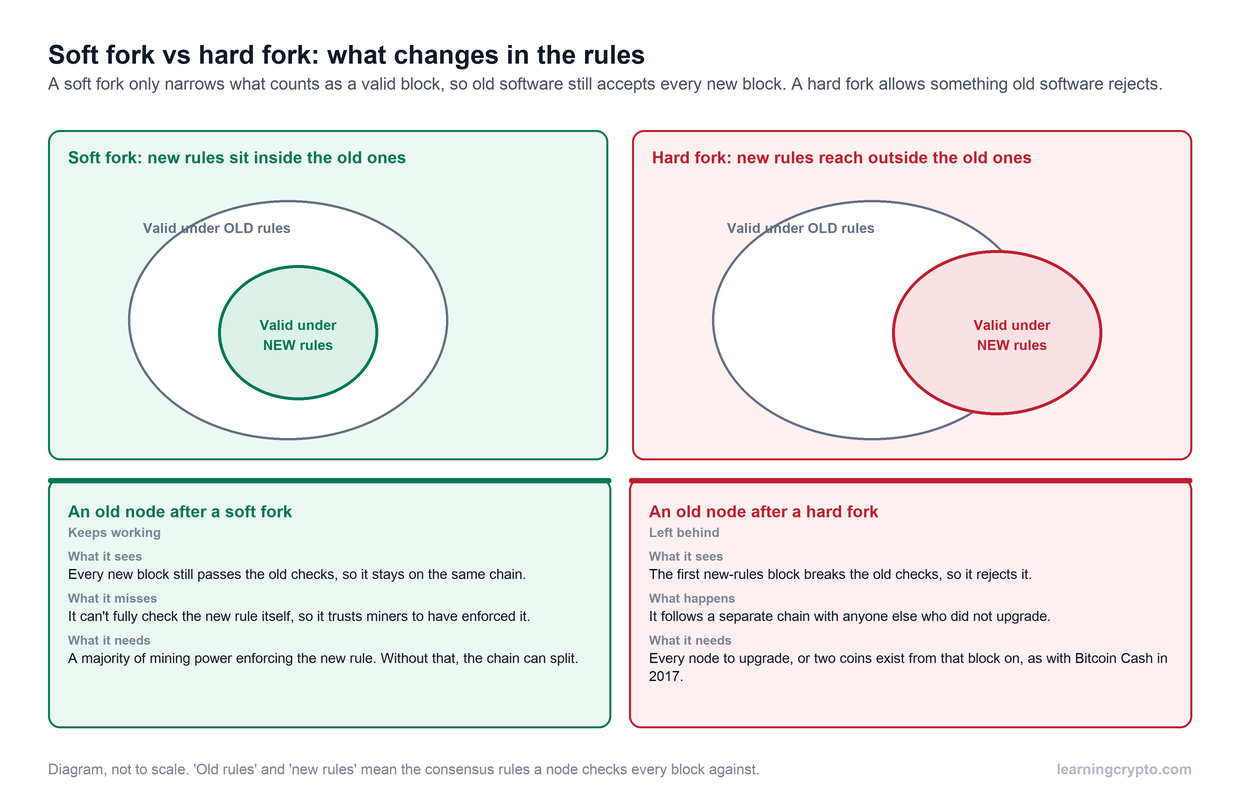
A soft fork's new rules fit inside the old ones. A hard fork's do not, which is why old software rejects the first hard-fork block.
Once a soft fork is live, upgraded miners only build blocks that follow the stricter rules, and upgraded nodes reject any block that breaks them. Old nodes see blocks that look perfectly normal, because nothing in them breaks a rule they know about.
The clever part is how new features get added this way. Bitcoin's SegWit upgrade in 2017 used a type of output that old software treated as "anyone can spend". To an old node, those coins looked unprotected. Upgraded nodes, which were the large majority of the mining power, enforced a new rule that only the owner's signature could spend them. Old nodes never saw a block that broke their rules, so the network never split, yet a whole new transaction format was added underneath them.
There is a trade-off for nodes that don't upgrade. An old node accepts SegWit blocks without checking the new signatures, trusting that miners did. Anyone who wants to verify every rule for themselves needs to run current software.
Soft fork vs hard fork: what's the difference?
| Soft fork | Hard fork | |
|---|---|---|
| Rule change | Tightens the rules or adds meaning to something already allowed | Loosens or replaces the rules, allowing something old software rejects |
| Old nodes | Keep following the same chain | Reject new blocks and follow a separate chain |
| Who must upgrade | A majority of mining power | Every node that wants to stay on the new chain |
| Chain split | Only if the new rule lacks majority support | Permanent, if any group refuses to upgrade |
| New coin | None | Possible, as with Bitcoin Cash in 2017 |
| Typical use | Bitcoin upgrades: P2SH, SegWit, Taproot | Ethereum upgrades such as Pectra, and contested splits |
Neither type is better in principle. Bitcoin prefers soft forks because they let people who never upgrade keep using the network, which fits a system built to change slowly. Ethereum ships most of its upgrades as scheduled hard forks that every client adopts, such as the Pectra upgrade in 2025. Because the whole ecosystem coordinates those upgrades in advance, they don't normally create a second coin. Contested hard forks are a different story, and our guide to hard forks and chain splits covers Bitcoin Cash, Ethereum Classic and what holders should do when one happens.
How is a soft fork activated?
A soft fork is only safe once enough miners enforce it, so Bitcoin uses a signalling process before any new rule switches on. The method has changed over the years, and each change came out of a fight.
- Write and review the proposal. Changes start as a Bitcoin Improvement Proposal (BIP), then go through years of review, testing on test networks, and public debate.
- Release code with activation built in. Node software ships the new rule switched off, along with the conditions that will switch it on.
- Miners signal. Under the BIP 9 method, miners set a bit in each block they produce to show they are ready. If enough blocks in one 2,016-block period (about two weeks) signal, the change "locks in". BIP 9 set the bar at 95%; Taproot used 90%.
- Grace period, then activation. After lock-in there is a further period so stragglers can upgrade. Then the new rule is enforced from a set block.
Miners signalling is a readiness check, not a vote. That distinction became the centre of Bitcoin's block size war. In 2017, SegWit sat at around a third of miner support for months. Users responded with a user-activated soft fork (UASF), BIP 148, under which nodes would reject blocks that did not signal for SegWit from 1 August 2017. Facing the risk of being on the wrong side of a split, miners locked SegWit in, and it activated on 24 August 2017 at block 481,824. The miners who wanted bigger blocks left to create Bitcoin Cash through a hard fork on the same 1 August date. BIP 9's specification sets out the signalling rules, and Bitcoin Optech's activation overview covers the methods proposed since.
What are the best-known soft fork examples?
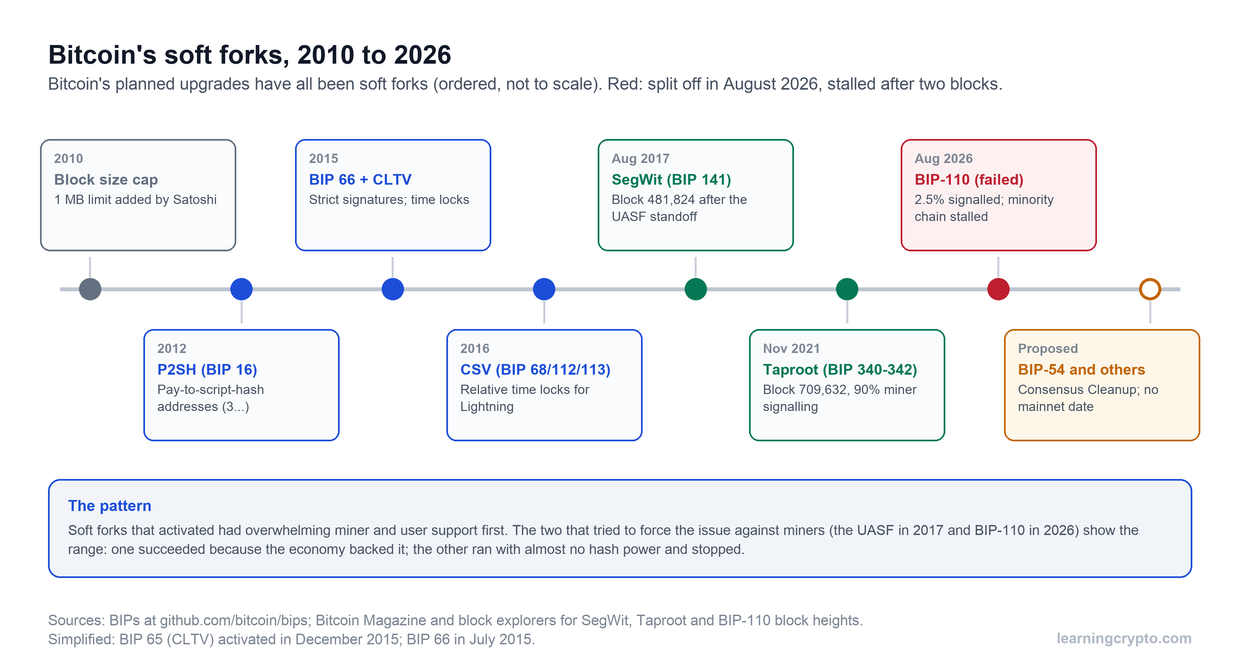
Bitcoin's planned upgrades have all been soft forks. Most were uncontroversial; SegWit and BIP-110 were not.
- The 1 MB block size limit (2010). Satoshi Nakamoto added it as an anti-spam measure. Ironically, the fight over raising it later drove the Bitcoin Cash hard fork.
- P2SH (2012). Pay-to-script-hash introduced addresses starting with 3, which made multisig wallets practical to share and use.
- Time locks (2015 and 2016). CLTV and CSV let coins be locked until a date or for a period. They are the building blocks of the Lightning Network; see how Lightning wallets work.
- SegWit (2017). Moved signature data out of the main part of the transaction, fixed a long-standing bug called transaction malleability, raised capacity, and opened the way for Lightning.
- Taproot (2021). Added Schnorr signatures and made complex spending conditions, such as multisig, look like ordinary payments on-chain. It activated on 14 November 2021 at block 709,632 after reaching 90% miner signalling.
Our 2021 explainer on Taproot, recorded as the soft fork was heading for activation. Watch it on our CryptoTips channel.
Can a soft fork split the chain?
Yes, if the new rule is enforced by less than a majority of mining power. Upgraded nodes reject blocks that break the new rule, so if most miners ignore it, the upgraded nodes end up on their own shorter chain. Two real cases show how this plays out.
July 2015, BIP 66. Shortly after this soft fork activated, a small miner produced a block that broke the new rule. Some large pools had been signalling support without actually checking the rule, and they built on top of the invalid block. For about six blocks there were two competing chains, and wallets that relied on miners rather than checking blocks themselves showed confirmations that later vanished. The lesson: signalling and enforcing are not the same thing.
August 2026, BIP-110. This proposal, known as the Reduced Data Temporary Softfork and enforced by Bitcoin Knots, aimed to cap arbitrary data such as Ordinals inscriptions for about a year. It set a 55% signalling threshold, but only 51 of the 2,016 blocks before its mandatory period signalled support, about 2.5%. From block 961,632 on 8 August 2026, BIP-110 nodes rejected any block that did not signal. Almost all of the hash power stayed on the main chain, and the minority chain produced two blocks in eight hours before it stalled. Bitcoin Magazine's report covers the split.
The pattern across both events is simple. A soft fork backed by most miners is close to invisible. One that isn't puts the nodes enforcing it on a chain of their own.
Which soft forks are being debated in 2026?
Several proposals are live in Bitcoin's developer community. None has an activation date on the main network as of 1 October 2026, and some may never get one.
- BIP-54, the Consensus Cleanup. Four narrow fixes for known weaknesses: the timewarp attack on mining difficulty, blocks that take too long to validate, a quirk in how transactions are summarised in a block, and duplicate transactions. The specification was finished in May 2026 and the code has been written without a mainnet trigger. At least one large mining pool, F2Pool, has said it will not signal for it in advance. bip54.org explains each fix.
- Covenant proposals. CTV (BIP 119), CSFS and OP_CAT (BIP 347) would let coins carry conditions on how they can be spent next, which could enable vaults that slow down a thief. They remain drafts being tested on test networks.
- BIP-361, a quantum migration plan. Proposed in April 2026, it would first stop new coins being sent to older, quantum-vulnerable address types, then later stop old-style signatures being accepted at all, freezing coins that have not moved to new addresses. Technically it is a soft fork, because it only removes things the rules allow. Critics argue that freezing coins makes it something much bigger than an upgrade.
BIP-361 is a useful reminder that "soft" describes compatibility, not gentleness. A soft fork can take options away from coin holders, which is exactly why Bitcoin's culture demands such broad agreement before anything activates. We covered the proposal in our BIP-361 explainer video.
What should you do when a soft fork happens?
For most holders, nothing. Your coins stay where they are, your keys keep working, and your existing addresses remain valid. A soft fork creates no new coin, so there is nothing to claim. A few practical points still apply:
- Ignore anyone offering to help you "claim" soft-fork coins. There are none. Requests for your recovery words around any fork are a scam, every time.
- Update your wallet software when convenient. You only need to update to use a new feature, such as Taproot addresses, but staying current is good practice anyway.
- If you run a node, upgrade it. An old node keeps working, but it no longer checks every rule for you. Running current software is what makes your node a full check on the network.
- During a contested activation, slow down. If the news talks about a possible split, wait for more confirmations than usual on large transfers until it is clear which chain the economy follows. Keeping your coins in a wallet you control, rather than on an exchange, means you decide what happens next. Our beginner's guide to Bitcoin covers the basics of self-custody.
If a fork headline leaves you unsure what it means for your own coins, put it to Ask Crypto AI, our encrypted crypto assistant, or browse more explainers in the Bitcoin hub.
Disclosure: this is education, not financial advice. Our YouTube video descriptions carry Trezor and Ledger affiliate links. Proposal statuses were checked on 1 October 2026 and change often.
Frequently asked questions
What is a soft fork in simple terms?
A soft fork is an upgrade that makes a blockchain's rules stricter without breaking old software. Nodes that have not upgraded still accept the new blocks, because nothing in them breaks a rule they know. The network stays as one chain, no new coin is created, and holders normally don't need to do anything when one activates.
How is a soft fork activated?
On Bitcoin, new node software ships with the rule switched off, then miners signal readiness by flagging the blocks they produce. Once enough blocks in a two-week, 2,016-block period signal, 95% under the original BIP 9 method or 90% for Taproot, the change locks in, and it is enforced from a set block after a short grace period.
Was SegWit a soft fork?
Yes. SegWit activated as a soft fork on 24 August 2017 at block 481,824. It moved signature data out of the main transaction structure in a way old nodes still accepted. Its activation was the most contested in Bitcoin's history, pushed through by the user-activated soft fork movement, and the miners who opposed it left to create Bitcoin Cash.
Do you get free coins from a soft fork?
No. A soft fork keeps the network on a single chain, so no second coin is created and there is nothing to claim. Free coins only appear when a hard fork splits a chain and both sides keep running. Anyone offering to help you claim soft-fork coins, especially if they ask for your recovery words, is running a scam.
Can a soft fork be reversed?
Not easily. Undoing a soft fork means removing a restriction, which is a loosening of the rules and therefore a hard fork. Every node would need to upgrade to accept blocks the current rules reject. That is one reason Bitcoin developers take years to review a soft fork: once it is live and coins depend on it, it is effectively permanent.
Is Taproot a soft fork?
Yes. Taproot activated as a soft fork on 14 November 2021 at block 709,632, after 90% of the blocks in a two-week signalling period showed miner support. It added Schnorr signatures and made complex spending conditions, such as multisig, look like ordinary single-signature payments on-chain, which improves privacy and lowers fees for those transactions.
Keep learning
- What Is a Fork in Crypto? Hard Forks vs. Soft Forks Explained
- What Are Nodes in Crypto and How Do They Power Blockchain Networks?
- What is a Lightning Wallet? [Explained] - How it Works?
- Ethereum Pectra Upgrade Explained: Here’s What Experts are Saying
- What Is Bitcoin? A Complete Guide for Beginners
- More guides in the Bitcoin hub
- Free headlines: the Learning Crypto news feed on Telegram