Bitcoin is the reason everything else in this industry exists, and it is still the thing most people have never had explained properly. This guide covers what it is, how it actually works, who controls it, how you own it, and what it is genuinely useful for. No hype and no jargon you are expected to already understand.
What is Bitcoin, in plain English?
Bitcoin is digital money that no company, bank or government runs. It is a shared record of who owns what, maintained by thousands of independent computers around the world, none of which has to trust any of the others. The software that runs it, Bitcoin Core, is open source and anyone can inspect or run it.
Two properties make it different from the money in your bank account. First, the supply is fixed: there will only ever be 21 million bitcoin, and no one can decide to make more. Second, ownership is proved by a cryptographic key rather than by a company's database entry, so nobody can freeze, reverse or confiscate a balance held properly in self-custody.
The unit is the bitcoin (BTC), and it divides into 100 million smaller units called satoshis, so you never need to buy a whole one. The network launched in January 2009 and has run continuously ever since.
Why was Bitcoin created?
It was a direct response to the 2008 financial crisis. An anonymous developer using the name Satoshi Nakamoto published the Bitcoin whitepaper in October 2008, weeks after Lehman Brothers collapsed, and embedded a newspaper headline about bank bailouts into the very first block.
The problem it set out to solve was specific: how do you send value directly between two people online, with no bank in the middle, and prevent the same money being spent twice? Every previous attempt at digital cash had needed a central operator to keep the ledger honest, and every central operator was a point that could fail, be pressured or be shut down. Bitcoin's contribution was a way for strangers to agree on one shared history without anyone being in charge. We cover the origins in more depth in why Bitcoin was created, and the movement it grew out of in our guide to the cypherpunks.
How does Bitcoin actually work?
Four moving parts, and once you see how they fit the rest follows.
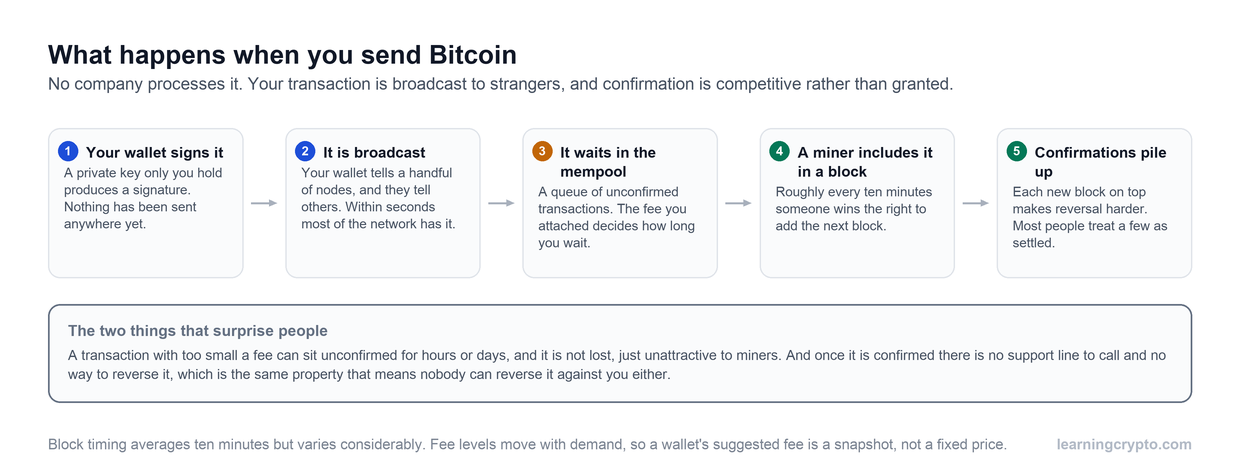
No company processes any of this. The fee you attach decides how long you wait, and once a transaction confirms there is nobody to call, which is the same property that stops anyone reversing one against you.
- The ledger. Every transaction ever made is recorded in a chain of blocks, each cryptographically linked to the one before it. Change anything in an old block and every block after it breaks, which is what makes history practically impossible to rewrite. The general mechanism is covered in how blockchain works.
- Nodes. Thousands of computers each keep a full copy of that ledger and independently check every rule. If a miner tries to create bitcoin out of thin air or spend coins they do not own, nodes simply reject the block. This is where the real power sits, and it is why running a node matters.
- Mining. New blocks are added roughly every ten minutes by miners who spend electricity solving a computational puzzle. The winner adds the next block and collects newly issued bitcoin plus transaction fees. The cost of that electricity is what makes attacking the chain expensive, and it is explained in crypto mining for beginners.
- Keys. Your bitcoin is not a file on your computer. It is an entry on the ledger that can only be moved by whoever holds the corresponding private key. Control the key and you control the coins.
Who controls Bitcoin?
Nobody, and that is the point rather than a slogan. There is no company, no chief executive and no head office. Satoshi Nakamoto disappeared in 2011 and has never been identified.
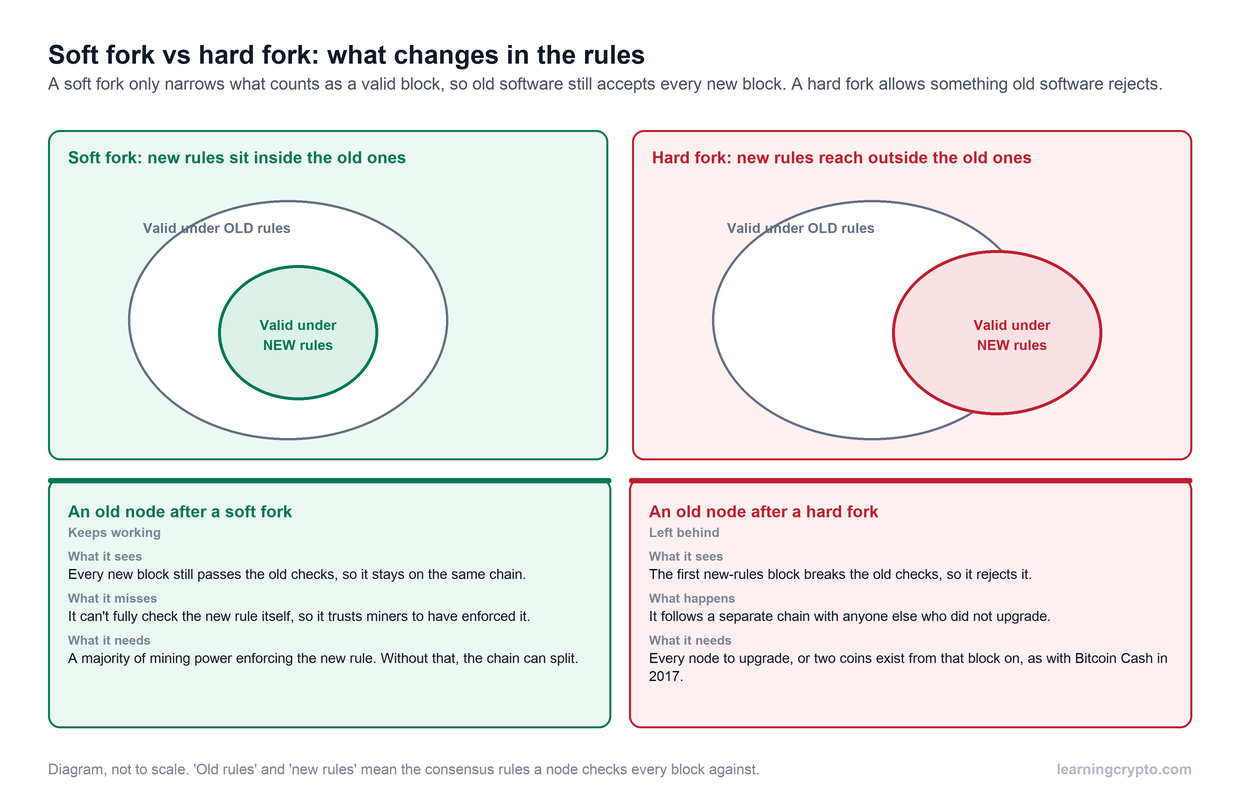
What exists instead is a balance between three groups. Developers propose changes to the software but cannot force anyone to run them. Miners produce blocks but must follow the rules nodes enforce or have their blocks rejected. Node operators, including anyone running the software at home, choose which version of the rules to accept. Changing anything meaningful requires overwhelming agreement across all three, which is why Bitcoin changes so slowly compared with other networks.
When agreement fails, the chain can split, which is what a fork is. Several have happened and none has displaced the original chain. Our guide to forks in crypto explains how they work and what holders should do when one occurs.
Where does the 21 million limit come from?
From the issuance schedule written into the software at launch. Every block creates a fixed number of new bitcoin, and that number halves roughly every four years in an event called the halving. The reward started at 50 BTC per block, and after halvings in 2012, 2016, 2020 and 2024 it now stands at 3.125 BTC.
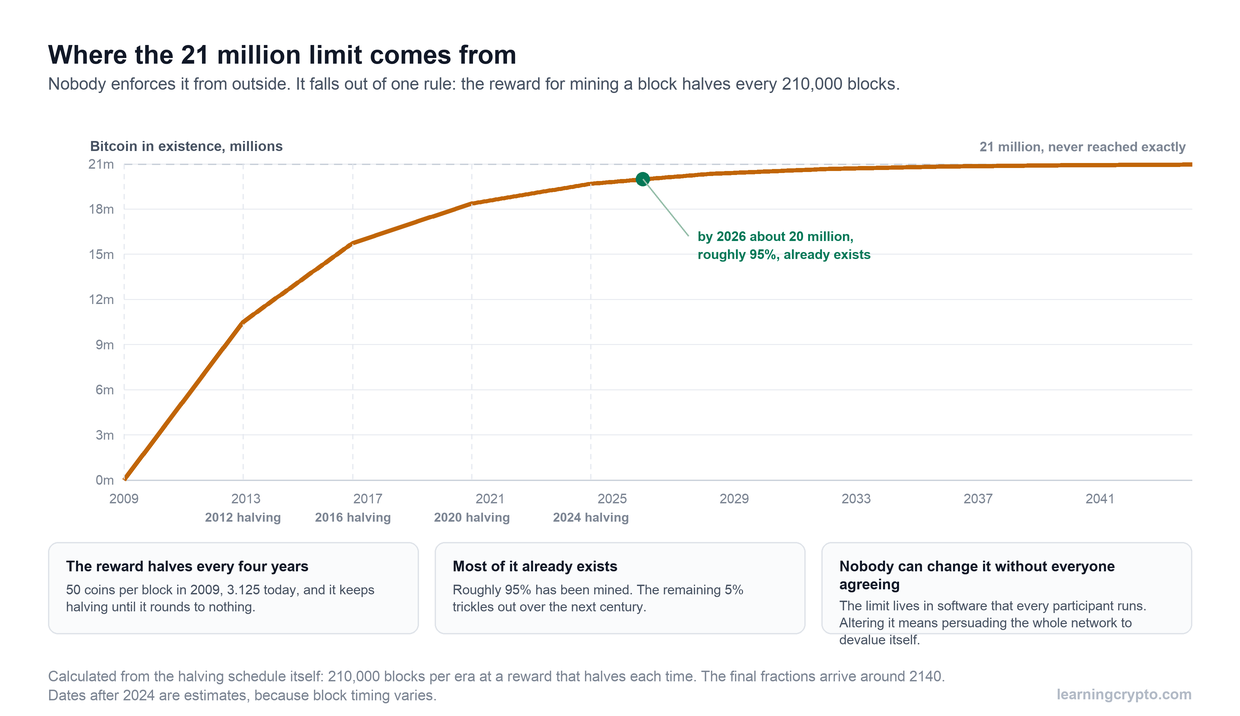
The limit is not a policy anyone enforces. It falls out of one rule, that the mining reward halves every 210,000 blocks, and the arithmetic of halving forever is what produces a ceiling of 21 million.
Because the reward keeps halving, the total issuance converges on 21 million and the last coins will be mined around 2140. Well before then, miners will be paid by transaction fees alone, which is a genuine open question about long-term security rather than a settled matter. We look at it properly in what happens when all the Bitcoin is mined.
The halving matters because it is the only scheduled supply shock in any major asset. Historically it has been followed by large price moves, though four data points is not a law of nature and expecting a repeat on cue is how people get hurt.
How is Bitcoin different from money in your bank account?
The differences that matter are about who controls the asset and who can change the rules, not about the technology.
| Bank money | Gold | Bitcoin | |
|---|---|---|---|
| Who issues it | Central bank, expanded at will | Nature, mined at roughly 1.5% a year | Fixed schedule, capped at 21 million |
| Who can freeze it | Your bank, a court, a payment processor | Whoever physically holds it | Nobody, if you hold the key |
| Settlement | Days, business hours, reversible | Physical delivery | Minutes to an hour, any day, final |
| Verifying you own it | Trust the institution's records | Assay and store it yourself | Check the ledger yourself |
| Deposit protection | Usually insured to a limit | None | None |
| Moving it across a border | Permissioned, slow, reportable | Heavy and physically difficult | Same as sending it next door |
Read that last row alongside the deposit protection row and you have the honest trade. Bitcoin gives you an asset nobody can debase, freeze or block. In exchange it removes every safety net: no chargebacks, no fraud department, no password reset, and no compensation scheme if you make a mistake. That trade suits some people and genuinely does not suit others.
How do you actually own Bitcoin?
By holding the private key. Everything else is a variation on who holds it for you.
If you buy on an exchange and leave it there, the exchange holds the key and you hold a promise. That is convenient and it is how most people start, but it is also how people lost funds when platforms such as FTX and Celsius failed. The phrase "not your keys, not your coins" is not tribalism; it is a description of the legal reality.
Self-custody means holding the key yourself, in a wallet you control. A wallet does not store coins; it stores the key that moves them. That key is backed up as a seed phrase, a list of words that can rebuild the wallet on any device, which is why the seed phrase is the single most sensitive thing you will ever handle in crypto.
Start with the difference between cold and hot wallets, then Trezor versus Ledger if you are buying a hardware device, and what a Bitcoin address is for the mechanics of receiving. If you hold enough that losing it would genuinely hurt, also read our crypto inheritance guide, because self-custody with no succession plan is how coins are lost permanently.
How do you buy Bitcoin and send it?
Most people buy through a regulated exchange, which requires identity verification, then withdraw to their own wallet. Bitcoin ATMs exist and are convenient but charge heavily; we break the costs down in how Bitcoin ATMs work.
Sending is straightforward once you have done it once. You paste the recipient's address, choose a fee, and broadcast. Confirmation usually takes ten minutes to an hour depending on the fee you paid and how busy the network is, explained in how long Bitcoin takes to send and step by step in how to send Bitcoin to another wallet.
Two habits worth building immediately: always send a small test amount first when using a new address, and always verify the address on your hardware wallet screen rather than trusting what your computer displays.
Is Bitcoin a good investment?
That depends entirely on your time horizon, your risk tolerance and your reason for holding it, and anyone who answers with a number is guessing. What can be said honestly is what the asset is and how it has behaved.
Bitcoin is volatile. Drawdowns of 70% or more have happened in every cycle, including for people who were eventually right about the direction. It has no cash flow, no earnings and no intrinsic value in the accounting sense; its price rests entirely on what others will pay, which is also true of gold. Its case as a long-term holding rests on fixed supply, genuine decentralisation and a fifteen-year track record of running without interruption. Its risks are regulatory, technological and behavioural, and the behavioural one causes the most damage.
If you decide to buy, the two questions worth answering first are how much and how often. Our guides on how much to invest per month and dollar-cost averaging cover both, and Bitcoin versus gold compares it with the asset it is most often measured against. For the longer-term technical questions, quantum computing and Bitcoin addresses the one people worry about most.
This is educational information, not investment advice. Bitcoin is a high-risk asset and you should never commit money you cannot afford to lose.
What is Bitcoin actually used for?
Four things, in rough order of how much value they carry today.
- A long-term store of value. The dominant use. People buy it to hold, on the thesis that a fixed supply beats an expanding one over time.
- Moving money across borders. Sending a large amount internationally on a weekend, without a bank's permission, is something Bitcoin does genuinely well.
- An escape hatch from failing currencies. In countries with capital controls or high inflation, the use case is not theoretical.
- Institutional and sovereign reserves. Spot exchange-traded funds launched in the United States in January 2024, and governments have begun discussing strategic reserves, covered in our strategic Bitcoin reserve guide.
What it is not, for most people, is everyday payment. Base-layer fees and confirmation times do not suit buying coffee, which is what the Lightning Network was built to address. Anyone telling you Bitcoin will replace card payments tomorrow is overselling it.
There is more across our Bitcoin hub, and members tracking the market cycle can use the Satoshi Indicator, our daily read on whether conditions favour accumulating.
Frequently asked questions
What is Bitcoin in simple terms?
Bitcoin is digital money that runs without a bank or a company in charge. A network of independent computers keeps a shared record of every transaction, and ownership is proved by a private key rather than an account with an institution. Its supply is capped at 21 million coins, so no one can create more of it.
Who created Bitcoin?
An anonymous person or group using the name Satoshi Nakamoto published the Bitcoin whitepaper in October 2008 and launched the network in January 2009. Satoshi stopped communicating publicly in 2011 and has never been identified. No one has controlled Bitcoin since, which is a deliberate feature rather than an accident of history.
How many bitcoin are there?
The maximum is 21 million, fixed in the software since launch. New coins enter circulation as mining rewards, and that reward halves roughly every four years, currently standing at 3.125 BTC per block. The final coins are expected to be mined around 2140, after which miners are paid by transaction fees alone.
Is Bitcoin safe?
The network itself has never been successfully attacked and has run continuously since 2009. The risk is almost entirely at the edges: exchanges failing, people losing their seed phrase, and scams. Bitcoin the protocol is robust; Bitcoin the experience depends on how carefully you handle keys and who you trust with custody.
Can Bitcoin be shut down?
There is no single point to shut down, because the ledger is duplicated across thousands of independent nodes worldwide and anyone can run one. Governments can and do regulate the on-ramps, making it harder to buy or sell within their borders, but the network keeps producing blocks regardless of what any individual country decides.
Do I need to buy a whole bitcoin?
No. Each bitcoin divides into 100 million satoshis, so you can buy an arbitrarily small amount. Most exchanges have minimums of a few dollars or pounds. Buying a fraction is completely normal and is how the overwhelming majority of people hold it.
What is the difference between Bitcoin and other cryptocurrencies?
Bitcoin was first, has the longest track record and is the most decentralised, with a deliberately limited feature set focused on being sound money. Most other cryptocurrencies trade some of that decentralisation or simplicity for speed, programmability or lower fees. That trade can be reasonable, but it means they are solving a different problem.
This guide is part of stage 2 of 8, how bitcoin works, in the free Learning Crypto curriculum. Next: How Does Blockchain Work? A Beginner's Guide.