
On-chain analysis means reading the actual transaction data recorded on a public blockchain: wallet movements, exchange flows, coin age, and miner behavior. The goal is to understand what market participants are really doing, not just what price is doing. Unlike technical analysis, it's grounded in verifiable, tamper-proof data anyone can access. |
Crypto is loud. Twitter has conviction. Influencers have calls. Everyone seems to know where Bitcoin is going next.
On-chain data doesn't have opinions. It just shows you what's happening.
That's the whole point. Every transaction on a public blockchain is recorded permanently and visibly: every transfer between wallets, every deposit to an exchange, every coin that's sat unmoved for two years. Anyone can read it. On-chain analysis is simply the discipline of reading it well.
We’ll discuss what that means in practice: the key metrics, the tools that make them accessible, what on-chain data can and can't tell you, and how to start using it to make more grounded decisions.
What You'll Learn
→ What on-chain analysis actually is and how it differs from technical and fundamental analysis
→ The metrics that matter most including MVRV, SOPR, exchange flows, active addresses, and more
→ How to track whale and smart money behavior without needing to build your own blockchain node
→ The tools you need (free and paid) and what each one is best for
→ Where on-chain analysis fails and what it genuinely can't tell you
What Is On-Chain Analysis?
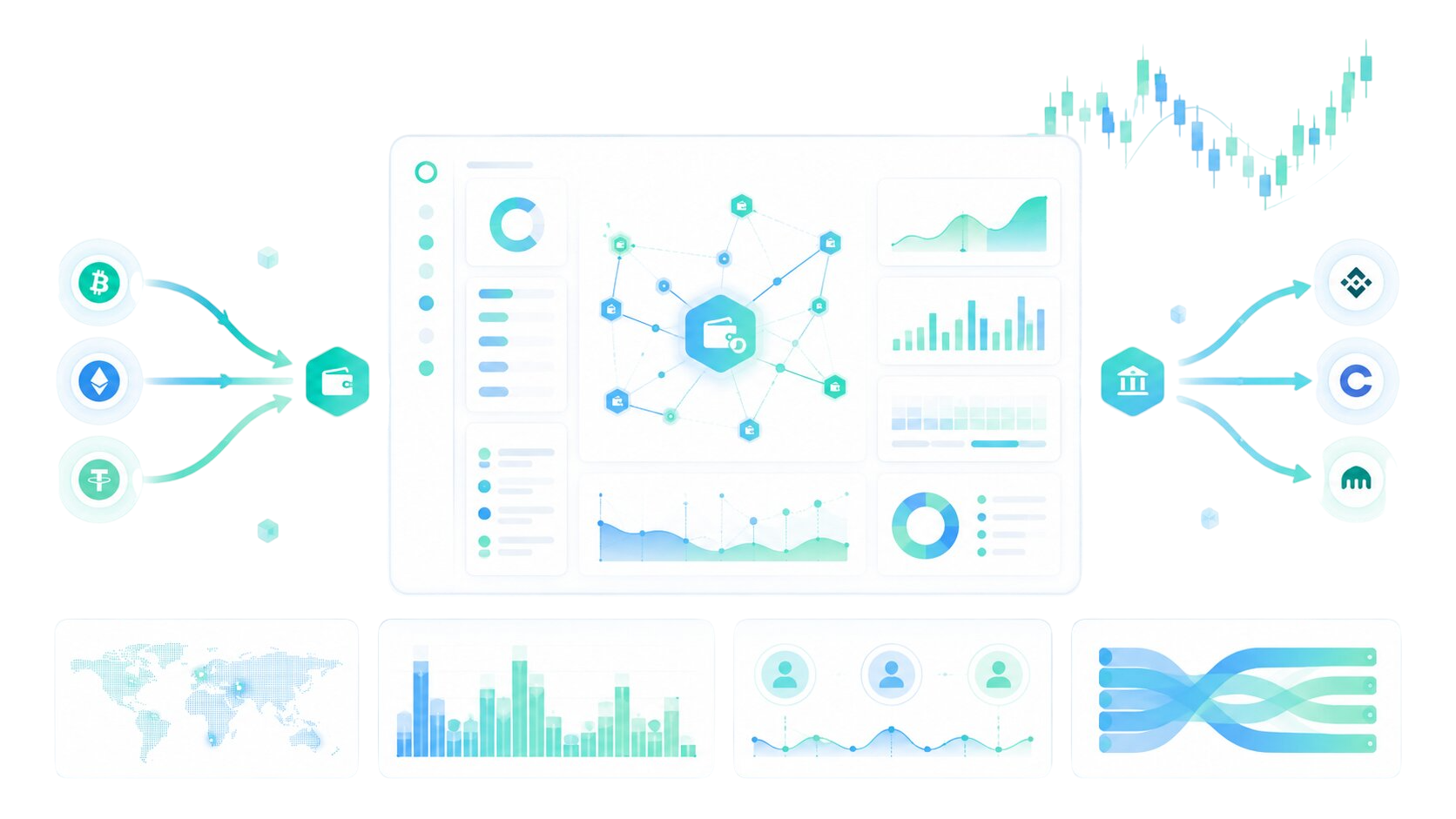
Every public blockchain is a ledger. And unlike every other financial ledger in existence, it's open. You don't need access. You don't need to be an accredited investor or a Bloomberg terminal subscriber. The data is just there.
On-chain analysis is the practice of reading that ledger to understand market behavior. Not price behavior specifically, though that's connected. Participant behavior.
What are holders actually doing? Are coins moving to exchanges or away from them? Are long-term holders still holding, or are they distributing? Is new money entering the network, or is the same money cycling around?
How It Compares to Other Analysis Types
Most crypto research falls into three buckets:
Technical analysis reads price charts and trading volume to find patterns. It tells you something about supply-and-demand dynamics, but nothing about whether the sellers have held their coins for 3 days or 3 years.
Fundamental analysis evaluates the project itself: the team, technology, tokenomics, and roadmap. Useful for long-term positioning, but it won't tell you what's happening right now.
On-chain analysis reads actual participant behavior directly from the blockchain. It's the only one of the three that's grounded in real-time, verifiable data.
The three approaches complement each other. Most serious analysts use all three.
Why On-Chain Data Is Unique
In traditional finance, the data you'd actually want is private: who the large holders are, how institutional positioning is shifting, where the big money is moving. You see price and volume. That's mostly it.
Crypto flips this. Bitcoin is pseudonymous, not anonymous. Every wallet is publicly visible. Every transaction is permanently recorded. And while you don't always know who owns a wallet, you can often know what a wallet is: whether it belongs to an exchange, a mining operation, a known fund, or a historically high-performing trader.
Analytics platforms like Glassnode, Nansen, and CryptoQuant do the heavy lifting: labeling wallets, aggregating metrics, and presenting the data in ways that don't require you to query raw blockchain data yourself. What once required a developer background is now accessible to anyone willing to spend an hour learning the tools.
The core advantage: blockchain data is verifiable. It can't be massaged, selectively disclosed, or delayed to suit a narrative. When a major holder moves 10,000 BTC to an exchange, that's public information the moment it happens.
Key On-Chain Metrics Explained
These are the metrics that show up repeatedly in serious on-chain analysis. Not all of them are equally useful at all times, but understanding what each one measures is the starting point.
Exchange Flows
Exchange netflow tracks the difference between crypto flowing into centralized exchanges and crypto flowing out. In plain terms, it tells you whether coins are moving toward selling or away from it.
Inflows (coins moving to exchanges) generally signal selling intent. You can't sell on Coinbase without getting your coins there first.
Outflows (coins moving away) suggest accumulation. Holders withdrawing to self-custody are typically planning to hold, not sell.
How to use it: Pull up exchange reserves on Glassnode or CryptoQuant and watch the trend over days and weeks, not hours. A sustained decline in exchange reserves alongside rising prices is generally a healthy signal.
A sudden spike in inflows from wallets that haven't moved in years is worth taking seriously. Not a perfect signal (some deposits are for staking or DeFi, not selling), but one of the more intuitive places to start.
MVRV Ratio (Market Value to Realized Value)
MVRV compares what the market says Bitcoin is worth today to what holders paid on average.
Realized cap values each Bitcoin at the price it last moved, making it a proxy for the network's aggregate cost basis. Market cap is just current price times supply. Divide one by the other to get MVRV.
High MVRV (above 3.5) means holders are sitting on large unrealized profits. Historically, readings above 3.5 have coincided with cycle tops, when enough holders feel they're up enough to sell.
MVRV around 1 is roughly neutral: the market is trading near its cost basis.
MVRV below 1 means the market is on aggregate underwater, which has historically marked major cycle bottoms.
How to use it: Check MVRV on Glassnode. If it's deep in the red zone (above 3.5), that's not a sell signal on its own, but it's a cue to reduce risk exposure and watch other indicators closely.
If it's below 1, historically that's been a zone where long-term buyers have found value. The MVRV Z-Score refines this further by standardizing against historical deviation, useful for comparing across cycles.
SOPR (Spent Output Profit Ratio)
SOPR measures whether the coins that moved on a given day were sold at a profit or a loss. In short, are sellers making money or capitulating?
Above 1: coins sold at a gain
Below 1: sellers taking losses, often a sign of capitulation
How to use it: In a bull market, watch for SOPR dipping toward 1 on pullbacks. When it touches 1 and bounces, that often means short-term sellers have shaken out, and buyers have stepped in, historically a decent entry signal.
In a bear market, SOPR staying persistently below 1 signals ongoing capitulation. When it finally crosses back above 1 and holds, that's often the first sign the worst is over. Use the adjusted version (aSOPR), which strips out very short-term holders for a cleaner read.
Active Addresses
Active address count tracks how many unique wallets sent or received transactions on a given day. Simple proxy for network usage and organic adoption.
Rising active addresses alongside rising prices suggest real demand. Price rising while active addresses fall is a yellow flag. You might be seeing speculation rather than genuine network growth.
HODL Waves and Coin Age
HODL waves show the distribution of Bitcoin supply by when coins last moved, in age bands from under a day to over ten years old.
When long-term holders (LTHs, typically wallets holding 155+ days) start moving coins, it can signal distribution. Growing LTH supply suggests conviction. Short-term holders (STHs) tend to be more reactive. When they're underwater, they often represent latent sell pressure waiting for break-even.
Hash Rate and Miner Behavior
Hash rate is the total computational power securing the Bitcoin network. Rising hash rate signals investment and confidence. Sharp drops can indicate miner capitulation: miners selling holdings to cover operating costs.
Large miner outflows to exchanges during stressed periods are worth watching. Not always bearish long-term, but they can create short-term headwinds.
Tracking Whales and Smart Money

One of the more powerful applications of on-chain analysis is watching what large, experienced holders are actually doing.
Whale wallets are publicly visible. Platforms like Nansen label wallets associated with funds, known traders, and historically high-performing addresses ("Smart Money"). When several of these wallets start accumulating a specific token or moving holdings to exchanges, that's a signal worth factoring in.
A few caveats:
Correlation isn't causation. Whales don't always front-run the market. What looks like accumulation might be portfolio rebalancing.
Entity labeling has limits. Attribution is probabilistic unless a wallet is publicly disclosed. Reliable for major entities, not infallible.
Pseudonymity persists. You might see a wallet doing interesting things and have no idea who controls it. The data is visible; the identity isn't always.
Tools like Arkham Intelligence go further by attempting to link addresses to real-world identities. Useful, but scrutinize the sourcing.
On-Chain Tools: What to Use
You don't need to run your own node. These platforms handle the infrastructure.
Tool | Best For | Cost |
Glassnode | Bitcoin on-chain metrics (MVRV, SOPR, HODL waves, miner flows) | Free tier + paid |
CryptoQuant | Exchange flows, miner data, stablecoin movements | Free tier + paid |
Nansen | Wallet intelligence, smart money tracking, EVM chains | Paid |
Dune Analytics | Community dashboards for any protocol | Free |
Bitcoin Magazine Pro | Macro Bitcoin cycle analysis | Paid |
Etherscan / Memepool.space | Looking up individual wallets and transactions | Free |
Live on-chain AI queries via Ask Crypto, and the Satoshi Indicator, a proprietary DCA signal built on on-chain fundamentals | Free trial + paid |
Glassnode is the go-to starting point for Bitcoin. Nansen is the better tool if you're focused on Ethereum and DeFi. Dune fills the gaps for anything protocol-specific.
What On-Chain Analysis Can't Tell You
Don't trust, verify. And part of that is being clear about the limits.
It doesn't predict price. On-chain data describes behavior and network health. It's context, not a crystal ball. You can see long-term holders distributing into strength. You can't see when or by how much that affects price.
Off-chain activity is invisible. Most trading on centralized exchanges happens off-chain. CEX order books, OTC deals, derivatives positioning: none of this shows up in on-chain data directly.
Pseudonymity creates ambiguity. Large wallet movements can look bearish and turn out to be routine custodial rebalancing. Context isn't always available.
It lags in fast markets. On-chain data is excellent for structural and cycle-level positioning. For short-term trading on hourly timeframes, it's rarely the right primary tool.
Data quality varies by chain. Bitcoin and Ethereum have years of clean, well-analyzed data. Newer chains have thinner datasets and fewer established baselines.
How to Start
Start simple. Pick one metric (exchange netflow is a good first choice) and track it alongside price for a few weeks on Glassnode or CryptoQuant. Get a feel for what normal looks like before trying to read signals.
Then add MVRV for cycle context. Understand whether the market is historically overextended or undervalued before trading against short-term signals.
The traders who use on-chain data well treat it as a layer of context alongside their other research. The ones who use it badly treat it as a prediction machine.
The data is public. You have access to the same information as any fund with a Glassnode subscription. What you do with it is the part that takes time.
Put On-Chain Analysis to Work. Without Doing It Alone.
You now know what MVRV, SOPR, and exchange flows are. You know where to find them. The harder part is doing this consistently, in real time, while the market is moving.
That's what LearningCrypto is built for.
Every weekday before the US market opens, members get a pre-market brief covering exactly what the on-chain data is saying: smart money flows, exchange reserve movements, key signals. The two hours of research most people skip because they don't have time. It's on your dashboard every morning.
The platform also includes the Satoshi Indicator, a proprietary DCA signal built directly on on-chain fundamentals. No opinions, no influencer takes. Just a daily read on whether conditions favor stacking or waiting, grounded in the same data this article covers.
Ask Crypto pulls live, verifiable on-chain data on demand. Ask it where smart money is accumulating right now, what Ethereum's fee trends look like over the last 30 days, or whether the current MVRV reading is historically significant. It queries the blockchain, not Twitter.
No commitment, cancel anytime, 30-day money-back guarantee.
FAQs
What is on-chain analysis in simple terms?
It means reading the public transaction data recorded on a blockchain to understand how participants are behaving: whether they're accumulating, selling, moving coins to exchanges, or holding long-term. Every transaction on a public chain like Bitcoin or Ethereum is permanently recorded and visible to anyone.
How is on-chain analysis different from technical analysis?
Technical analysis looks at price charts and volume to find patterns. On-chain analysis looks at the underlying behavior of actual participants: what wallets are doing, where coins are moving, and how long they've been held. Both can complement each other, but they're reading different things.
What are the most important on-chain metrics for Bitcoin?
MVRV ratio, SOPR, exchange netflows, active addresses, HODL waves, and hash rate are the most widely followed. MVRV gives cycle-level context; exchange flows give shorter-term signals about near-term sell pressure or accumulation.
What tools do I need to start?
Glassnode for Bitcoin on-chain metrics (free tier available). CryptoQuant for exchange flow data. Nansen for Ethereum and EVM chains. Dune Analytics for protocol-specific dashboards.
Can on-chain analysis predict price movements?
No. It can indicate structural conditions that have historically preceded major moves, but timing and magnitude aren't readable from on-chain data alone. Use it as one layer of context, not a trading signal generator.
Does on-chain analysis work for altcoins?
It’s better for assets with large networks and years of historical data, primarily Bitcoin and Ethereum. For smaller altcoins, datasets are thinner, and wallet labeling is less reliable, so greater skepticism is warranted.
Keep learning
- What Are Crypto Prediction Markets? How Polymarket and Onchain Betting Work
- Is Pi Network Legit or Hype? Comprehensive Expert & Honest Analysis
- What Is RWA Tokenization? Real World Assets on the Blockchain Explained
- More guides in the Fundamentals hub
- Members: Ask Crypto AI, ask it any beginner question, privately