
Launched during the DeFi boom, Aave lets you lend and borrow cryptocurrencies without intermediaries. With about $22.4 billion locked in its ecosystem as of December 2024, it is one of the largest and longest-running decentralised finance protocols, and for many people it is the first place they earn interest on crypto without handing it to a company.
Its features have made waves before. In 2021, Aave's flash loans generated over $1 billion in volume within weeks, and multi-chain deployments have since cut the fees that once kept small users out. It is no surprise that many seasoned investors see Aave as a cornerstone of the DeFi space.
We have seen countless projects rise and fall since 2016, and Aave stands out for its ability to keep adapting. This guide explains what Aave is, how lending and borrowing actually work under the hood, what flash loans are, what the AAVE token does, and the risks you take on when you deposit. It is education, not financial advice.
What is Aave?
Aave is a non-custodial liquidity protocol. Instead of a bank sitting between savers and borrowers, a set of smart contracts pools deposits and lends them out automatically, with interest rates adjusted by code according to how much of each pool is being borrowed. Nobody at Aave holds your funds, and you interact with it from your own wallet. Aave is:
- Built on blockchain technology, creating a transparent, efficient, and permissionless financial system
- One of the largest DeFi platforms, with billions of dollars in total value locked (TVL) and support for a wide range of cryptocurrencies
- A platform offering a usable interface, extensive features, and a strong community
You can lend by depositing your cryptocurrency into liquidity pools, which are then made available to borrowers, who can access them by providing collateral. This system enables a seamless exchange of assets while offering:
- Lenders the opportunity to earn passive income in the form of interest.
- Borrowers quick access to liquidity without having to sell their assets.
Aave's decentralized structure not only improves efficiency but also promotes inclusivity, allowing anyone with a cryptocurrency wallet to participate in lending and borrowing. It now runs on Ethereum and a number of other networks, including Layer 2 chains where fees are lower, and governance is handled by holders of the AAVE token, who vote on which assets are listed and on the parameters that control risk.
Aave vs. the traditional lending market
Traditional banking systems rely on financial institutions to manage user assets, often resulting in opaque transactions and a lack of trust. Moreover, they involve slow and cumbersome access to liquidity due to lengthy approval processes.
Compared with traditional lending markets, Aave operates without intermediaries. Users retain full control over their assets and can engage in transactions with complete visibility, because every loan and every rate is visible on-chain.
The Origin of Aave: From ETHLend to Aave
Aave's story began in 2017 when it was launched as ETHLend by its founder, Stani Kulechov. ETHLend was created to solve a fundamental problem in the crypto space: the lack of decentralized lending options. It allowed users to connect directly with each other to borrow and lend crypto assets. However, the peer-to-peer model posed scalability challenges, as finding matching lenders and borrowers manually was inefficient.
Recognizing the limitations of the ETHLend model, the team rebranded the platform to Aave, which means "ghost" in Finnish, reflecting the vision of a transparent and decentralized system that operates in the background, invisible yet vital to the ecosystem. The pooled version launched in January 2020.
The major innovations that made Aave one of the most versatile and efficient lending protocols in DeFi were:
- Shifting from peer-to-peer lending to a liquidity pool model, which dramatically improved efficiency and user experience.
- Instead of matching individual borrowers with lenders, funds are now deposited into large pools, from which borrowers can draw.
How does lending on Aave work?
You deposit an asset, such as USDC or ETH, into its Aave pool and immediately begin earning interest. In exchange you receive an aToken (aUSDC, for example) that represents your deposit and grows in balance as interest accrues. You can withdraw at any time, provided the pool has enough unborrowed liquidity, by returning the aToken.
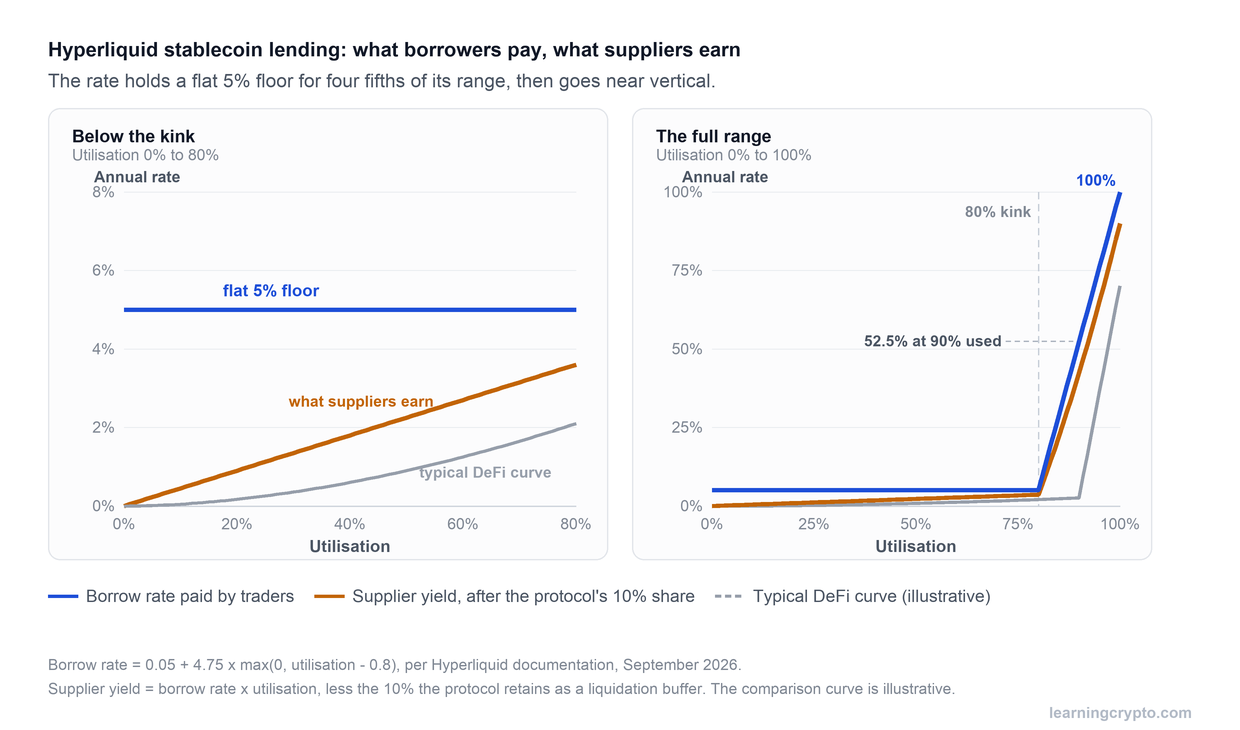
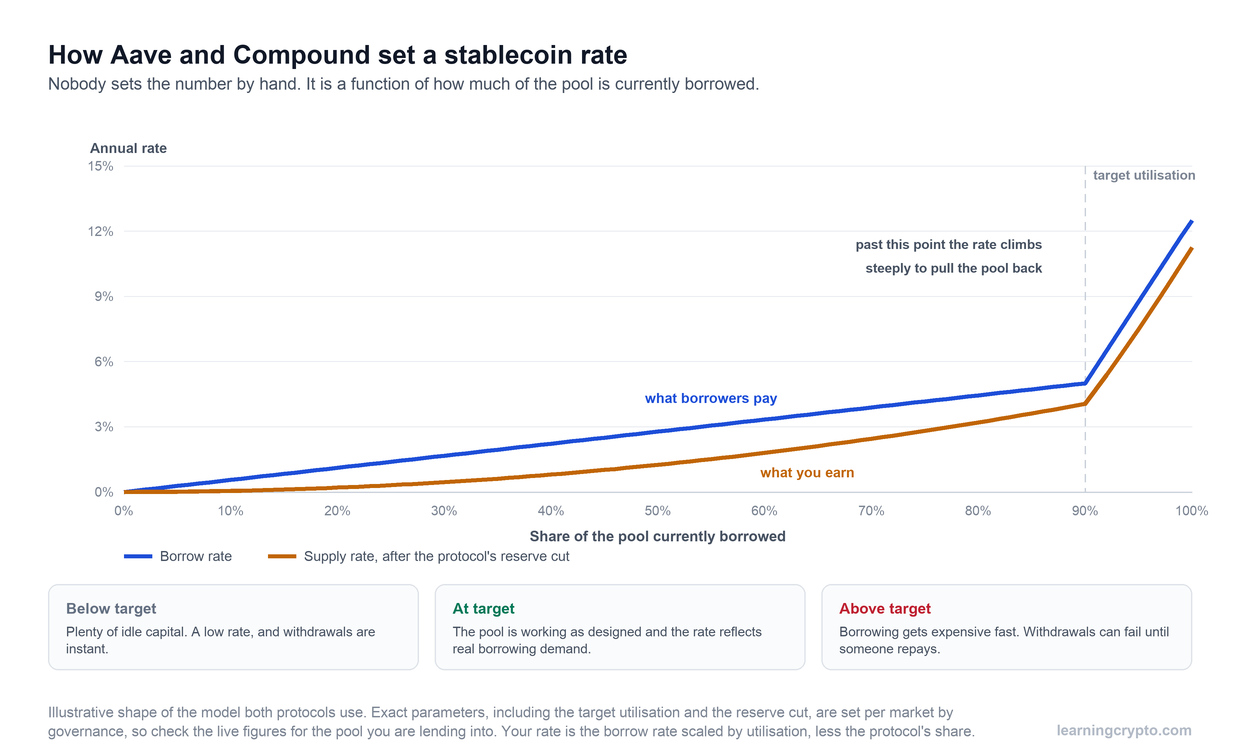
The interest rate is not set by anyone. It rises as more of the pool is borrowed and falls when the pool is mostly idle, which is why stablecoin rates on Aave jump during bull markets, when traders borrow dollars to buy more crypto, and sink in quiet periods. Rates are variable, quoted as an APY, and can change hour to hour. If you are comparing this with other ways to earn, our guide on how to make money with DeFi puts lending alongside staking and liquidity provision.
At its core, the whole protocol runs on three pieces:
- Lending: Users deposit their crypto assets into liquidity pools and receive aTokens, representing their stake in the pool and interest over time. For example, if you deposit ETH, you will receive aETH tokens, which automatically increase in balance as interest accumulates.
- Borrowing: Borrowers take loans by providing collateral. The loan amount is a percentage of the collateral's value to minimize risk. For instance, if the loan-to-value (LTV) ratio for an asset is 75%, a borrower who deposits $1,000 worth of collateral can borrow up to $750.
- Smart contracts: All transactions are governed by smart contracts, which ensures they are secure, transparent, and tamper-proof. This eliminates the need for intermediaries, making the system more efficient and cost-effective.
How does borrowing work, and what is the health factor?
Borrowing on Aave is over-collateralised: you must deposit more value than you take out. Each asset has a maximum loan-to-value ratio, so you might lock $10,000 of ETH and be allowed to borrow up to around $8,000 in stablecoins. There is no credit check and no fixed repayment date. You pay interest for as long as the loan is open. Overcollateralization protects lenders from defaults and allows the protocol to liquidate collateral if its value drops significantly.
The protocol tracks your position with a number called the health factor. Above 1 you are safe; if the value of your collateral falls or your debt grows until the health factor drops below 1, anyone can repay part of your loan and take a slice of your collateral at a discount. That is liquidation, and it is automatic and unforgiving. Our explainer on liquidation in crypto describes how it plays out. The practical rule is to borrow far less than the maximum and to keep an eye on the health factor when markets move.
Interest rate options
Aave historically let borrowers choose between a stable rate, which offered predictability, and a variable rate that moved with market conditions. Stable-rate borrowing was phased out on the newer markets after it was found to be exploitable, so in practice new Aave loans in 2026 are variable rate, and the rate you see when you open a loan is not the rate you will pay next month.
What are flash loans?
Flash loans are an Aave invention. They let you borrow any amount from a pool with no collateral, on the condition that you repay it, plus a small fee, within the same blockchain transaction. If the repayment does not happen, the whole transaction is reversed as if it never occurred, so the pool is never at risk.
They are used for arbitrage between exchanges, for swapping the collateral behind an existing loan, and for liquidations. They are tools for developers and bots rather than something a typical user will touch, and they have also been used in attacks on other, weaker protocols, which is worth knowing when you read about "flash loan exploits". Everything you need to know about flash loans:
What is the AAVE token used for, and how does Aave staking work?
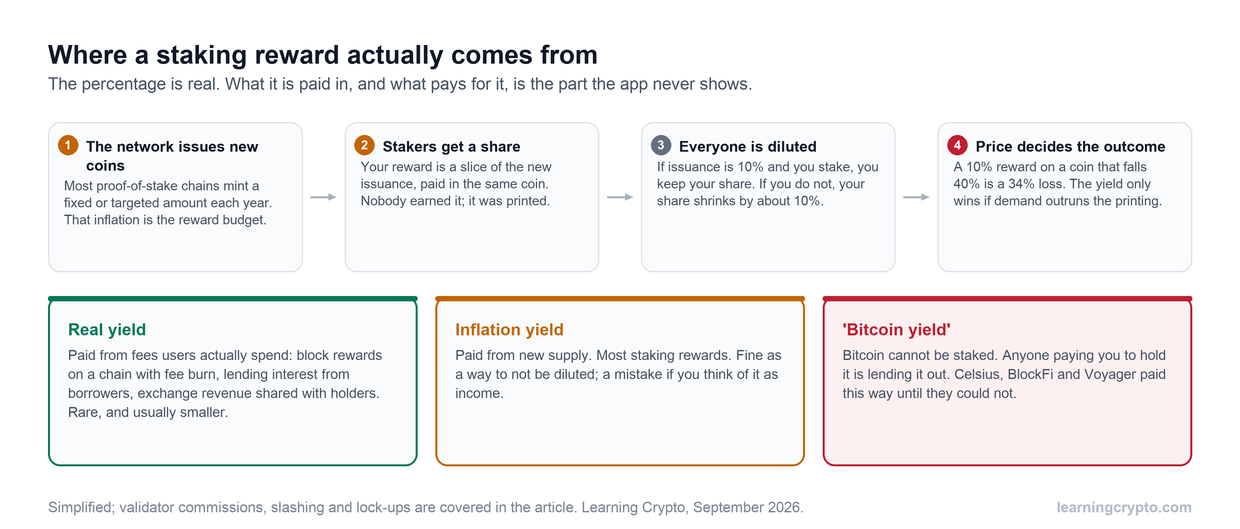
AAVE is the native governance and utility token of the protocol. Holders propose and vote on protocol changes, including which assets are listed and how risk parameters are set. Holders can also stake AAVE in the Safety Module, which earns rewards but acts as insurance: if the protocol suffers a shortfall, a portion of staked tokens can be sold to cover it. That is a real risk, not a technicality. Aave also issues its own over-collateralised stablecoin, GHO, and the protocol earns revenue from the spread between what borrowers pay and what lenders receive, plus flash loan and liquidation fees.
Here is what to know about AAVE's tokenomics:
- It has a maximum supply of 16 million, with most already in circulation.
- A portion is allocated for staking to secure the protocol and reward participants.
- Deflationary mechanisms such as token buybacks and burns have been used to reduce supply over time.
- A significant share of AAVE is staked in the Safety Module, with stakers earning a yield in return for backstopping the protocol; that yield varies and is paid for taking on slashing risk.
Aave staking, in plain terms, means locking AAVE in the Safety Module for rewards while agreeing that up to a set percentage of your stake can be taken if the protocol needs to cover bad debt. There is also a cooldown period before you can withdraw. It is not comparable to a savings account.
The Evolution of Aave
Aave has undergone significant upgrades since its inception:
- Aave V1: Launched in January 2020, it introduced the basic functionalities of lending and borrowing through liquidity pools.
- Aave V2: Released in December 2020, this version improved the user experience by adding features like debt swapping, credit delegation, and better gas efficiency.
- Aave V3: Introduced cross-chain deployments and more efficient capital use, allowing users to lend and borrow across different networks, including Layer 2 chains with far lower fees.
- Aave V4: Proposed in 2024 as the next major upgrade, with a unified liquidity layer and "smart account" features that let users manage multiple positions from a single wallet address, aimed at better access, efficiency and security. Check the official Aave governance forum for the current rollout status.
Pros and Cons of Investing in Aave
Pros of Aave
- Proven features: Flash loans and a rate model that has run through several market cycles distinguish it from other lending platforms. Flash loans in particular appeal to traders and developers seeking arbitrage opportunities.
- Strong team and community: Aave is led by experienced developers and an active governance community. Each version has focused on improving the platform and its security.
- Multi-chain support: Aave operates on many blockchains, which lowers transaction costs, increases usability, and attracts a global user base.
Cons of Aave
- Price volatility: Like most cryptocurrencies, AAVE swings with market sentiment and broader economic conditions, which can mean substantial losses for short-term investors or traders.
- Regulatory risk: DeFi platforms, including Aave, face increasing regulatory scrutiny as governments write rules for decentralized finance. Changes in the rules could introduce new limits on how the protocol or its front-ends operate.
Aave's Pricing History
Aave's pricing history reflects the volatility typical of the cryptocurrency market, marked by dramatic price swings.
Launch and initial performance
- Initially launched in 2017 as ETHLend, with the LEND token later migrated to AAVE at 100 LEND per AAVE.
- AAVE had a slow start but gained significant traction following the DeFi boom of 2020 and 2021.
All-time high
- In May 2021, AAVE reached its all-time high of around $667, driven by rapid growth and adoption of DeFi protocols.
- AAVE's price climbed as investors flooded into DeFi platforms, driving up demand for the token.
Volatility
- Like most cryptocurrencies, Aave's price has followed the broader market cycles and macroeconomic factors.
- After the 2021 peak, Aave's price fell sharply in line with the wider crypto correction of 2022 before recovering in the following cycle.
Aave's price is influenced by several factors, including adoption of its platform, market trends, and the macroeconomic environment, such as global regulation and market sentiment.
The price of AAVE can change rapidly on new developments within the DeFi sector, technological upgrades, or external market pressures, so anyone holding it should follow those factors rather than the chart alone.
Is Aave a good investment, and what are the risks?
Aave has strong fundamentals for a DeFi project: years of operation, large liquidity, audited code and active governance. That makes it one of the more credible protocols to use. Whether the AAVE token is a good investment is a separate question, and one we cannot answer for you. The token is volatile, its price depends on sentiment as much as on protocol revenue, and regulators in several countries are still deciding how to treat DeFi lending.
Will Aave's price go up? That depends on the continued growth of the DeFi sector. If DeFi keeps expanding and Aave keeps shipping upgrades, demand for the token has room to grow. But competition from other lending protocols could take market share, and regulatory changes could affect how the platform operates. Nobody knows the price next year.
Using the protocol carries its own risks. Smart contracts can have bugs, price oracles can be manipulated, a listed asset can collapse and leave bad debt, and a wallet mistake is irreversible. Keep your signing wallet clean, and read our guide on whether MetaMask is safe before connecting it. Start with a small deposit, borrow conservatively, and never put in money you would need back on a specific date. For a plain-English read on a specific position, Ask Crypto can walk you through the risks, and our DeFi hub covers the wider ecosystem.
How to avoid fake Aave websites
Because Aave is a large target, search results and social media are full of lookalike domains that copy its branding. The only official addresses are aave.com and app.aave.com; anything else claiming to be "Aave" with a hyphenated or misspelled domain is not the protocol, and connecting your wallet to such a site typically ends with a drained wallet. Bookmark the real app, never follow a link from an ad or a direct message, and check every transaction your wallet asks you to sign.
Aave's Role in the Future of DeFi
Aave is well-positioned to remain a leader in the DeFi space, thanks to its ongoing work on scalability, security, and efficiency. With multi-chain support, a mature rate model, and strong governance, Aave continues to shape decentralized finance. While challenges such as competition and regulatory hurdles remain, Aave's track record and community-driven approach give it a good chance of long-term relevance as DeFi adoption grows.
Newer entrants, such as World Liberty Financial, are pitching a similar mix of scalability, security and user-focused design, and face the same regulatory and competitive questions. Whether they earn the kind of track record Aave has built is something only time will show.
Conclusion
Aave is a mature, working platform for lending and borrowing cryptocurrencies. Through smart contracts, liquidity pools, and flash loans, it has established itself as a frontrunner in DeFi, and for crypto investors looking at on-chain yield, understanding Aave is essential.
Its wider significance is the model it proved: transparent, user-controlled lending without a bank in the middle. Whether you are a seasoned investor or just curious, knowing how Aave works is a good foundation for understanding the rest of DeFi.
If you are starting your journey in cryptocurrency, Learning Crypto offers extensive text and video materials on crypto investing, and a community of crypto enthusiasts who share insights and help each other learn.
FAQ
What is Aave used for?
Aave is used for decentralized lending and borrowing. Users deposit assets into liquidity pools to earn interest, or borrow funds by providing collateral worth more than the loan. Traders use it for leverage, holders use it to raise cash without selling, and developers use its flash loans for arbitrage and collateral swaps.
Is Aave a good investment?
Aave has strong fundamentals and continues to innovate, which is why it is often treated as a long-term DeFi holding. However, the token is highly volatile and faces regulatory uncertainty, and past performance of the protocol does not guarantee the token's price. Treat it as a speculative asset, size it accordingly, and do your own research before buying.
How does Aave make money?
Aave generates revenue through interest rate spreads between borrowers and lenders, fees charged on flash loans and liquidations, and income from its GHO stablecoin. Users who stake AAVE in the Safety Module earn staking rewards in return for backstopping the protocol, and part of protocol revenue is directed by governance to the treasury.
Can I borrow without collateral on Aave?
Yes, through flash loans, users can borrow funds without collateral for specific use cases such as arbitrage trading or liquidity management. The catch is that the loan must be repaid within the same transaction, which requires writing or using a smart contract. Ordinary loans on Aave always require collateral worth more than the amount borrowed.
What is an Aave pool?
An Aave pool is the smart contract that holds all deposits of one asset on one network, such as the USDC pool on Ethereum. Lenders add to the pool and receive aTokens, borrowers draw from it against collateral, and the interest rate is set automatically by how much of the pool is currently borrowed.
How does Aave staking work?
Aave staking means locking AAVE tokens in the protocol's Safety Module. Stakers earn rewards, but they agree that a portion of their stake can be sold to cover a shortfall if the protocol suffers bad debt, and there is a cooldown period before withdrawal. It is insurance for the protocol, paid for with your tokens.
Is aave.com the official Aave website?
Yes. aave.com and app.aave.com are the official sites. Hyphenated or misspelled lookalike domains that appear in search results and ads are phishing sites designed to drain wallets, so bookmark the real address and never connect a wallet to a site reached from a message or advert.
This guide is part of stage 5 of 8, beyond bitcoin, in the free Learning Crypto curriculum. Next: Stablecoin Lending Explained: How the Rates Work and What Can Go Wrong.
Keep learning
- Is crypto staking worth it?
- A Look into Litecoin MWEB Wallet and Privacy Extension Block
- How To Buy Monero? [A Complete Guide]
- What is Virtual Protocol Crypto? [A Complete Guide]
- More guides in the Fundamentals hub
- Members: Ask Crypto AI, ask it any beginner question, privately