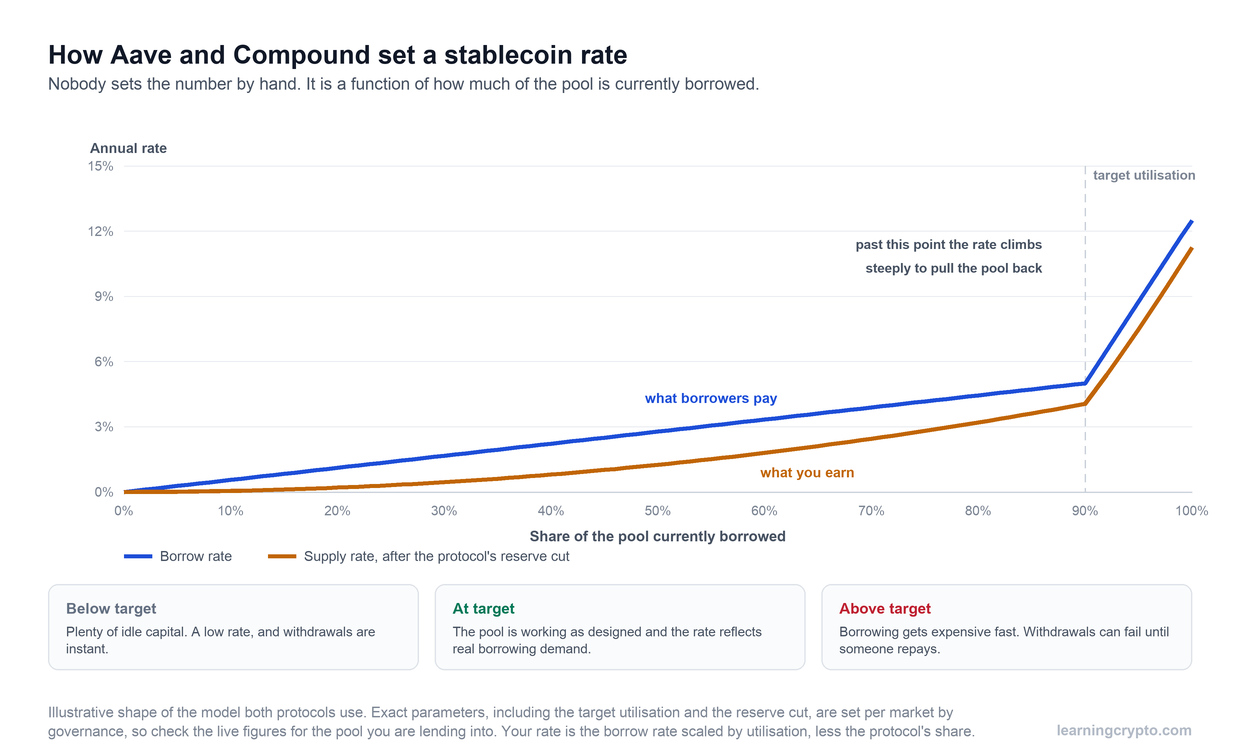

DeFi is what happens when you rebuild lending, trading and market-making as software that anyone can use and nobody can switch off. It is genuinely useful and genuinely dangerous, often in the same afternoon. This guide covers what it is, what you can actually do with it, what it costs, and the specific ways people lose money.
What is DeFi, in plain English?
Decentralised finance is financial services delivered by smart contracts on a public blockchain instead of by a company. The contract holds the rules, executes them automatically, and anyone can inspect the code or use it without applying for permission.
The defining property is non-custodial. When you lend on a DeFi protocol, you are not depositing with an institution that then owes you the money. Your assets go into a contract whose behaviour is fixed in advance, and you keep the key that lets you withdraw. Nobody approves your account, nobody can decline your withdrawal, and equally nobody can reverse your mistake.
That single trade explains most of what follows. Remove the intermediary and you remove the gatekeeping, the paperwork and the banking hours. You also remove the fraud department, the deposit insurance and the person you can call.
How does DeFi actually work?
Three ingredients, and the third is the one that makes DeFi different from simply putting a bank on a blockchain.
- Smart contracts. Programs deployed to a blockchain that run exactly as written. A lending market is a contract holding deposits and applying an interest-rate formula. Once deployed, the rules are visible to everyone and typically cannot be quietly changed.
- Your wallet as the account. There is no signup. You connect a wallet and your address is your identity. The same wallet works across every protocol, which is why wallet security is the foundation of DeFi safety rather than an afterthought.
- Composability. Protocols plug into each other. A token you receive for depositing into one protocol can be used as collateral in another, which can itself be wrapped by a third. This is where the real innovation lives, and where risk quietly compounds, because a failure three layers down reaches you.
Total value locked across protocols is tracked publicly on dashboards such as DefiLlama, which is a useful sanity check on how established a protocol actually is. Most DeFi runs on Ethereum and networks compatible with it, which is why the Ethereum Virtual Machine and the ERC-20 token standard come up constantly.
What can you actually do with DeFi?
| Activity | What it replaces | The catch |
|---|---|---|
| Swap tokens on a decentralised exchange | A broker or exchange desk | You pay network fees and price slippage, and you can be front-run |
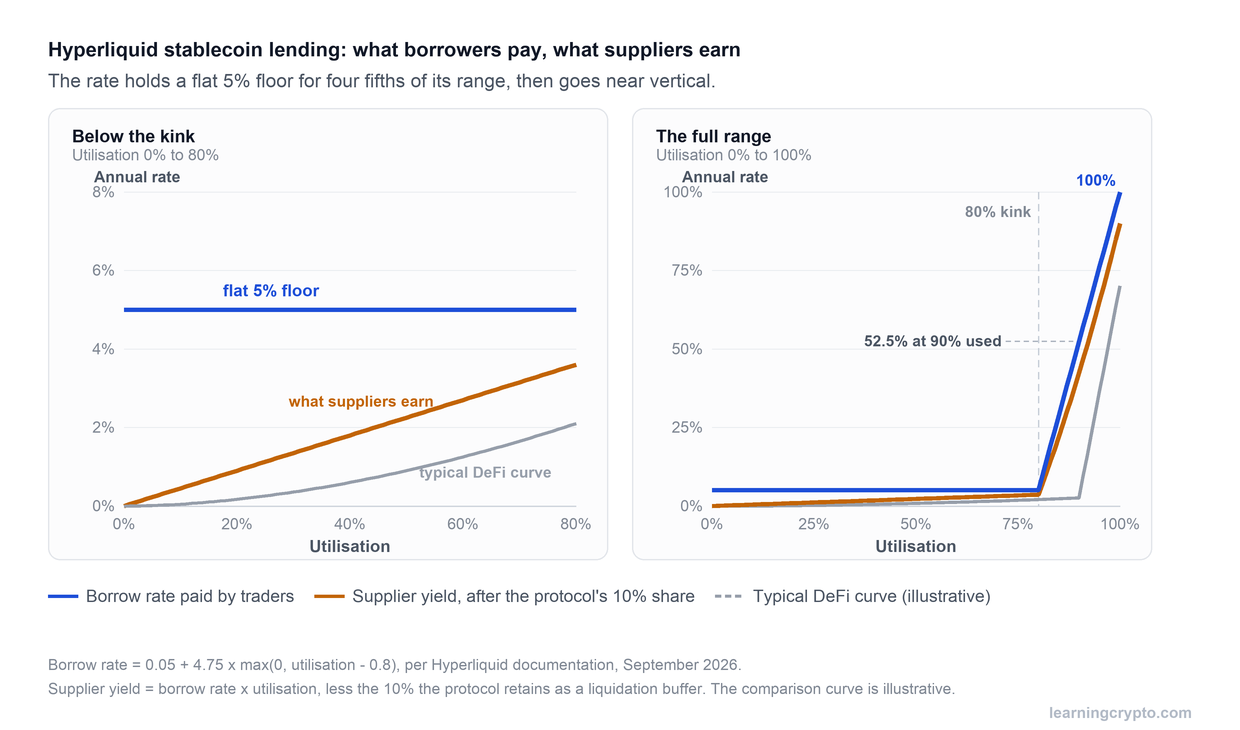
| Lend assets for interest | A savings account | Rates float constantly and your yield depends on borrower demand |
| Borrow against collateral | A secured loan | Over-collateralised, and you are liquidated automatically if the price moves against you |
| Provide liquidity to a pool | Market making | Impermanent loss can leave you worse off than simply holding |
| Stake, including liquid staking | A term deposit | Lock-ups, slashing risk and the reliability of the staking provider |
| Hold tokenised real-world assets | A bond or money-market fund | You are trusting whoever custodies the underlying asset |
Each has its own guide: centralised versus decentralised exchanges, lending and borrowing on Aave, yield farming, liquid staking, real-world asset tokenisation and DeFi trading. If you want the earning side specifically, start with how to make money with DeFi.
How is DeFi different from an exchange or a bank?
| Bank | Centralised exchange | DeFi | |
|---|---|---|---|
| Who holds your assets | The bank | The exchange | You, via a contract |
| Getting an account | Application and approval | Identity verification | Connect a wallet |
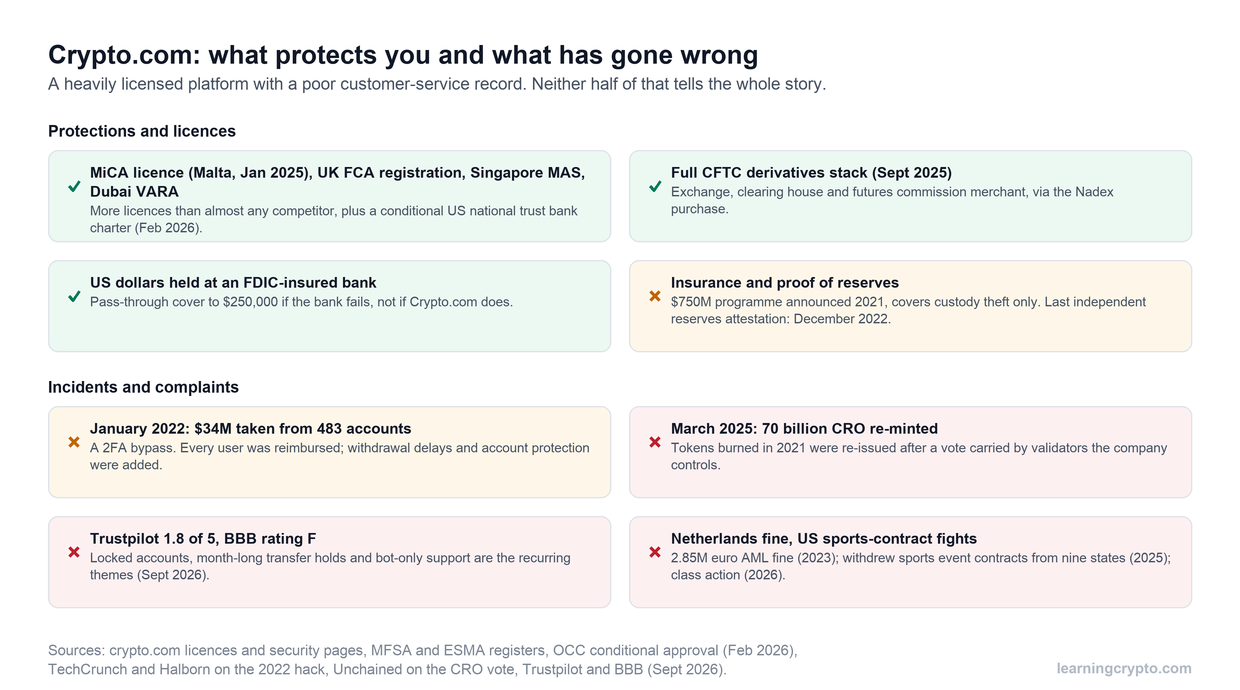
| If something goes wrong | Complaints process, insurance | Support ticket, sometimes recovery | Nothing. The code did what it said |
| Hours | Business hours | Always on | Always on |
| Who can be excluded | Anyone the bank declines | Restricted jurisdictions | Nobody at the protocol level |
| Transparency | Quarterly filings | Attestations, sometimes | Every position visible on-chain |
The comparison with traditional finance is explored further in TradFi versus DeFi.
How does a decentralised exchange actually swap tokens?
Not with an order book matching buyers to sellers, in most cases, but with a pool. An automated market maker holds a reserve of two tokens and prices them with a formula based on their relative quantities. When you swap, you add one token to the pool and remove the other, and the price moves along that curve.
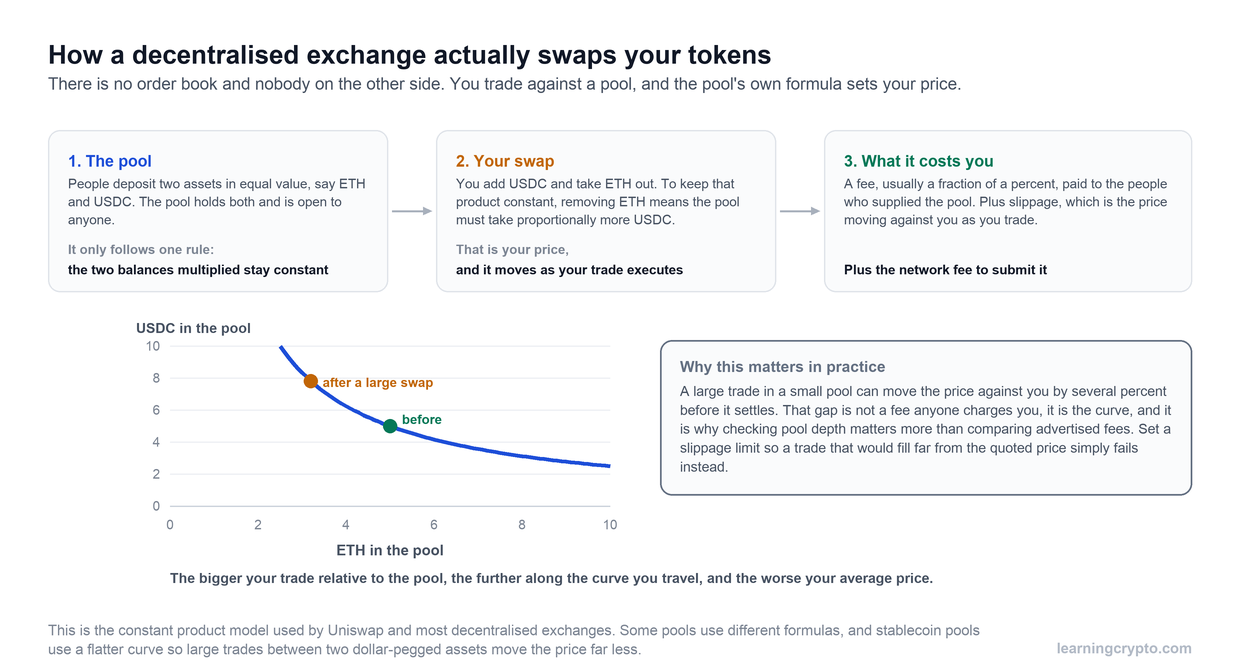
There is no order book and nobody on the other side of your trade. The pool's formula sets your price, and the larger your trade relative to the pool, the further along the curve you travel and the worse your average price.
This is why two things happen that surprise newcomers. Larger trades get worse prices, because you are moving further along the curve; that gap is slippage, and every interface lets you set a tolerance for it. And the people who supplied the two tokens earn a share of the trading fees, which is what liquidity provision is.
It also explains impermanent loss. If you deposit two assets and one rises sharply, the pool automatically sells the winner as traders buy it from you. You end up with more of the loser and less of the winner than if you had simply held both. The fees you earn may or may not cover that difference, and on a volatile pair they frequently do not. The full comparison of venue types is in centralised versus decentralised exchanges.
Which networks does DeFi run on?
Ethereum still holds the most value and the deepest liquidity, and it remains the default answer for anything where security matters more than cost. The trade-off is fees, which is why most day-to-day activity has moved elsewhere.
Layer 2 networks such as Arbitrum, Optimism and Base settle back to Ethereum but execute transactions far more cheaply, so they inherit much of Ethereum's security at a fraction of the cost. Separate chains such as Solana and BNB Chain run their own consensus with their own trade-offs around decentralisation and throughput.
The practical consequence is that the same protocol may exist on several chains, and assets do not move between them automatically. Getting funds from one chain to another means using a bridge, which historically has been the single most attacked component in the industry. If you are new, staying on one network until you are comfortable removes an entire category of risk.
What does it cost to use?
Every action is a blockchain transaction and every transaction pays a network fee, usually called gas. That fee goes to the network, not to the protocol, and it rises when the chain is busy. On Ethereum's main chain a single swap can cost anywhere from cents to a great deal more during congestion, which is why small positions are often uneconomic there.
This is what pushed activity onto Layer 2 networks, which batch transactions and settle back to Ethereum for a fraction of the cost. Our guide to zk-rollups explains that mechanism. On top of gas, expect protocol fees on swaps, spreads and slippage on larger trades, and the hidden cost of MEV, where bots reorder transactions around yours.
What are the real risks?
Not vague ones. These are the specific failure modes that actually take people's money.
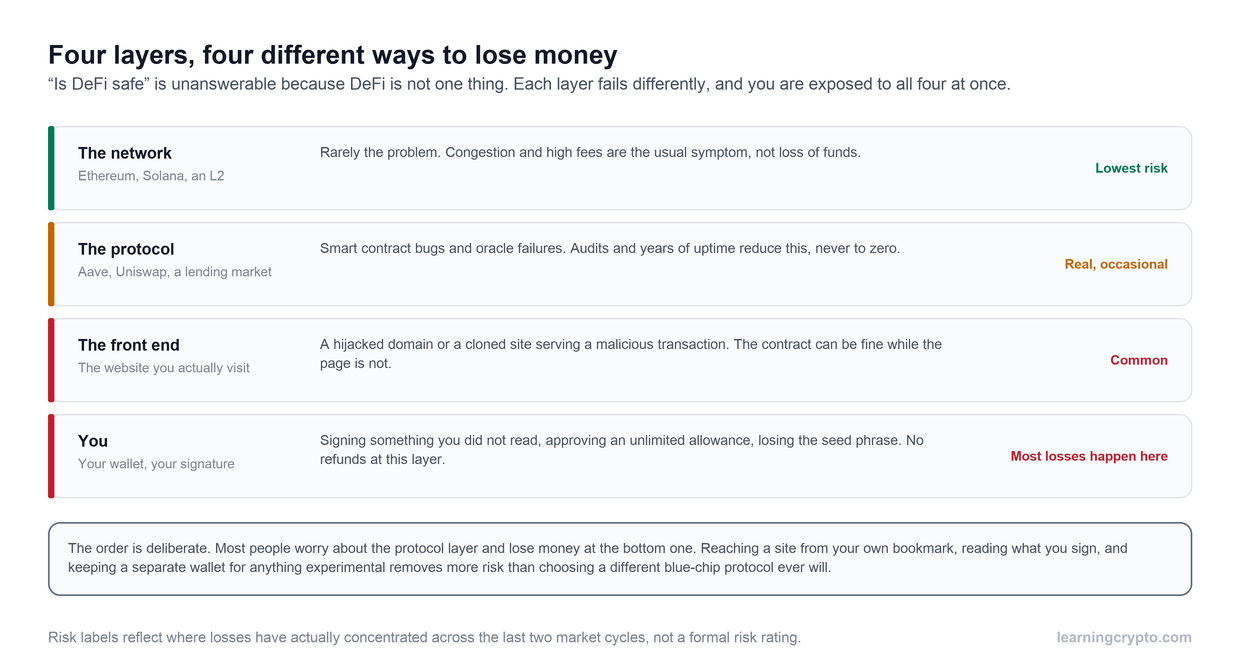
Asking whether DeFi is safe is unanswerable because each layer fails differently and you are exposed to all four at once. Most people worry about the protocol layer and lose money at the bottom one.
- Smart contract bugs. The code runs exactly as written, including the parts written wrong. Audits reduce this risk and do not remove it.
- Approval phishing. The most common way DeFi users are drained, and it never touches your seed phrase. Understand it before you connect to anything: token approval phishing.
- Liquidation. Borrow against volatile collateral and a price move can close your position automatically, at a loss, while you sleep. See how liquidation works.
- Impermanent loss. Providing liquidity to a volatile pair can leave you with less value than if you had simply held the two assets.
- Oracle failure. Protocols need external price data. Manipulate the price feed and you can drain a lending market without breaking a single line of its code.
- Bridge risk. Moving assets between chains has produced some of the largest losses in the industry: how bridges work and where they fail.
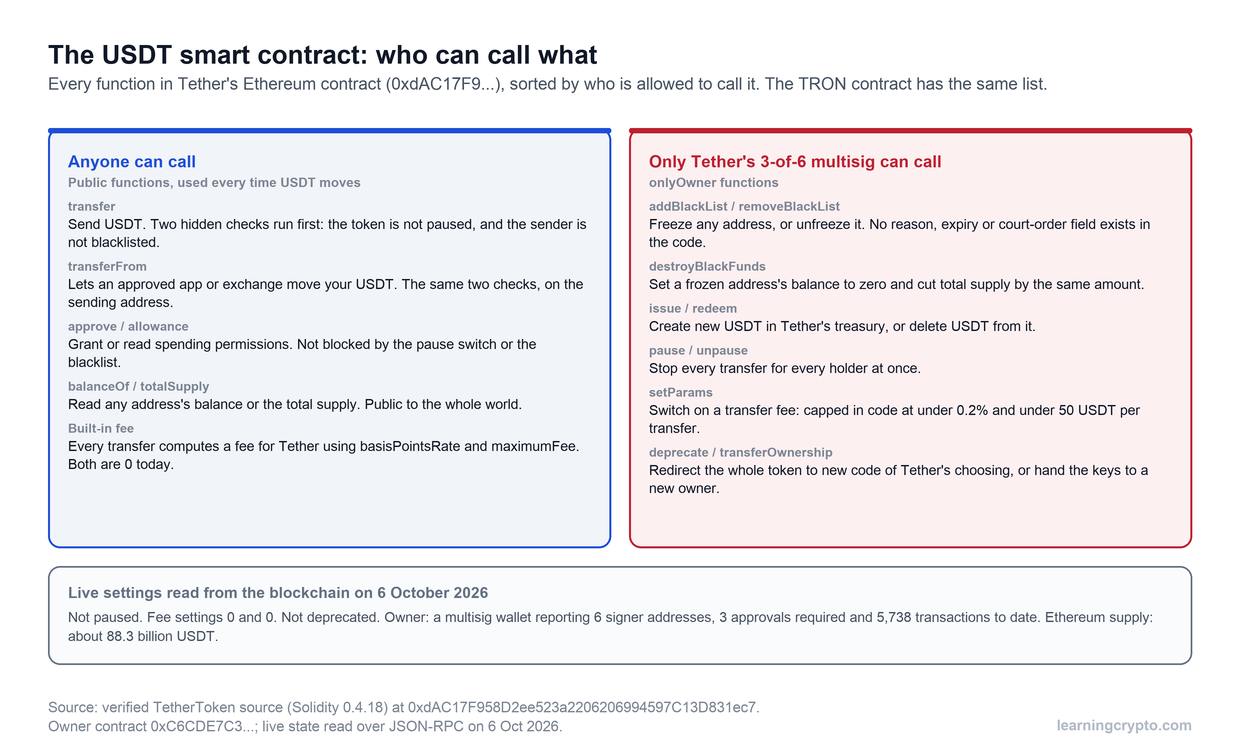
- Stablecoin failure. Most DeFi positions are denominated in stablecoins, so the peg is a dependency you inherit whether you think about it or not. See why stablecoins depeg.
- Rug pulls and governance capture. Anonymous teams with admin keys, or a DAO whose votes are controlled by a handful of holders.
How do you start safely?
- Use a separate wallet. Never connect the wallet holding your long-term savings to a new protocol. Fund a second wallet with only what that experiment is worth to you.
- Start on a cheap network so a mistake costs a few cents in fees rather than a meaningful sum.
- Use established protocols first. Years of operation with large sums at stake is imperfect evidence, but it is evidence. A protocol launched last week with a triple-digit yield is not offering you a bargain the market missed.
- Read what you are signing, set bounded approvals rather than unlimited ones, and verify on your hardware wallet screen. Browser wallet risks are covered in is MetaMask safe.
- Revoke approvals periodically. Every permission you granted is still live until you remove it.
- Assume any yield above the risk-free rate is payment for a risk and find out which one before you commit.
This is educational information, not investment advice. DeFi carries the risk of total loss and transactions cannot be reversed.
Is DeFi legal and regulated?
Using it is legal in most jurisdictions; how it is regulated is unsettled and moving. Regulators have largely focused on the points where DeFi meets the traditional system, which means exchanges, stablecoin issuers and the fiat on-ramps, rather than the contracts themselves. Europe's framework is covered in our MiCA guide.
Two things are true regardless of where you live. Tax obligations apply to DeFi activity in most countries, and swaps, rewards and liquidations are frequently taxable events people forget to record; our crypto record keeping guide covers what to track. And you have no regulatory protection when a protocol fails, so due diligence is not a formality. There is more across our DeFi hub, and members can see what our analysts actually hold in the Team Portfolio.
Frequently asked questions
What does DeFi stand for?
DeFi is short for decentralised finance. It describes financial services such as trading, lending and borrowing that run on smart contracts on a public blockchain rather than being operated by a bank or a broker. There is no company holding your assets and no approval process to use it.
Is DeFi safe for beginners?
It can be used safely, but it is unforgiving of mistakes because transactions cannot be reversed and there is no support desk. Start with a separate wallet holding a small amount, use established protocols on a low-fee network, and learn to read what you are signing before committing anything you would miss.
How do people make money in DeFi?
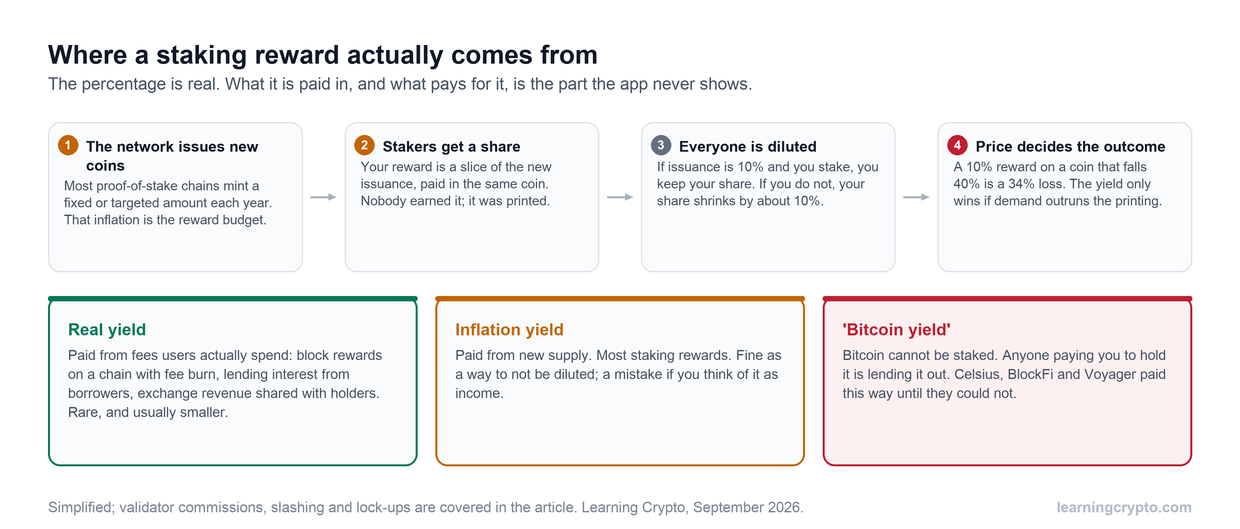
Mainly by lending assets for interest, providing liquidity to trading pools in exchange for fees, and staking. All three pay you for taking a risk: borrower default, impermanent loss, or protocol failure. Returns are not guaranteed and can be negative even when the headline yield looks positive.
Do you need a lot of money to use DeFi?
No, but network fees set a practical floor. On Ethereum's main chain, transactions can cost enough that small positions are not worthwhile. Layer 2 networks reduce fees dramatically, which makes experimenting with modest amounts realistic. Start small deliberately, because the first few transactions are where mistakes happen.
What is the difference between DeFi and a crypto exchange?
A centralised exchange holds your assets and requires identity verification, so you are trusting a company. DeFi protocols never take custody: your assets stay in contracts you can withdraw from with your own key. The exchange can help if something goes wrong; a DeFi protocol cannot, because there is no one operating it.
Can DeFi transactions be reversed?
No. Once a transaction is confirmed on-chain it is final. There is no chargeback, no fraud department and no administrator who can undo it. This is why verifying addresses, checking what you are approving and sending a small test transaction first are habits rather than optional extras.
What is the biggest risk in DeFi?
For most individual users it is not a protocol collapse but approving a malicious contract, which grants a stranger permission to move your tokens without ever seeing your recovery phrase. Smart contract bugs, oracle manipulation and bridge failures cause the largest headline losses, but user-side approval phishing is the most common.
This guide is part of stage 5 of 8, beyond bitcoin, in the free Learning Crypto curriculum. Next: What is Aave?