
The good news? You've got time to prepare. The final Bitcoin won't appear until sometime around the year 2140; everyone reading this will be long gone before it becomes an actual problem.
But that distant deadline shapes Bitcoin's value proposition right now, and understanding what happens when the mining stops matters even if you won't be around to see it.
Bitcoin's final act was written in the first scene. When Satoshi launched the network, the 21 million cap and halving mechanism were already in place, ticking down like a very slow clock. This wasn't an accident or an arbitrary choice; rather the core feature that makes Bitcoin scarce, predictable, and fundamentally different from fiat currency.
The transition to a fee-based mining economy was always the plan. What nobody can predict is whether transaction fees will be sufficient to maintain network security by then, or what Bitcoin's role in the global economy will actually look like.
What You'll Learn in This Guide
→ What miners do after block rewards end - and why they won't just quit
→ Why transaction fees will replace block rewards as the network's economic engine
→ What Bitcoin's fixed supply means for scarcity, value, and your investment thesis
→ Competing economic models for how Bitcoin actually functions in 2140
Bitcoin's Fixed Supply: The 21 Million Cap
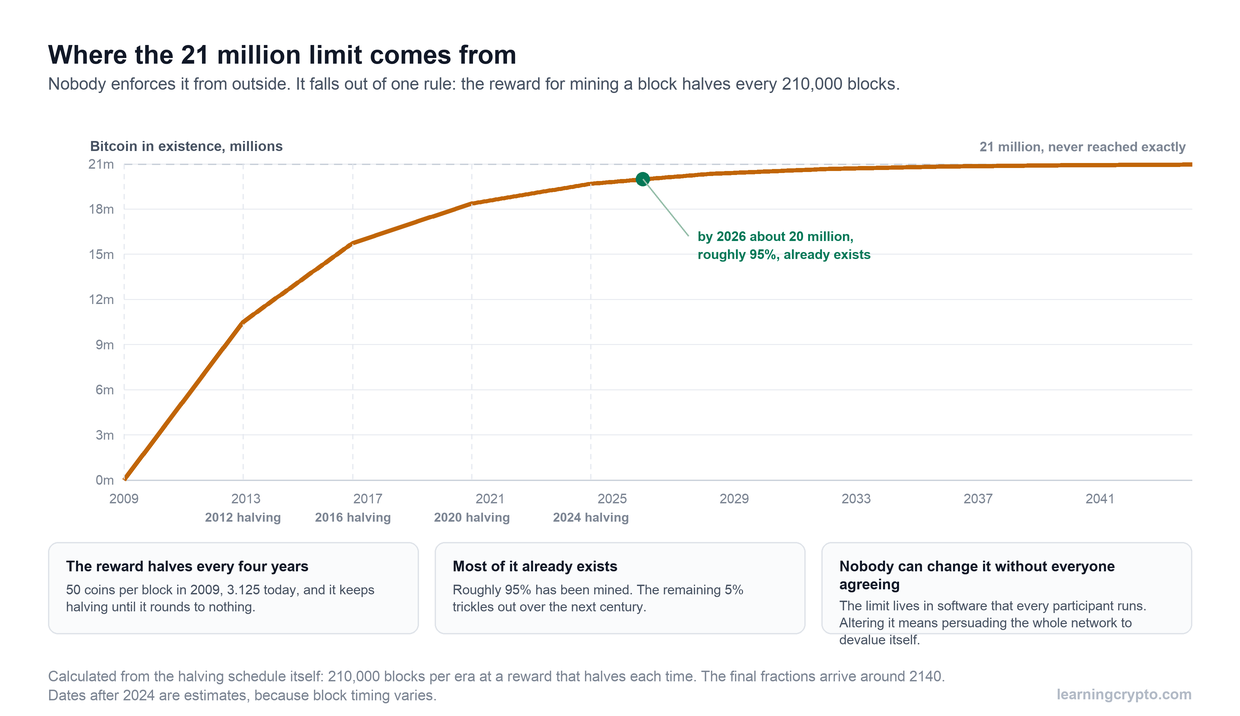
One of Bitcoin’s defining features is that its supply is permanently capped. There will never be more than 21 million Bitcoin in existence. This limit isn’t a guideline or a policy choice but enforced by Bitcoin’s code and validated by every node on the network.
That means no central bank, developer group, or government can decide to create more Bitcoin to respond to economic pressure. The supply schedule is transparent, predictable, and known decades in advance. This fixed issuance model is a core reason Bitcoin is often compared to gold - except Bitcoin’s scarcity is mathematically enforced rather than physically constrained.
To understand why this matters, it helps to look at where Bitcoin’s supply stands today and how long it will take for the remaining coins to be mined.
How Many Bitcoin Exist Today?
As of January 2026, approximately 19.6 million Bitcoin have been mined. That represents roughly 93.3% of the total 21 million supply, leaving about 1.4 million BTC still to be issued over the next century.
Following the 2024 halving, miners currently earn 3.125 BTC per block, which works out to roughly 450 new Bitcoin per day, or around 160,000 BTC per year. This rate continues to decline over time as future halvings reduce the block reward even further.
You’ve also got to separate mined supply from usable supply. It’s estimated around 3–4 million Bitcoin are permanently lost due to forgotten private keys, discarded hard drives, or early user mistakes. That puts the effective circulating supply closer to 15–16 million BTC, making Bitcoin scarcer in practice than the headline numbers suggest.
Most of the Bitcoin that will ever exist is already here, and the pace of new supply is slowing every year.
When Will the Last Bitcoin Be Mined?
As we’ve mentioned, the last Bitcoin is expected to be mined around the year 2140, more than a century from now. The exact date can’t be predicted with precision because block times fluctuate, but the long-term trajectory is clear.
Bitcoin’s issuance follows a halving schedule that dramatically slows new supply over time. While more than 93% of Bitcoin has already been mined, the remaining coins are released at an increasingly slow pace:
By the early 2030s, roughly 99% of all Bitcoin will have been mined
By around 2040, that figure rises to approximately 99.5%
The final fraction of Bitcoin is stretched across the following 100 years
This asymptotic approach means Bitcoin never suddenly “runs out.” Instead, new issuance tapers off gradually until block rewards effectively reach zero.
That long runway is intentional. It gives the network decades to transition from relying on block rewards to relying on transaction fees. It’s a shift Bitcoin has been preparing for since its launch.
Together, these mechanics explain why Bitcoin’s supply cap isn’t a looming problem or a future shock. It’s a slow, predictable process that’s already well underway.
Bitcoin’s Halving Cycle: The Built-In Schedule That Limits Supply
Bitcoin doesn’t rely on guesswork or policy decisions to control its supply. Instead, it follows a built-in schedule that quietly does the job in the background: the halving cycle.
Roughly every four years, the number of new Bitcoin created with each block is cut in half. This isn’t a reaction to price, demand, or market sentiment; it’s automatic. The rules were set at launch, and the network enforces them without asking anyone’s permission.
The result is a slow, predictable reduction in new supply. Bitcoin becomes harder to earn over time, not suddenly, but gradually enough for the network to adapt.
How the Halving Schedule Works
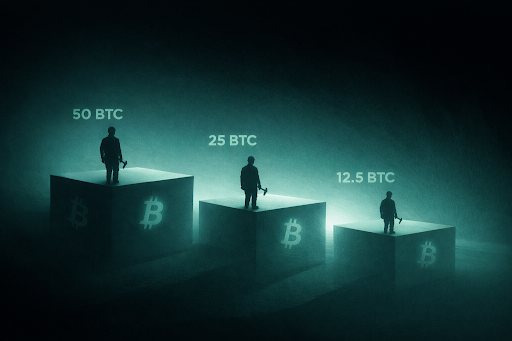
Bitcoin halvings occur every 210,000 blocks, which works out to about once every four years. When Bitcoin launched in 2009, miners earned 50 BTC per block. That reward has been cut in half again and again: to 25 BTC in 2012, 12.5 BTC in 2016, 6.25 BTC in 2020, and 3.125 BTC after the 2024 halving.
The next halving is expected around 2028, when the block reward drops to 1.5625 BTC. After that, the pattern continues, with each halving pushing Bitcoin closer to its 21 million cap.
Here’s how that plays out in practical terms:
Period | Block Reward | BTC per Day | % of Supply Mined |
2009–2012 | 50 BTC | 7,200 | 0–50% |
2012–2016 | 25 BTC | 3,600 | 50–75% |
2016–2020 | 12.5 BTC | 1,800 | 75–87.5% |
2020–2024 | 6.25 BTC | 900 | 87.5–93.75% |
2024–2028 | 3.125 BTC | 450 | 93.75–96.88% |
2028–2032 | 1.5625 BTC | 225 | 96.88–98.44% |
Toward 2140 | Near zero | Near zero | Near 100% |
Purpose:
Controlled, predictable supply emission
Creates scarcity over time
Gives the network time to develop the fee market
Prevents inflation
Each halving is a big deal in Bitcoin markets. Historically, halvings have preceded major price rallies as the reduced supply hits a market with steady or growing demand. But more importantly, each halving moves Bitcoin closer to its final form: a purely fee-based security model.
What Happens After All Bitcoin Is Mined?
When people hear that Bitcoin has a hard cap, the natural follow-up is: okay… then what? Does mining stop? Does the network grind to a halt? Does Bitcoin suddenly stop working?
The short answer: none of that happens.
When the last Bitcoin is mined, the network simply finishes one phase of its design and moves fully into the next.
Miners Transition to Transaction Fees
Today, miners are paid in two ways:
newly created Bitcoin (the block reward), and
transaction fees paid by users.
As halvings continue, the block reward shrinks, and fees make up a larger share of miner revenue. By the time the final Bitcoin is mined, block rewards drop to zero, and transaction fees become the sole incentive for miners.
This isn’t a sudden change. It’s a slow handoff that plays out over more than a century. Each halving nudges miners a little further toward a fee-based model, giving the network plenty of time to adjust.
The transition is already happening. Look at periods when Bitcoin's mempool (the waiting room for unconfirmed transactions) fills up. Fees spike as users compete for block space. During high-traffic events, fees can temporarily exceed block rewards. This gives us a preview of Bitcoin's post-mining economy.
Layer 2 solutions, such as the Lightning Network, help here. By moving everyday transactions off the main blockchain, they leave room for larger, higher-value settlements that can support substantial fees.
Bitcoin's base layer will be like international wire transfers, expensive but secure for large amounts, while Lightning handles the coffee purchases.
Will Bitcoin Still Be Secure?
Network security depends on one thing: whether mining remains economically worthwhile. If miners are paid enough to keep hashing, the network stays secure.
Nobody can predict what will $100 in transaction fees will actually mean in 2140? If Bitcoin succeeds as a global reserve asset, settling even 0.01 BTC on the main chain might be worth thousands in today's dollars. The fees don't need to be huge in BTC terms-they need to be valuable enough in real purchasing power to keep miners operational.
Bitcoin's difficulty adjustment serves as a safety mechanism. If mining becomes unprofitable and miners drop off, the network becomes easier to mine, which makes it more profitable for remaining miners. The system self-corrects.
It's been doing this successfully since 2009 through every market cycle, price crash, and mining exodus.
Economic Models for a Post-Mining Bitcoin
Nobody knows exactly how Bitcoin will function in 2140, but several competing theories exist about what a fee-only mining economy actually looks like.
The High-Value Settlement Layer
This model sees Bitcoin becoming an expensive, secure, final settlement for large transfers. Layer 2 solutions like Lightning Network would handle everyday transactions: buying coffee, paying bills, and sending money to friends. The base layer processes periodic settlements between Lightning channels, major institutional transfers, and high-value transactions where security matters more than cost.
Under this model, a single on-chain transaction might cost hundreds or thousands of dollars in fees, but that's acceptable because you're settling $10 million, not $10. The high fees support miners adequately because even though transaction volume is lower, each transaction pays substantially.
The Fee Market Maturity Model
This theory assumes Bitcoin achieves massive adoption, generating enormous transaction volume. Even if individual fees remain relatively modest, the sheer number of transactions per block creates sufficient miner revenue. Think of it like retail-low margins but high volume.
For this to work, Bitcoin needs to become a genuine medium of exchange globally, not just a store of value. Billions of people would need to transact in Bitcoin regularly. Block space becomes incredibly valuable because demand vastly exceeds the 1MB (or slightly larger with SegWit) per block limit. Users compete for inclusion, and that competition sustains miner profitability.
This model faces scalability challenges since Bitcoin's base layer can only handle about 7 transactions per second. It likely requires some combination with Layer 2 solutions to achieve the necessary volume while keeping base layer fees high enough.
The Merged Mining Concept
Merged mining allows miners to secure multiple blockchains simultaneously with the same computational work. Bitcoin miners could theoretically secure Bitcoin plus other compatible chains, earning rewards from multiple sources.
Under this model, Bitcoin mining remains profitable because miners earn Bitcoin transaction fees plus additional revenue from securing other networks. The other chains benefit from Bitcoin's massive hash rate security, while Bitcoin miners diversify their income streams without additional energy costs.
Critics argue this dilutes Bitcoin's security focus and creates dependencies on other projects. Proponents counter that it's simply economic efficiency - the same mining equipment earning from multiple revenue streams.
The Reserve Asset Model
This is the "digital gold" thesis taken to its logical conclusion. Bitcoin primarily becomes a store of value, with relatively minimal transaction activity. Institutions, corporations, and nation-states hold Bitcoin as a reserve asset, rarely moving it.
When transactions do occur, they involve massive settling positions between major financial entities, moving treasury reserves, or handling once-in-a-lifetime personal transfers, such as inheritances. These rare but enormous transactions carry fees proportional to their value. Moving $1 billion in Bitcoin might carry a $100,000 fee, but that's trivial compared to the transferred value.
This model assumes Bitcoin's per-coin value increases dramatically, perhaps into millions of dollars per BTC. At those valuations, even capturing a tiny fraction of global financial settlement activity generates substantial fee revenue for miners. Transaction volume is low, but transaction value and fees are extremely high.
Why Bitcoin’s Fixed Supply Matters

Scarcity and Value
Bitcoin’s 21 million cap is the single feature that separates it from every fiat currency in history.
With fiat money, supply is flexible by design. Central banks can create more units whenever they decide the economy needs it - whether to stimulate growth, cover deficits, or respond to crises. Bitcoin removes that option entirely. Its supply is algorithmically enforced, and no central authority can change it.
That’s where the idea of digital scarcity comes from. Bitcoin isn’t scarce because it’s hard to mine or expensive to produce. It’s scarce because the rules say so, and the entire network agrees to enforce those rules.
Economic Implications
When supply is fixed, and demand grows, pressure builds on price. That’s basic economics, and it’s why Bitcoin is often described as a deflationary asset. Over long time frames, each unit represents a larger share of the total network.
This is also why Bitcoin is frequently compared to gold. Gold’s value is that there’s a limited amount of it on Earth, and we’re not suddenly discovering vast new supplies. Bitcoin applies that same scarcity logic, but in digital form.
Unlike government currencies, Bitcoin’s monetary policy is fully predictable. Everyone knows how much Bitcoin exists today, how much will exist in ten years, and exactly when new supply slows again. There are no surprises.
The Investment Angle
Scarcity is the foundation of Bitcoin’s long-term value proposition. Early participants benefit from earlier distribution, when new supply was higher and competition was lower. As issuance slows, each new Bitcoin becomes harder to earn.
The moment the final Bitcoin is mined represents complete scarcity - no new supply, ever. While that event is still far off, the economics leading up to it matter now. This is why models like stock-to-flow gained attention: they attempt to explain how declining issuance affects value over time.
Whether or not you buy into any specific model, the core idea remains the same - Bitcoin’s supply shock is baked in.
The Long-Term Perspective
Even now, the network still adds roughly 160,000 new BTC per year, and that won’t drop to zero for more than a century.
But markets don’t wait for events to happen; they price them in early. Investors buying Bitcoin today aren’t reacting to today’s supply alone. They’re reacting to the certainty that supply is capped forever.
That psychological certainty matters. Knowing there will never be more than 21 million Bitcoin influences how people value it today, how they hold it, and how it’s positioned relative to inflation-prone currencies.
Bitcoin’s code is its monetary policy. Changing the cap would require convincing the entire network ( nodes, miners, exchanges, and users) to accept a new version. Any attempt to increase supply would almost certainly result in a chain split, with the capped version retaining the Bitcoin name and market trust.
Wrapping It All Up
By now, it should be clear Bitcoin’s fixed supply and halving cycle aren’t quirks or bugs; they’re how the system stays honest, predictable, and scarce. Most Bitcoin has already been mined, but the slow, code-enforced tapering of new supply is what gives the network time to grow into a mature fee-based economy.
This isn’t a future shock. It’s a design that plays out over generations, not days, and markets already price it in because scarcity isn’t just about the final coin coming out of the ground. It’s about knowing exactly how supply works, at every step. That’s a very different monetary story than anything we’ve seen with government-printed money.
See the Full Picture
The real edge comes from understanding how these mechanics manifest on-chain, in miner behavior, fee markets, and real-world adoption.
Learning Crypto brings AI-powered education, a supportive community, and advanced tools together in one place so you’re not guessing, Googling, or chasing narratives.
If you want to understand crypto as a system, not just a price chart, this is where it clicks.
FAQs
Will Bitcoin lose value after all coins are mined?
Its value will depend on demand, utility, and adoption, not ongoing mining. Fixed supply may increase value if demand grows. By the 22nd century, Bitcoin's role in the economy will determine its value, not whether new coins are created. Scarcity could enhance value preservation if Bitcoin maintains its position as a store of value and medium of exchange.
What if transaction fees aren't enough to secure the network?
Legitimate concern, but 100+ years allows for adaptation. Bitcoin's value will likely be much higher, making fee-based revenue substantial even with smaller BTC amounts. Layer 2s can handle everyday transactions while the main chain settles high-value transfers with appropriate fees. The market will find equilibrium. If fees are too low to sustain security, they'll rise until mining becomes profitable again.
How do miners survive between now and 2140 as rewards shrink?
Miners are already adapting through operational efficiency, cheaper energy sources, and better hardware. As block rewards decrease, only the most efficient miners survive each halving cycle. This is already happening. Transaction fees will gradually make up a larger percentage of revenue long before that date, giving miners decades to adjust their business models.
What if quantum computing breaks Bitcoin before 2140?
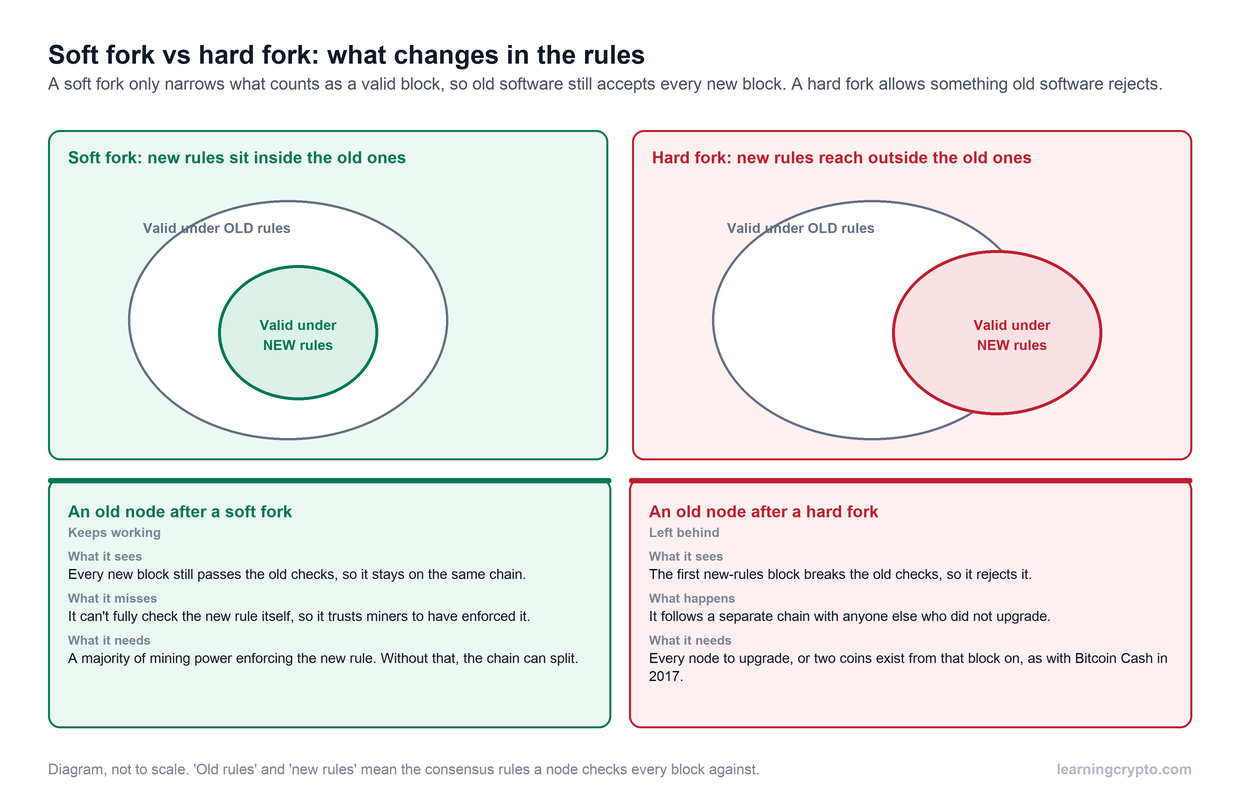
Quantum computing threats affect cryptographic security, not supply issuance. If quantum computers threaten Bitcoin's encryption, the protocol can upgrade to quantum-resistant algorithms through a soft fork. The 21 million cap and halving schedule are independent of encryption methods. Fixing quantum threats is a security update, not an economic policy change.
This guide is part of stage 2 of 8, how bitcoin works, in the free Learning Crypto curriculum. Next: What Is a Fork in Crypto? Hard Forks vs. Soft Forks Explained.
Keep learning
- What Is a Crypto Mining Rig and How to Build One?
- Difference Between Bitcoin & Ethereum: Breaking Down the Basics
- What Is a BTC Wallet Address?
- More guides in the Bitcoin hub
- Members: Satoshi Indicator, a daily Bitcoin DCA signal for members