
A stablecoin is a promise, and a peg is only as good as whatever stands behind it. Most of the time that promise is kept and the token trades at a dollar, which lulls people into treating it as cash. This guide is about the days when it does not, and how to tell a liquidity wobble that resolves by lunchtime from a solvency failure that never comes back.
Educational information, not investment advice. Stablecoins carry issuer, counterparty and regulatory risk and are not equivalent to bank deposits or insured savings.
What actually holds a stablecoin at a dollar?
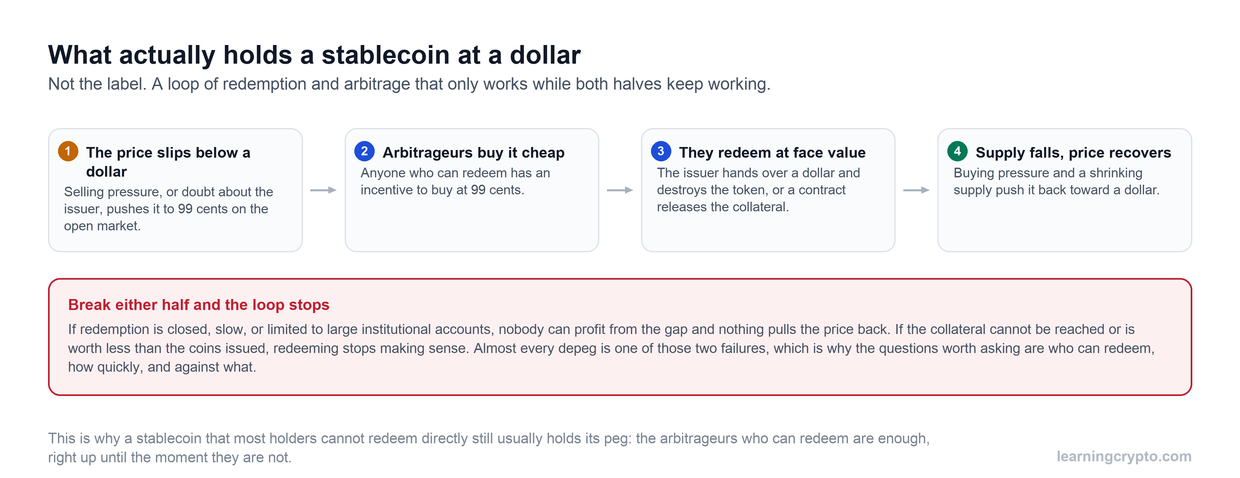
Not a law of nature and not the label on the token. What holds it is a redemption mechanism plus arbitrage, working together.
The mechanism is the ability to exchange one token for one dollar of the underlying asset with the issuer. The arbitrage is what makes that matter to the market price. If the token trades at 99 cents, someone who can redeem at par buys cheap, redeems at a dollar and pockets the difference, and their buying pushes the price back up. If it trades above a dollar, they mint new tokens at par and sell them. Those trades are what keep the market price glued to the peg.
Read that closely and the vulnerability is obvious: the peg holds only while the redemption loop is open and believed. Close the loop, slow it down, or convince the market that redemption will not be honoured, and the arbitrage stops. There is a broader explainer in our guide to what pegging means in crypto.
One consequence catches retail holders out. For most large stablecoins, direct redemption is available only to verified institutional partners with minimum sizes. You are not the arbitrageur. You are relying on someone else's ability to arbitrage, which is fine until the moment their access is what is in question.
What are the three ways a peg breaks?
Separating these is the whole skill, because they look identical on a price chart for the first hour and have completely different outcomes.
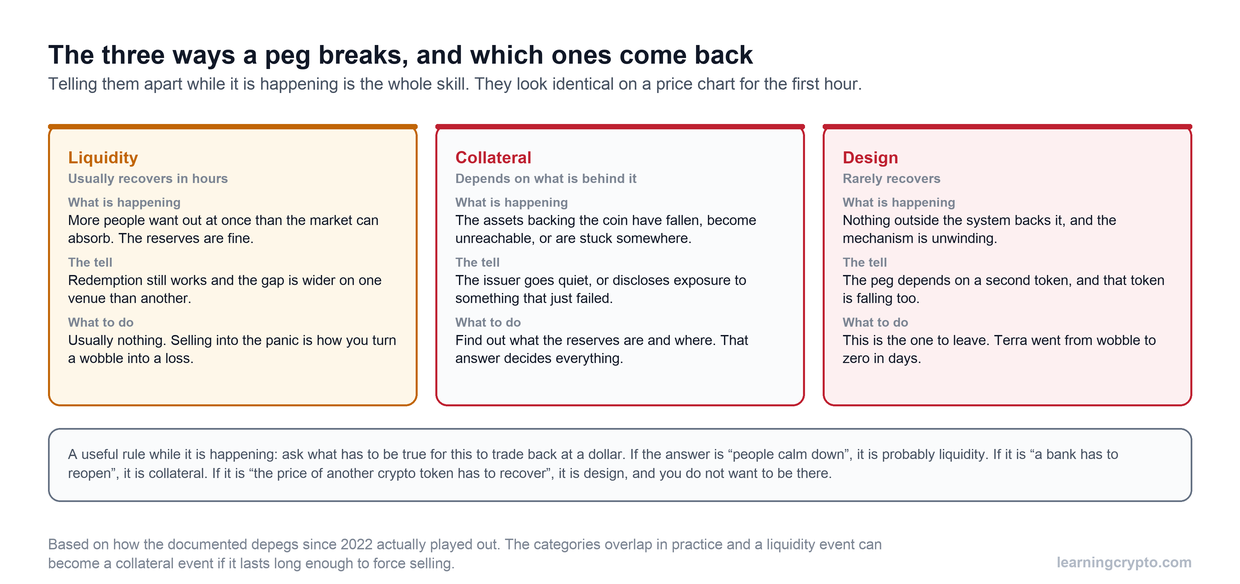
They look identical on a price chart for the first hour. The question that separates them is what has to be true for this to trade back at a dollar: people calming down, a bank reopening, or another crypto token recovering.
| Type | What is wrong | Typical outcome |
|---|---|---|
| Liquidity depeg | The assets exist and are accessible, but a venue is thin, a pool is imbalanced or redemption is queued | Recovers, often within hours. The discount is usually small |
| Collateral or solvency depeg | The reserves are not what was claimed, or are real but temporarily unreachable | Depends entirely on whether the assets come back. Recovers fully or fails completely |
| Design depeg | The stabilising mechanism itself cannot survive a loss of confidence | Usually terminal, and fast, because the mechanism accelerates the collapse |
The two case studies below are the cleanest illustration of the difference, and both are well documented.
What did the Terra UST collapse show?
That a mechanism can be reflexive, and reflexivity works in both directions. UST was algorithmic: it held its peg through a mint-and-burn relationship with a companion token, LUNA. Holders could always swap one UST for a dollar's worth of newly created LUNA, and that swap was supposed to absorb any selling pressure.
In May 2022 it did the opposite. Enough selling pushed UST below the peg, holders exercised the swap, and the system minted LUNA to honour it. That new supply pushed LUNA's price down, which meant each subsequent redemption required minting even more, which pushed the price down further. The mechanism designed to defend the peg became the engine destroying it. Within days both tokens were effectively worthless, and unlike a bank run there was no vault of assets to distribute at the end because there had never been meaningful external collateral.
The lesson is structural rather than historical. A design that depends on the market remaining confident cannot be rescued by that same design once confidence goes. Our guide to the different types of stablecoins covers where algorithmic models sit relative to collateralised ones.
What did the USDC depeg show?
The opposite failure mode, and a far more reassuring one. In March 2023, Circle disclosed that a portion of USDC's cash reserves was held at Silicon Valley Bank, which had just failed. The reserves were real and the accounting was accurate. The question was whether that cash was accessible.
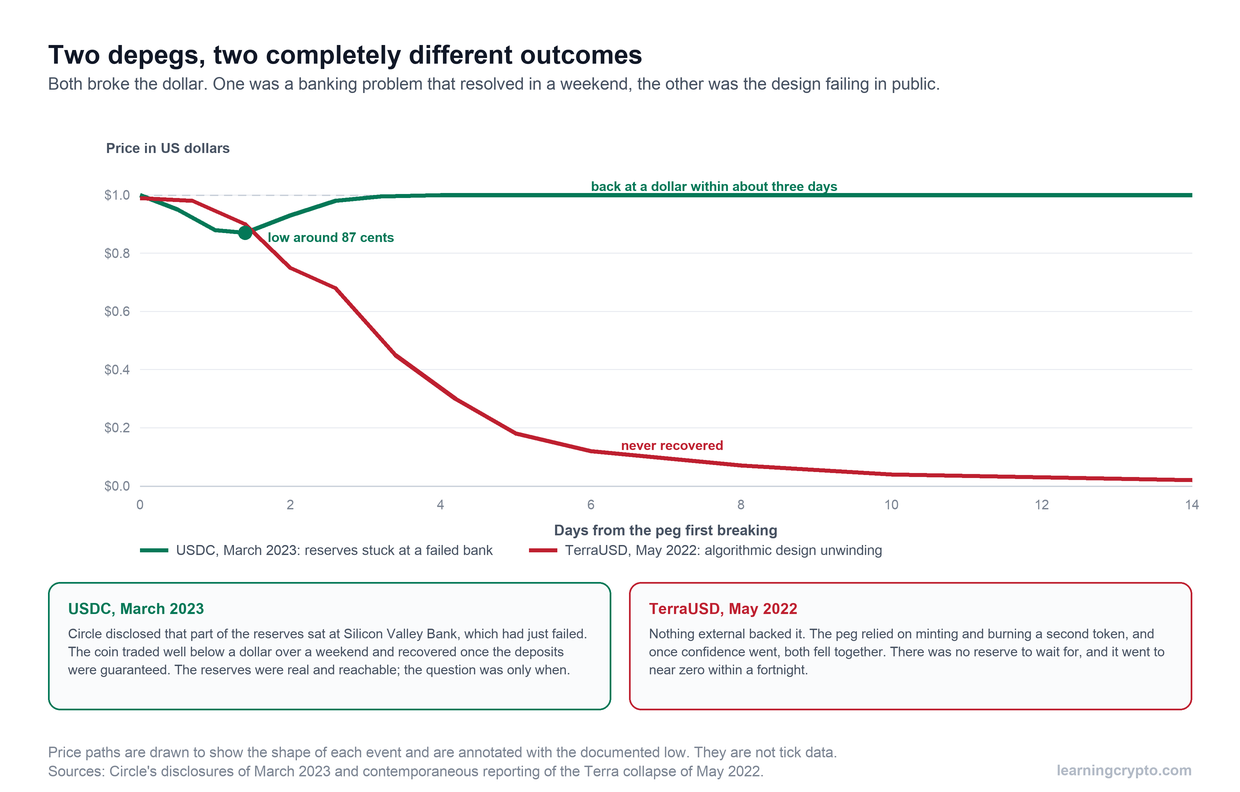
Both broke the dollar and only one came back. USDC had real reserves that were temporarily unreachable; TerraUSD had nothing outside its own system to wait for.
USDC traded below a dollar across a weekend, when banks were closed and the answer could not be confirmed. Once US regulators announced that SVB depositors would be made whole and Circle confirmed access to the funds, the peg restored. Holders who sold into the panic took a loss; holders who waited did not.
So one was insolvency and one was a banking-hours problem. The distinction to carry forward: ask whether the assets are gone or merely unreachable, and whether the timeline is a weekend or a bankruptcy. A comparison of the two largest issuers is in USDT versus USDC.
What should you check before trusting a stablecoin?
Six questions, and you can answer all of them in about fifteen minutes from public sources.
| Question | What a good answer looks like |
|---|---|
| What backs it? | Short-dated government bills and cash, held separately from the issuer's own money. Not the issuer's own token, not illiquid loans |
| Who holds the reserves? | Named, regulated custodians and banks, with concentration disclosed |
| Who verifies it, and how often? | A named accounting firm publishing on a regular schedule, ideally monthly, with a clear scope |
| Who can redeem? | Direct redemption open to a broad set of participants. Institution-only is normal but means you depend on their access |
| Where does it live? | Multiple chains, with the bridged versions clearly identified. A bridged token carries the bridge's risk as well |
| How deep is the liquidity? | Deep pools on major venues and exchanges, so a large sale does not move the price on its own |
Circle publishes its reserve composition and attestations on its transparency page and Tether publishes equivalent disclosures on its transparency page. Read the actual documents rather than a summary of them.
Why is an attestation not an audit?
Because they answer different questions, and the difference is routinely blurred in marketing.
An attestation is an accountant confirming that a specific statement was true at a specific moment, typically that reserves of a certain size existed on a given date. A full audit examines the financial statements as a whole, tests internal controls and offers an opinion on whether they present a true and fair view over a period.
Attestations are genuinely useful. What they cannot tell you is what happened between the snapshots, whether reserves were borrowed for the date in question, or how robust the controls are. Treat regular attestation as a meaningful positive signal and the absence of any independent verification as disqualifying, but do not read a monthly attestation as proof that nothing can go wrong.
What does the yield tell you about the risk?
More than almost anything else on the page, because yield has to come from somewhere and the source is the risk.
There is a real distinction between a token that generates yield because its reserves sit in Treasury bills earning a policy rate, and a platform that pays you yield because it lends your deposit to a borrower. The first is close to the risk-free rate and the return has an obvious source. The second is credit risk wearing a savings-account costume, and you are the lender whether or not the interface uses that word.
The rule of thumb that has held through several cycles: when a stablecoin yield is far above what short-dated government debt pays, the excess is compensation for a risk somebody has decided not to emphasise. Our guides on yield-bearing stablecoins and comparing stablecoin interest rates go into where each type of yield originates.
How do you tell a wobble from a failure while it is happening?
Four signals, read together rather than individually.
- Size and persistence of the discount. A fraction of a percent that closes within the hour is market noise. One or two percent that persists for days is the market pricing real doubt. Depth of discount matters less than how long it lasts.
- Whether redemption is open. The single most important question. If authorised participants are still redeeming at par, the arbitrage still works and the peg has a path home. If redemption is paused, the loop is broken.
- Pool composition on major venues. When a liquidity pool becomes heavily weighted toward the questioned token, that is the market swapping out at any price.
- Issuer communication. Specific, prompt and verifiable disclosure is a good sign, even when the news is bad. Silence, vagueness or attacking critics has historically been the reliable warning.
Context helps, which is what following funding and liquidity conditions gives you. Members get that in the Daily Brief before the US open, and stress in traditional funding markets frequently precedes stress in stablecoins, as March 2023 demonstrated.
What can a holder actually do?
Decide in advance, because the decision is bad if you make it during the event.
Selling into a depegged market crystallises the loss immediately; waiting risks total loss if the failure is structural. Neither is right in general and the choice depends on which of the three failure types you are looking at. Write down your threshold and your action before anything happens, so that on the day you are executing a decision rather than reacting to a chart.
The rest is unglamorous. Do not hold your entire cash position in one issuer, since issuer risk is the concentrated risk here. Understand that if you cannot redeem directly, the market price is the only exit you have. And keep in mind that a stablecoin is a claim on a company, not the asset itself, which is the fundamental difference explored in stablecoins versus Bitcoin. Where you hold them matters too, and the trade-offs between venues are covered in centralised versus decentralised exchanges.
Where is regulation heading?
Toward mandatory reserve quality and disclosure, which should make the collateral question easier to answer over time. Europe's framework brings stablecoin issuers into a licensing regime with reserve and redemption requirements, covered in our guide to MiCA, and other major jurisdictions have moved in the same direction.
The honest caveat: regulation changes who is accountable and what must be disclosed. It does not make a stablecoin risk-free, and a regulated issuer holding assets at a bank still depends on that bank. Better disclosure means you can do the analysis above with better inputs, not that you can skip it. There is more on this cluster in our stablecoins hub.
Frequently asked questions
What does it mean when a stablecoin depegs?
It means the token is trading away from the value it is supposed to track, usually below a dollar. The cause can be as minor as a thin market on one venue or as serious as reserves that do not exist. The price alone does not tell you which, so the useful question is whether redemption at par is still open.
Can a stablecoin recover after losing its peg?
Yes, and several have. Recovery depends on whether the backing is real and reachable. USDC traded below a dollar in March 2023 and returned to par once access to the affected bank deposits was confirmed. By contrast, a design failure like Terra's UST in May 2022 never recovered, because there was no external collateral to restore confidence.
Are stablecoins safer than a bank account?
No. Bank deposits in most developed countries carry government-backed insurance up to a limit, and stablecoins do not. Holding a stablecoin makes you an unsecured creditor of the issuer with no deposit protection, no central bank backstop and, for most retail holders, no direct right of redemption. They are a payment and settlement tool rather than a savings product.
What is the difference between an attestation and an audit?
An attestation confirms that a specific statement, such as the size of reserves, was accurate on a particular date. An audit examines the financial statements as a whole, tests controls and gives an opinion covering a period. Most major stablecoin issuers publish attestations rather than full audits, which is a meaningful signal but a narrower one than many people assume.
Why do some stablecoins pay high interest?
Because the yield is generated by taking a risk with the deposit. Reserve-backed yield from short-dated government bills is limited by prevailing interest rates. Anything meaningfully above that generally comes from lending your funds to borrowers or deploying them in a protocol, which introduces credit and smart-contract risk. A yield well above the risk-free rate is a description of risk, not a bonus.
Should I sell a stablecoin when it depegs?
That depends on whether the problem is liquidity or solvency, which is why the decision should be made in advance. Selling locks in the loss straight away, while holding risks everything if the issuer is genuinely insolvent. Set a threshold and an action before an event, and use redemption status and issuer disclosure rather than the price chart to judge the situation.
This guide is part of stage 5 of 8, beyond bitcoin, in the free Learning Crypto curriculum. Next: What Is DeFi? A Complete Guide to Decentralised Finance.