
Market & on-chain analysis
Analysis is how you turn data into decisions: on-chain flows, tokenomics, whale behaviour, and structured DYOR. These guides teach frameworks you can reuse every cycle.
 Analysis
What People Actually Ask AI About Crypto: 1,018 Real Questions
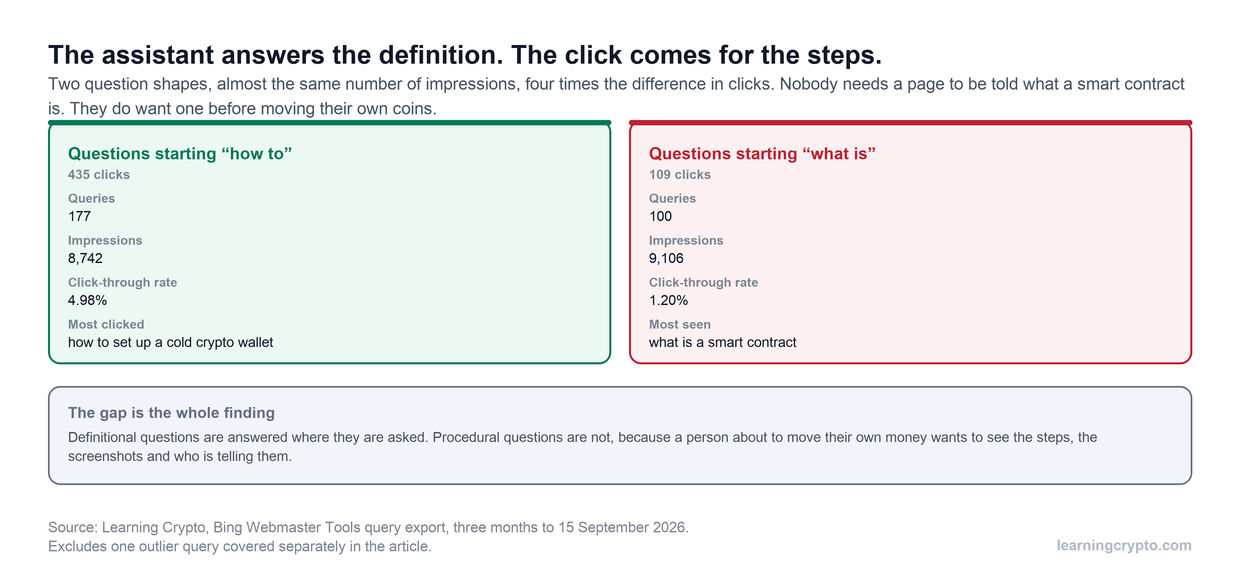
We exported every search query that brought someone to our site through Bing, the index Microsoft Copilot searches, over three months. It came to 1,018 questions, most of them written as full sentences. Here is what people asked, what they clicked, and the whole dataset to download and check for yourself.
Toby CunninghamAnalysis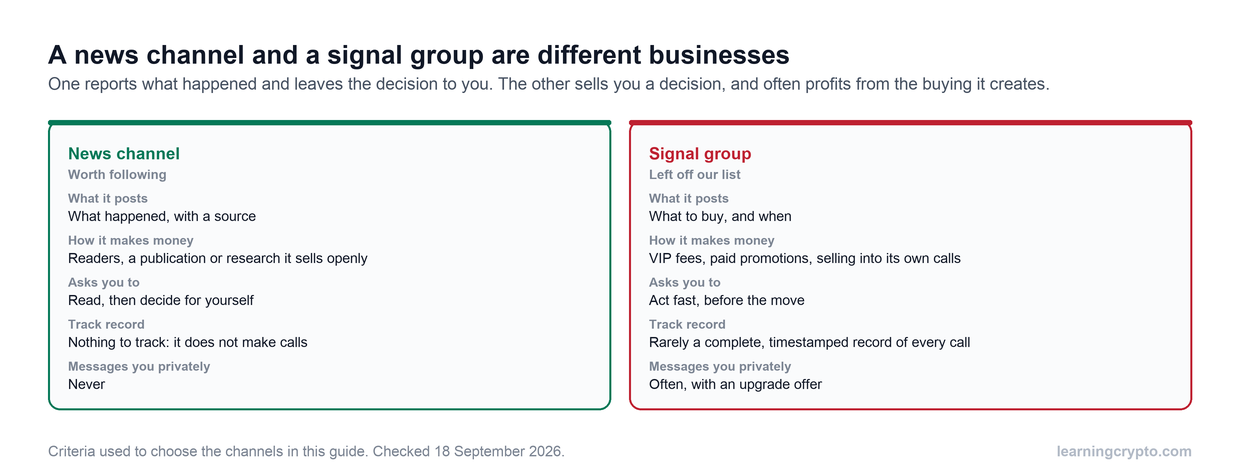 Analysis
The Best Crypto News Telegram Channels in 2026 (No Signal Groups)
The crypto Telegram channels worth following report news; they do not sell signals. Our nine picks cover breaking headlines, whale movements, Asian markets, exchange listings and hack investigations, each with a handle we checked on 18 September 2026. Join through the publisher's own website, never through a link someone sends you.
Toby CunninghamAnalysis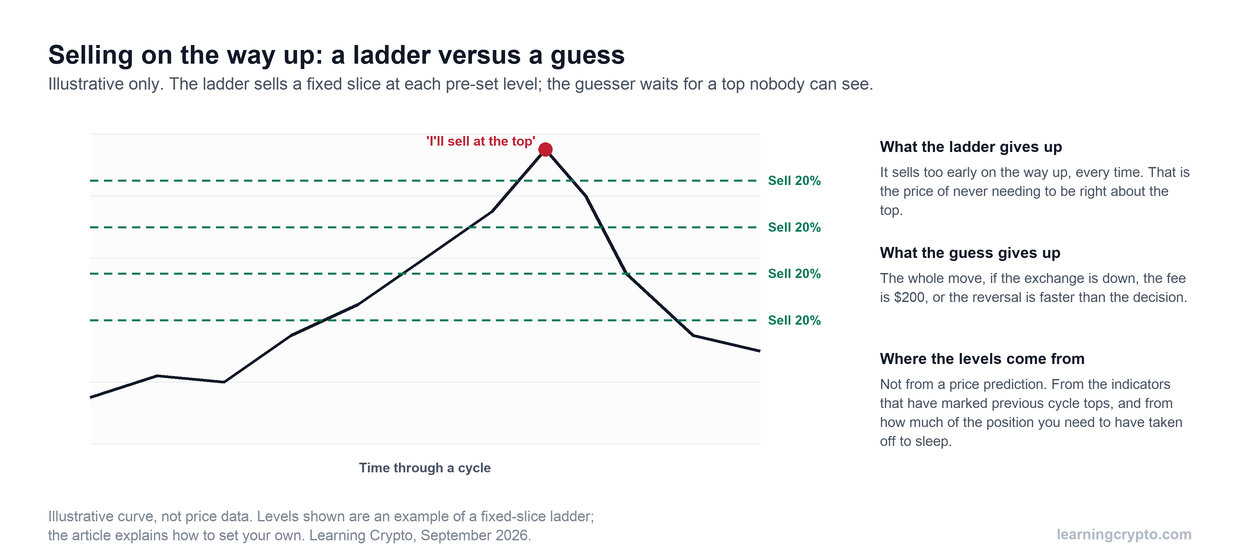 Analysis
How to Take Profits in Crypto: The Ladder We Use Instead of Guessing the Top
Take profits in crypto by deciding the plan before the peak: fixed slices of a position sold at pre-set levels, on a venue you have tested, with the tax treatment of each sale already known. Nobody sells the top; the ladder sells early on purpose. Across three cycles on the channel, the losses we have seen came from waiting for a number.
Toby CunninghamAnalysis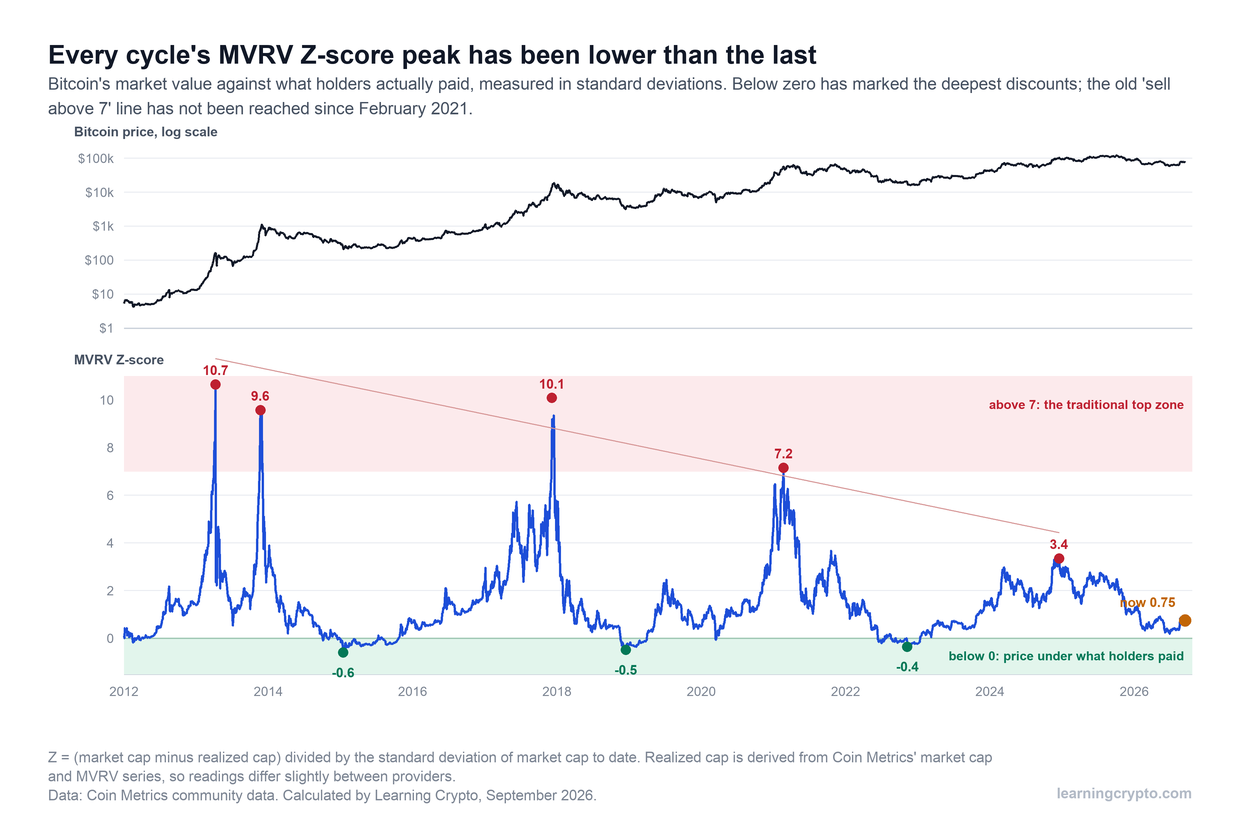 Analysis
MVRV Z-Score Explained: How to Read Bitcoin's Most Watched Valuation Metric
The MVRV Z-score compares Bitcoin's market value with what holders actually paid, scaled by volatility. Readings below zero marked the 2015, 2018 and 2022 lows, and readings above 7 marked the 2013, 2017 and early 2021 tops. Each cycle's peak has been lower than the last, and this cycle topped at just 3.4. In mid-September 2026 it read 0.75.
Toby CunninghamAnalysis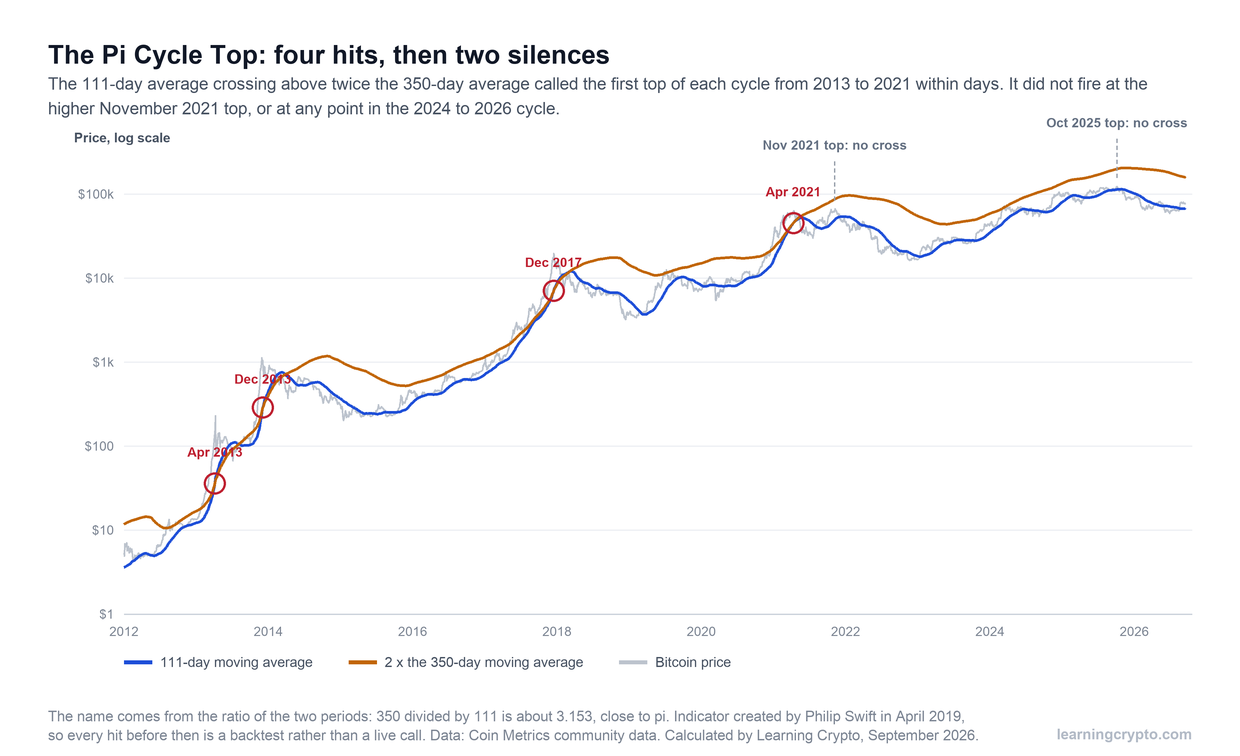 Analysis
The Pi Cycle Top Indicator: How It Works, What It Caught and What It Missed
The Pi Cycle Top fires when Bitcoin's 111-day moving average crosses above twice its 350-day average. It caught the April 2013, December 2013, December 2017 and April 2021 tops within days. It did not fire at the November 2021 top or at any point in the 2024 to 2026 cycle, which peaked in October 2025 with the ratio at 0.57.
Toby CunninghamAnalysis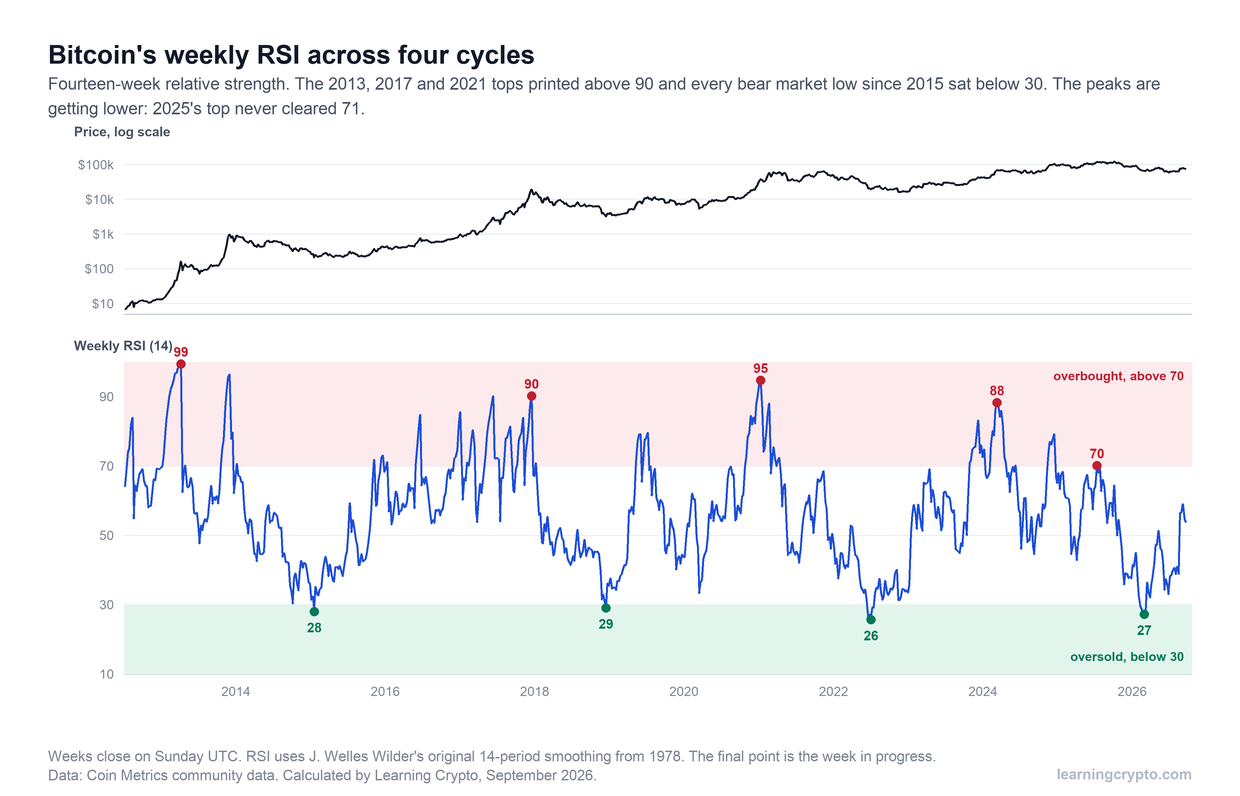 Analysis
Bitcoin Weekly RSI: What It Shows About Cycle Tops and Bottoms
Bitcoin's weekly RSI weighs fourteen weeks of gains against losses on a 0 to 100 scale. Every bear market low since 2015 printed below 30, and the 2013, 2017 and 2021 tops printed above 90. In 2022 and 2026 the oversold reading came months before the final price low, which then arrived with a higher RSI.
Toby CunninghamAnalysis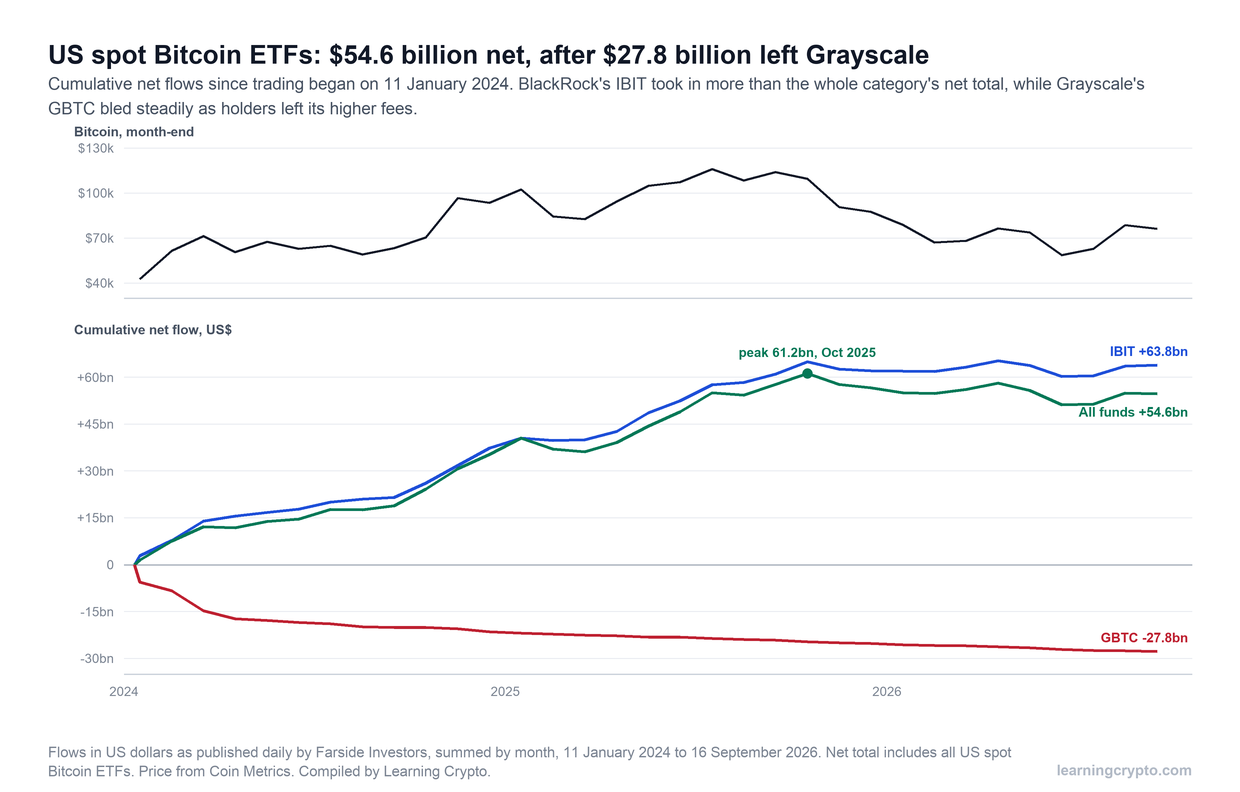 Analysis
Bitcoin ETF Flows Explained: What the Daily Numbers Mean for Price
Bitcoin ETF flows are the net dollars entering or leaving US spot Bitcoin funds each trading day. Since January 2024 they total $54.6 billion net, led by BlackRock's IBIT, while Grayscale's GBTC lost $27.8 billion. Monthly flows have moved with the same month's price, but have said almost nothing about the month after.
Toby CunninghamAnalysis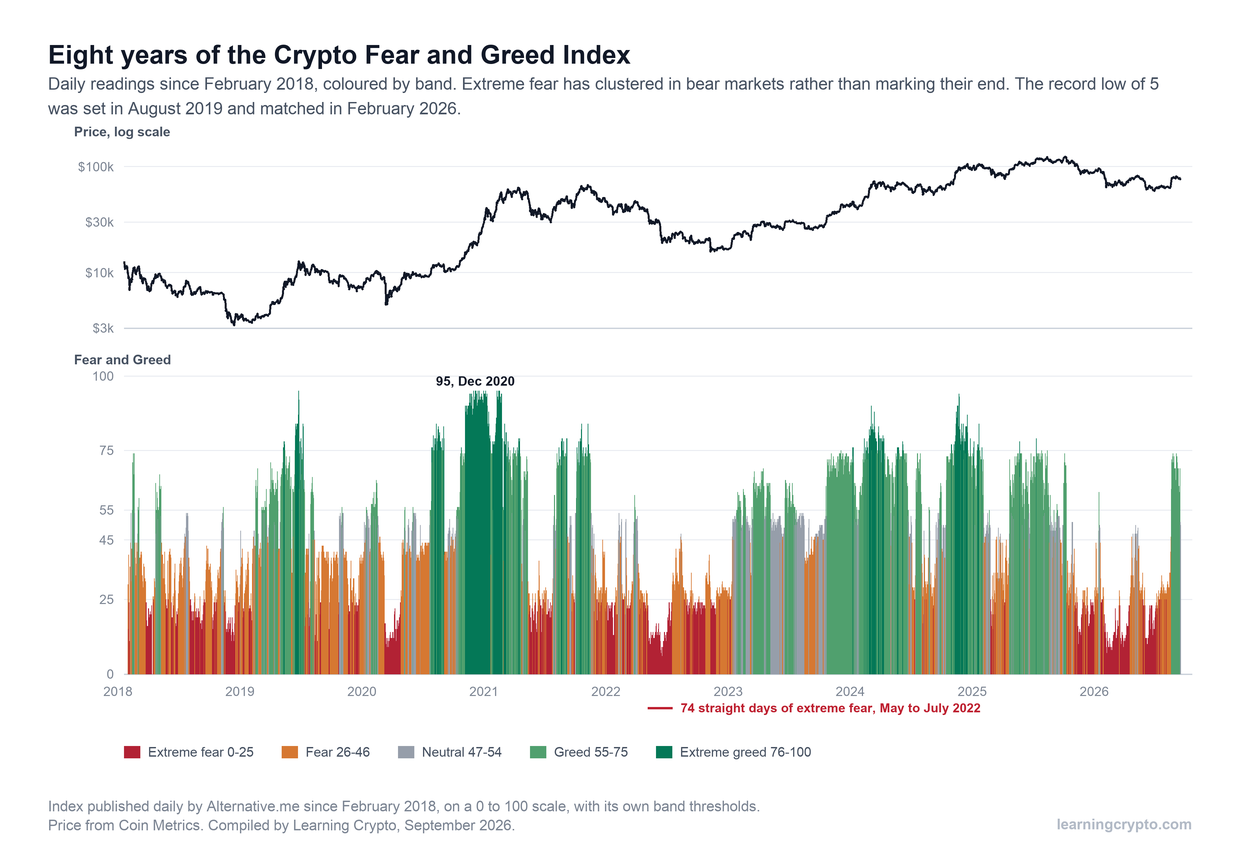 Analysis
Crypto Fear and Greed Index: What It Measures and What Its Record Shows
The Crypto Fear and Greed Index scores market mood from 0 to 100 using volatility, momentum, social media, Bitcoin dominance and search trends. Since 2018, extreme fear has not been a reliable buy signal on its own: three and six months later Bitcoin was lower more often than not, because fear lingers through bear markets.
Toby CunninghamAnalysis Analysis
How to Read a Crypto Whitepaper
Read a crypto whitepaper like a sceptic, not a fan: ask whether the problem is real, whether blockchain is actually needed, how tokens are distributed and vested, and whether the team is named and verifiable. Insider allocations above 30 to 40% with vesting under 12 months, plagiarised text, no working product and an anonymous team raising large sums are the main red flags.
13 min read/Heidi ChakosAnalysis Analysis
What Are Crypto Prediction Markets? How Polymarket and Onchain Betting Work
Crypto prediction markets are platforms where you buy yes or no shares on a future event, priced between $0 and $1 to reflect the crowd's probability; winning shares pay $1. Onchain platforms like Polymarket hold funds in smart contracts on Polygon, settle in USDC and resolve outcomes through UMA's optimistic oracle. Kalshi is the CFTC-regulated option for US residents.
17 min read/Heidi ChakosAnalysis Analysis
On-Chain Analysis: Reading Blockchain Data to Understand Markets
On-chain analysis is reading the public transaction data on a blockchain (wallet movements, exchange flows, coin age, miner activity) to understand what participants are actually doing rather than only what price is doing. The core Bitcoin metrics are exchange netflow, MVRV, SOPR, active addresses, HODL waves and hash rate, available through Glassnode, CryptoQuant and Nansen. It gives cycle-level context; it does not predict price.
13 min read/Heidi ChakosAnalysis Analysis
Tokenomics Explained: Master Crypto Project Economies & Value
Tokenomics is the economic design of a crypto project: the rules for how a token is created, allocated, distributed and used. It rests on three pillars, supply, distribution and demand, and is usually hardcoded at launch. To analyze it, compare market cap with fully diluted valuation, check circulating supply and release schedules, and ask whether rewards come from real revenue or pure inflation.
14 min read/Heidi ChakosAnalysis Analysis
Agentic Finance: How AI Agents Are Reshaping Crypto Investing
Agentic finance is the use of autonomous AI agents that analyze data, make decisions, and execute financial actions without a human approving each step. In crypto they already hold wallets, trade across DeFi, and pay in stablecoins over rails like x402. Safe use rests on scoped permissions (EIP-7702 and session keys), on-chain identity (ERC-8004), spending policies, and auditability. Most tools still target developers.
Heidi ChakosAnalysis Analysis
Mastering DYOR in Crypto: Your Step-by-Step Research Framework
DYOR (Do Your Own Research) means independently investigating a crypto project before committing money, instead of trusting a tweet or an influencer. A workable process has six steps: read the whitepaper for a real problem and solution, verify the team, analyze token supply and vesting, check roadmap delivery and GitHub activity, confirm on-chain data like holder concentration, then seek credible critics. First pass: several hours.
16 min read/Heidi ChakosAnalysis Analysis
What Is a Crypto Whale and Why Do They Matter?
A crypto whale is an individual or entity holding enough cryptocurrency to influence prices when they move funds, roughly 1,000 or more BTC or 10,000 or more ETH. Whales include early adopters, institutions, exchanges holding customer funds, and anonymous wallets. Their transfers move markets partly through the trades and mostly through how smaller holders react, so treat whale alerts as context, not a trading signal.
15 min read/Heidi ChakosAnalysis Analysis
What Is a Crypto Bull Run and When Is the Next One Coming?
A crypto bull run is a sustained, months-long rise in crypto prices driven by growing demand, fresh capital inflows and a shift from fear to greed. Every past bull run peaked 12-18 months after a Bitcoin halving. Bitcoin topped at $126,210 in October 2025, so the next one likely builds toward the 2028 halving unless this is a mid-cycle correction.
Heidi ChakosAnalysis Analysis
What Is DCA in Crypto? Your Complete Guide to Dollar Cost Averaging
DCA (dollar-cost averaging) in crypto means investing the same amount on a fixed schedule, weekly or monthly, no matter what the price is doing. You automatically buy more coins when prices dip and fewer at peaks, smoothing your average cost without timing the market. Exchanges like Coinbase, Kraken, Swan and Strike automate recurring buys; Bitcoin and Ethereum are the usual starting points.
Heidi ChakosAnalysis Analysis
What Is Exit Liquidity in Crypto and Why You Should Care
Exit liquidity is what you become when your buy order lets someone else sell at the top: whales, early investors, or founders cashing out into hype. The pattern is quiet accumulation, coordinated hype, distribution into strength, then a crash that can leave latecomers down 80%. Warning signs include guaranteed-return promises, pumps with no fundamentals, price-obsessed communities, and restrictions on selling.
12 min read/Heidi ChakosAnalysis Analysis
What Is FDV (Fully Diluted Valuation) in Crypto?
FDV, or fully diluted valuation, is a crypto token's price multiplied by its maximum (or total) supply: what the market cap would be if every token were already circulating. Divide FDV by market cap to gauge dilution risk: a ratio near 1.0 (Bitcoin about 1.05, Solana 1.13) means most tokens already circulate; above 5 or 10, large releases could weigh on the price.
Heidi ChakosAnalysis Analysis
What Is Market Cap in Crypto: A Complete Guide
Market cap in crypto is the current price multiplied by circulating supply, so it measures a project's total value rather than the misleading price of one coin. Large caps sit above $10 billion, mid caps between $1 billion and $10 billion, and small caps below $1 billion, with risk rising as size falls. Check trading volume and fully diluted valuation too.
Heidi ChakosAnalysis Analysis
What Are Blue Chip Cryptocurrencies? A Guide to Crypto's Safest Assets
Blue chip cryptocurrencies are the established digital assets that have survived market cycles, hold large market caps, trade with deep liquidity, and swing less than small-cap coins. Bitcoin and Ethereum are the clearest examples, alongside Solana, BNB and XRP. They are not risk-free, but they offer a more measured way to hold crypto, and most beginners start with the big two.
11 min read/Heidi ChakosAnalysis Analysis
How AI & Bots Are Reshaping Crypto Trading in 2026
Crypto trading bots are software that connects to exchanges through APIs and buys or sells automatically on preset rules, running 24/7 without fear or greed. Popular options include Cryptohopper, Pionex (free built-in bots, 0.05% trading fee), 3Commas and Altrady. They are not set-and-forget: bots can fail in flash crashes, over-fit their backtests, and add API security risk, so oversight still matters.
Heidi ChakosAnalysis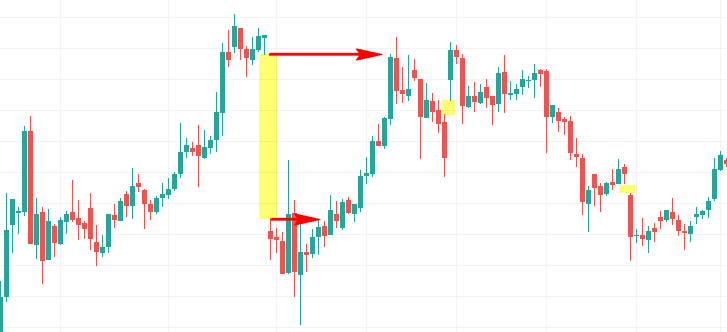 Analysis
CME Gaps Explained: How They Impact Bitcoin Price and Trading Strategies
A CME gap is a blank space on the CME Bitcoin futures chart left when Bitcoin moves while CME is closed, usually over the weekend. Traders watch gaps because price often returns to fill them, and unfilled gaps tend to act as support or resistance. Some gaps stay open for months or years, so treat gap-fill as a tool, not a guarantee.
Heidi ChakosAnalysis Analysis
Hottest Crypto Picks to Buy Today for Long Term: Experts Reveal
For long-term holding, the assets most worth studying are Bitcoin and Ethereum as the foundation, then Solana, Chainlink, Avalanche, Polkadot, Arbitrum and BNB for growth and infrastructure exposure, each judged on market cap, utility, developer activity and adoption. Crypto remains high-risk and volatile, so diversify, use a hardware wallet, invest only what you can afford to lose and do your own research. Education, not advice.
Heidi ChakosAnalysis Analysis
How Much To Invest In Crypto Monthly? [A Quick Complete Guide]
A sensible starting point is 1-5% of your monthly income, invested on a fixed schedule through dollar-cost averaging. On a $3,000 income that is $30 to $150 a month; even $10 to $50 builds the habit. Lower-risk investors keep 1-2% in Bitcoin and Ethereum, higher-risk up to 5% with some altcoins. Automate recurring buys and only use money you can afford to lose.
Heidi ChakosAnalysis Analysis
What Does Volume Mean In Cryptocurrency? [A Complete Guide]
Volume in crypto is the total number of coins or tokens traded over a given period, shown as a histogram under the price chart. High volume means deep liquidity and real conviction behind a move; a rally on falling volume is a warning sign. OBV and Chaikin Money Flow help read it, but wash trading and thin markets distort the numbers.
Heidi ChakosAnalysisAnalysisGuide to Long Term Crypto Investment Strategy
A long-term crypto strategy means staying the course through volatility rather than reacting to swings like Bitcoin's fall from over $68,000 in 2021 to under $20,000 by mid-2022. Research the sectors shaping the market such as DeFi and Layer 2, diversify, secure your assets, keep detailed transaction records, and remember that crypto gains are taxable in most countries. Educational only, not financial advice.
4 min read/Heidi ChakosAnalysis Analysis
Cryptocurrency Analysis With AI [Everything You Need To Know]
AI crypto analysis applies machine learning to price history, news sentiment and on-chain data to spot patterns, flag risk and automate trades. Deep learning models such as LSTM networks have reached roughly 60% to 70% accuracy on price direction, useful but nowhere near a crystal ball. Platforms like Token Metrics and Incite AI package these capabilities, yet results still depend on data quality and oversight.
Heidi ChakosAnalysisAnalysisWhat Makes a Cryptocurrency Successful: A Comprehensive Guide
A cryptocurrency succeeds when it combines a credible development team, real utility, an engaged community, a transparent white paper, and sound tokenomics such as Bitcoin's 21 million cap or BNB's burn mechanism. High trading volume brings liquidity and steadier prices, and gradual growth beats spikes followed by crashes. Regulatory compliance and regular, transparent communication build the investor trust that drives adoption.
Heidi ChakosAnalysis Analysis
Arbitrage Trading in Crypto: How to Profit from Price Differences
Crypto arbitrage means buying an asset on one exchange and selling it on another where it trades higher, pocketing the gap. It is legal and gaps still appear, but typical spreads have shrunk to 0.1% to 2% and vanish in seconds, so the profit goes to automated bots with large capital and low fees. For most retail traders, fees and speed make it unprofitable.
Toby CunninghamFAQ
What is on-chain analysis?
Reading blockchain data — transfers, exchange flows, holder distribution — to understand what large players and networks are actually doing, not just what price did.
How does this connect to Learning Crypto tools?
Guides teach the frameworks. Members use the Satoshi Indicator, Daily Brief, and Ask Crypto for ongoing signals and Q&A on top of that foundation.