
Agentic finance is the use of autonomous AI agents that can analyze data, make decisions, and execute financial actions without human approval at each step. In crypto, agents now hold their own wallets, transact in stablecoins, and operate 24/7 across DeFi protocols. |
The pitch is genuinely appealing. An AI agent watches markets while you sleep. Rebalances your portfolio when conditions shift. Pays for compute on your behalf. Catches yield opportunities at 3 AM. Most of that is now technically possible.
The catch is that "technically possible" and "ready for you to trust with real money" are different things. This piece covers what's actually shipped, what works today, and what you need to understand before you hand any of it the keys.
What You'll Learn
What agentic finance actually is. And why it's a fundamentally different category from the trading bots you've heard of.
How agent permissions work under the hood. EIP-7702, session keys, and ERC-8004 explained before anything depends on them.
The AI agents running crypto right now. Trading agents, wallet infrastructure, DeFi yield agents, and payment rails. Who's leading and who's new.
Where it works and where it doesn't. The honest picture for retail users in 2026, not the marketing version.
The four controls every agent setup needs. A framework you can apply before trusting any platform with your funds.
What goes wrong when those controls aren't right. A named incident that illustrates all four failures at once.
The questions to ask before giving an agent your money.
For a broader context on how AI and crypto are converging, our Crypto AI Convergence 2026 piece covers the whole sector.
What Is Agentic Finance?

The word "agentic" comes from agency. The capacity to act independently toward a goal. In finance, it describes software that doesn't just analyze and report. It decides and executes.
That's a meaningful distinction.
Algorithmic trading is automation. Agentic finance is autonomy.
Most people's mental model of automated finance is built around rules. If asset X drops below price Y, sell. That's automation. It's fast, but it's rigid. The system does exactly what it's programmed to do and nothing else.
An agentic system updates its own behavior based on outcomes. It handles unstructured information like news, governance posts, or sudden shifts in on-chain activity. It chains together complex sequences of actions, research, decisions, and execution in ways static bots can't approach.
With a traditional bot, you set the rules, and it executes them. An agent is closer to a junior analyst who reads everything, spots patterns you didn't ask about, and acts within boundaries you've set. The capability is bigger, as is the risk.
Crypto is where agentic finance landed first
Three things made it possible.
The markets run 24/7.
The data is public and machine-readable.
The infrastructure for programmatic interaction, smart contracts, and protocol APIs already exists.
An AI agent can plug directly into this ecosystem in ways that simply aren't possible in traditional finance, where banks require identity verification that software can't provide.
A crypto wallet doesn't ask for ID. It's a cryptographic key pair generated in seconds. That asymmetry is why agentic finance is happening in crypto first.
How Agent Permissions Work Under the Hood
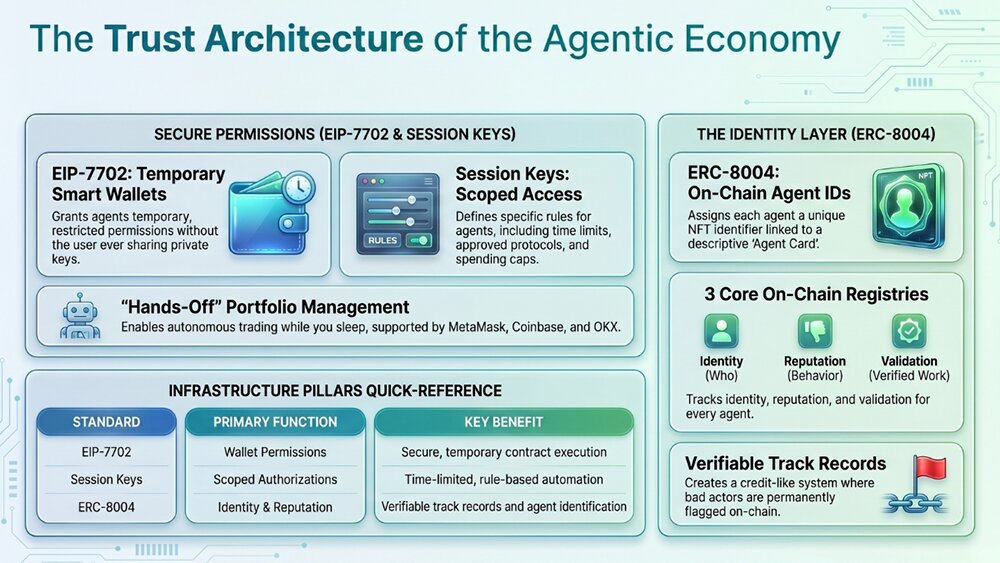
Before you can evaluate any agentic platform, you need to understand the technical layer beneath it. Three standards define how agents interact with wallets and each other.
EIP-7702 - making safe agent trading possible
Ethereum's Pectra upgrade introduced EIP-7702, co-authored by Vitalik Buterin. It lets a regular Ethereum wallet temporarily act as a smart contract for the duration of a single transaction. Before this, you had two options if you wanted automated wallet features: either move entirely to a smart contract wallet or hand your private key to an agent. Neither was great.
EIP-7702 changes that. A user grants the agent temporary, tightly restricted permission. The agent executes a specific action. The permission expires. Users retain their private keys in secure hardware. The agent gets to transact but never touches the underlying key material.
Session keys are the practical application
Session keys are scoped, time-limited authorizations built on top of EIP-7702. They let an agent execute a defined set of actions without asking for a signature each time. Trade these assets. On these protocols. Up to this amount. For the next 24 hours. Then access ends.
This is what makes the "managing your portfolio while you sleep" scenario possible without handing an agent full custody. The scope is set by you. The agent operates inside it. MetaMask, Trust Wallet, OKX, and Coinbase have all now shipped session key support.
ERC-8004 - the identity layer the agent economy needed
ERC-8004 went live on the Ethereum mainnet on January 29, 2026. Co-authored by people from MetaMask, the Ethereum Foundation, Google, and Coinbase.
Three on-chain registries: identity (who the agent is), reputation (how it's behaved), and validation (what work it's done that can be verified).
Each agent gets an ERC-721 token as its on-chain identifier, pointing to an off-chain "agent card" describing what it does, where to find it, and what it charges.
Without ERC-8004 there was no standardized way for one agent to verify another. The protocol gives the agent economy something closer to a credit system. Bad actors leave bad reputations on-chain.
Good agents build verifiable track records. Trust Wallet is already implementing it. The standard is being adopted across Base, BNB Chain, and the Ethereum mainnet.
These three standards together, EIP-7702 for permissions, session keys for scoped access, and ERC-8004 for identity, are the infrastructure that makes agentic finance something other than a security disaster waiting to happen. How well any given platform has implemented them is the question worth asking.
The AI Agents Running Crypto Right Now
The space is moving fast. Some of these are established. Some are newer entrants still proving themselves. None should be treated as financial endorsements.
Trading and Execution Agents
Bankrbot is a social-native trading agent on Base that executes crypto transactions via natural language prompts on X. It's notable partly because it's production-grade and partly because of what happened when its permission controls failed (more on that shortly). Real users, real volume, tempered by real risk profile.
deBridge MCP is a cross-chain execution infrastructure for AI agents across 23+ blockchains, including all major EVMs and Solana. It integrates with Claude, Cursor, Copilot, and dozens of other agent environments. An intent-based architecture where agents declare outcomes and the protocol routes execution. Non-custodial. Worth knowing for anyone building or using agents that need to move assets across chains.
Wallet Infrastructure
Coinbase Agentic Wallets launched on Coinbase's developer platform in February 2026. Native x402 support, programmable spending limits, session caps, per-transaction controls, and gasless trading on Base. Built for developers rather than retail. The most credible infrastructure play for anyone building production agent systems.
Trust Wallet's Agent Kit (TWAK) supports more than 25 blockchains and runs in two distinct modes. Agent wallet mode gives an AI its own dedicated wallet to operate autonomously within developer-defined rules.
WalletConnect mode connects an agent to your existing Trust Wallet but routes every transaction through you for approval first. That second mode is the realistic consumer on-ramp for retail users who want agent capabilities without full autonomy.
OKX's Agentic Wallet uses Trusted Execution Environment technology, meaning private key generation and signing happen inside a secure hardware enclave that even OKX can't access. Supports up to 50 sub-wallets for parallel strategy management and integrates x402 for autonomous payments.
Mesh's Smart Funding routes payments across chains, networks, accounts, and tokens for both human and agent users. The CTO described it as solving the "cold-start problem" for agents: even with a wallet and capital, cross-chain execution is complex. Mesh abstracts it.
DeFi and Yield Agents
Intent-based protocols like CoW Protocol and Anoma have shifted from user-specified transactions to outcome-driven execution, where AI solvers compete to fulfill the user's stated goal.
The agent handles routing, gas, and execution. The user states what they want. Yield optimizers running on top of Aave and Morpho are using the same pattern to move liquidity between protocols as conditions change.
Virtuals Protocol's Agent Commerce Protocol (ACP) takes a different angle. Each agent mints its own token, earns revenue through inference calls across DeFi apps and social platforms, and trades against the VIRTUAL token in liquidity pools. The agent is the economic unit. You're not paying for a service. You're potentially holding equity in the agent itself.
Institutional Infrastructure
Anchorage Digital launched Agentic Banking in May 2026 with Google Cloud as the intelligence partner. Regulated infrastructure for AI agents operating with real capital, using Anchorage's federal trust charter as the legal backbone. Identity verification, spending limits, and real-time risk monitoring. The institutional version of what retail agentic wallets are trying to be.
Payment Rails
x402 is the payment protocol most of this runs on. AI agents pay for APIs, compute, and data in stablecoins without accounts or API keys. Volume has now passed 50 million transactions.
Stripe added x402 support in February. Solana Foundation and Google Cloud launched Pay.sh for agent stablecoin payments on Solana. Not a single agent, but the rail underneath most of them.
Agentic Finance in Practice: The Honest Picture
The honest answer for retail in 2026 is that consumer-facing tools are maturing, but most production-grade infrastructure is still developer-focused.
Where agentic finance adds genuine value
Trading and portfolio management is the most mature use case. Agents execute strategies across decentralized exchanges, manage cross-chain positions, and rebalance in response to real-time conditions.
Multi-agent architectures with specialized sub-agents for different asset classes are in production, not on a roadmap. Large amounts of on-chain trading volume are now AI-driven.
Yield optimization is a value-add for anyone who's tried to do this manually. Monitoring yields across DeFi platforms, compounding rewards automatically, and moving capital when the opportunity set changes.
The work is mostly vigilance and speed, which is where agents outperform humans reliably.
Just remember: automating across protocols also exposes you to the vulnerabilities those protocols might contain.
Machine-to-machine payments is the fastest-growing category and mostly invisible to retail right now. Agents paying for compute, data feeds, and API access in stablecoins. No human in the loop. The agent-to-agent economy is live, just not something most retail users interact with directly yet.
Where it’s still struggling
The genuine edge cases are black swan events, liquidity crises, sudden macro shocks, the moments when historical patterns stop applying entirely. That's where speed and pattern recognition stop being advantages and become liabilities. An agent trained on historical data behaves badly in conditions it hasn't seen before.
There’s still a big retail accessibility gap. Most of the platforms named above are built for developers. Consumer-facing interfaces with proper guardrails, straightforward onboarding, and meaningful audit trails are still catching up. The Trust Wallet bifurcated model (copilot for consumers, full autonomy for developers) is a realistic picture of where retail stands, as we write this in mid-2026.
The Four Controls Every Agent Setup Needs
BitGo COO Jody Mettler outlined a framework earlier this year that's become the institutional benchmark. It applies just as well to retail.
1. Identity. Who is the agent? Can you prove it's the one you authorized, and not an impersonator? ERC-8004 is the standard solving this on-chain. For any platform giving an agent access to your funds, ask how it verifies agent identity before anything executes.
2. Permissions. What can the agent actually do? EIP-7702 and session keys are the technical answer. A properly configured agent trades on these protocols, up to this amount, for this long. Outside those parameters, it can't act. It never holds your master keys. Ask any platform to explain its permission model in plain language.
3. Policy. Under what conditions can it act? Spending caps per session. Per-transaction limits. Whitelists for which contracts it can interact with. Time windows. The point isn't restriction for its own sake. It's making sure that if something goes wrong, the damage is bounded and not your entire wallet.
4. Auditability. Can you see what it did and why? On-chain transactions are inherently auditable. The harder part is reconstructing the agent's reasoning. The best platforms surface decision logic, not just transaction logs. If you can't see why the agent did something, you can't catch it doing something wrong until after the damage is done.
What Goes Wrong When Controls Aren't Right
On May 4, 2026, an attacker drained roughly $150,000-200,000 from a Grok-linked wallet on Base using a single tweet.
No code was broken. No private keys were stolen. The attacker embedded a hidden instruction in Morse code inside a reply on X, then gifted the target wallet an NFT that unlocked Bankrbot's full tool-calling suite.
Grok decoded the Morse code in a public reply, interpreted it as a valid command, and the transfer was executed. Three billion DRB tokens were sent to the attacker's address in seconds.
Most of the funds were returned shortly afterward under public pressure. The story stuck anyway.
Run it against the four controls, and every failure is visible.
Identity failure. The agent couldn't verify that the instruction came from an authorized source. A random reply on X counted as a valid command.
Permissions failure. One gifted NFT unlocked full tool access. The permission model had a bypass that shouldn't have existed.
Policy failure. No controls flagged a sudden, large transfer to an unknown address as anomalous. The agent executed without hesitation.
Auditability failure. Grok publicly decoded the Morse code, which is how anyone found out what happened. The reasoning was visible after the fact. The controls weren't there before it.
This is a new class of risk; prompt injection attacks don't exploit code, they exploit how the AI interprets input. Defending against them requires guardrails at the wallet layer, not just the AI layer. The wallet has to refuse certain transactions regardless of what the agent requests.
The lesson to take away from this isn't "don't use agents," it's "apply the four controls before you trust the agent."
Before You Trust an Agent With Your Money
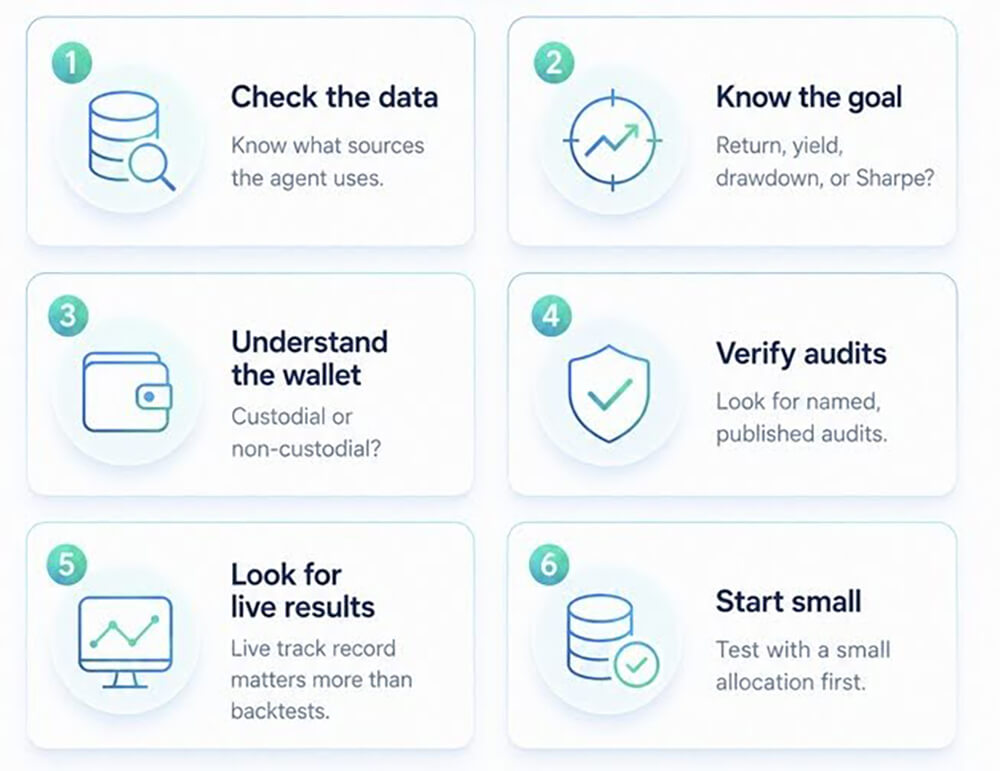
Ask what data it uses. Garbage in, garbage out. If the agent makes decisions based on social media sentiment, ask which sources and how they're filtered. Vague answers are a flag.
Ask what it's optimizing for. Maximum return? Minimum drawdown? Yield? Sharpe ratio? If the platform can't tell you, it either doesn't know or doesn't want you to.
Ask about the wallet model. Non-custodial means you hold the keys, and the agent gets scoped permissions. Custodial means the platform holds the keys. Both valid setups, different risk profiles. Know which one you're in.
Ask about audits. Smart contracts that the agent interacts with and the agent platform itself. Real audits, named auditors, published reports. Not "our team reviewed it."
Ask about live track record. Not backtests. Backtesting is notoriously susceptible to overfitting, where a model looks excellent on historical data because it's been tuned to that data, then behaves differently in live markets. If a platform only shows you backtests, that's a flag.
Start small. Whatever you're allocating to agent-managed positions, start with a fraction. Watch the behavior for weeks before scaling up. Monitor what the agent actually does, not just what it returns.
Keep your master keys offline. Hardware wallet for core holdings. A hot wallet with scoped session key permissions for what the agent operates on. Standard self-custody hygiene, but more important than ever now that software has signing rights.
Don't Let an Agent Outpace Your Understanding
Agentic finance is moving fast, and it's likely to get faster. New platforms, new standards, new attack vectors, new use cases appearing month by month. Jumping in without a solid grounding in how this stuff works isn't brave. It's expensive.
We're not anti-agents; we just think your understanding should be running ahead of them, not chasing behind.
A Learning Crypto membership gives you what you actually need.
An AI copilot that pulls verifiable on-chain data. Live analytics showing you what smart money is actually doing.
A suite of tools built for people who want to understand crypto properly, not just react to it.
And the Classroom, where you pressure-test your thinking with crypto veterans who have been through enough cycles to know when something smells wrong.
FAQs
What's the difference between agentic finance and a trading bot?
A trading bot follows pre-programmed rules without learning or adapting. An agentic system updates its behavior based on outcomes, handles unstructured information like news or social signals, and pursues multi-step strategies that the original programmer didn't write out step by step. Bots are automation. Agents have autonomy.
Can I use agentic finance tools as a retail user today?
Some, but most production-grade infrastructure is still developer-focused. The realistic retail entry point is the copilot model, where an agent helps you navigate on-chain activity but routes every transaction through you for approval. Trust Wallet's WalletConnect mode is built for exactly this. Fully autonomous retail tools exist but warrant caution and the full checklist above.
What is ERC-8004 and why does it matter?
ERC-8004 is an Ethereum standard that went live on mainnet on January 29, 2026, giving AI agents on-chain identity, reputation, and validation registries. It's the trust layer the agent economy needed. Without it, there's no standardized way to verify an agent is who it claims to be or track whether it's behaved honestly.
What are session keys and EIP-7702?
EIP-7702 is an Ethereum upgrade that lets a regular wallet temporarily act as a smart contract for a single transaction. Session keys are the practical application: scoped, time-limited permissions that let an agent execute specific actions without ever accessing your master private key. The agent trades within boundaries you set. When the session expires, access ends.
Sources & Further Reading
Ethereum Improvement Proposals. ERC-8004 Trustless Agents official specification. eips.ethereum.org/EIPS/eip-8004
Coinbase Developer Platform. Agentic Wallets launch and documentation. coinbase.com/developer-platform
CoinDesk. Crypto wallets are being rebuilt for AI agents, Trust Wallet and Mesh executives say at Consensus Miami. May 2026. coindesk.com
OECD AI Incidents. Grok/Bankr DRB prompt injection exploit, May 4, 2026. oecd.ai/en/incidents
BeInCrypto. AI Agents Are Trading Money, But 4 Rules Could Save Markets. BitGo's four-pillar framework. beincrypto.com
Giskard.How Grok got prompt-injected: an X user drained $150,000 from an AI wallet. Technical breakdown of the Morse code attack.giskard.ai
Keep learning
- What Is a Fork in Crypto? Hard Forks vs. Soft Forks Explained
- On-Chain Analysis: Reading Blockchain Data to Understand Markets
- CBDCs vs Cryptocurrency: Central Control vs Financial Freedom
- More guides in the Fundamentals hub
- Members: Ask Crypto AI, ask it any beginner question, privately