
DeFi guides
DeFi lets you trade, lend, and earn yield without a broker — and introduces smart-contract, oracle, and liquidity risks traditional finance does not. These guides explain the mechanics and the failure modes.
 DeFi
DeFiIs Crypto.com Safe? Licences, Hacks, Complaints and the CRO Decision, Reviewed for 2026
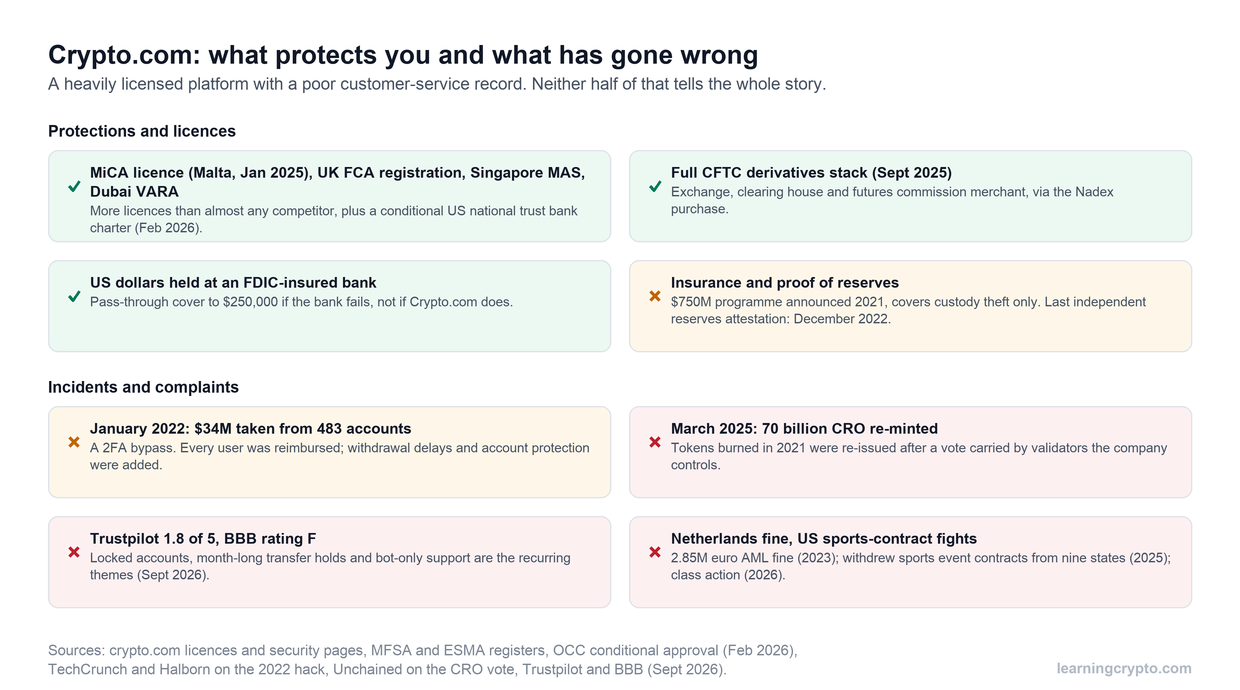
Crypto.com is safe enough to buy on and risky to store on. It holds MiCA, UK, Singapore, Dubai and US derivatives licences, and its only hack, $34 million in January 2022, was fully reimbursed. Against that: a 1.8 Trustpilot score, no independent proof of reserves since 2022, and a 2025 vote that re-minted 70 billion burned CRO. Use it as an on-ramp, not a vault.
Heidi ChakosDeFi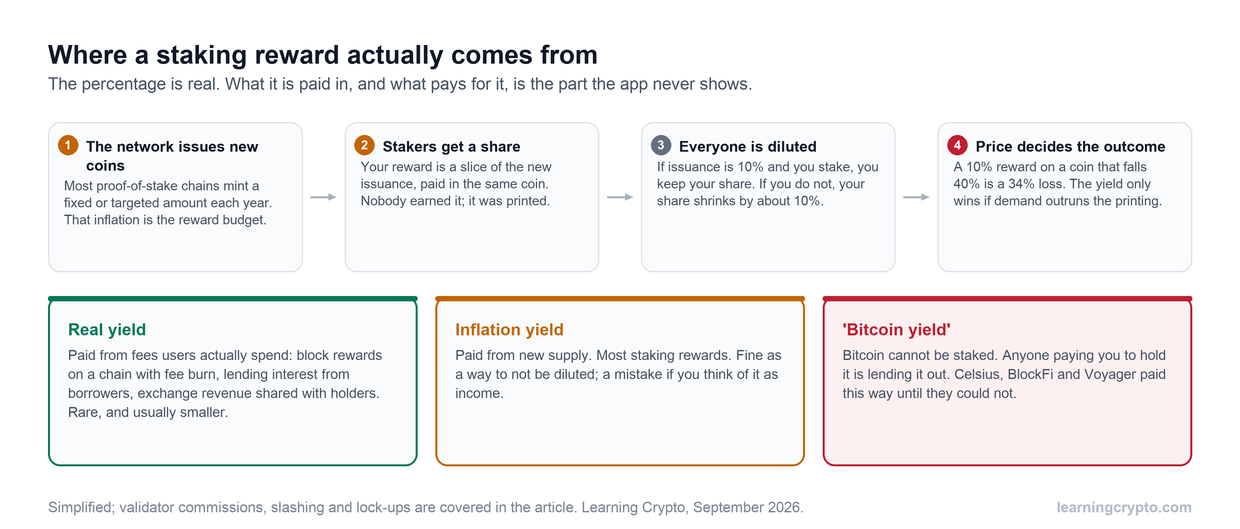 DeFi
DeFiIs Crypto Staking Worth It? Where the Yield Comes From, and When It Is a Trap
Staking is worth it when you would hold the coin anyway and the reward keeps your share from being diluted; it is a trap when you buy a coin for its yield. Most rewards are newly issued coins, so a 10% yield on a coin that falls 40% is a loss. Exchange locked staking adds custody risk, and any Bitcoin yield is lending.
Toby CunninghamDeFi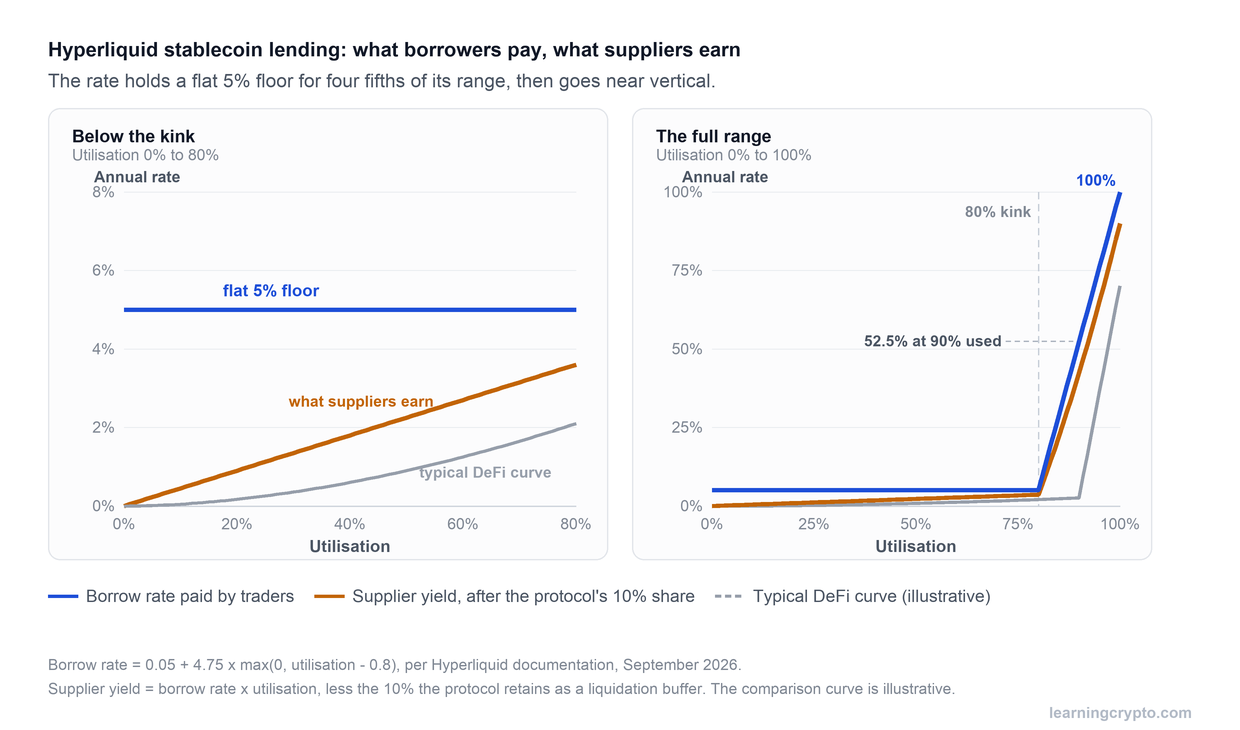 DeFi
DeFiHyperliquid Earn Explained: Where the USDC Yield Comes From
Hyperliquid Earn pays interest on USDC by lending it to traders who borrow against collateral to open larger positions. The rate is set by a formula with a 5% floor below 80% utilisation that climbs steeply above it, unlike Aave where rates fall to almost nothing when borrowing is quiet. The catch is that supplied USDC is also collateral.
Toby CunninghamDeFi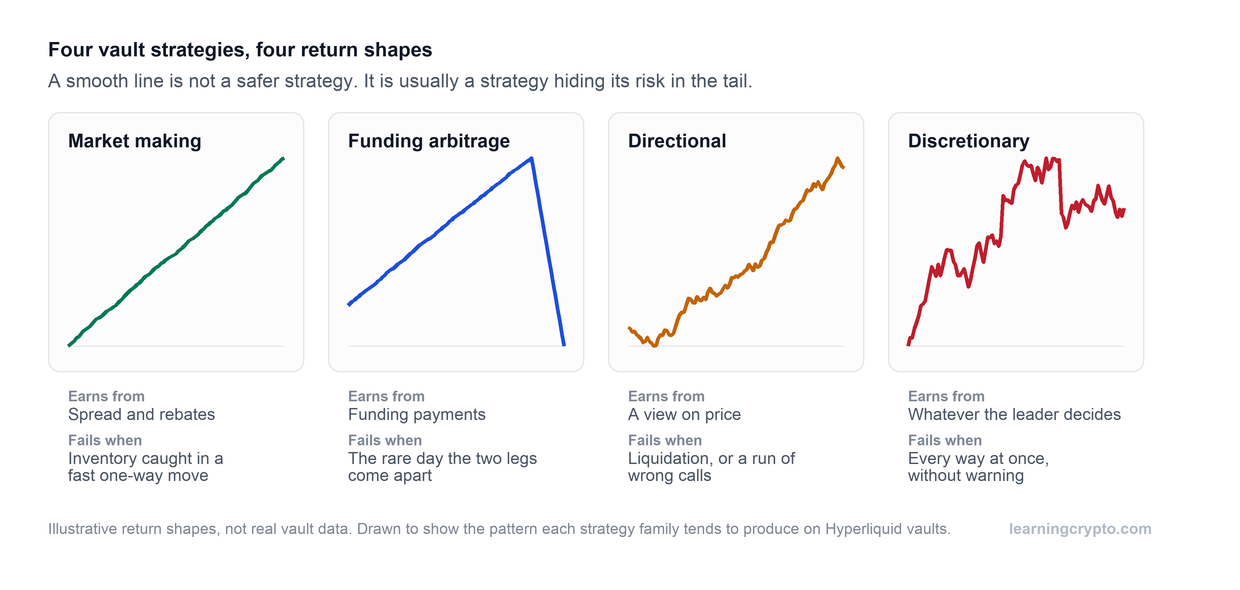 DeFi
DeFiHyperliquid Vaults Explained: Copy Trading, HLP and What You Are Actually Buying
A Hyperliquid vault is an on-chain trading account you can deposit USDC into, where a leader trades the pooled money and everyone shares the profit and loss by ownership share. User vault leaders take 10% of profits above the high-water mark and must keep 5% of the vault themselves. HLP is the protocol's own vault and charges nothing. Both can lose money.
Heidi ChakosDeFi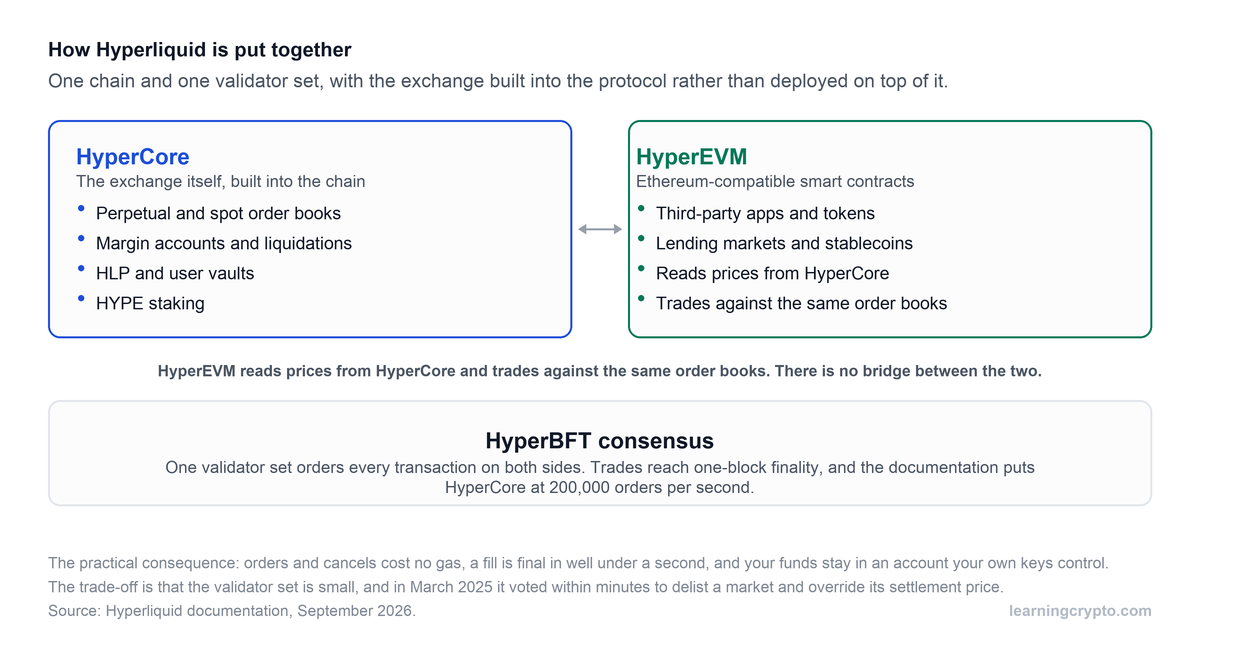 DeFi
DeFiWhat Is Hyperliquid? The Complete Beginner's Guide to the On-Chain Perps Exchange
Hyperliquid is a layer-1 blockchain that runs a fully on-chain order book for perpetual futures, with no gas on trades, no KYC, and up to 40x leverage on Bitcoin. You trade from your own wallet, fees start at 0.045% taker, and the HYPE token was airdropped to users rather than sold. It is not available to US residents, and leverage is the main risk.
Toby CunninghamDeFi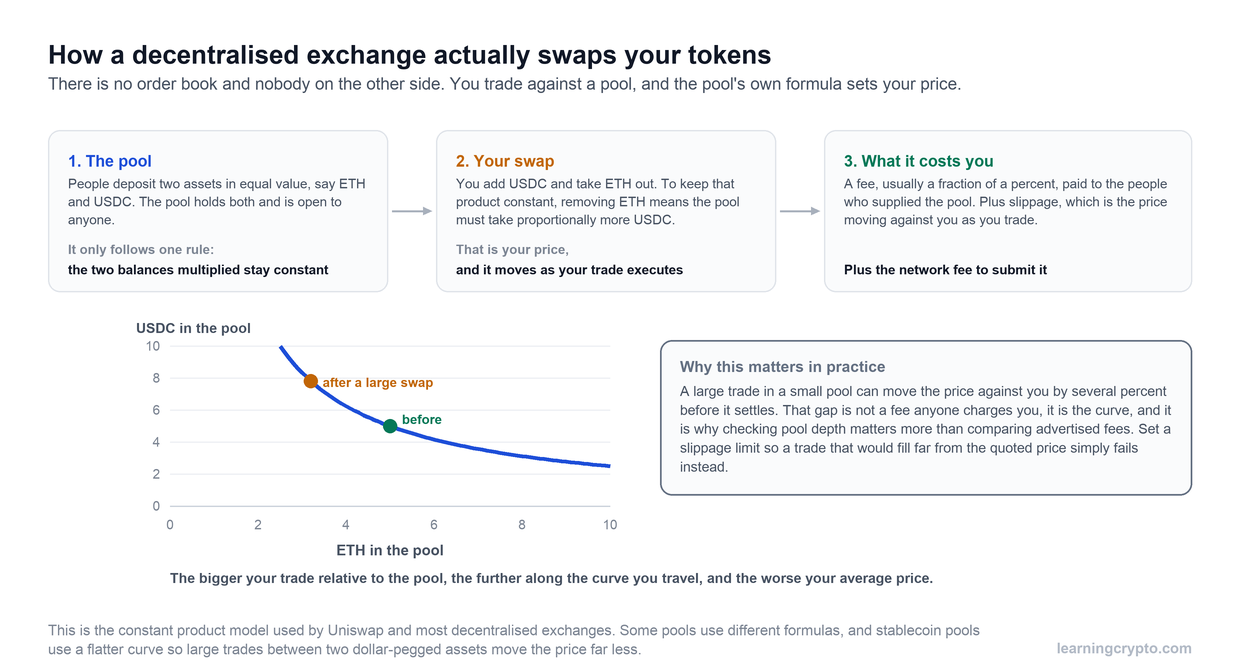 DeFi
DeFiWhat Is DeFi? A Complete Guide to Decentralised Finance
DeFi is financial services run by smart contracts on a public blockchain instead of by a company. You keep custody of your assets and need no approval to use it, which also means no deposit insurance, no reversals and no support desk. The most common way users lose money is approving a malicious contract.
Toby CunninghamDeFi DeFi
DeFiTradFi vs DeFi and The Birth of 'Invisible' Finance
TradFi and DeFi do the same jobs, holding, moving and lending money, but TradFi runs on permission and trust in institutions while DeFi runs on open code and self-custody. The five real differences are access, custody, yield, regulation and speed. The test that matters: if you hold the keys you are in DeFi; if an exchange or bank holds them you are in TradFi.
14 min read/Heidi ChakosDeFi DeFi
DeFiWhat is Liquid Staking? Your Guide to Flexible Crypto Rewards
Liquid staking lets you stake crypto for network rewards while receiving a tradeable liquid staking token (LST), such as Lido's stETH or Rocket Pool's rETH, that represents your position. You can trade, lend, or post the LST as collateral while the stake keeps earning, with no 32 ETH minimum. The trade-offs: smart contract risk, LSTs trading below peg under stress, slashing, and concentration in Lido.
Heidi ChakosDeFi DeFi
DeFiWhat Is RWA Tokenization? Real World Assets on the Blockchain Explained
RWA tokenization creates a blockchain token that represents a legally defined claim on an off-chain asset such as property, gold, Treasury bills, or private loans. A token is only as good as the legal wrapper, custodian, and redemption mechanics behind it. Private credit is the largest segment, tokenized Treasuries passed $10 billion in early 2026, and PAXG and XAUT dominate gold. Key risks: regulation, liquidity.
17 min read/Heidi ChakosDeFi DeFi
DeFiUnderstanding MEV in Crypto: Maximal Extractable Value Explained
MEV (Maximal Extractable Value, originally Miner Extractable Value) is the extra profit a block producer or bot captures by choosing which transactions enter a block and in what order. It is a structural feature of public blockchains, not a hack. Front-running and sandwich attacks give DeFi traders worse prices, while arbitrage keeps DEX prices in sync. Tight slippage and private relays reduce exposure.
Heidi ChakosDeFi DeFi
DeFiWhat Is a DAO in Crypto? A Guide to Decentralized Autonomous Organizations
A DAO (Decentralized Autonomous Organization) is a community-run organization governed by smart contracts and token-holder votes rather than a CEO or board. Its rules and treasury live on a blockchain, and funds move only when a vote passes. DAOs now govern protocols like Uniswap and Aave, hold over $24 billion in treasuries, and can gain legal status under Wyoming's DUNA. Voter apathy is their weakness.
13 min read/Heidi ChakosDeFi DeFi
DeFiWhat Is a zk-Rollup? Scaling Without Trust
A zk-rollup is an Ethereum Layer 2 that executes transactions off-chain, batches thousands of them, and posts a cryptographic validity proof plus compressed data back to Ethereum, where a verifier contract checks it. Transactions are final once the proof is accepted, so withdrawals take minutes instead of the 7-day window on optimistic rollups, and fees fall to fractions of a cent.
Heidi ChakosDeFi DeFi
DeFiWhat Is SocialFi? The Future of Social Media on the Blockchain
SocialFi (social finance) combines social media with decentralised finance so users own their identity, content and social graph on-chain and earn directly from their audience through social tokens, NFTs and tipping. Farcaster, Lens Protocol and DeSo are the main platforms today. The infrastructure is real, but user numbers are small, wallets and gas fees remain friction, and Friend.tech showed how fast speculation-driven platforms collapse.
Heidi ChakosDeFi DeFi
DeFiWhat Is ERC-20? The Standard Behind Ethereum Tokens
ERC-20 is the technical standard that defines how fungible tokens work on Ethereum. Six required functions (totalSupply, balanceOf, transfer, transferFrom, approve and allowance) make every compliant token work with the same wallets, exchanges and smart contracts. That shared language is why MetaMask can hold thousands of tokens and why DeFi protocols plug together, though compliance says nothing about whether a token is legitimate.
Heidi ChakosDeFi DeFi
DeFiWhat Does EVM Mean in Crypto? Ethereum Virtual Machine Explained
EVM stands for Ethereum Virtual Machine, the software environment that executes smart contracts on every Ethereum node so all of them reach the same result. EVM-compatible chains such as Arbitrum, Optimism, Base, Polygon and BNB Chain run the same bytecode, which is why MetaMask and Uniswap work across them. Gas units are identical on every EVM chain; only the gas price differs.
Heidi ChakosDeFi DeFi
DeFiA Complete Guide to Crypto Margin Trading
Crypto margin trading is borrowing money from an exchange, with your own crypto as collateral, to buy more cryptocurrency than your balance allows, typically at 2x to 5x. You own what you buy but owe the loan plus interest, and if collateral falls below the maintenance margin you face a margin call or liquidation. Interest can hit 1 to 2% per day.
Toby CunninghamDeFi DeFi
DeFiWhat Is Liquidation in Crypto? Understanding Forced Closures in Trading
Liquidation in crypto is the automatic, forced closure of a leveraged position when losses push your collateral below the exchange's maintenance margin, usually 10% to 20% of the position. The exchange sells at market, deducts a 0.5% to 1% fee and returns whatever is left, often close to nothing. A 5x long on Solana at $200 with 15% maintenance margin dies near $190.
Toby CunninghamDeFi DeFi
DeFiDeFi Trading Explained: How to Trade in Decentralized Finance
DeFi trading is swapping cryptocurrencies through smart contracts and community-funded liquidity pools rather than a company's order book. You connect a Web3 wallet such as MetaMask, hold some of the chain's native token for gas, and trade on a DEX like Uniswap or an aggregator like 1inch. Start with a small test swap and watch your slippage setting; flash loans and yield farming can wait.
20 min read/Toby CunninghamDeFi DeFi
DeFiPump and Dump Schemes in Crypto: How to Spot and Avoid Them
A pump and dump is market manipulation where organized groups quietly buy a thin, obscure token, flood social media and paid influencers with hype to push the price up, then sell their holdings into the retail buying frenzy. Warning signs include synchronized shilling, anonymous teams, low liquidity and promised price targets. Position limits, stop-losses and an exit plan set in advance are the practical defenses.
17 min read/Toby CunninghamDeFi DeFi
DeFiDifference Between Bitcoin & Ethereum: Breaking Down the Basics
Bitcoin and Ethereum solve different problems. Bitcoin, launched in 2009 with a hard cap of 21 million coins and proof-of-work mining, is built to be digital gold: a secure store of value and payment network. Ethereum, launched in 2015 and running proof-of-stake since 2022, is a programmable blockchain for smart contracts, DeFi and dApps with no fixed supply. Many investors hold both.
15 min read/Heidi ChakosDeFi DeFi
DeFiHow to Make Money with DeFi: Comprehensive Guide for Beginners
The main ways to make money with DeFi are yield farming, lending on protocols like Aave and Compound, providing liquidity on DEXs such as Uniswap, holding governance tokens, and staking. Each pays in fees, interest or tokens, but carries market volatility, smart contract bugs, lock-up periods and impermanent loss. Start with a self-custody wallet, a small amount and audited platforms. Nothing is guaranteed.
12 min read/Heidi ChakosDeFi DeFi
DeFiEthereum Pectra Upgrade Explained: Here’s What Experts are Saying
Ethereum's Pectra upgrade bundles the Prague execution-layer and Electra consensus-layer changes into one hard fork. Its key EIPs let regular wallets act like smart contracts (EIP-7702), raise the maximum effective validator balance from 32 to 2,048 ETH (EIP-7251), allow exits triggered from the execution layer (EIP-7002), and double blob capacity for cheaper Layer 2 transactions. Validator activation drops from about 6 hours to 12 minutes.
Heidi ChakosDeFi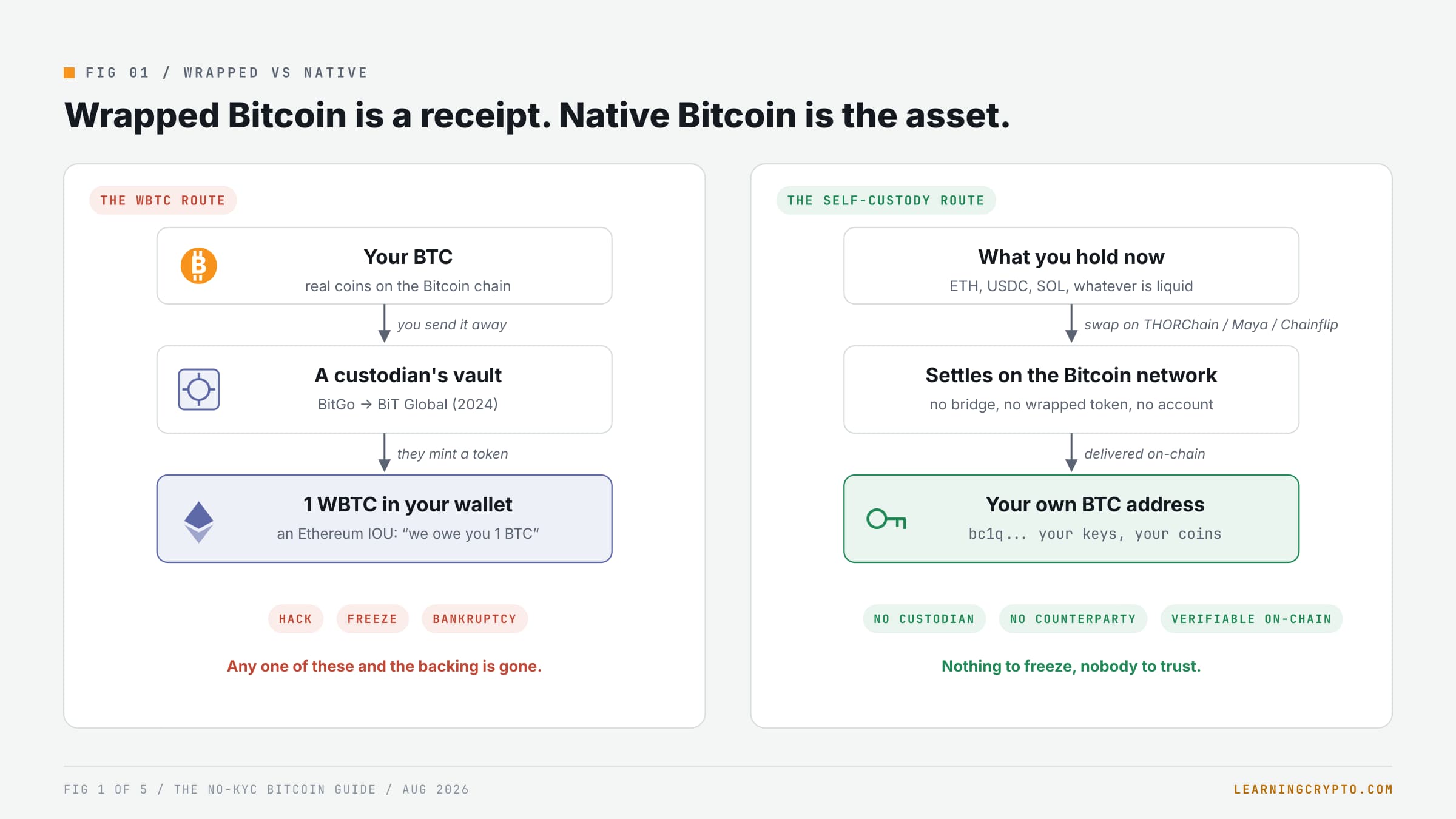 DeFi
DeFiNo-KYC Bitcoin in 2026: How to Buy, Swap, and Cash Out Without Handing Over Your ID
There is no perfect no-KYC Bitcoin solution, only trade-offs. For fiat in and out, peer-to-peer platforms like Bisq and RoboSats never learn your identity, though your bank still sees the transfer. For native BTC without a custodian, swap through THORChain, Maya Protocol or Chainflip rather than holding wrapped Bitcoin, which is an IOU. A real DEX never asks for ID. You still owe taxes.
Heidi ChakosDeFiDeFiWhat is Aave? The Future of DeFi [Explained]
Aave is a decentralised lending protocol that lets you earn interest by depositing crypto into liquidity pools or borrow against your holdings without a bank or intermediary. It runs on smart contracts, sets interest rates by supply and demand, and pioneered flash loans. It is one of DeFi's most established projects, but deposits still carry smart-contract, liquidation and regulatory risk.
Heidi ChakosDeFiDeFiBest Stablecoin Interest Rates (2025) – Compare Top Platforms
The best stablecoin interest rates come from a mix of centralised lenders like Nexo, DeFi protocols like Aave and Compound, and exchange reward programs like Coinbase's USDC rewards. Rates move with borrowing demand and are not guaranteed. Higher advertised yields almost always mean higher platform or issuer risk, so compare the source of the yield, not just the number.
Heidi ChakosDeFi DeFi
DeFiWhat Is Crypto Bridging and How Do Blockchain Bridges Work?
Crypto bridging moves a token from one blockchain to another through a protocol that either locks the original and mints a wrapped version, or pays you from a liquidity pool on the destination chain. Native Layer 2 bridges (Arbitrum, Optimism, Base) inherit Ethereum's security and are safest; third-party bridges add their own validators and risk. Over $2.5 billion has been stolen from bridges since 2021.
Heidi ChakosDeFi DeFi
DeFiWhat Is Yield Farming in Crypto? A Complete Beginner’s Guide
Yield farming is depositing crypto into DeFi protocols to earn trading fees, lending interest and token rewards. Established pools on Aave, Curve or Uniswap typically pay 3% to 20% APY; anything far higher usually signals unsustainable tokenomics. The main risks are impermanent loss, smart contract exploits and locked liquidity, and there is no deposit insurance. Beginners should start small with a stablecoin pair.
14 min read/Toby CunninghamFAQ
Is DeFi safe?
DeFi is usable and powerful, but it is not “safe” in a bank sense. Smart contracts can fail, bridges can be exploited, and approvals can be abused. Size positions accordingly.
Where should a beginner start in DeFi?
Learn what a DEX swap is, how gas and approvals work, then practice with tiny amounts on a reputable chain before chasing yield.