
Reviews & safety
Reviews & safety is where Learning Crypto ranks best: honest takes on wallets, exchanges, and “is X safe” questions. Use these guides to judge custody, counterparty risk, and product trade-offs before you commit size.
 Reviews & Safety
What Is Pepe Coin? A Look at the Token Behind the Meme
Pepe Coin (PEPE) is an ERC-20 meme token deployed on Ethereum on April 17, 2023 by anonymous developers, using Matt Furie's Pepe the Frog without his involvement. It has a fixed supply of 420.69 trillion tokens, no transaction tax, a renounced contract and no real use case. It hit a $1 billion market cap in three weeks and peaked above $11 billion in December 2024.
Heidi ChakosReviews & Safety Reviews & Safety
What Is Ape Protocol? The Complete Guide to ApeCoin and ApeChain
Ape Protocol is the ecosystem behind ApeCoin (APE) and ApeChain, a Layer 3 on Arbitrum with 0.25-second blocks, sub-cent fees and native yield on bridged assets. APE is a fixed-supply 1 billion ERC-20 token used for gas, governance and Otherside purchases. In 2025 holders voted 98% to replace the DAO with ApeCo; by early 2026 APE traded near $0.10, down 99.6% from its high.
Heidi ChakosReviews & SafetyReviews & SafetyCan You Make $100 a Day with Crypto? [Ultimate Expert Guide]
Yes, some people make $100 a day with crypto, but it is neither consistent nor guaranteed, and most day traders lose money. Passive routes need serious capital: $100 a day is $36,500 a year, which at a 5% yield means roughly $730,000 at work. Treat it as a skill to build over years, not a paycheck you can switch on.
Heidi ChakosReviews & Safety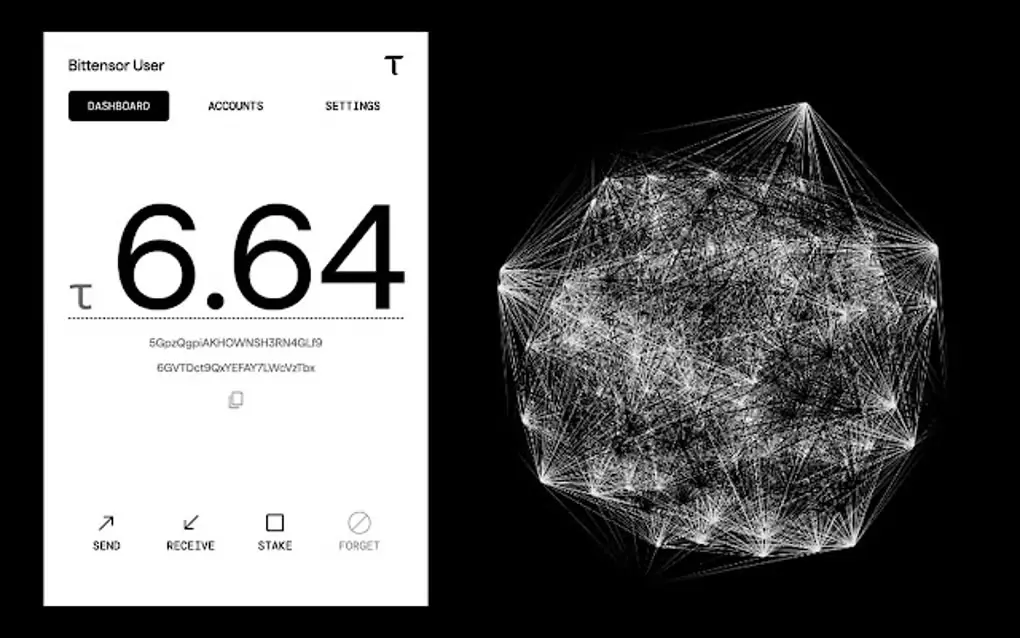 Reviews & Safety
Comprehensive Guide to Bittensor Wallets: Securing Your TAO
A Bittensor wallet is a non-custodial wallet holding the key pair that proves identity, signs transactions and accesses TAO. It has two parts: an always-encrypted coldkey that controls funds, transfers and subnet creation, and hotkeys for everyday tasks like running miners or validators. Create one via the web wallet or btcli, back up the seed phrase offline, and consider a hardware wallet for larger balances.
Heidi ChakosReviews & Safety Reviews & Safety
How To Buy Monero? [A Complete Guide]
Buy Monero on a KYC exchange that still lists XMR, such as Kraken (outside the UK and EU/EEA) or Bitfinex, using a card or bank deposit. If you already hold Bitcoin, swap it for XMR through Changelly, SimpleSwap or Cake Wallet. For a no-KYC purchase, use Bisq, Haveno or RetoSwap. Whichever route you take, withdraw the coins to a wallet you control.
Heidi ChakosReviews & SafetyReviews & SafetyInternet Computer Protocol (ICP) Review: What Is It?
Internet Computer Protocol (ICP) is a blockchain for hosting apps and data on a decentralized network rather than cloud servers. The ICP token pays fees, converts into cycles that power canister smart contracts, is staked to secure the network, and gives holders a vote via the Network Nervous System. Its weak spot: a few groups run many nodes, and DFINITY still steers the project.
Heidi ChakosReviews & SafetyReviews & SafetyCentralized vs Decentralized Exchanges: Which is Best for Your Crypto?
The main difference between centralized and decentralized exchanges is custody. A CEX holds your funds and acts as intermediary, offering high liquidity, simple interfaces and regulatory compliance. A DEX lets you trade peer-to-peer while keeping control of your private keys, but has lower liquidity, needs more technical knowledge and still carries smart contract risk. Many traders use both.
4 min read/Heidi ChakosReviews & Safety Reviews & Safety
Is Coinbase Safe for Beginners? The Ultimate Guide
Yes, Coinbase is one of the safest crypto exchanges for beginners. It is publicly traded, licensed in all 50 US states and 100+ countries, keeps 98% of crypto in offline cold storage, carries $255 million in crime insurance, and USD deposits are FDIC insured up to $250,000. The trade-off is higher fees, around 1.49% on bank transfers, and no insurance covers your own mistakes.
Heidi ChakosReviews & Safety Reviews & Safety
Coinbase vs Binance: Which Crypto Exchange Is Right for You?
Coinbase is the better choice for beginners and US investors: licensed in all 50 states, simple interface, phone support, but fees of roughly 1.49% plus spread. Binance Global wins on cost and choice with 0.1% spot fees and 500+ coins, though it is harder to learn and under compliance monitoring. US residents only get Binance.US: about 150 coins, no futures, unavailable in 14 states.
Heidi ChakosReviews & Safety Reviews & Safety
Coinbase vs Kraken: Key Differences for Crypto Traders
Coinbase is the better pick for beginners and anyone in New York or Maine, since it is licensed in all 50 states and offers phone support. Kraken wins on cost and range: maker/taker fees start at 0.16%/0.26% versus Coinbase's 0.60% on Advanced Trade, it lists 450+ coins to Coinbase's 300+, adds margin, futures and US stocks, and has 24/7 live chat.
Heidi ChakosReviews & Safety Reviews & Safety
Is Coinbase Wallet Safe? Pros, Cons, and Security Tips
Coinbase Wallet is safe for moderate holdings and DeFi use. It is a self-custody hot wallet: the 12-word BIP-39 phrase is generated on your device, keys are AES-256 encrypted and never reach Coinbase's servers, and no confirmed incident has compromised its core architecture. Because it is always online, your phone and habits are the real security model, so keep long-term holdings on a hardware wallet.
21 min read/Heidi ChakosReviews & Safety Reviews & Safety
Is Exodus Wallet Safe? Breaking Down Its Security Features
Exodus Wallet is safe for everyday crypto use and moderate holdings. Private keys are generated and stored locally with AES-256 encryption, transactions are signed on your device, and it has had no catastrophic breach of its own making. Trade-offs: the core code is closed-source, there is no 2FA, multi-sig or insurance, and password rules are lenient. Pair it with Trezor or Ledger for larger sums.
Heidi ChakosReviews & Safety Reviews & Safety
Is Kraken Safe to Use? A Look at Its Security Features
Yes. Among centralized exchanges, Kraken is one of the safest: it has operated since 2011 with no breach that cost customers funds, holds over 95% of crypto in air-gapped multi-signature cold storage, and publishes quarterly proof-of-reserves you can verify with your own Merkle proof. It is still custodial, so keep long-term holdings on a hardware wallet and enable hardware-key 2FA and Global Settings Lock.
Heidi ChakosReviews & Safety Reviews & Safety
Is MetaMask Safe? Risks and Best Practices for Security
Yes, MetaMask is safe as a piece of software. It is open-source, audited by firms like Cure53 and Trail of Bits, and keeps your private keys encrypted on your own device. Nearly every so-called MetaMask hack is a user approving a malicious contract or typing a seed phrase into a phishing site. Pair it with a hardware wallet, review every approval, and bookmark your dApps.
Heidi ChakosReviews & Safety Reviews & Safety
Is Pi Network Legit or Hype? Comprehensive Expert & Honest Analysis
Pi Network is not a traditional scam: nobody has lost money they put in, the founders are Stanford PhDs, and a mainnet has been live since February 2025. Nor is it a proven cryptocurrency. As of mid-2026 the Pi Core Team controls most validator nodes, tokenomics are opaque, Binance and Coinbase have not listed it, and Pi trades near $0.18, down from a $2.80 peak.
Heidi ChakosReviews & SafetyReviews & SafetyKaspa (KAS) Review: What to Know?
Kaspa is a proof-of-work cryptocurrency built on a BlockDAG rather than a single chain, letting it confirm blocks in seconds while keeping Bitcoin-style mining and a fair launch with no premine. It is genuinely innovative and has shipped major upgrades, but it remains a speculative, ASIC-mined asset with unfinished smart-contract plans and no guarantee of adoption.
Heidi ChakosReviews & SafetyReviews & SafetyTrezor Safe 7 Review - Is It Worth It?
The Trezor Safe 7 is worth it for most people: it is Trezor's most complete hardware wallet yet, pairing the TROPIC01 chip, the first auditable secure element, with a dual secure element design, a 2.5-inch touchscreen, and Bluetooth 5.1 or USB-C. Bluetooth can be disabled for air-gapped use, though purists who want absolute isolation may still prefer a fully offline device.
Toby CunninghamReviews & Safety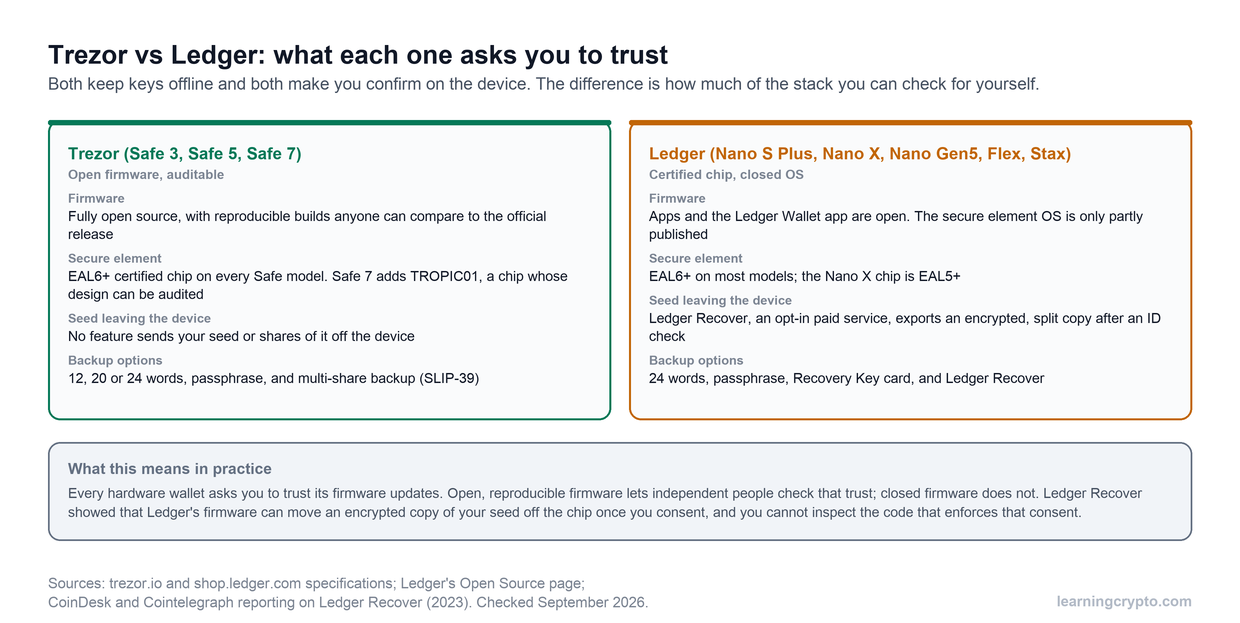 Reviews & Safety
Trezor vs Ledger (2026): Which Hardware Wallet Should You Trust?
Both Trezor and Ledger keep your keys offline, and neither has had customer funds taken through a remote hack of its devices. Where they differ is trust. Trezor's firmware is fully open source. Ledger's secure element software is only partly published and supports Ledger Recover, which can export an encrypted copy of your seed. We moved to Trezor in 2023 for that reason.
Heidi ChakosFAQ
How do you judge whether an exchange is safe?
Look at custody model, proof-of-reserves or audit posture, withdrawal history, regulatory footing, and whether you can move funds to self-custody quickly. “Safe” is relative — size exposure accordingly.
Should I trust hardware wallet reviews?
Prefer reviews that explain threat models, recovery flows, and supply-chain risks — not just feature lists. Buy devices from official channels and verify firmware.