
Scams & risk
Most crypto losses are operational, not market losses: phishing, fake support, address poisoning, and social engineering. These guides teach the patterns so you can spot them before they cost you.
Ledger "Hack" Explained: Who Is Affected, What Happened and Why You Should Never Buy a Hardware Wallet From a Reseller
The Ledger thefts traced so far involve devices sold by one reseller, CryptoBilis, in Malaysia, Indonesia and the Philippines. Ledger has confirmed a hidden hardware implant in one affected device and sees no sign its own systems were compromised. Losses are estimated near $93 million. If you bought direct from Ledger and made your own recovery phrase, nothing reported points at you.
Toby CunninghamScams & Risk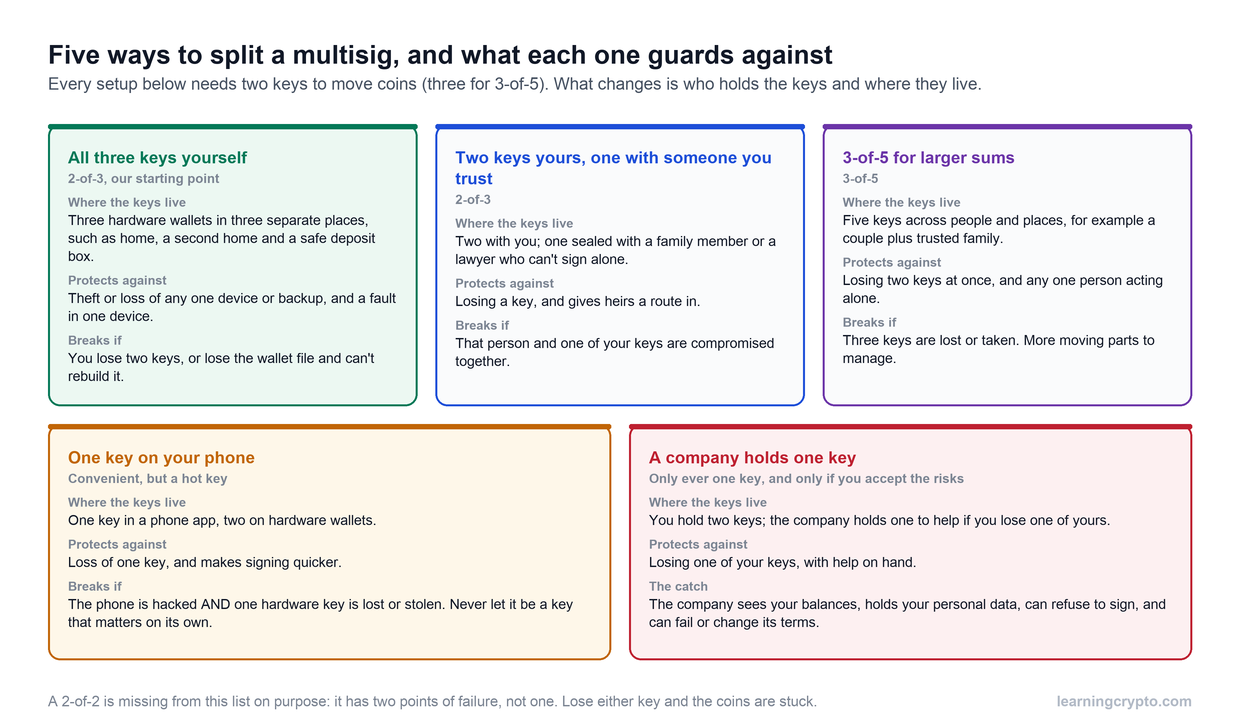 Scams & Risk
Multisig Explained: How to Split Your Bitcoin Keys and Why It Matters
Multisig means your bitcoin only moves when a set number of keys sign, for example any 2 of 3. No single lost, stolen or faulty key can empty the wallet. In the July 2026 Coldcard drain, single-key wallets were emptied, while multisig wallets with only one affected key were not reported drained.
Heidi ChakosScams & Risk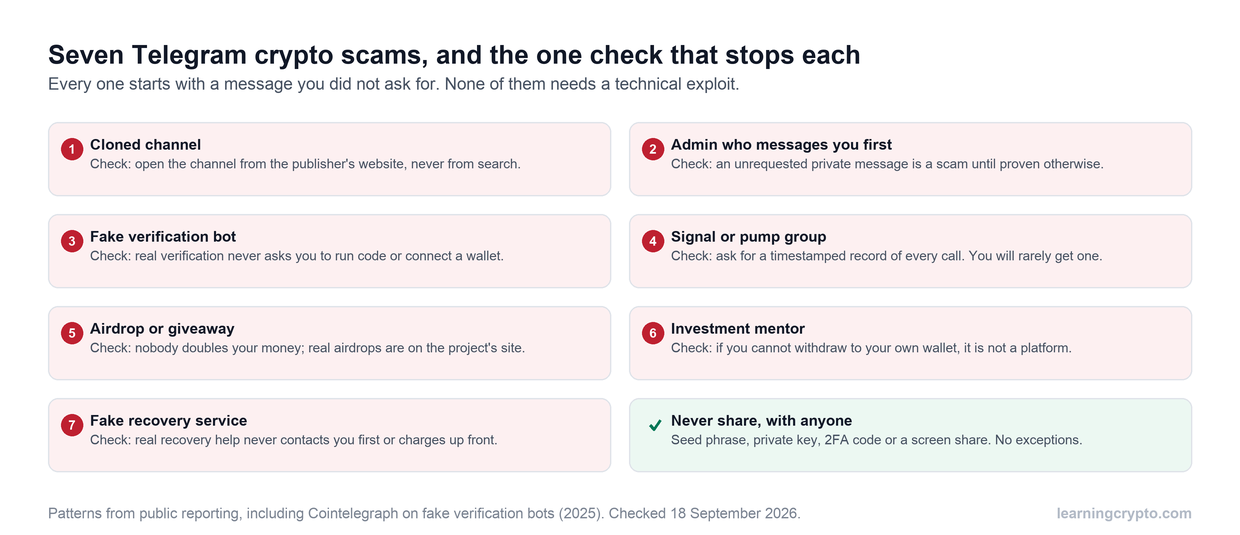 Scams & Risk
Crypto Scams on Telegram: How to Spot a Fake Channel, Admin or Bot
Almost every crypto scam on Telegram starts the same way: someone you did not contact offers help, profit or verification. Real channels broadcast one way and never ask for your seed phrase, a wallet connection or a payment. Join channels only from the publisher's website, and check the handle letter by letter.
Heidi ChakosScams & Risk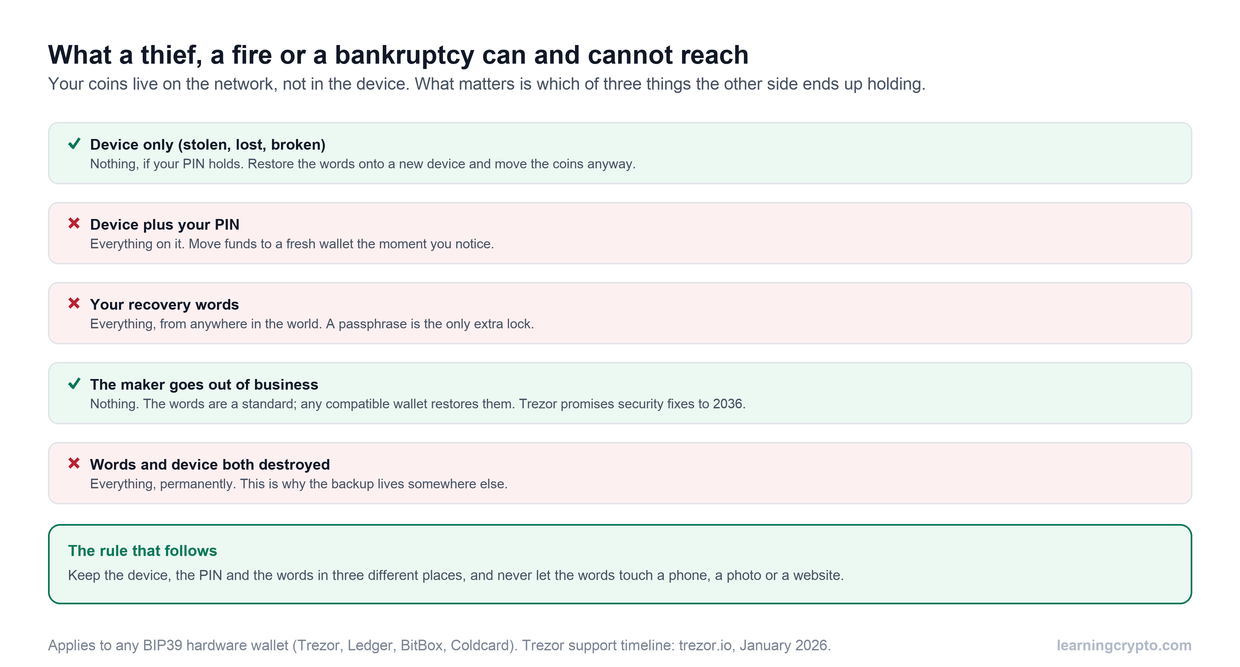 Scams & Risk
Lost or Stolen Hardware Wallet, or the Maker Goes Bust: What Happens to Your Crypto
Your crypto is not inside the hardware wallet; it is on the network, and the device only holds the key. Lose the device and your recovery words restore everything onto any compatible wallet. Lose the words and the device together and the coins are gone. If the maker goes bust nothing changes, because the words follow an open standard.
Heidi ChakosScams & Risk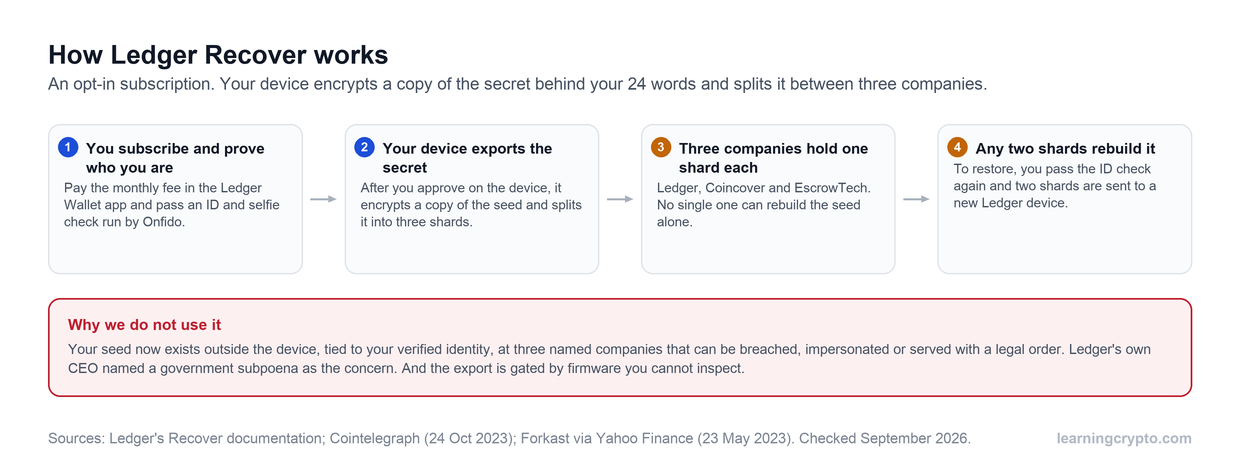 Scams & Risk
Ledger Recover Explained: How It Works and Why We Don't Use It
Ledger Recover is an optional paid service in which your Ledger encrypts a copy of your seed, splits it into three shards and sends them to Ledger, Coincover and EscrowTech after an ID check. Any two shards can rebuild your wallet. We do not use it: it ties your identity to your keys and relies on firmware you cannot inspect.
Heidi ChakosScams & Risk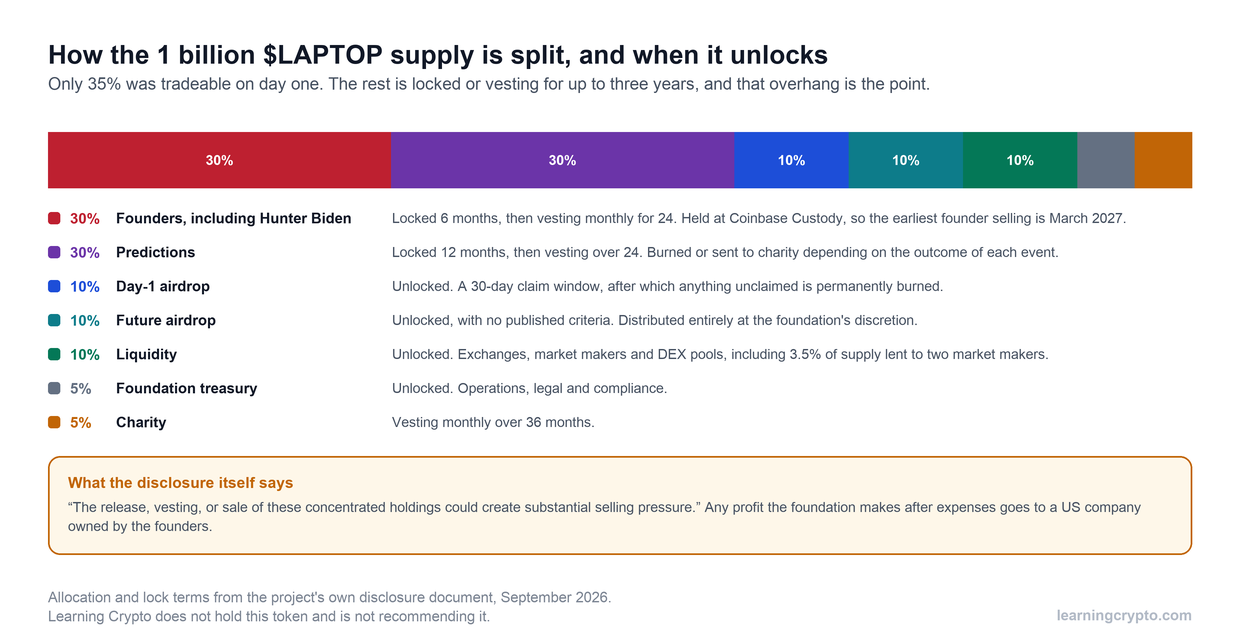 Scams & Risk
$LAPTOP Memecoin: What Hunter Biden's Token Is, and What It Is Not
$LAPTOP is a memecoin co-founded by Hunter Biden, launched on Base in September 2026 and issued via a Cayman Islands foundation and a BVI company. It has no utility and no price floor, by its issuer's own account. Founders hold 30% of the 1 billion supply, 65% is locked or vesting, and hundreds of fake LAPTOP tokens appeared within hours. This is not an endorsement.
Heidi ChakosScams & Risk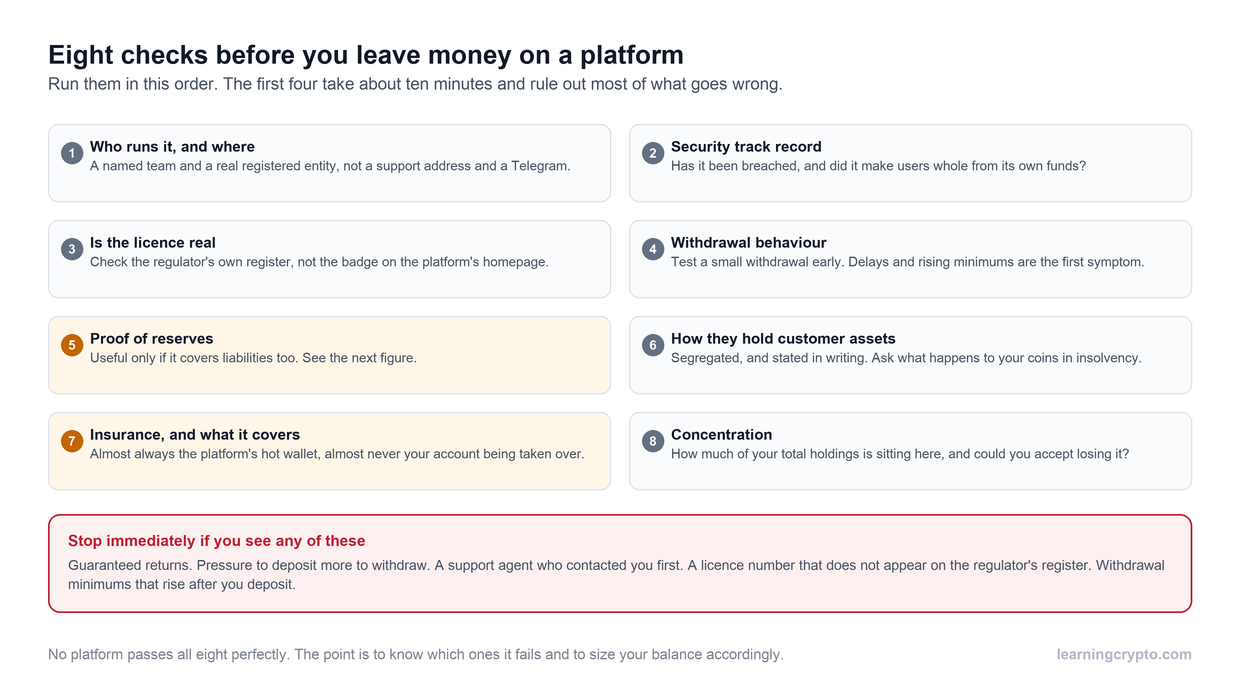 Scams & Risk
How to Tell If a Crypto Exchange or Wallet Is Safe
Judging a crypto platform comes down to eight checks: who holds the keys, the security track record, proof of reserves, licensing, insurance, transparency, account controls and how easily you can withdraw. The most reliable warning sign is difficulty getting your own money out.
Heidi ChakosScams & Risk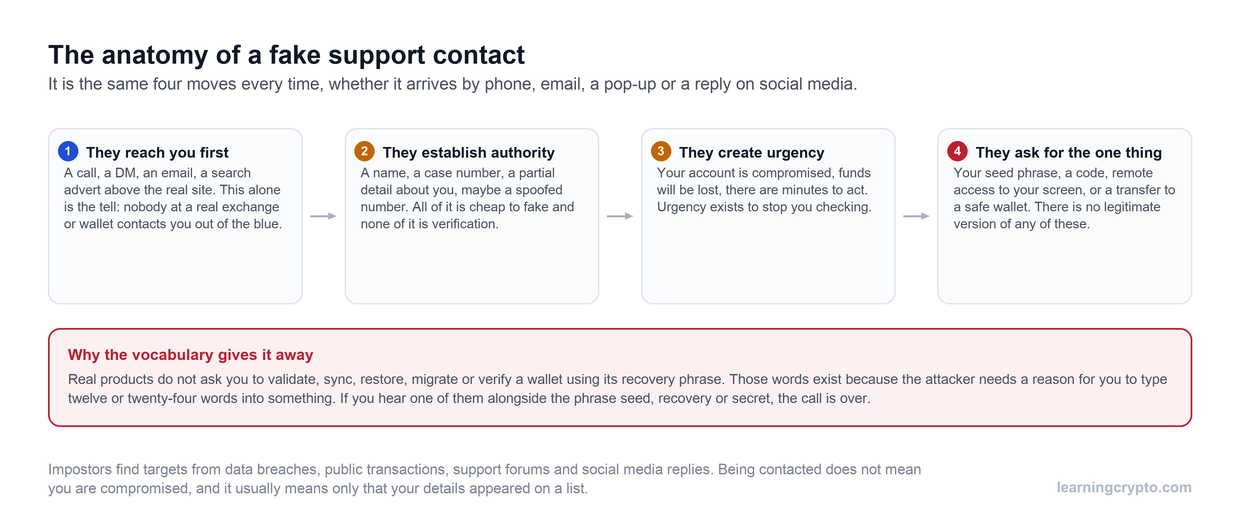 Scams & Risk
Fake Crypto Support Scams: How the Con Works
Nobody in crypto has support that contacts you first. Fake support scams reach you after you ask for help publicly, then ask for one of four things: your recovery phrase, a two-factor code, remote access to your computer, or a transfer to a validation address. All four are the scam.
Heidi ChakosScams & Risk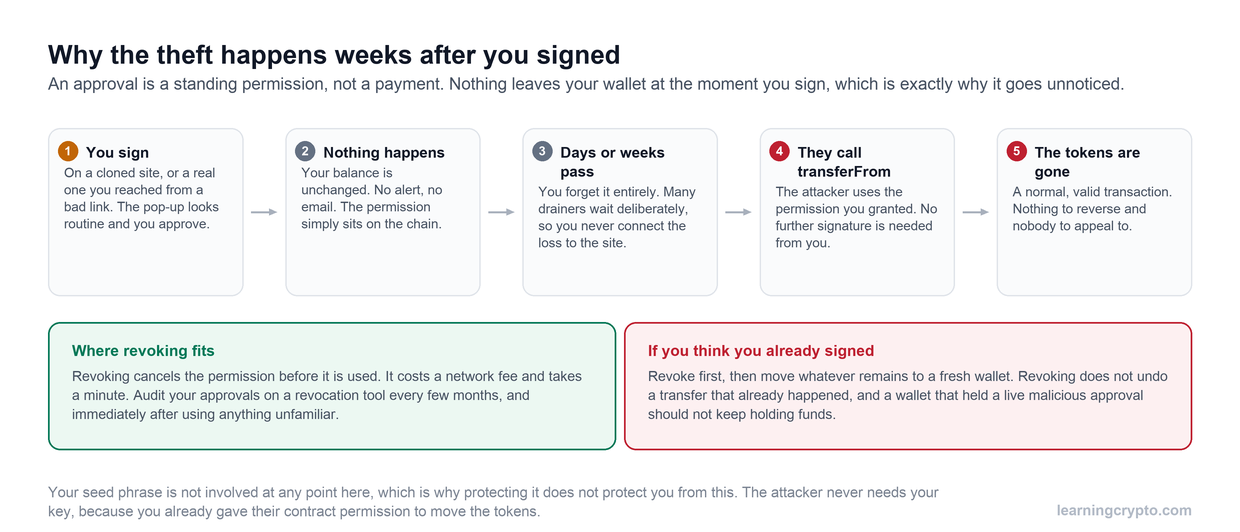 Scams & Risk
Token Approval Phishing: How Wallet Drainers Empty Wallets
Token approval phishing tricks you into granting a malicious contract permission to spend your tokens, then transfers them later. Your seed phrase is never exposed, and a hardware wallet will sign it if you confirm. The defences are bounded approvals, reading the device screen, and revoking old permissions periodically.
Heidi ChakosScams & Risk Scams & Risk
A No-Nonsense Guide to Spotting Crypto Scams
Crypto scams took an estimated $17 billion globally last year, with $11.4 billion in US losses reported to the FBI. The main types are phishing, rug pulls, pig butchering, impersonation and deepfakes, fake wallets and exchanges, and address poisoning. Transactions are irreversible, so prevention is on you: never share a seed phrase, verify full addresses, check liquidity locks and audits, and distrust urgency.
16 min read/Heidi ChakosScams & Risk Scams & Risk
What Is a Seed Phrase and Why It's Critical to Crypto Security
A seed phrase is a list of 12 to 24 words from the 2,048-word BIP-39 list that encodes your wallet's master private key. Any compatible wallet can rebuild every address and balance from it, making it the only true backup. Anyone who holds it controls your crypto, and no company can reset it. Write it on paper or metal and never store it digitally.
19 min read/Heidi ChakosScams & Risk Scams & Risk
Pump and Dump Schemes in Crypto: How to Spot and Avoid Them
A pump and dump is market manipulation where organized groups quietly buy a thin, obscure token, flood social media and paid influencers with hype to push the price up, then sell their holdings into the retail buying frenzy. Warning signs include synchronized shilling, anonymous teams, low liquidity and promised price targets. Position limits, stop-losses and an exit plan set in advance are the practical defenses.
17 min read/Toby CunninghamScams & Risk Scams & Risk
How to Sell Pi Coins in 2026? [An Expert Guide]
To sell Pi Coin, first complete KYC in the Pi app, migrate your balance to mainnet and set up a Pi Wallet in the Pi Browser. Then transfer PI to an exchange that lists it, such as OKX, Gate.io, MEXC or Bitget, and sell into USDT, ideally with a limit order because liquidity is thin. Binance and Coinbase do not list PI.
Heidi ChakosScams & Risk Scams & Risk
Bitcoin Security Explained Simple: How to Protect Your Wallet from Hacks, Scams, etc
The Bitcoin protocol itself is secure; your coins are only as safe as your own key management. Hackers stole over $2.2 billion from crypto platforms in 2024, so hold your own keys, keep long-term funds on a hardware wallet, store encrypted seed phrase backups offline, enable 2FA, and verify every recipient address to defeat clipboard malware and phishing. Multi-sig adds another layer for larger holdings.
11 min read/Heidi ChakosScams & RiskScams & RiskCrypto Security Best Practices: Comprehensive Guide to Secure Crypto Assets in 2025
The crypto security best practices that matter are simple but non-negotiable: keep long-term holdings on a hardware wallet, write your seed phrase on paper or metal and never type it into any device, use app-based or hardware 2FA rather than SMS, switch on withdrawal allowlists at every exchange, and treat every unsolicited message about your crypto as a scam until proven otherwise.
2 min read/Heidi ChakosScams & Risk Scams & Risk
Will Cryptocurrency Fail? An In-Depth Expert Analysis
Cryptocurrency has evolved from a niche digital currency into a significant component of the global financial ecosystem. As of early 2025, the cryptocurrency market boasts a total capitalization of approximately $3.8 trillion, encompassing over 25,000 active cryptocurrencies.
Learning Crypto TeamFAQ
What is the most common crypto scam?
Impersonation and fake support. Scammers pose as exchange staff, wallet vendors, or influencers and push you to “verify” a wallet or send funds.
How do I stay safe day to day?
Never share seed phrases, verify URLs carefully, revoke unused token approvals, and treat unsolicited DMs as hostile until proven otherwise.