
Stablecoins
Stablecoins are the cash layer of crypto markets. Understanding who issues them, how they stay pegged, and where yield comes from is essential before parking size in any “dollar” token.
 Stablecoins
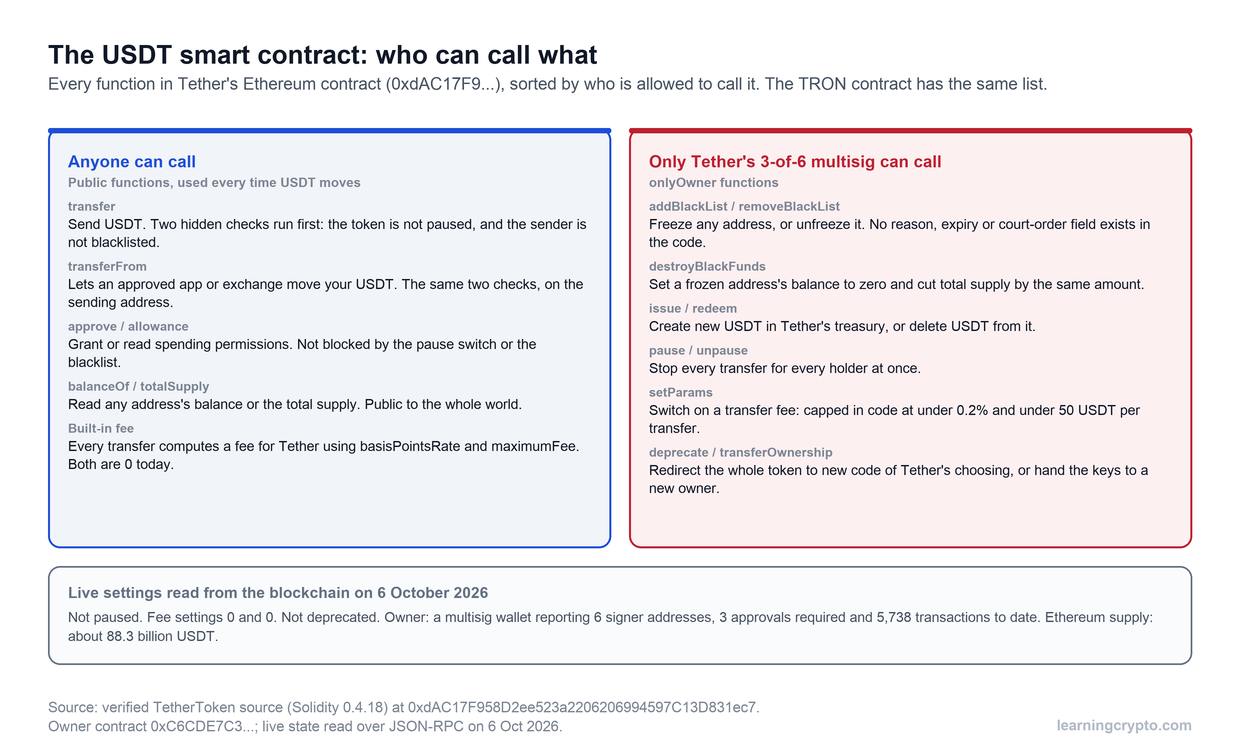
What They're Hiding in the Tether Smart Contract: Every Function Explained
Tether's USDT contract is public code, and it gives one party special powers. Anyone can send tokens, but only Tether's 3-of-6 multisig can mint, redeem, pause the whole token, freeze any address and wipe its balance to zero. In 2025 Tether froze $1.26 billion across 4,163 addresses and destroyed 55.6% of it. Here is every function in plain English.
Toby CunninghamStablecoins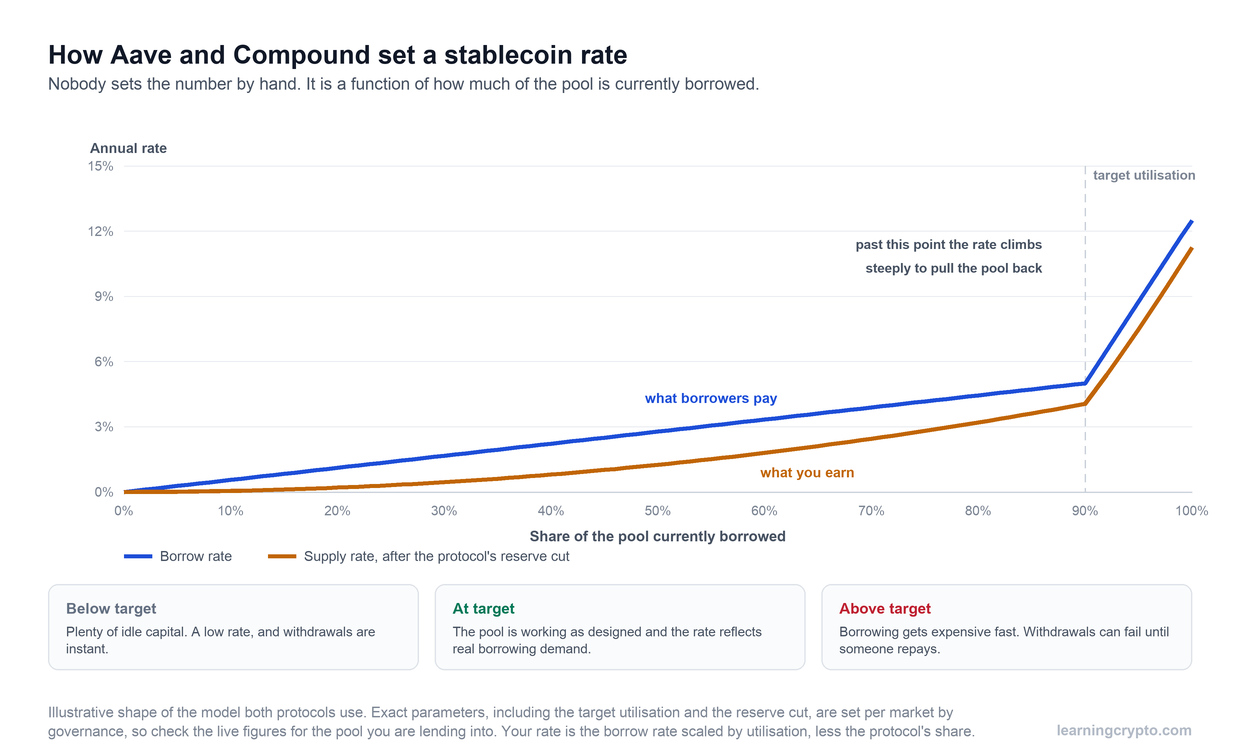 Stablecoins
Stablecoin Lending Explained: How the Rates Work and What Can Go Wrong
Stablecoin lending means depositing USDC or USDT into a pool that borrowers draw from against collateral, and the interest they pay is your yield. On Aave and Compound the rate is set by how much of the pool is borrowed, not by a promise, so it floats daily. Over-collateralisation and liquidations protect lenders from defaults, not from smart contract bugs, bad debt or a depeg.
Toby CunninghamStablecoins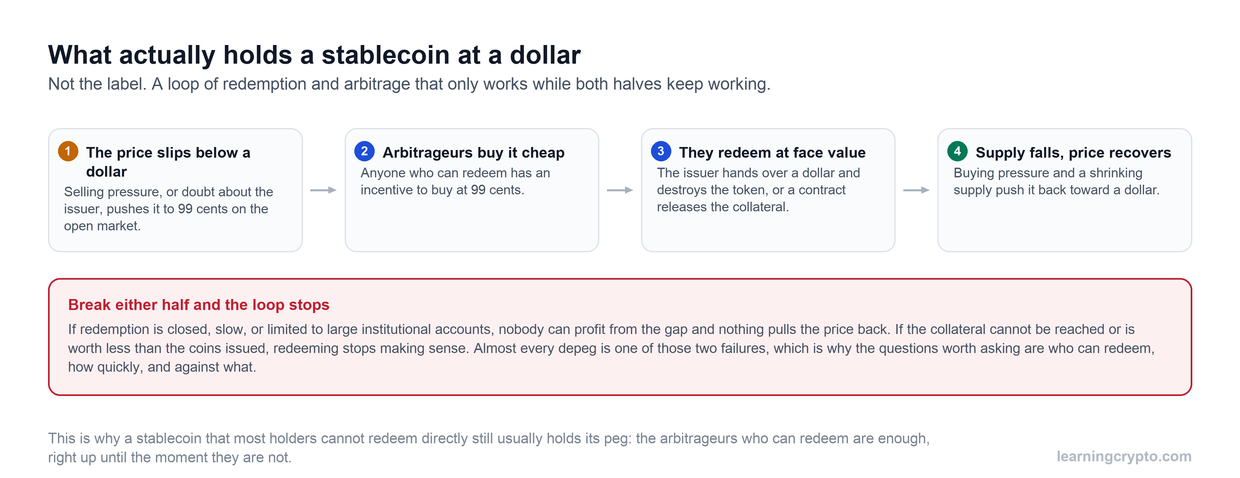 Stablecoins
What Is a Stablecoin? How They Work and the Risks
A stablecoin is a crypto token designed to hold a steady value, almost always one dollar. It stays stable because reserves back it or collateral is locked in a contract, not because of anything inherent to the token. Holding one means holding a claim on an issuer, with no deposit insurance and, for most retail holders, no direct redemption.
Toby CunninghamStablecoins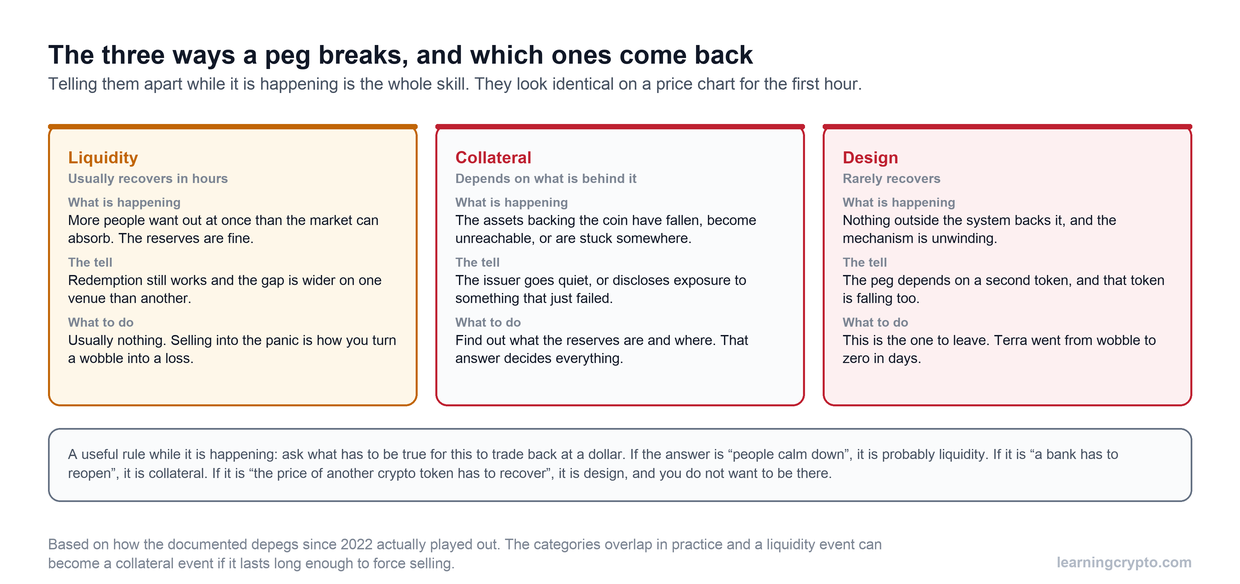 Stablecoins
Stablecoin Depegs: Why Pegs Break and What to Do
A stablecoin holds its peg through redemption plus arbitrage, so a depeg means that loop is blocked or doubted. Liquidity depegs usually recover within hours, collateral depegs depend on whether the assets are reachable, and design failures like Terra in 2022 rarely recover at all.
Toby CunninghamStablecoins Stablecoins
How Yield-Bearing Stablecoins Work and Are They Safe?
Yield-bearing stablecoins are dollar-pegged tokens that pay returns simply for being held, unlike USDT or USDC where the issuer keeps the interest on reserves. Yield comes from Treasury bills (USDY, USDM), DeFi lending (sDAI, sUSDS) or delta-neutral derivatives (sUSDe), mostly 4% to 7% in 2026 with derivatives-based yields swinging wider. Not savings accounts: depegs, contract bugs, variable yield and US access limits are real.
11 min read/Heidi ChakosStablecoins Stablecoins
USDT vs USDC Compared: Reserves, Risks, and Which Is Safer
USDC is the lower-risk stablecoin on fundamentals: its reserves are cash and short-dated Treasuries, attestations are monthly, and Circle is authorized under MiCA and the GENIUS Act. USDT has deeper liquidity, more chains, and dominates offshore trading, but its reserves include secured loans and bitcoin, it lacks a Big Four audit, and it is not MiCA compliant. USDC for savings; USDT for high-volume offshore trading.
11 min read/Heidi ChakosStablecoinsStablecoinsDifferent Types of Stablecoins: Types, Uses, and Benefits
There are four main types of stablecoins, grouped by what backs them: fiat-collateralized (USDT, USDC), crypto-collateralized (DAI), commodity-backed (PAXG, XAUT) and algorithmic (the model that failed with TerraUSD in 2022). Fiat-backed coins from regulated issuers are the most widely used and, for most people, the sensible default; algorithmic designs have the worst track record.
2 min read/Heidi ChakosStablecoins Stablecoins
What Does Pegging Mean in Crypto? A Comprehensive Guide
Pegging in crypto means tying a token's value to another asset at a fixed ratio, usually a stablecoin tracking the dollar 1:1. Pegs are held by collateral reserves (USDC, USDT, DAI), by algorithms (TerraUSD, which collapsed in 2022), or a mix. Pegged is not the same as backed, and pegs can break: USDC fell to $0.87 in March 2023 when Silicon Valley Bank failed.
Heidi ChakosStablecoins Stablecoins
Stablecoins vs Bitcoin: Which Crypto is Right for You?
Stablecoins and Bitcoin do different jobs. Stablecoins such as USDT and USDC are pegged to assets like the US dollar, so they suit payments, remittances and parking value in DeFi, but you rely on the issuer's reserves. Bitcoin has a fixed 21 million supply and no central issuer, making it a long-term store of value, at the cost of large price swings.
Heidi ChakosStablecoinsStablecoinsBest Stablecoin Interest Rates (2025) – Compare Top Platforms
The best stablecoin interest rates come from a mix of centralised lenders like Nexo, DeFi protocols like Aave and Compound, and exchange reward programs like Coinbase's USDC rewards. Rates move with borrowing demand and are not guaranteed. Higher advertised yields almost always mean higher platform or issuer risk, so compare the source of the yield, not just the number.
Heidi ChakosFAQ
Is USDT or USDC safer?
Both have trade-offs. USDC is generally seen as more transparent and regulated; USDT has deeper liquidity on many venues. Diversify and know the issuer risk.
Can stablecoins depeg?
Yes. Algorithmic and under-reserved designs have failed historically. Even fiat-backed coins can trade off peg during stress — treat them as credit instruments, not cash.