
Regulation & tax
Regulation and tax shape what you can do with crypto and what you owe when you sell, stake, or earn. These guides explain the landscape in plain language. They are educational, not personalised legal or tax advice.
 Regulation & Tax
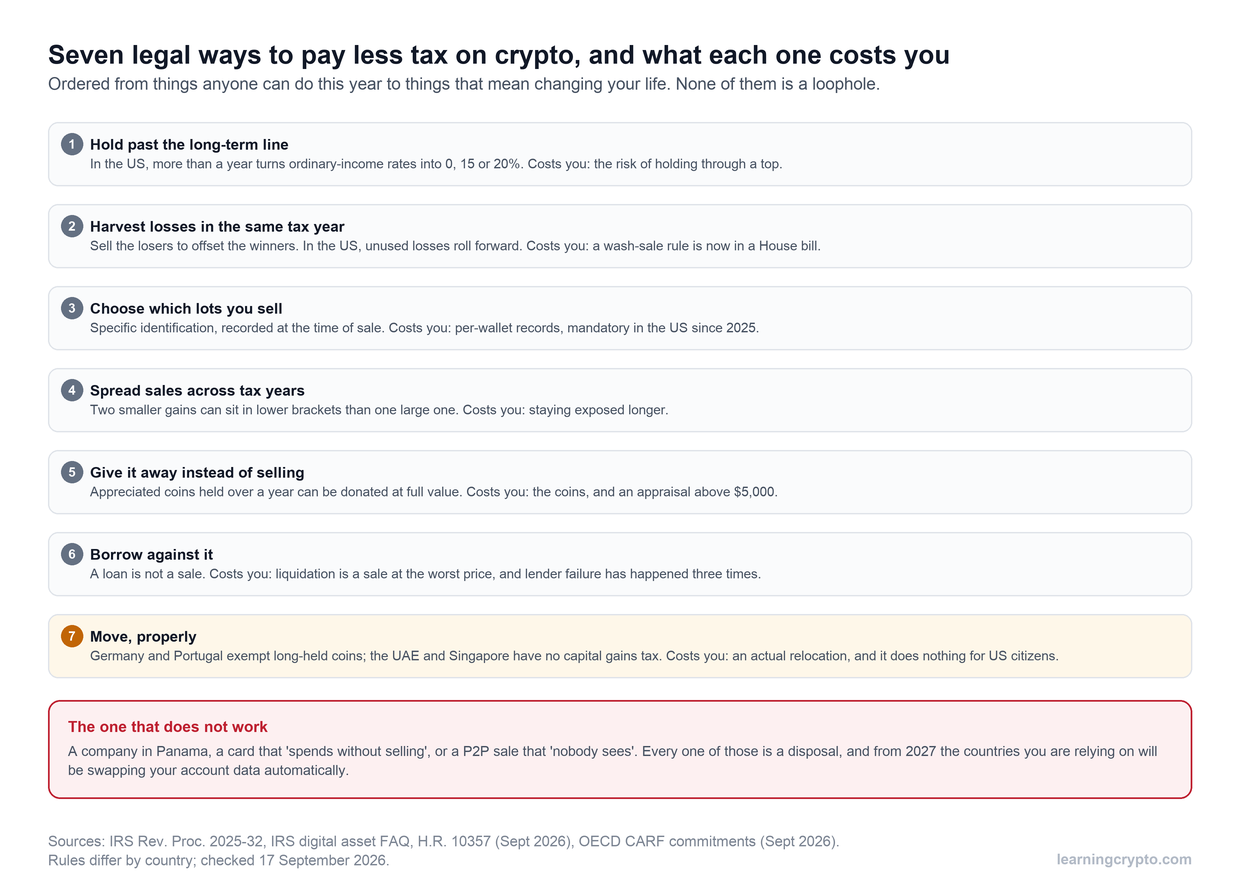
How to Legally Reduce Your Crypto Taxes: What We Did and What Actually Works in 2026
You cut crypto tax legally by holding past the long-term line, harvesting losses in the same year, choosing which lots you sell, spreading sales across tax years, donating instead of selling, borrowing rather than selling, or genuinely moving to a country that exempts long-held coins. Spending on a card, swapping into stablecoins and offshore paper companies do not work. We moved; here is what changed.
Heidi ChakosRegulation & Tax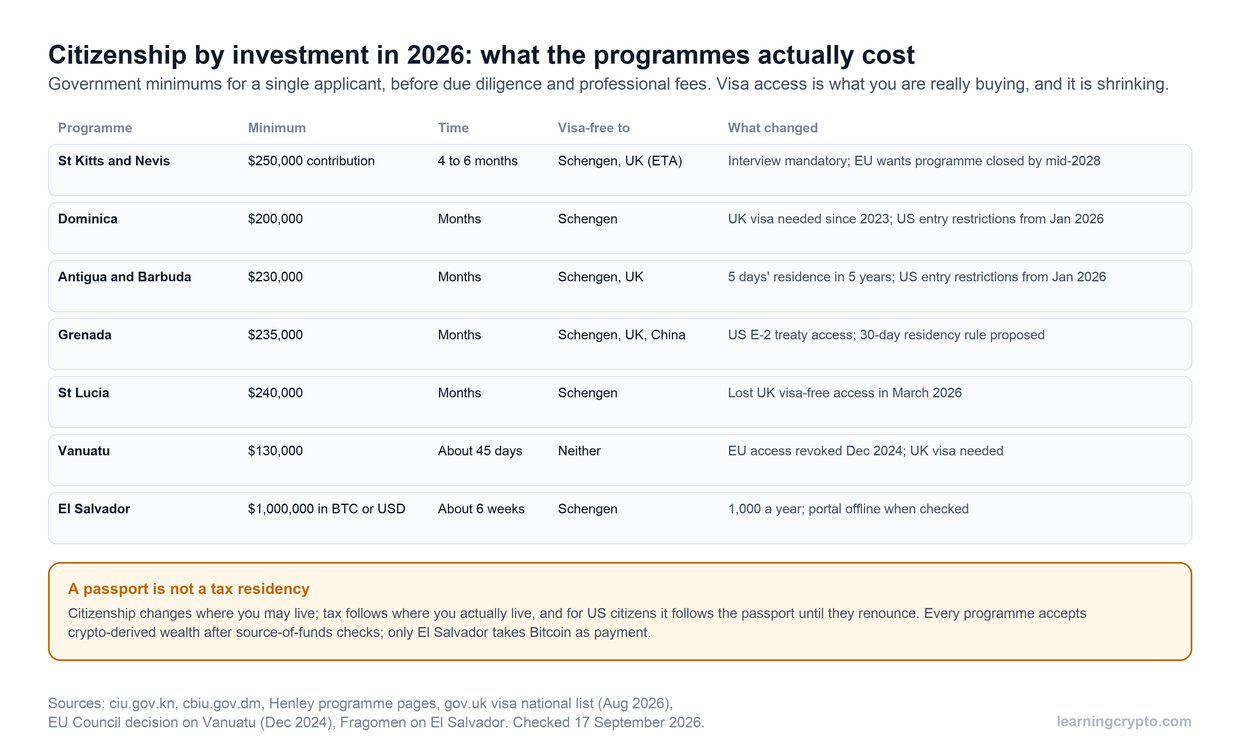 Regulation & Tax
Second Citizenship by Investment for Crypto Holders: What It Costs in 2026 and What We Learned Doing It
Citizenship by investment gives you a second passport for a government contribution, from about $200,000 in the Caribbean to $1 million in El Salvador, after source-of-funds checks that accept crypto wealth. It buys optionality, not a tax break: a passport is not a tax residency. Heidi got St Kitts citizenship in 2018; here is what changed since and what to check before paying anyone.
Heidi ChakosRegulation & Tax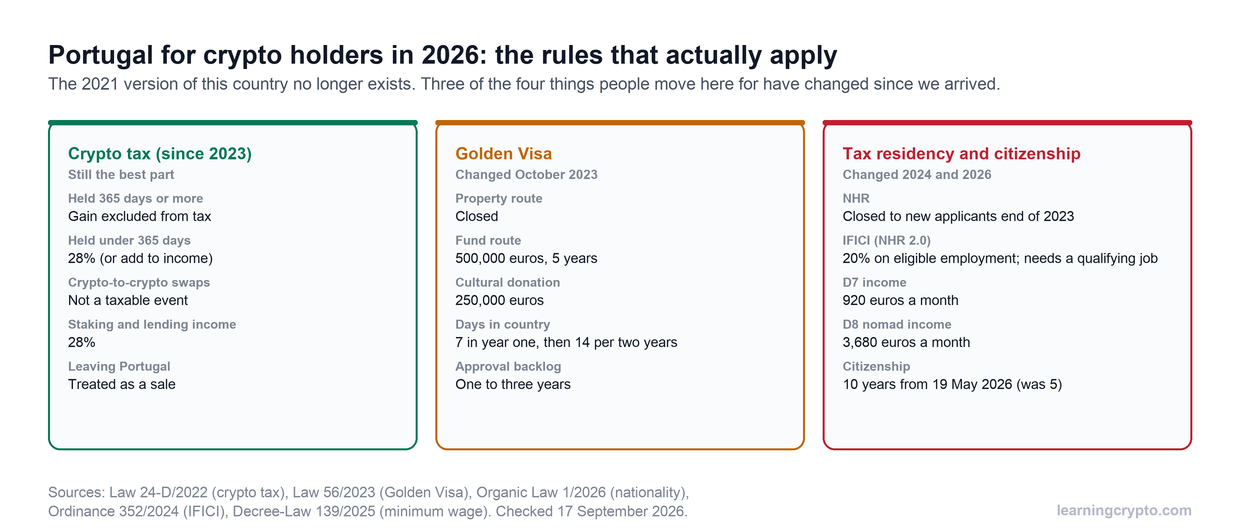 Regulation & Tax
Portugal Residency and Crypto Taxes in 2026: What Changed and What We've Learned Living Here
Portugal still excludes gains on crypto held 365 days or more and does not tax crypto-to-crypto swaps, but almost everything else has changed: the Golden Visa property route closed in 2023, NHR closed to newcomers, and from 19 May 2026 citizenship takes 10 years of residence instead of 5. We moved here in 2021; this is the 2026 picture.
Heidi ChakosRegulation & Tax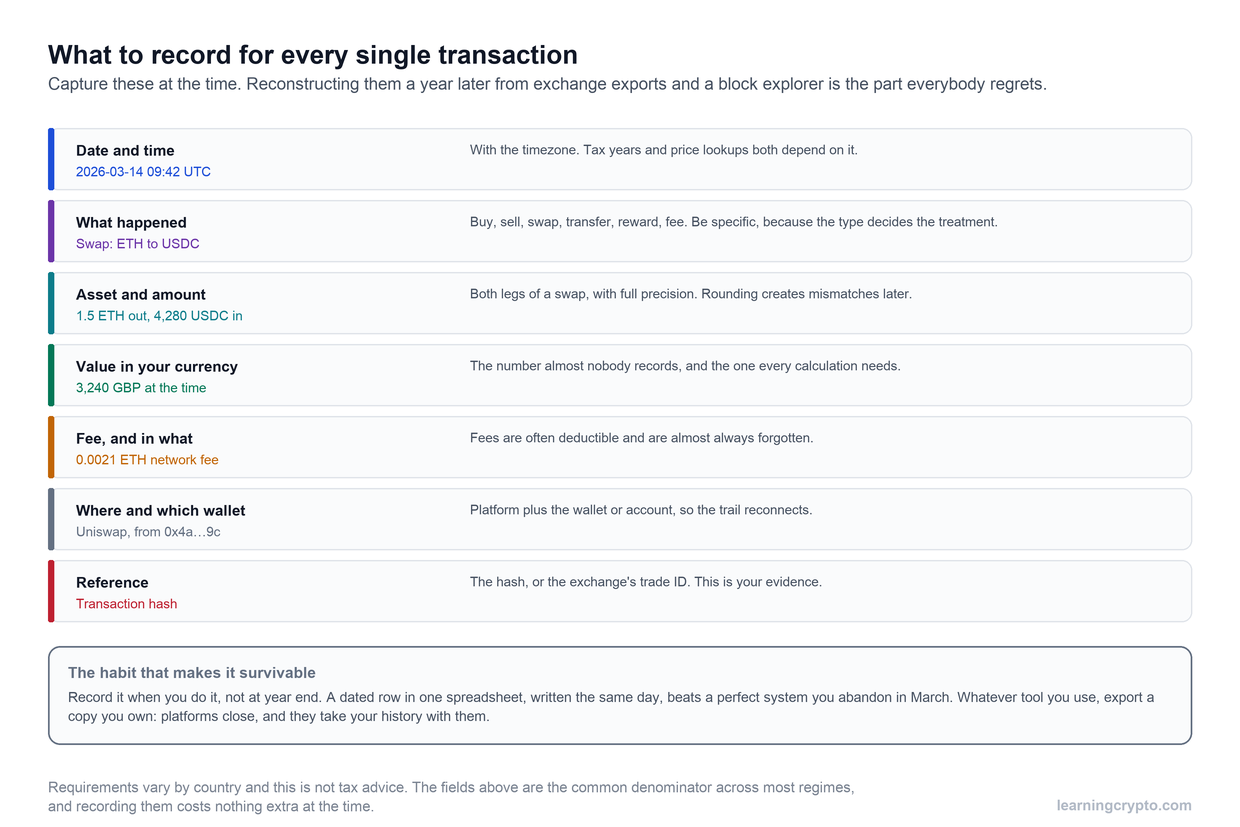 Regulation & Tax
Crypto Record Keeping: What to Track for Tax
Record seven things for every crypto transaction: date and time, type, asset and quantity, the fiat value at the time, fees, the venue, and the transaction ID. The fiat value is the field people skip and the hardest to reconstruct later. Export from every exchange quarterly and keep the raw files.
Toby CunninghamRegulation & Tax Regulation & Tax
MiCA: Europe's Crypto Regulation Framework Explained
MiCA (Markets in Crypto-Assets Regulation) is the EU's unified crypto law for all 27 member states. It licenses service providers (CASPs), sorts tokens into three categories, and makes stablecoin issuers hold full reserves and redeem at par. Circle's USDC and EURC complied; Tether did not, so USDT was delisted from regulated EU exchanges. Transitional periods end July 1, 2026; unlicensed providers are then in breach.
16 min read/Heidi ChakosRegulation & Tax Regulation & Tax
A Complete Guide to Cryptocurrency Taxes
Most countries tax crypto as property, so selling for fiat, swapping one coin for another, or spending it triggers a capital gain or loss, while buying, holding and moving between your own wallets does not. Staking and mining rewards are taxed as income when received. Germany and Portugal exempt holdings kept over a year. Automatic reporting under CARF, DAC8 and Form 1099-DA starts in 2026.
17 min read/Heidi ChakosRegulation & Tax Regulation & Tax
What Is KYC in Crypto? Know Your Customer Explained
KYC (Know Your Customer) in crypto is the identity verification a centralized exchange or fiat onramp runs before you can deposit money, trade or withdraw: a government ID, a selfie or liveness check, and proof of address. Platforms require it to satisfy anti-money-laundering rules and keep their banks. Self-custody wallets and decentralized exchanges never ask for ID.
Heidi ChakosRegulation & Tax Regulation & Tax
Genius Act Full Guide: Control, Not Freedom, in the Digital Dollar Era
The GENIUS Act (S.394) is the first federal law regulating US payment stablecoins. It requires 1:1 reserves in cash, insured deposits or short-term Treasuries, bans rehypothecation and yield-bearing stablecoins, and puts issuers under Bank Secrecy Act AML rules with OCC and Federal Reserve oversight. Our reading: it turns stablecoins into an intermediated digital dollar and strengthens the case for self-custodied Bitcoin.
Heidi ChakosFAQ
Do I owe tax when I sell crypto?
In many jurisdictions, yes — disposing of crypto can be a taxable event. Rules vary by country; keep records and consult a qualified professional for your situation.
What is MiCA?
MiCA is the EU Markets in Crypto-Assets framework. It sets rules for issuers and service providers across the European Union and is reshaping how products are offered to EU residents.