
In the months leading up to the 2024 US presidential election, millions of people stopped watching polls. They watched Polymarket instead.
Built on blockchain, Polymarket was giving Trump a 60% chance of winning while mainstream media was calling it a toss-up. When the results came in, the market had it right. That moment put crypto prediction markets on the map for a much wider audience.
Since then, the sector has exploded. Monthly trading volume across major prediction market platforms has grown from around $1.2 billion to over $21 billion in roughly a year, according to TRM Labs. What started as a niche experiment in crypto-native forecasting is now pulling in hedge funds, journalists, researchers, and retail traders who have never held a cryptocurrency before.
What You'll Learn in This Guide
What a prediction market is and how it differs from traditional betting
How onchain markets work: smart contracts, oracles, and settlement
What Polymarket is and how it became the dominant platform
Who the main competitors are: Kalshi, Augur, Manifold, and others
The regulatory environment in 2026 and why it's still unsettled
The real risks and limitations users should understand
When prediction markets are useful as information tools, and when they aren't
What Is a Prediction Market?
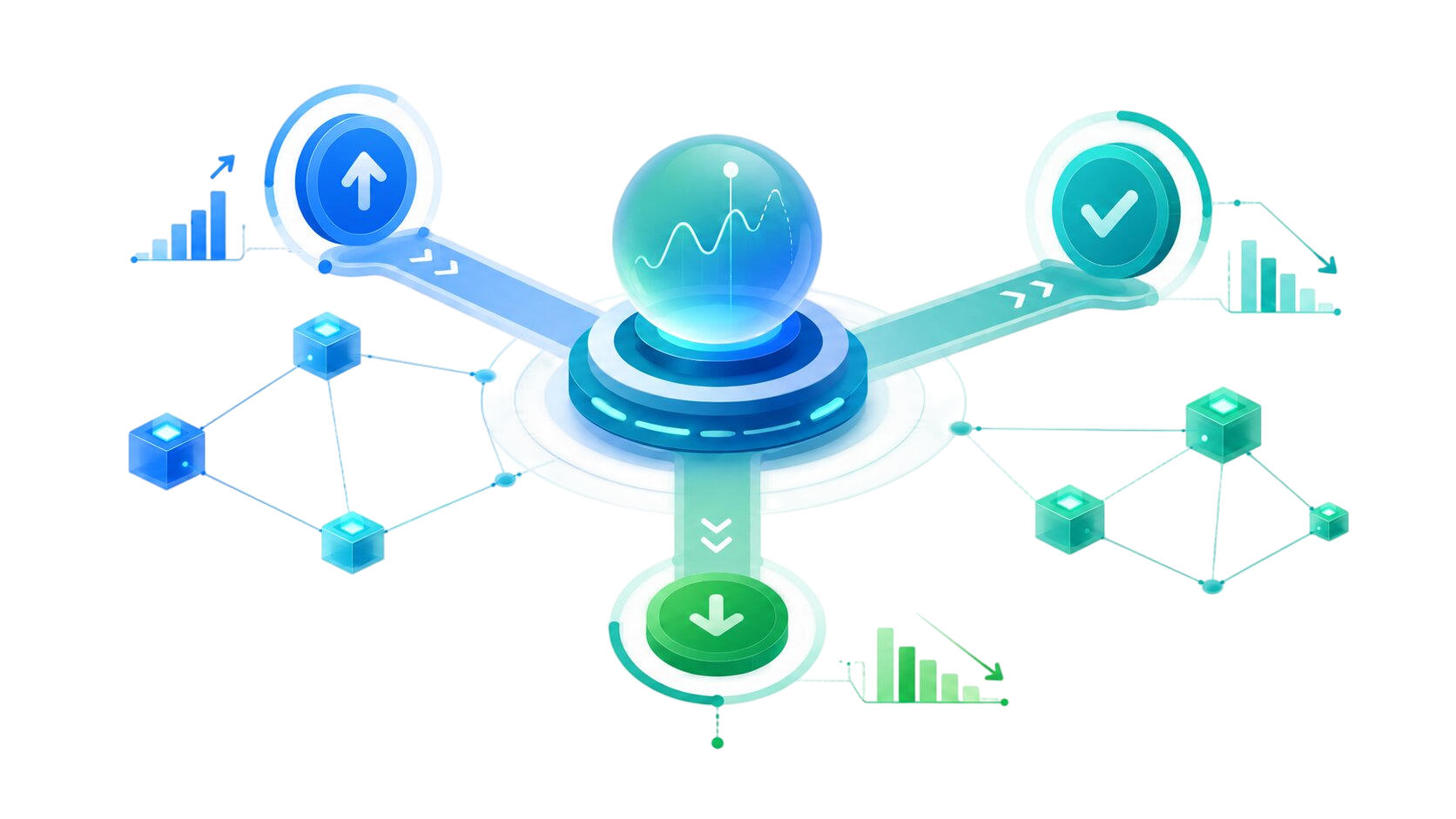
A prediction market is a platform where people trade on the outcome of future events. Instead of buying shares in a company, you're buying a contract that pays out if a specific thing happens.
The mechanics are simple. Each contract is a binary question: Will X happen, yes or no? Shares in the "Yes" outcome and shares in the "No" outcome are priced between $0 and $1. That price reflects the implied probability the market assigns to each outcome. A "Yes" share trading at $0.65 means participants collectively think there's about a 65% chance the event occurs.
If you're right, your shares pay out $1. If you're wrong, they expire worthless.
That's the core structure. Everything else: decentralization, onchain settlement, token mechanics. All of it is infrastructure built around that basic idea.
How Prediction Markets Differ from Gambling
This distinction matters, and it's one the industry itself debates constantly.
Sports betting, for example, is zero-sum: your profit comes directly from someone else's loss, with the house taking a cut. Prediction markets are also technically zero-sum in terms of payouts, but the argument for their social value is different. The claim is that markets aggregate information efficiently.
Because traders are putting real money behind their views, prices reflect genuine probability assessments rather than opinions or gut feelings.
That's the concept of the "wisdom of the crowd," and it's why researchers, policy analysts, and financial professionals have taken an interest in prediction market data. When the price of a "Yes" share on a question like "Will the Fed cut rates in June?" shifts sharply, it can be a more useful signal than any individual analyst's forecast.
Whether that makes prediction markets fundamentally different from gambling is a live debate in regulatory circles. We'll get to that.
How Onchain Prediction Markets Work
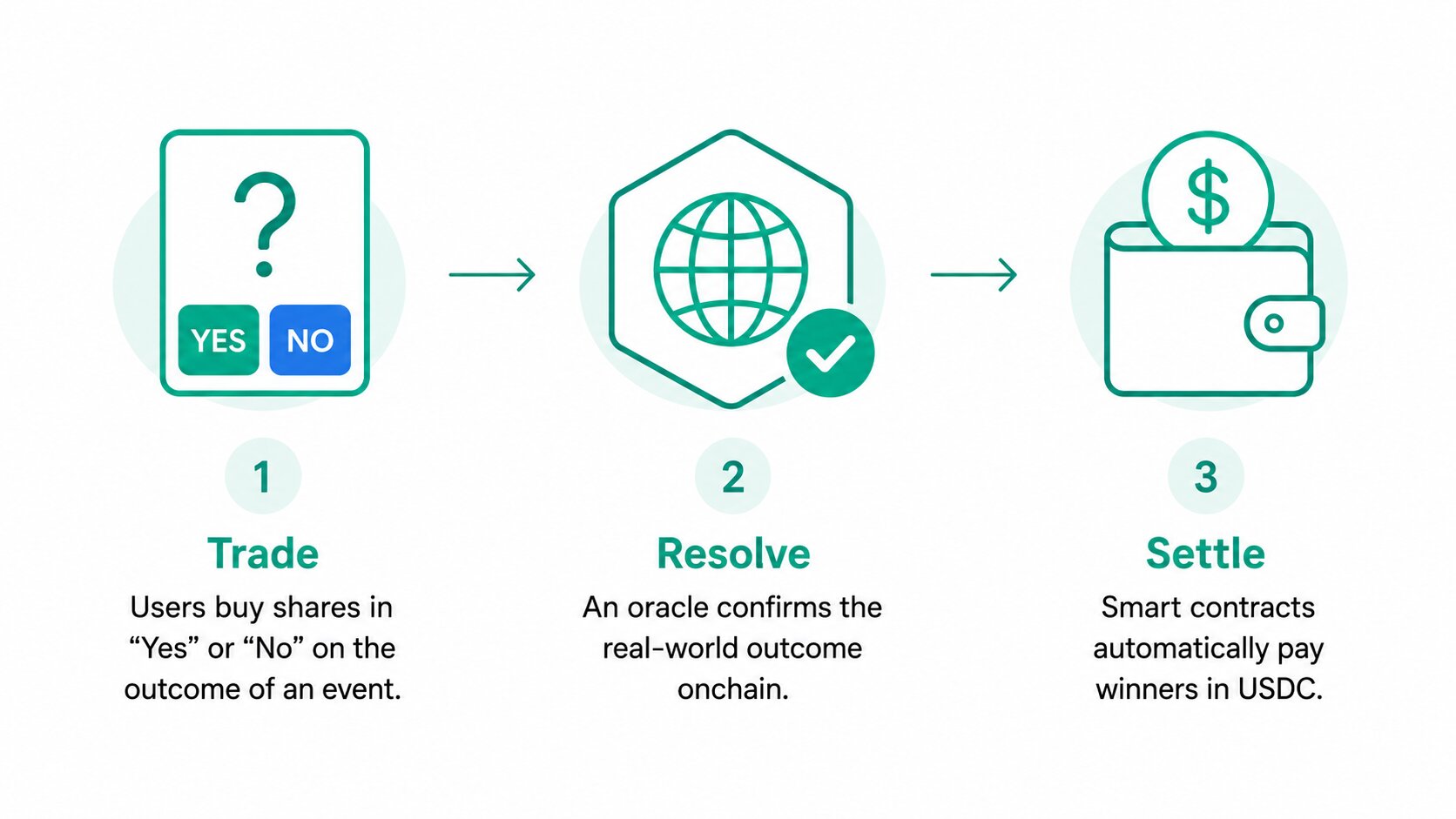
Traditional prediction markets can be run by a centralized company, like a sportsbook. You deposit money, place a bet, and trust the company to pay out correctly. Onchain prediction markets replace that trust with code.
Here's how the mechanics work in practice.
Smart Contracts
When a market is created on a platform like Polymarket, a smart contract is deployed on the blockchain. In Polymarket's case, that's the Polygon network, an Ethereum layer-2 chain. That contract holds all user funds and defines the rules: what the question is, when it resolves, and how payouts are calculated.
No one can alter those terms once the contract is live. Not the platform, not a moderator, not the market creator. Settlement is automatic. When the outcome is confirmed, the smart contract distributes funds to winning shareholders without anyone pressing a button.
Oracles
Here's the problem: blockchains can't see the real world. A smart contract can't independently verify whether an election has been called, whether a company filed for bankruptcy, or what the Bitcoin price was at a specific timestamp. It only knows what's on the blockchain.
That's what oracles solve. An oracle is a system that feeds verified real-world data onto the blockchain so smart contracts can use it.
Polymarket uses UMA's Optimistic Oracle. The process works roughly like this: after an event resolves, anyone can propose an outcome. That proposal sits in a challenge window, typically 24 to 48 hours, during which other participants can dispute it if they believe it's wrong. If no valid dispute is raised, the outcome is accepted and settlement proceeds. If it is disputed, UMA's token holders vote on the correct resolution.
This decentralized approach means no single party controls outcomes. But it also creates edge cases. In June 2026, a Polymarket contract worth over $60 million in trading volume ("Did MicroStrategy sell any Bitcoin by May 31?") ended up in dispute when an SEC filing revealed a small sale that occurred just before the deadline.
The market had been overwhelmingly pricing in "No." That dispute went to UMA token-holder voting, raising questions about whether token-weighted resolution is reliable enough for high-stakes contracts.
It's worth keeping that in mind: the system is more transparent than a centralized sportsbook, but it isn't perfect.
USDC and Wallet Access
Most onchain prediction markets, including Polymarket, use USDC as their settlement currency. USDC is a stablecoin pegged to the US dollar. To participate, you connect a crypto wallet (MetaMask and Coinbase Wallet are commonly used), deposit USDC, and trade directly from your wallet.
What Is Polymarket?
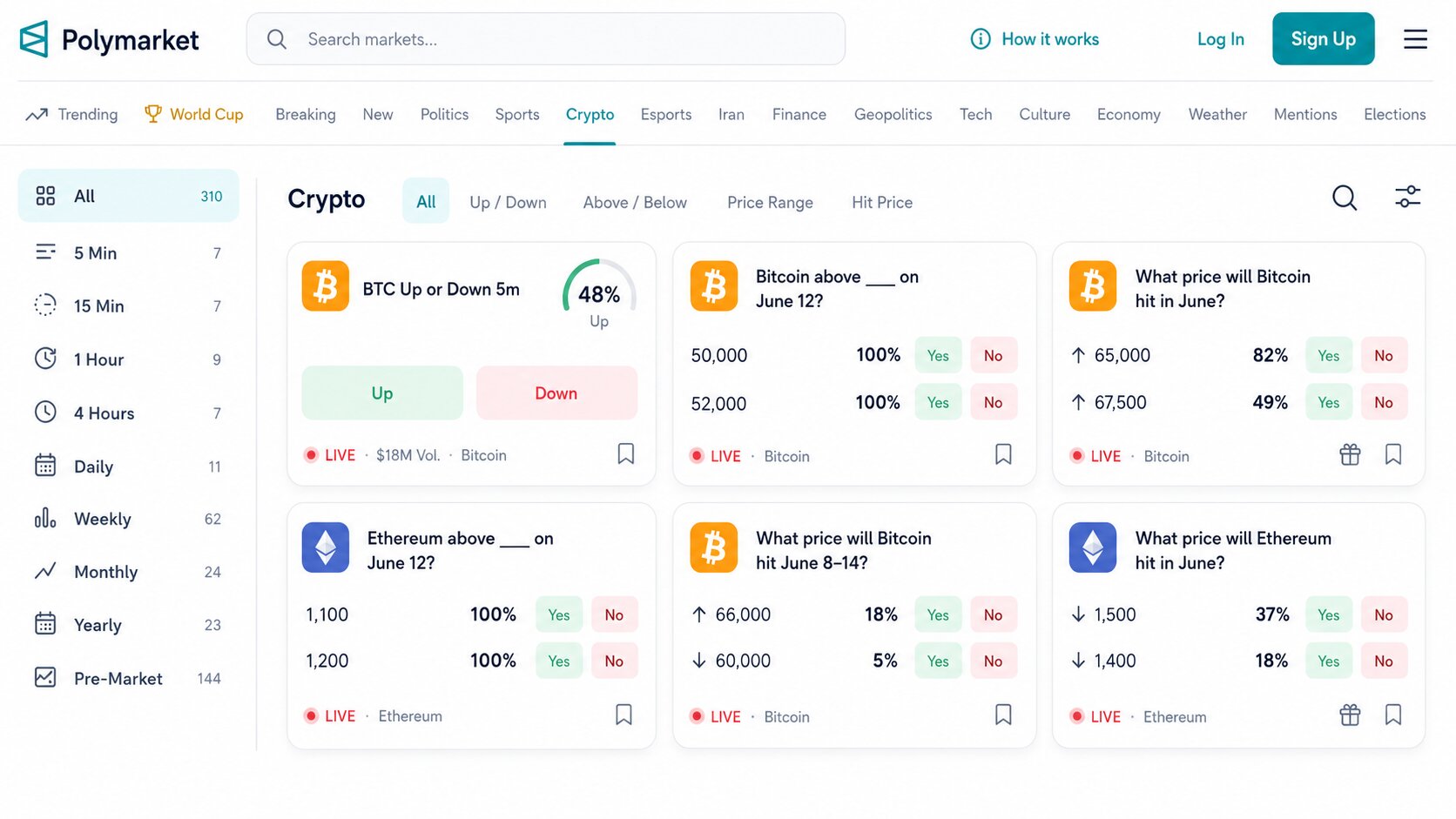
Polymarket was founded in 2020 and is built on the Polygon blockchain. It's currently the largest decentralized prediction market by trading volume and registered users, with over 22 million accounts as of 2026.
Users connect a crypto wallet, deposit USDC, and trade yes/no shares on a wide range of events: politics, economics, crypto prices, sports, science, and more. In early 2026, Polymarket expanded into financial markets, adding tradeable contracts on stock price outcomes for assets like Tesla and Nvidia, and commodities like gold and crude oil.
Trading volume has grown sharply. The platform went from around $1 billion in monthly volume in mid-2025 to over $8 billion by March 2026, according to industry data.
How Polymarket Makes Money
Polymarket charges a taker fee ranging from 0.75% to 1.80% depending on market category. Market makers pay no fee. These are participants who add liquidity by posting resting orders.
The Polymarket Effect
Prediction market accuracy got a lot of attention during the 2024 election cycle, when Polymarket and similar platforms were consistently giving Trump better odds than traditional polls. The pattern of markets front-running official confirmations of news events, before media reported it, has been observed across corporate and political topics. The explanation is straightforward: when money is on the line, people with genuine information have strong incentives to use it.
That doesn't mean prediction markets are always right. They reflect collective beliefs at a moment in time, not certainties. And like any financial market, they can be moved by large traders, coordinated manipulation, or thin liquidity on niche contracts.
Regulatory Status
Polymarket operates globally without CFTC oversight for most users. US residents are technically blocked from the platform. The company has faced enforcement scrutiny from the CFTC in the past over its registration status. In 2026, following the acquisition of Polymarket by QCX LLC, the platform moved toward CFTC-regulated status, though details of that framework are still being worked out.
The Main Alternative Platforms
The prediction market sector now has several players, each taking a different approach.
Kalshi
Kalshi is the main regulated alternative to Polymarket. It operates as a CFTC-designated contract market: a federally licensed exchange, available to US residents, and subject to federal financial oversight.
The platform supports USDC deposits and is expanding its blockchain integration, but it operates more like a fintech trading platform than a crypto-native app. Kalshi covers politics, economics, sports, weather, and crypto price events.
Growth has been fast. The company raised $300 million at a $5 billion valuation in October 2025, followed by a $1 billion round valuing it at $22 billion in early 2026. A partnership with Robinhood has expanded its reach into mainstream retail investors. As of early 2026, it holds the highest valuation of any prediction market platform and approximately 350,000 active markets.
Fee structure: a flat $0.02 per contract.
Augur
Augur was one of the original decentralized prediction markets, launched in 2018. It remains the most fully decentralized option: no central authority, no KYC, censorship-resistant. The REP token is used for market creation and dispute resolution.
The trade-offs are real. Augur has lower liquidity than Polymarket, higher gas fees, and a steeper learning curve. It's not a practical starting point for most users. Where it has a genuine use case is for blockchain developers building applications that need a manipulation-resistant, cross-chain truth oracle for settlement.
Manifold Markets
Manifold takes a completely different approach: no real money involved. It's a play-money prediction market where anyone can create markets on anything. Popular with researchers, forecasting communities, policy analysts, and rationalist communities, it's genuinely useful for calibration and forecasting practice without financial risk.
If you want to understand how prediction markets work conceptually before committing real capital, Manifold is a low-pressure way to experiment.
Robinhood Event Contracts
Robinhood launched its own prediction market product in partnership with Kalshi, allowing US users to trade event contracts through the existing Robinhood interface without needing to manage crypto wallets or USDC. It's currently focused on sports and major economic events.
What’s of note here is distribution: Robinhood has tens of millions of existing retail users. Event contracts integrated into a familiar brokerage interface could bring prediction markets to a much broader audience than crypto-native platforms have reached.
Prediction Markets and Regulation: Where Things Stand
The regulatory picture for prediction markets is genuinely complicated, and it's actively being litigated.
The CFTC vs. States Dispute
The central question is jurisdictional: are prediction market contracts financial derivatives (regulated federally by the CFTC) or gambling products (regulated at the state level)?
In February 2026, the CFTC filed amicus briefs in disputes with five states, including Nevada, New York, and Illinois, arguing that "event contracts" are derivatives under the Commodity Exchange Act and that federal jurisdiction preempts state-level gambling laws. At least 12 states are currently involved in active litigation on this question.
The American Gaming Association has argued that sports event contracts are "indistinguishable from legal sports betting," and that prediction market platforms don't carry the same consumer protections, age verification requirements, or tax obligations that licensed sportsbooks do.
In March 2026, the CFTC signaled it was building a formal regulatory framework for the sector, including an information-sharing agreement with Major League Baseball. CFTC Chair Michael Selig stated that a new rulemaking process was underway to define the boundaries of event contracts.
European Restrictions
In March 2026, France, Spain, and the Netherlands officially banned major prediction market platforms from operating within their borders, classifying event contract trading as illegal online gambling.
EU-wide implications remain unclear: MiCA's grandfathering period ends in July 2026, after which platforms must hold formal licenses to operate within the EU. The UK position is similarly unresolved. A prediction market platform would likely need to be licensed either as a betting exchange or as a financial product.
The DEATH BETS Act
In the US, Congress has proposed legislation specifically banning contracts tied to war, terrorism, or assassination. The Public Integrity Act is addressing additional categories. These legislative moves signal that even in a more permissive regulatory environment, certain market types are likely to be restricted.
What This Means for You
If you're outside the US, your access to regulated platforms is limited, and decentralized alternatives like Polymarket operate in a gray area. If you're a US resident, Kalshi and Robinhood Event Contracts currently offer the clearest regulated access. The legal framework is still being built, and it can change quickly.
Comparison: Major Prediction Market Platforms
Factor | Polymarket | Kalshi | Augur | Manifold |
Type | Decentralized | Centralized (regulated) | Decentralized | Play money |
Regulation | Unregulated (for most users) | CFTC-licensed | None | N/A |
US Access | Blocked for most users | Yes | Yes | Yes |
Settlement Currency | USDC | USD/USDC | DAI/ETH | Mana (play money) |
KYC Required | No | Yes | No | No |
Fees | 0.75–1.80% taker | $0.02/contract | None | Free |
Monthly Volume | ~$10B+ (March 2026) | ~$1.3B | Low | N/A |
Market Range | Politics, crypto, sports, finance | Politics, economics, sports, crypto | Any (open) | Any (open) |
Best For | Crypto-native global traders | US residents, mainstream access | Developers, crypto purists | Research, calibration practice |
What Prediction Markets Are Useful For
Used well, prediction market data has real informational value. Researchers treat platform prices as probability forecasts. Journalists track sudden price shifts as early signals of news developments. Financial professionals watch economic event markets alongside traditional indicators.
The key limitation is that prices reflect the beliefs of whoever is currently trading. On liquid, well-followed markets (major elections, Fed rate decisions, large-cap crypto price questions) the aggregation is reasonably meaningful. On thin markets with low volume, a single large trade can move the price significantly with no informational content behind it.
Prediction markets also can't create information that doesn't exist. They aggregate and price what participants know. On questions where no participant has a meaningful edge, genuinely unknowable future events, the prices are essentially a structured measure of collective uncertainty, not a forecast with predictive power.
Risks and Limitations
Smart contract risk. Code can have bugs. Funds held in a smart contract are at risk if a vulnerability is found and exploited. Unlike a bank account, there's no deposit insurance and no recourse.
Oracle disputes. As the MicroStrategy example illustrates, high-value markets can produce genuine ambiguity about outcomes. Token-weighted dispute resolution is transparent but not necessarily impartial or fast.
Liquidity risk. On smaller markets, spreads can be wide and exits can be costly. Don't assume you can exit a position at a fair price when volume is thin.
No regulatory protection on decentralized platforms. If Polymarket makes a decision you disagree with, there's no ombudsman, no FDIC, no CFTC complaint mechanism. At least not currently.
Jurisdictional uncertainty. The legal status of prediction markets is actively contested in multiple countries. Access restrictions can change with little notice.
Manipulation potential. Suspicious trading activity around high-profile events has attracted regulator and researcher scrutiny, as Reuters reported in May 2026. Thin markets are more vulnerable to manipulation than deep ones.
Getting Started with Prediction Markets
If you want to explore prediction markets, starting on Manifold costs nothing and carries no financial risk. It's genuinely useful for understanding how markets form, how prices move in response to new information, and how resolution works.
For real-money participation:
US residents: Kalshi is the clearest regulated path. You can sign up with standard identity verification, deposit USD or USDC, and trade without managing a crypto wallet. Robinhood Event Contracts offer a similar experience if you already have a Robinhood account.
Non-US users: Polymarket is the largest platform by volume and market variety. You'll need a crypto wallet and USDC to get started. Be aware of the regulatory gray area and the risks of decentralized settlement.
Steps for Polymarket:
Set up a non-custodial wallet (MetaMask or Coinbase Wallet work)
Acquire USDC via a crypto exchange and transfer it to your wallet
Connect your wallet at polymarket.com
Browse markets, review the resolution criteria carefully before trading, and start with small positions
The Bigger Picture
Prediction markets have moved from a crypto-native experiment to a genuinely contested piece of financial infrastructure. The volume numbers, the institutional interest, the CFTC rulemaking, the European bans: all of it signals a sector that's no longer niche.
Whether they represent a new information layer for finance, a form of gambling dressed up in probability language, or something genuinely new that doesn't fit existing categories is a debate that regulators, academics, and courts are actively working through. The honest answer is probably that they're all three, depending on how they're used and what's being traded.
Understanding how prediction markets work is a start. Knowing what the blockchain is showing right now is more useful.
That's what LearningCrypto is for. Daily briefs, live on-chain data, and a DCA signal built on fundamentals. Try it for free.
Frequently Asked Questions
Can anyone create a prediction market, or only the platforms?
It depends on the platform. Augur and Manifold are fully open: anyone can create a market on any question. Polymarket uses a curated system where market creation goes through an approval process, which is part of how it keeps question quality and resolution criteria consistent. Kalshi, as a regulated exchange, creates all markets in-house. So the answer ranges from "anyone" to "only the platform" depending on where you're trading.
Do I pay tax on prediction market winnings?
In the US, profits from prediction market contracts are generally treated as taxable income or capital gains, depending on how the IRS classifies the specific product. Kalshi, as a CFTC-regulated platform, issues tax forms. Decentralized platforms like Polymarket don't, which means the burden of tracking and reporting falls entirely on you. Tax treatment varies by country and is an area regulators are still formalizing.
What happens to my funds if a platform shuts down?
On centralized platforms like Kalshi, funds are held in customer accounts and subject to the same regulatory protections as other licensed financial entities. If it shuts down, there's a wind-down process. On decentralized platforms, funds are held in smart contracts on the blockchain, not by the company. If Polymarket ceased to exist tomorrow, your USDC would still be accessible via the smart contract. The platform shutting down doesn't mean the funds disappear. That said, interacting with those contracts without a working front-end interface would require technical knowledge.
Is there a minimum amount needed to trade?
On Polymarket, the practical minimum is whatever your wallet's gas fees make economical. Technically, you can buy a fraction of a share, but transaction costs can eat into small positions quickly. Kalshi works more like a standard brokerage with no meaningful minimum. Manifold has no financial minimum because it uses play money. If you're just getting started, Manifold is the sensible place to test the mechanics without worrying about minimums or fees at all.
Keep learning
- Mastering DYOR in Crypto: Your Step-by-Step Research Framework
- How to Read a Crypto Whitepaper
- On-Chain Analysis: Reading Blockchain Data to Understand Markets
- More guides in the Fundamentals hub
- Members: Ask Crypto AI, ask it any beginner question, privately