
Last updated: August 13, 2026. This started life as our KYC-free resource paper. It has been rewritten from scratch with new platforms, the 2026 regulatory picture, and a full video walkthrough.
This guide began as a support ticket. A Learning Crypto member asked how to cash out their Bitcoin without identifying themselves, and the honest answer needed a research paper, not a two-line reply. That paper became this page, and this page now gets rewritten whenever enough of it goes stale to make the old version dangerous.
A lot went stale. Since the first version, giants of the P2P world died outright, US exchanges started filing a brand-new tax form on their customers, and the EU set a date to ban privacy coins from regulated platforms entirely.
One thing has not changed, and it's the first thing you should accept: there is no perfect privacy solution. Every tool on this page trades convenience for control somewhere. Your only real decision is which trade you can live with.
Short on time? Jump straight to the comparison tables.
Key takeaways
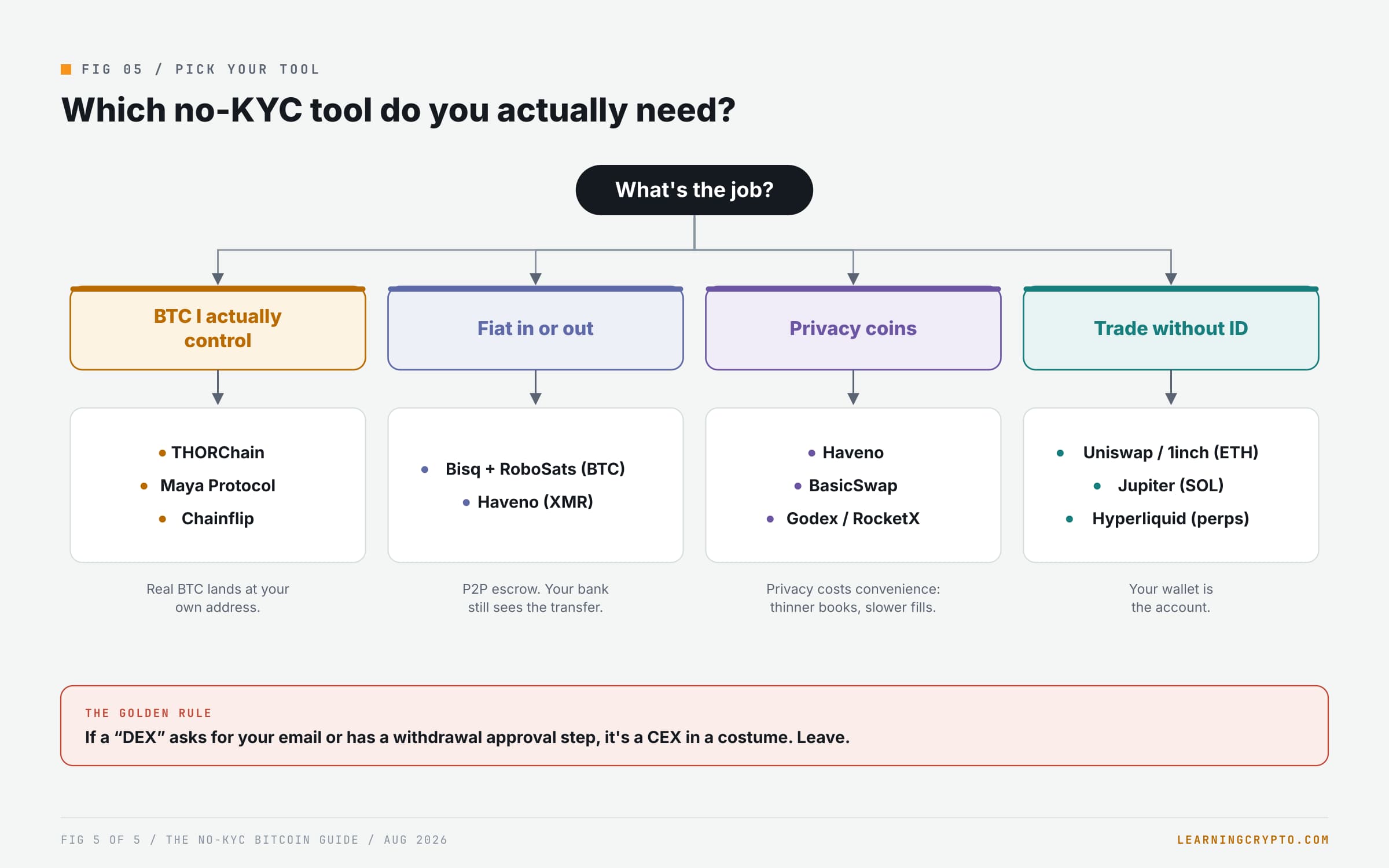
Wrapped Bitcoin (WBTC) is an IOU from a custodian. If you want BTC you actually control, swap through THORChain, Maya Protocol, or Chainflip and receive coins at your own Bitcoin address.
For fiat in and out without KYC, peer-to-peer is the only honest answer: Bisq and RoboSats for Bitcoin, Haveno for Monero.
A real DEX cannot ask for your passport. If a "DEX" wants your email or has a withdrawal approval step, it's a centralized exchange in a costume. Leave.
No-KYC does not mean no taxes. You still owe them. What you avoid is parking your passport in a database waiting to be hacked.
Platforms in this niche die fast. LocalBitcoins closed in 2023, LocalMonero in 2024. Confirm a platform is alive before funding a trade.
Why this guide needed a 2026 rewrite
The squeeze on KYC'd crypto got measurably tighter. In the US, custodial exchanges now file Form 1099-DA reporting your gross proceeds to the IRS, starting with the 2025 tax year. Congress did repeal the rule that would have forced DeFi protocols to do the same (April 2025), so on-chain trades stay unreported by the venue, but every centralized platform you've ever KYC'd with is now a reporting agent. In Europe it goes further: under the new anti-money-laundering regulation, regulated platforms must drop privacy coins and anonymous accounts by mid-2027. Binance already delisted Monero back in February 2024 and most large exchanges followed.
Meanwhile the old standbys kept dying. LocalBitcoins, the platform that onboarded half of early Bitcoin, shut down in February 2023. LocalMonero wound down in 2024. Every one of those shutdowns stranded users mid-trade or forced rushed withdrawals, which is exactly why this page leans toward tools with no company to shut down.
The good news: the replacements are better than what died. Cross-chain DEXs matured, Lightning P2P got genuinely usable, and Monero finally has a native DEX that works. That's what the rest of this page covers.
Wrapped Bitcoin is a receipt, not Bitcoin
Start with the biggest lie in DeFi: that wrapped Bitcoin is Bitcoin.
Here's what WBTC really is. Someone sends real BTC to a custodian. The custodian locks it in a vault and mints an Ethereum token that says "I owe you one Bitcoin." You're trusting that company not to get hacked, not to freeze the funds, and not to go bankrupt. That's a bank with extra steps.
If that risk sounds theoretical, it stopped being theoretical in 2024. BitGo moved WBTC custody into a joint venture linked to Justin Sun, the market panicked about who really controlled the vault, and Coinbase responded by delisting WBTC and pushing its own wrapped product, cbBTC. Which, note, just swaps one custodian for another. The token in your wallet never changed. The counterparty behind it did, overnight, without your permission. That is the product.
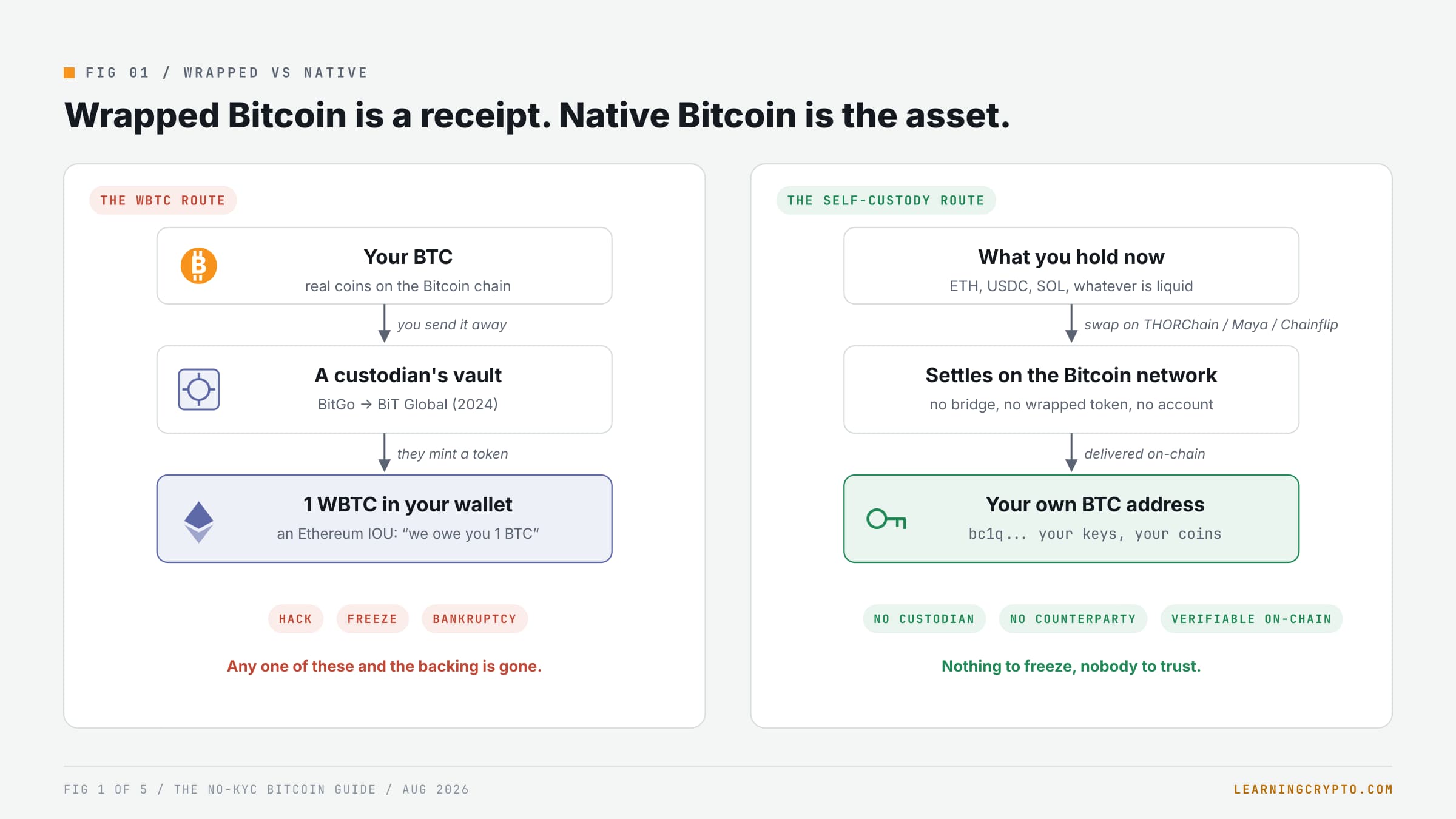
Does WBTC still have a use? One. If you're farming yield on Ethereum and want BTC price exposure without leaving Ethereum, the liquidity is deep and the slippage is low. Just be clear about what you hold: a promise. If the custodian fails, the promise is worth zero. Native Bitcoin doesn't have that failure mode.
Getting native Bitcoin without KYC
So how do you get real Bitcoin, delivered to your own address, without a custodian or a passport scan? Three protocols do this properly.
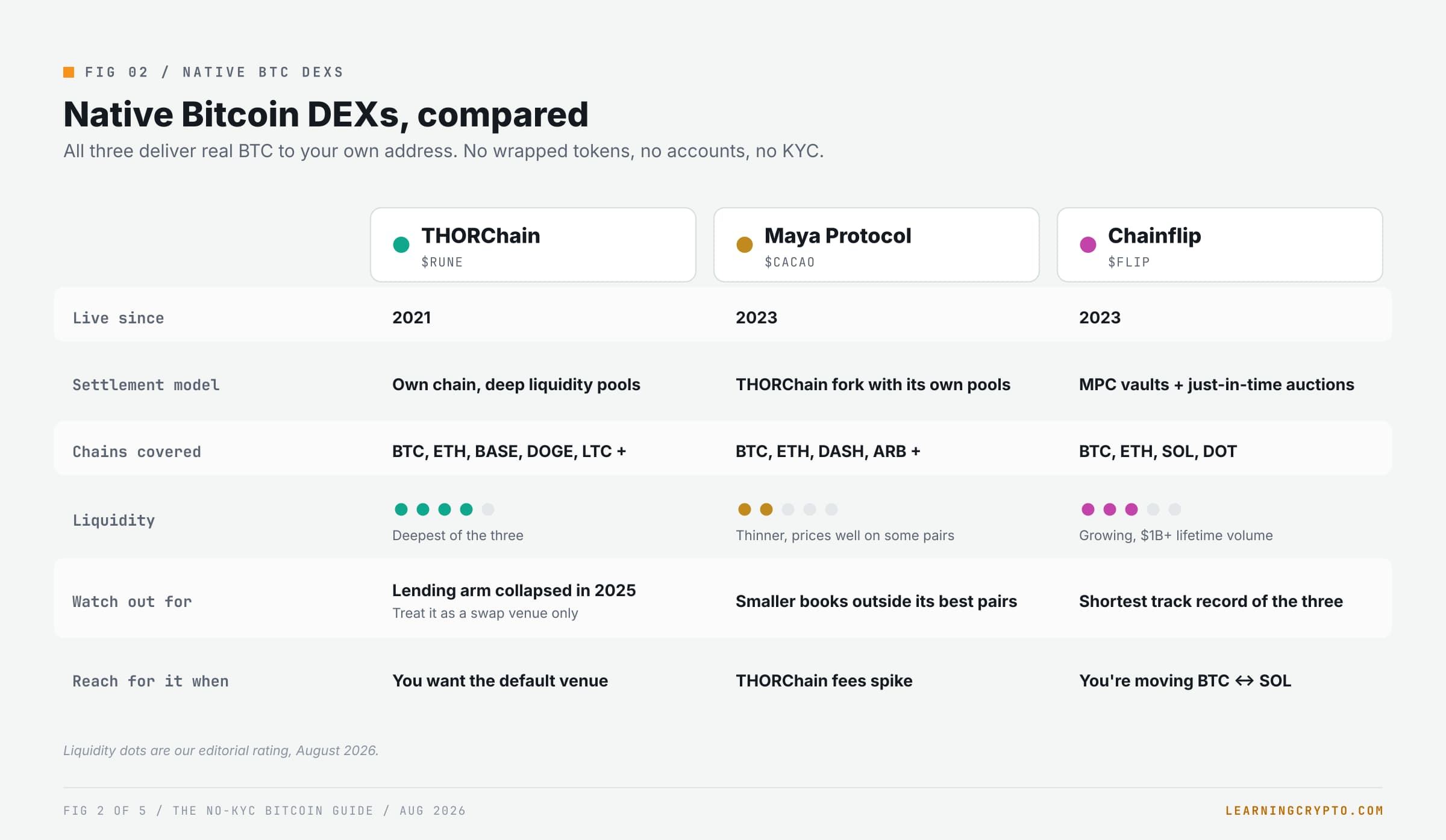
THORChain is the workhorse. Send ETH, USDC, or a dozen other assets from your wallet and receive actual BTC at your Bitcoin address, verifiable on-chain, no wrapped tokens anywhere in the route. Most people use it through a front end like THORSwap. The trade-off is liquidity: on trades under a couple of BTC the slippage is minor, above that you'll feel it. One caution worth knowing: THORChain's lending and savings experiment collapsed in early 2025 under roughly $200 million of liabilities and had to be restructured. The swap layer kept settling trades through the entire mess, which says something about the core design, but treat THORChain as a swap venue, never a savings account.
Maya Protocol is a THORChain fork with different tokenomics. Same mechanics, sometimes better pricing on specific pairs. Keep it bookmarked as the backup venue for when THORChain fees spike.
Chainflip is the newer entrant and it's growing fast, with over a billion dollars in cumulative volume. It uses multi-party computation instead of THORChain's model to handle the cross-chain settlement. BTC to Solana, BTC to Ethereum, no bridges, no wrapped anything.
Before you pick one, answer the only question that matters: why are you buying Bitcoin? If the answer involves sovereignty and self-custody, use one of these three and take delivery at your own address. If you're purely speculating on price inside Ethereum DeFi, wrapped versions work. Just don't confuse the two.
The no-KYC comparison tables
💡 Note: everything on this page is use-at-your-own-risk. Real DeFi has no refunds and no support desk. Platforms in this niche appear and disappear fast, so confirm any platform is alive and liquid before sending funds. This is not financial or legal advice.
Buying and selling BTC for fiat, peer-to-peer
P2P remains the best route for Americans: fiat lands directly in your bank account through Zelle, CashApp, Venmo or a plain wire, and no company ever custodies your coins. Lightning-capable platforms are marked, since LN trades settle faster and cost less. Where KYC says "P" (partial), either the platform wants a phone number or a specific trade's terms require some identifying detail, like bank account info for the payment itself.
Platform | USA | KYC | LN Enabled | BTC Only | 2FA | Mobile App | Fiat Off-Ramp | Notes |
|---|---|---|---|---|---|---|---|---|
RoboSats | Y | N | Y | Y | N | N | Y | Runs over Tor, no accounts at all, Lightning only. Tor Browser preferred |
Bisq | Y | N | N | Y | N | N | Y | Desktop app required. Running since 2014; Bisq 2 ("Bisq Easy") now makes small trades much simpler |
HodlHodl | N | N | Y | Y | Y | N | Y | Non-custodial multisig escrow. Not available to US users |
lnp2pbot | Y | N | Y | Y | Y | Y | Y | Runs inside Telegram, so you need a Telegram account |
Y | N | Y | Y | N | Y | Y | In-person cash trades. Log in with a Lightning wallet (Phoenix, Zeus, Breez) | |
P2PCoins | Y | N | N | N | N | N | Y | Small order book, mostly EUR. Verify liquidity before relying on it |
Poloniex | N | P | N/A | N | Y | Y | Y | Centralized, US-restricted. Email-only "Level 1" accounts capped around $10k/day withdrawals; a CEX can change this policy overnight |
N | P | N | Y | N | N | Y | UK only. Requires bank details and a phone number | |
N | P | N | N | Y | Y | Y | Phone number required. P2P, Europe and Asia markets. Confirm current status before trading |
No-KYC DEXs and swap tools
These don't touch fiat. They're for swapping between assets, including into and out of native BTC and Monero, without an account.
Tool | Best for | KYC | Who holds your coins | The trade-off |
|---|---|---|---|---|
THORChain (via THORSwap) | Native BTC ⇄ ETH, SOL, stables | None | Nobody, non-custodial | Slippage on large clips; ignore its lending history |
Maya Protocol | Backup venue for the same swaps | None | Nobody | Thinner liquidity on some pairs |
Chainflip | Native BTC ⇄ ETH/SOL via MPC | None | Nobody | Younger protocol, shorter track record |
Haveno | Monero ⇄ BTC and fiat, over Tor | None | Multisig escrow, no company | You run the software; trades take longer |
BasicSwap | Zero-fee atomic swaps (Particl) | None | Nobody, pure atomic swaps | Full local node; built for technical users |
Godex | One-off instant swaps | None | Briefly, during the swap | Fixed-rate spread is the fee |
RocketX | Aggregated swaps across 200+ chains | None | Nobody | You're trusting their routing |
Uniswap / 1inch | ERC-20 trading on Ethereum | None | Nobody | Watch your token approvals |
Jupiter | Everything on Solana | None | Nobody | The long tail is mostly junk; filter hard |
Hyperliquid | On-chain perps with leverage | None | On-chain | It's leverage. Behave accordingly |
Cashing out to fiat without KYC
Let's kill a myth first: there is no such thing as a fiat DEX. Dollars and euros move through banks and payment processors, and those are KYC'd by law. Anyone selling you "anonymous fiat conversion" through a slick app is lying or running something you want no part of.
What actually exists is peer-to-peer trading where the platform never learns who you are, even though your counterparty's bank might.
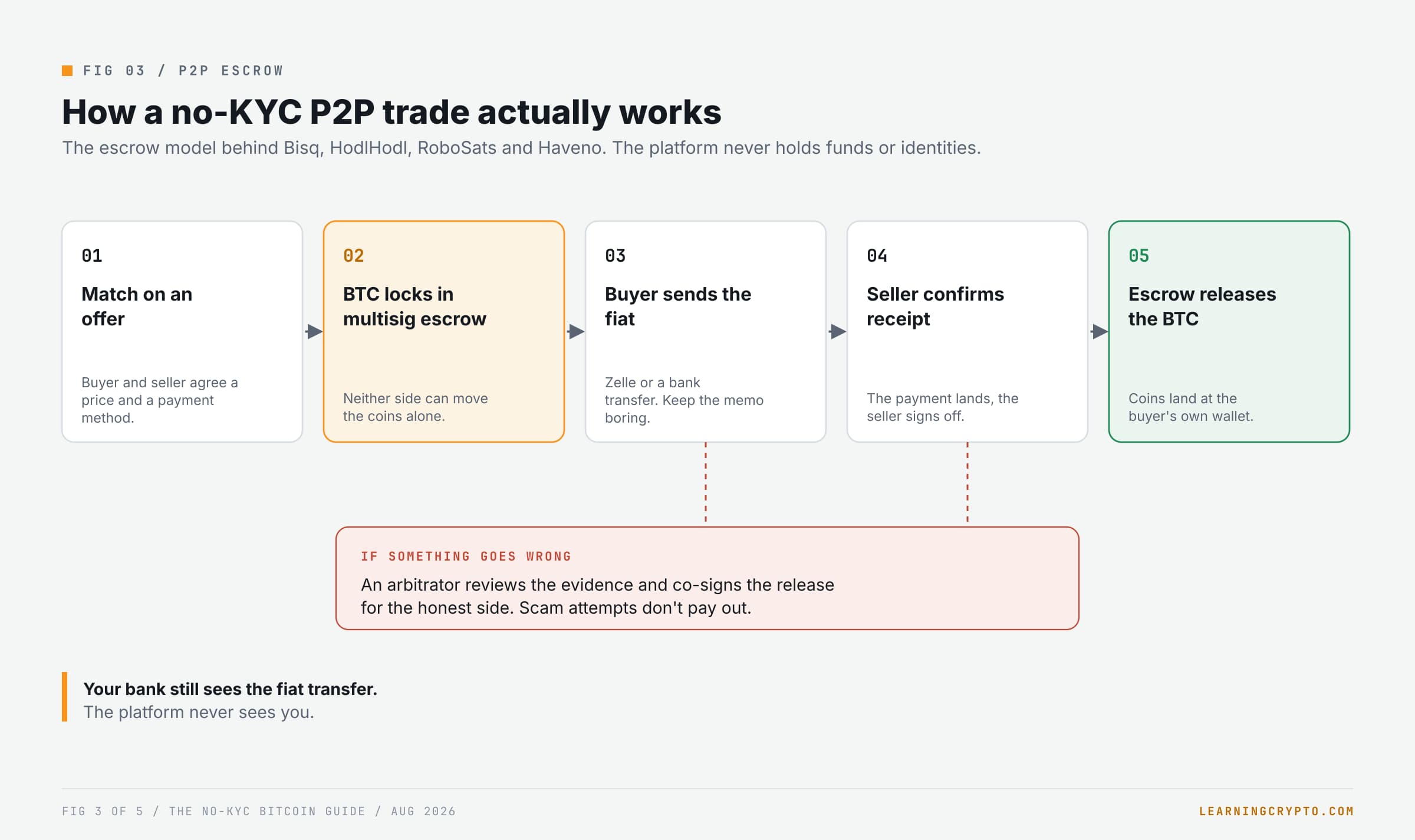
Bisq has run this model since 2014 with no central servers and no company to subpoena. You find a seller, agree a price, they lock BTC in a multisig escrow, you send fiat by Zelle or bank transfer, they confirm receipt, the escrow releases. Scam attempts go to arbitration, and the system has handled them for over a decade. Slower than Coinbase? Yes. But Bisq can't freeze your coins and can't leak your ID, because it never holds either.
Your bank is the weak point that remains. It sees the Zelle transfer, so keep trade descriptions boring. "Thanks" moves money exactly as well as "BTC trade #4471."
RoboSats does the same job over Lightning, faster and cheaper, best for smaller amounts. Haveno covers the Monero side: same P2P multisig model, run over Tor, and currently the cleanest way to move between XMR and fiat without an account.
None of this is beginner-friendly, and I won't pretend otherwise. Trades can take hours, occasionally days. What you get for the patience is that no company holds your funds, no database holds your passport, and no regulator can switch the network off. Whether that's worth it is your call. Now at least you know the option exists.
Where Monero actually trades in 2026
Monero got delisted from the major exchanges for one reason: it works. Amounts, senders and receivers are hidden at the protocol level, on every transaction, with no opt-out. Regulators can't selectively unmask it, so exchanges under regulatory pressure dropped it. The EU's 2027 deadline will finish that job on regulated platforms.
None of which killed the asset. It just moved the trading venues.
Haveno is the flagship: a Monero-native DEX running over Tor, live since 2024 through community-run networks (Haveno Reto is the busiest). No accounts, no emails. Atomic-swap and multisig mechanics mean neither side can scam the other. You download software, connect to the peer-to-peer network, and trade XMR against BTC or fiat directly with another human.
RocketX is the convenience play: a hybrid aggregator pulling liquidity from over 200 chains, so you can route ETH into XMR at a decent rate from a normal wallet without running anything. The trust trade-off is their routing, though they never custody funds. Godex is simpler still, an instant swap service with no accounts: send one coin, receive Monero, done. BasicSwap, built by the Particl community, is the maximalist option: pure atomic swaps, zero fees, everything over Tor, full local node required.
<!-- Internal link suggestion: link "Monero" to your Monero explainer or privacy-coin guide if you have one -->
The reality check applies to all four: privacy costs convenience. Thinner books, wider spreads, slower fills. If you won't pay that price, use a centralized exchange and accept that every transaction is logged, analyzed, and shared with regulators. Pick one; you don't get both.
Trading without ID: Uniswap, 1inch, Jupiter, Hyperliquid
A real DEX physically cannot demand KYC. It never custodies your funds, so there's nothing to gate behind a passport upload. Your wallet is your account.
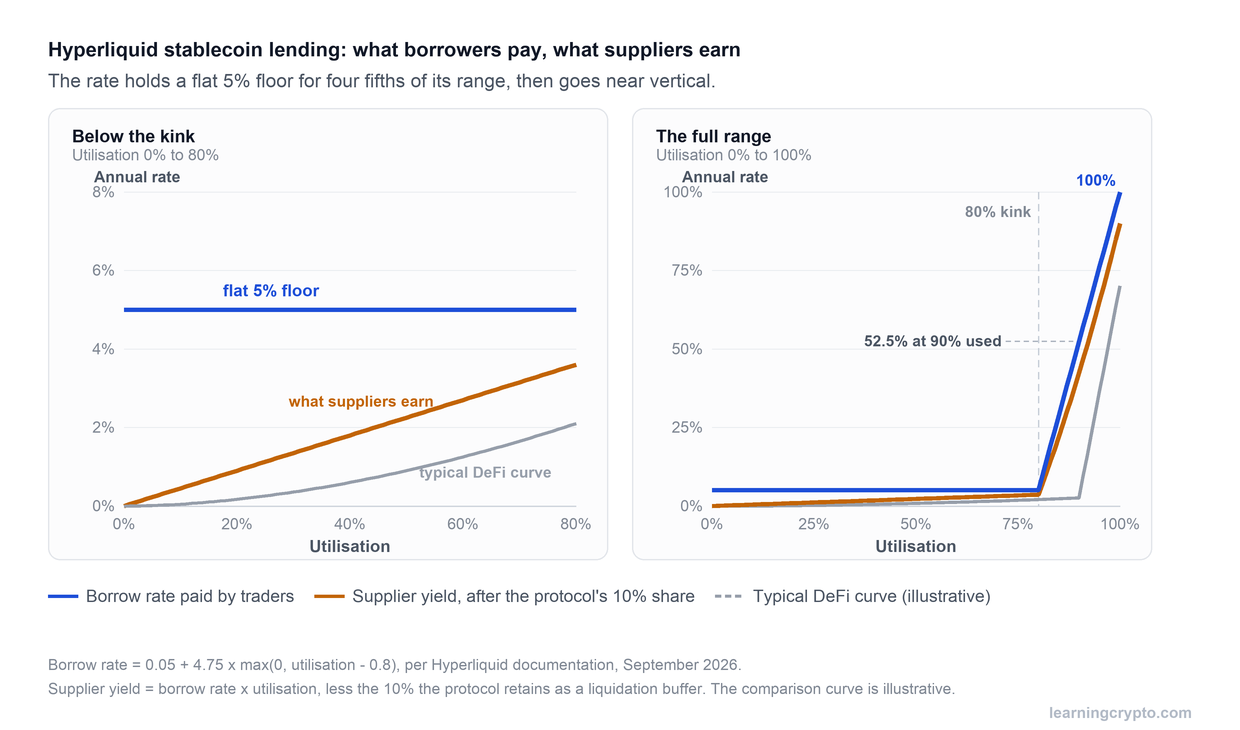
On Ethereum, Uniswap is still the standard: connect MetaMask or Rabby and trade, no email, no phone number. 1inch improves on it by aggregating liquidity across dozens of DEXs and splitting orders for a better fill. On Solana, Jupiter owns the field, scanning every DEX on the chain and processing more volume than the rest combined. And if you want perpetuals with leverage, Hyperliquid feels like a centralized exchange but settles fully on-chain (you fund it from Arbitrum; it runs on its own chain). No KYC, no custody.
How to spot a fake DEX
Plenty of platforms wear the DEX label while custodying funds or sneaking KYC in at withdrawal. The golden rule: if it asks for your email, or there's a withdrawal approval step, it is a centralized exchange in a costume. Real DEXs never hold your money, so there is nothing for them to "approve." Depositing into a contract that can freeze your funds isn't decentralized trading. It's a trap with better branding. Run.
Match the tool to the job
Stop defaulting to Ethereum for everything. Native Bitcoin belongs on THORChain, Maya, or Chainflip. Privacy needs Haveno or its cousins. Fiat needs a P2P network like Bisq. High-frequency trading is cheaper on Solana or an L2. Match the chain to the job, never the other way around.
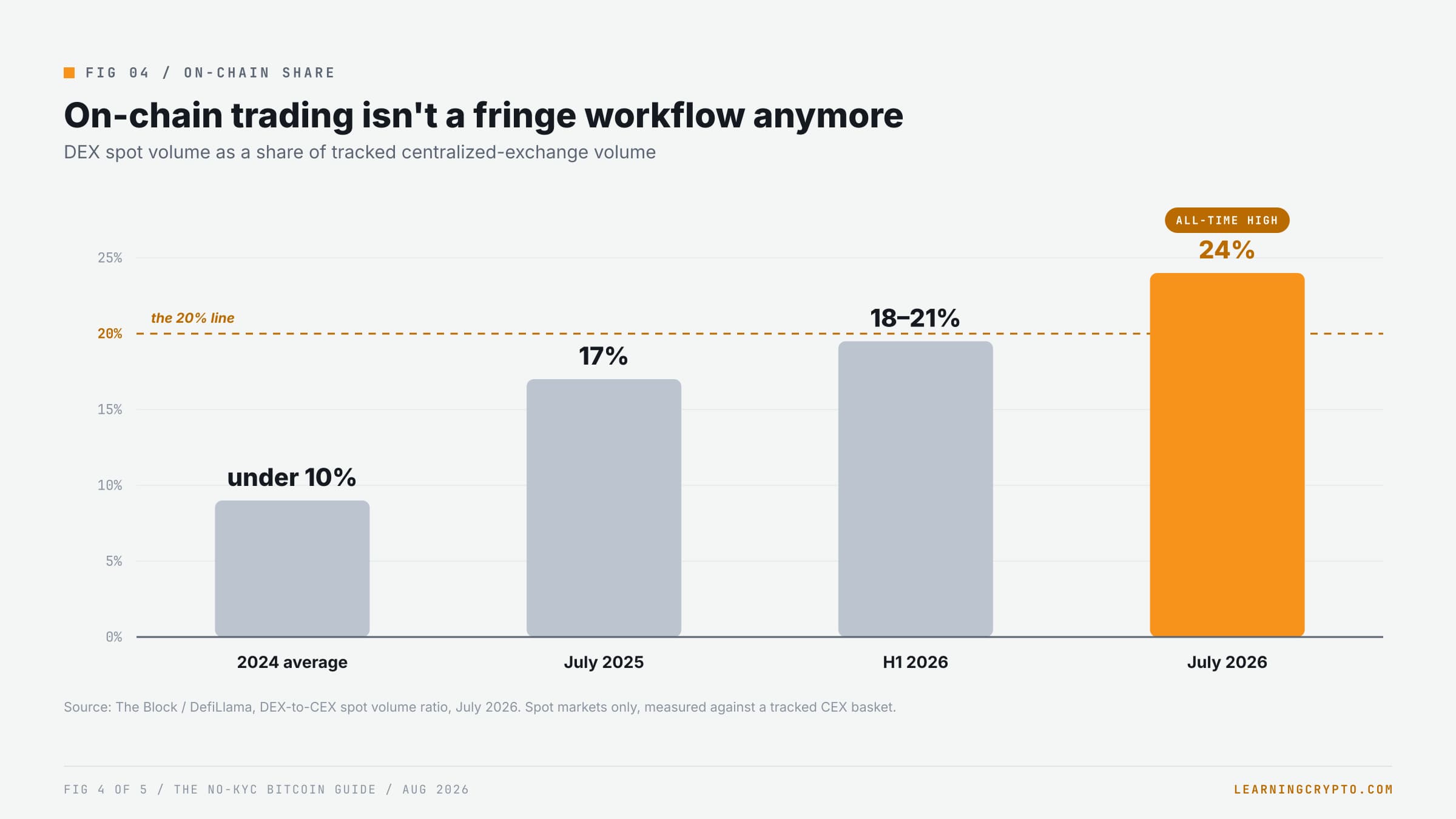
And this isn't a fringe workflow anymore. DEXs now clear north of 20% of all crypto spot trading. The infrastructure grew up while everyone was watching ETF flows.
The legal part (read it anyway)
None of this makes taxes optional. In the US you owe capital gains whether or not any exchange files a 1099-DA on you, and P2P trades make you responsible for your own records, so keep them. Some jurisdictions restrict P2P trading itself; know your local rules before you trade.
The point of no-KYC tools is narrower and more defensible than "disappearing": your passport doesn't sit in an exchange database waiting for the next breach, your balance isn't visible to anyone who buys or subpoenas a customer list, and no custodian can freeze what it never held. Privacy from surveillance and data leaks is legal almost everywhere. Hiding income is not, and it's a terrible trade. Don't confuse the two.
No-KYC Bitcoin FAQ
Is buying Bitcoin without KYC legal? In most jurisdictions, yes. P2P trading and DEX swaps are legal in the US and most of Europe; what's regulated is the platforms, not your right to trade property privately. You still owe tax on gains, and some countries restrict P2P specifically, so check your local rules.
Is wrapped Bitcoin (WBTC) the same as Bitcoin? No. WBTC is an Ethereum token backed by BTC that a custodian holds on your behalf. If the custodian is hacked, freezes funds, or goes under, the token can lose its backing. Native Bitcoin at your own address has no custodian to fail.
What's the easiest way to buy a small amount of BTC without KYC? RoboSats or lnp2pbot for Lightning trades, or Bisq Easy for a simple on-chain purchase. All three settle to your own wallet and none asks for identification.
Can I cash out to my bank account without KYC? The platform side, yes: Bisq, RoboSats and Haveno never learn your identity. Your bank still sees the incoming transfer, so keep payment memos generic and amounts unremarkable.
Do DEXs report my trades to the IRS? No. The rule that would have forced DeFi front ends to file 1099s was repealed in April 2025. Custodial exchanges do file Form 1099-DA. Either way, you're required to self-report gains.
Why can't I buy Monero on normal exchanges anymore? Binance delisted it in February 2024 and most large exchanges followed, with EU rules pushing regulated platforms to drop privacy coins entirely by mid-2027. Monero itself is fine; it trades on Haveno, BasicSwap, Godex, and RocketX.
Where to go from here
Every tool on this page works. Every one of them will also happily let you lose money with zero recourse, because real DeFi has no refunds, no support desk, and no undo button.
Premium members get the step-by-step setup guides for the tools above, plus direct access to people who've run these exact trades with real money on the line. If one mistake would cost you four figures, the membership pays for itself the first time it stops one. Join at learningcrypto.com.
Keep learning
- Second citizenship by investment for crypto holders
- How to legally reduce your crypto taxes
- What is Hyperliquid? The complete beginner's guide
- How to Sell Pi Coins in 2026? [An Expert Guide]
- How Long Does It Take To Send or Receive Bitcoin? - Understanding Crypto Transactions
- Amir Taaki: Bitcoin Pioneer and Privacy Prophet
- More guides in the Bitcoin hub
- Members: Satoshi Indicator, a daily Bitcoin DCA signal for members