
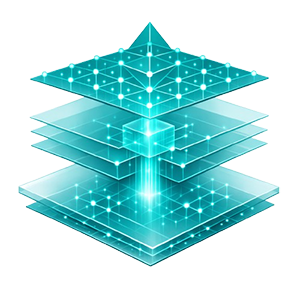
A zk-rollup is a Layer 2 scaling solution that processes transactions off the Ethereum mainnet, then posts a cryptographic validity proof back on-chain. The result is drastically lower gas fees, higher throughput, and security that's still anchored to Ethereum. |
Crypto can get loud. Memecoins pumping 4,000% in a week. Influencers screaming about the next 100x. Everyone watching price charts like they're hooked up to a heart monitor.
And profits are great, we’re not arguing with a green portfolio.
But strip away the noise, and the thing that keeps this space genuinely interesting is the engineering underneath. The stuff that actually gets built between the hype cycles.
Zero-knowledge rollups are a perfect example. They're not flashy. They don't trend on social media. But they're quietly solving one of the biggest problems in crypto: how do you make Ethereum fast and cheap without breaking what makes it secure?
What You'll Learn About zk-Rollups
→ What a zk-rollup is and why Ethereum needs them
→ How the transaction flow works from your wallet to the Ethereum mainnet
→ zk-Rollups vs optimistic rollups and what the differences mean in practice
→ Which projects are running zk-rollups right now
→ The real benefits and limitations laid out honestly
What is a zk-Rollup?
Ethereum can handle roughly 15 transactions per second on its base layer. For context, Visa processes around 1,700. When demand spikes, gas fees spike with it. During busy periods, a simple token swap can cost more than the tokens you're swapping.
A zk-rollup fixes this by moving the heavy lifting off-chain.
Instead of processing every transaction directly on Ethereum, a zk-rollup executes them on a separate Layer 2 network. It then bundles hundreds or thousands of those transactions into a single batch, generates a cryptographic validity proof confirming everything was executed correctly, and posts that proof back to Ethereum.
Ethereum's smart contract checks the proof. If the math holds, the entire batch is accepted. Thousands of transactions verified in one shot.
The Three Components
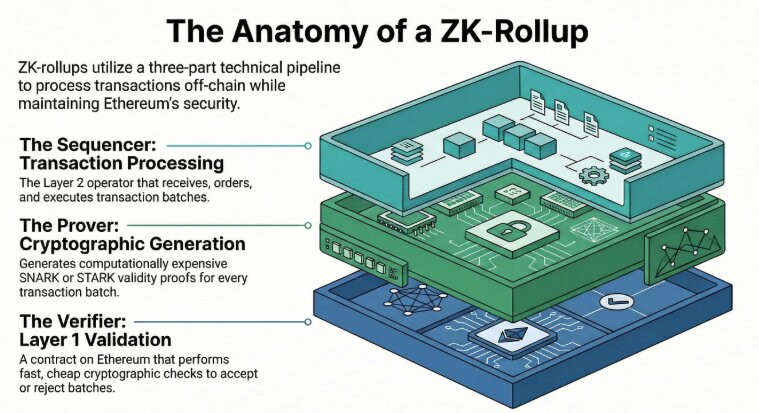
Three pieces make a zk-rollup work:
The Sequencer
This is the operator that receives your transactions, orders them, and executes them on the Layer 2. Think of it as the node that does the actual processing work. Most zk-rollups run centralized sequencers right now, though decentralization efforts are underway across the board.
The Prover.
After the sequencer processes a batch, the prover generates the validity proof. This is the computationally expensive part. The prover takes the execution trace and produces a zero-knowledge proof (a SNARK or STARK) that attests to the correctness of every transaction in the batch.
The verifier Contract
This sits on Ethereum itself. It receives the proof and the compressed transaction data, runs a quick cryptographic check, and either accepts or rejects the batch. Verification is cheap and fast. Proof generation is the hard part. Checking the proof takes milliseconds.
How Do zk-Rollups Work?
Here's what happens when you make a transaction on a zk-rollup, step by step.
What Happens | Where It Happens | |
1. | You sign a transaction in your wallet and submit it | Your device |
2. | The sequencer receives your transaction and adds it to a batch with hundreds or thousands of others | Layer 2 (off-chain) |
3. | The sequencer executes all transactions in the batch and produces a new state | Layer 2 (off-chain) |
4. | The prover generates a validity proof confirming that every transaction in the batch was executed correctly | Layer 2 (off-chain) |
5. | The proof, the new state root, and compressed transaction data get posted to Ethereum | Ethereum (on-chain) |
6. | The verifier contract on Ethereum checks the proof | Ethereum (on-chain) |
7. | If valid, Ethereum updates the rollup's state. All transactions in the batch are final | Ethereum (on-chain) |
That last step is important. Once Ethereum accepts the proof, those transactions are done. No waiting period. No dispute window. The proof already confirmed everything is correct.
Where the Data Lives
This isn’t always made clear, but zk-rollups still post transaction data to Ethereum. Not every individual transaction in full detail, but enough compressed data that anyone could reconstruct the rollup's state independently.
This is called data availability. It's what separates a zk-rollup from a validium (which stores data off-chain). The data availability piece is what gives you the full Ethereum security guarantee. If the sequencer disappears tomorrow, anyone with access to Ethereum's data can rebuild the rollup state and recover funds.
zk-Rollups vs Optimistic Rollups
Two types of rollups dominate Ethereum scaling right now. They solve the same problem but take opposite approaches to trust.
The Core Difference
A zk-rollup proves every batch is correct before Ethereum accepts it. Validity proofs. Math first, then finality.
An optimistic rollup assumes every batch is correct unless someone challenges it. Fraud proofs. Trust first, then a window to dispute.
That one difference cascades into everything else.
Feature | zk-Rollups | Optimistic Rollups |
Proof Type | Validity proofs (SNARKs/STARKs) | Fraud proofs |
Finality | Near-instant once proof is verified | Delayed (typically 7-day challenge window) |
Withdrawal to L1 | Minutes | Up to 7 days (or use third-party bridges) |
Security Model | Cryptographic certainty | Relies on at least one honest participant |
EVM Compatibility | Catching up fast (zkEVMs) | Full compatibility today |
App Ecosystem | Growing | Larger and more mature |
Proof Cost | High (computationally expensive) | Low (no proofs unless disputed) |
Major Projects | zkSync Era, Starknet, Scroll, Linea | Arbitrum, Optimism, Base |
What You're Actually Choosing Between
If you're moving funds between Layer 2 and Ethereum regularly, the withdrawal time difference is the biggest consideration. Seven days locked up on an optimistic rollup vs minutes on a zk-rollup. Third-party liquidity bridges can speed up optimistic withdrawals, but they add fees and counterparty risk.
If you're a developer, optimistic rollups are still easier to build on today. The EVM compatibility is more mature, the tooling is further along, and more protocols have already deployed there.
But zkEVMs are closing that gap fast. zkSync Era supports Solidity contracts with minimal changes.
If you care about security assumptions, zk-rollups win on paper. The validity proof is a mathematical guarantee. Optimistic rollups need at least one honest actor monitoring the network and willing to submit a fraud proof. That's a weaker assumption, even if it's worked fine in practice so far.
Which Projects Use zk-Rollups?
The zk-rollup space has been moving fast. Some projects have grown into serious infrastructure. At least one high-profile effort has already been wound down. Here's where things stand at the moment.
zkSync Era

Built by Matter Labs. Uses a hybrid proof system where STARKs handle the heavy computation and then get wrapped in a SNARK for cheaper on-chain verification. Full EVM compatibility through its own zkEVM, with native account abstraction baked in.
That means features like paying gas in any token, social recovery, and multi-sig wallets work without extra setup. zkSync processed over 700 million transactions by late 2025 and has attracted institutional partners, including Deutsche Bank and UBS for real-world asset tokenization.
The ecosystem includes 290+ deployed dApps across DeFi, gaming, and RWA platforms.
Starknet

Built by StarkWare. Uses STARKs exclusively. No trusted setup, quantum-resistant proofs, and strong scalability for complex computations. Starknet is the only major L2 that breaks away from the EVM entirely, using the Cairo programming language and its own CairoVM.
A steeper learning curve for developers, but the trade-off is proof generation optimized from the ground up.
Staking launched in 2025 and grew fast, with over 1.1 billion STRK staked by year's end. StarkWare's co-founder Eli Ben-Sasson also co-founded Zcash, and the team is exploring integration paths between Starknet and Zcash for privacy-preserving applications.
Scroll

Focused on being as close to Ethereum equivalence as possible at the bytecode level. Developers can copy existing Ethereum contracts over with zero code changes and expect identical behavior. Community-driven development, fully open-source approach, and a growing reputation as the "purest" zkEVM.
Scroll has been steadily building its DeFi ecosystem and positions itself as the option for teams that want ZK-proof security without any migration friction at all.
Linea

Built by Consensys, the company behind MetaMask. That relationship gives Linea a distribution advantage that other zk-rollups can't easily replicate. With tens of millions of users, Linea integrates directly into the MetaMask wallet experience.
The focus is on bringing zk-rollup technology to mainstream users who don't want to think about the infrastructure underneath. Linea has processed over 283 million transactions and created more than 7 million wallet addresses. The 2026 roadmap includes L3 building blocks and enterprise compliance tooling.
What Happened to Polygon zkEVM?
Worth addressing, since you'll still see it mentioned in older articles. Polygon Labs announced in June 2025 that it's sunsetting Polygon zkEVM Mainnet Beta, with deprecation scheduled for 2026.
The sequencer keeps running for at least 12 months, and all bridged assets remain withdrawable. The project originally stemmed from Polygon's $250 million acquisition of Hermez Network in 2021, but low adoption, delayed support for EIP-4844 blobs, and operating costs of over $1 million per year led to the decision.
Jordi Baylina, the ZK research lead, has spun out the underlying technology into a new independent project called ZisK. Polygon's focus has shifted to its PoS chain for stablecoin payments and RWAs, and the AggLayer for cross-chain interoperability.
If you're evaluating zk-rollups today, the active players are the four listed above.
Project | Proof Type | EVM Compatible | Language | Standout Feature |
zkSync Era | STARKs + SNARKs | Yes (zkEVM) | Solidity | Account abstraction, institutional RWA partnerships |
Starknet | STARKs | Via Cairo | Cairo | Quantum resistance, highest computation capacity |
Scroll | SNARKs | Yes (bytecode-level) | Solidity | Purest Ethereum equivalence, zero migration friction |
Linea | SNARKs | Yes (zkEVM) | Solidity | MetaMask integration, 283M+ transactions processed |
Benefits and Limitations of zk-Rollups
No technology is all upside. Here's what you actually get and what you give up.
Benefits | Limitations |
✓ Gas fees are dramatically lower than on Ethereum L1. Batch processing spreads costs across thousands of users | ✗ Proof generation is computationally expensive. Requires specialized hardware, and the cost gets passed on |
✓ Near-instant finality. Once the validity proof is verified on Ethereum, transactions are final. No dispute window | ✗ Sequencers are mostly centralized right now. If the sequencer goes down, the rollup stalls until it comes back |
✓ Ethereum-grade security. The validity proof means Ethereum itself confirms correctness. You don't need to trust the rollup operator | ✗ Smaller app ecosystem compared to optimistic rollups. Fewer DeFi protocols, fewer deployed contracts |
✓ Fast withdrawals to L1. Minutes instead of the 7-day wait on optimistic rollups | ✗ Developer tooling is still catching up. zkEVMs work, but debugging and testing aren't as smooth as on optimistic rollups yet |
✓ Data availability on Ethereum. If the rollup operator vanishes, the state can be reconstructed from on-chain data | ✗ Some opcodes and precompiles behave differently in zkEVMs. Not every Ethereum contract will work without changes |
✓ Privacy potential built into the architecture. ZK tech can enable private transactions, though most rollups don't use this yet | ✗ Proof generation adds latency. The batch needs to be proved before it's final, which can take minutes depending on the system |
The Infrastructure You Don't See
Crypto conversations tend to focus on tokens and prices. Understandable. That's where the money is.
But the projects building zk-rollup infrastructure are solving a problem that determines whether Ethereum can actually handle mainstream adoption. Fifteen transactions per second doesn't scale to a global financial system. ZK-rollups are the answer Ethereum is betting on, and they're delivering.
The technology is still early. Sequencers need to decentralize. Proof costs need to keep dropping. Developer tooling needs to catch up with what optimistic rollups already offer. But the trajectory is clear, and the pace of improvement across zkSync, Starknet, Scroll, and the rest has been faster than most people expected.
If you're using DeFi, trading on Layer 2, or building on Ethereum, you're going to interact with zk-rollups whether you realize it or not. Knowing how they work puts you ahead of most.
Go Further With Learning Crypto
Learning Crypto's Ask Crypto AI copilot pulls live, verifiable on-chain data so you can track what's happening across Layer 2 networks yourself. No influencer opinions. No sponsored picks. Just the data, and the tools to read it.
You also get a private community on Discord, monthly strategy webinars, smart-money tracking, and on-chain daily briefs posted straight to your dashboard.
FAQs
Are zk-rollups safe?
Yes, in terms of the core security model. The validity proof means Ethereum itself verifies that every transaction was executed correctly. You don't need to trust the rollup operator to be honest. The risks sit in other areas: smart contract bugs in the verifier, centralized sequencers that could censor transactions, and bridge vulnerabilities. The proof system is solid. The infrastructure around it is still maturing.
Can I use zk-rollups with MetaMask?
Yes. Most zk-rollup networks support MetaMask. You add the network (like zkSync Era or Linea) as a custom RPC endpoint, bridge funds from Ethereum, and use it like any other chain. Linea has the tightest MetaMask integration since Consensys builds both products.
How much cheaper are zk-rollups than Ethereum?
It varies by network and congestion, but typical transactions on zk-rollups cost fractions of a cent. After Ethereum's EIP-4844 upgrade introduced blob data, rollup costs dropped further. A token swap that might cost $5-15 on Ethereum L1 can cost under $0.01 on a zk-rollup during normal conditions.
Do zk-rollups use the same tokens as Ethereum?
They use ETH for gas fees, and you can bridge any ERC-20 token from Ethereum to the rollup. Some rollup networks also have their own native tokens (like ZK for zkSync or STRK for Starknet) used for governance or staking, but ETH remains the primary gas token.
What happens if a zk-rollup shuts down?
Because transaction data is posted to Ethereum, your funds aren't trapped. If the sequencer stops operating, the data needed to reconstruct the rollup state is already on-chain. You or anyone else could use that data to prove ownership and withdraw funds back to Ethereum L1. That's the whole point of data availability.
Keep learning
- Ethereum Pectra Upgrade Explained: Here’s What Experts are Saying
- What Are Blue Chip Cryptocurrencies? A Guide to Crypto's Safest Assets
- What Is SocialFi? The Future of Social Media on the Blockchain
- More guides in the DeFi hub
- Members: Team Portfolio, see what our analysts actually hold