
"Where's the best place to stake my Bitcoin?" is the question that made us record the video this guide is built on, because the honest answer is nowhere, and the reasons why explain most of what goes wrong with staking generally. This is for anyone looking at a yield figure in a wallet or exchange app and wondering whether to press the button. It covers where the reward actually comes from, when it is worth taking, the difference between staking on your own device and locking coins with an exchange, and four questions to ask before any APY.
Education, not financial advice. Yields, lock-ups and token rules change constantly; the figures here are examples from our own videos and were correct when recorded. We share what we do, not what you should do.
Where does a staking reward come from?
Mostly from new coins. A proof-of-stake network needs validators to secure it, and it pays them by issuing fresh supply on a schedule. Delegate your coins to a validator and you receive a slice of that issuance, in the same coin, minus the validator's commission. Nobody earned the reward from a customer; the network printed it. That has a direct consequence: if issuance is 10% a year and you stake, you keep your share of the network; if you do not stake, your share shrinks by about 10%. Staking is a way to avoid dilution, not a source of income.
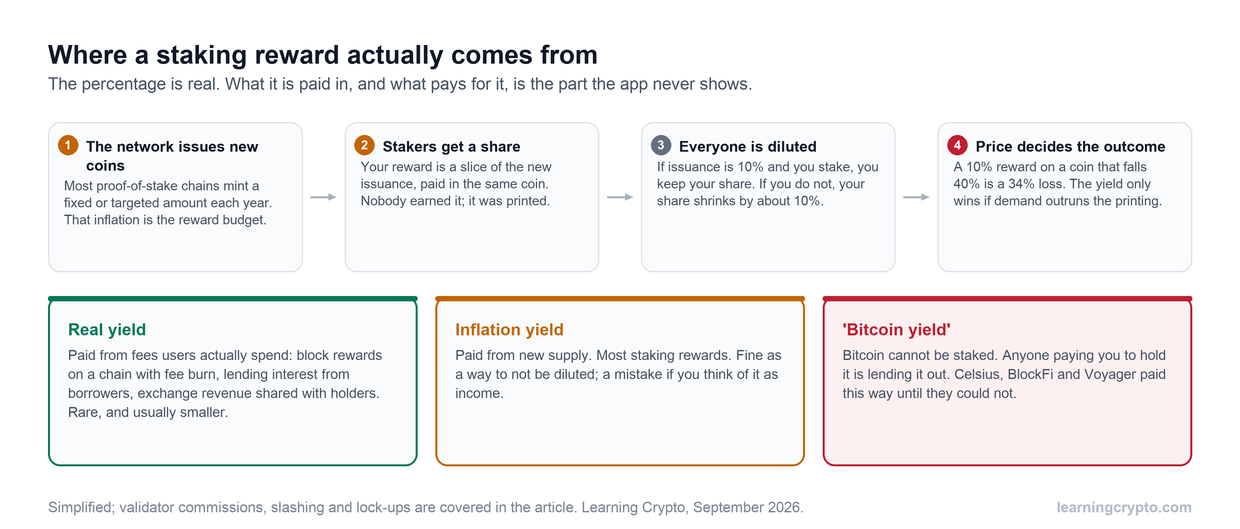
The percentage in the app is real. It is paid in a coin whose supply just grew by that percentage, which is the part the app does not show.
Some of the reward is real yield: on networks that burn transaction fees, or share them with validators, part of what you receive was paid by users. On most chains that part is small next to the issuance. Cosmos paid stakers 15 to 20% for years with inflation in the same range; Polkadot, Near and Aptos ran the same pattern with vesting schedules and early-investor selling on top. The staking rate held; the price did not, and stakers who bought for the yield lost money while collecting it.
When is staking worth it?
When two things are both true. You would hold the coin anyway, for reasons that have nothing to do with the yield, and staking it costs you nothing you cannot afford: no custody handed to a third party, an unbonding period you can live with, and a tax bill on the rewards you have planned for. In that case staking is simply not being diluted, and it is worth doing. Ethereum, Solana and Cardano can all be staked directly from a hardware wallet, with the keys never leaving it; our comparison of Trezor and Ledger covers which app supports which.
If either is false, the yield is a distraction. Heidi's 2021 video on the most profitable coins to stake still holds up on the method even though every number in it is out of date: judge a staking coin by the minimum stake, the trading volume you would need to exit, the emission rate and whether the rate falls as more people stake, and only then by the percentage.
Our June 2025 video: why most rewards are inflation, the Cosmos and Polkadot pattern, why 'risk-free 6% on Bitcoin' is a red flag, and the four questions to ask before any yield. Watch it on our CryptoTips channel.
Is exchange staking the same thing?
No, and the difference is custody. When you stake from your own wallet, you delegate a coin you still control. When you use an exchange's locked staking product, you hand the coins to the exchange, which stakes them, keeps part of the reward and may do other things with them; you hold a promise. Heidi walked through Binance's product in 2021 and the mechanics have not changed even though the rates have:
- The headline figure is annualised while you lock for 30, 60 or 90 days, so divide a 90-day rate by four to see what you actually get.
- Withdraw early and you forfeit all accrued interest, with the coins returned after a delay.
- Maximum amounts apply per product, and the best rates sell out.
- The exchange's insurance fund, where one exists, is unlikely to cover a staking product's losses.
Heidi in May 2021: how locked staking on an exchange works, why the annualised rate flatters a 30-day lock, what early redemption costs, and why the exchange, not you, holds the coins. Watch it on our CryptoTips channel.
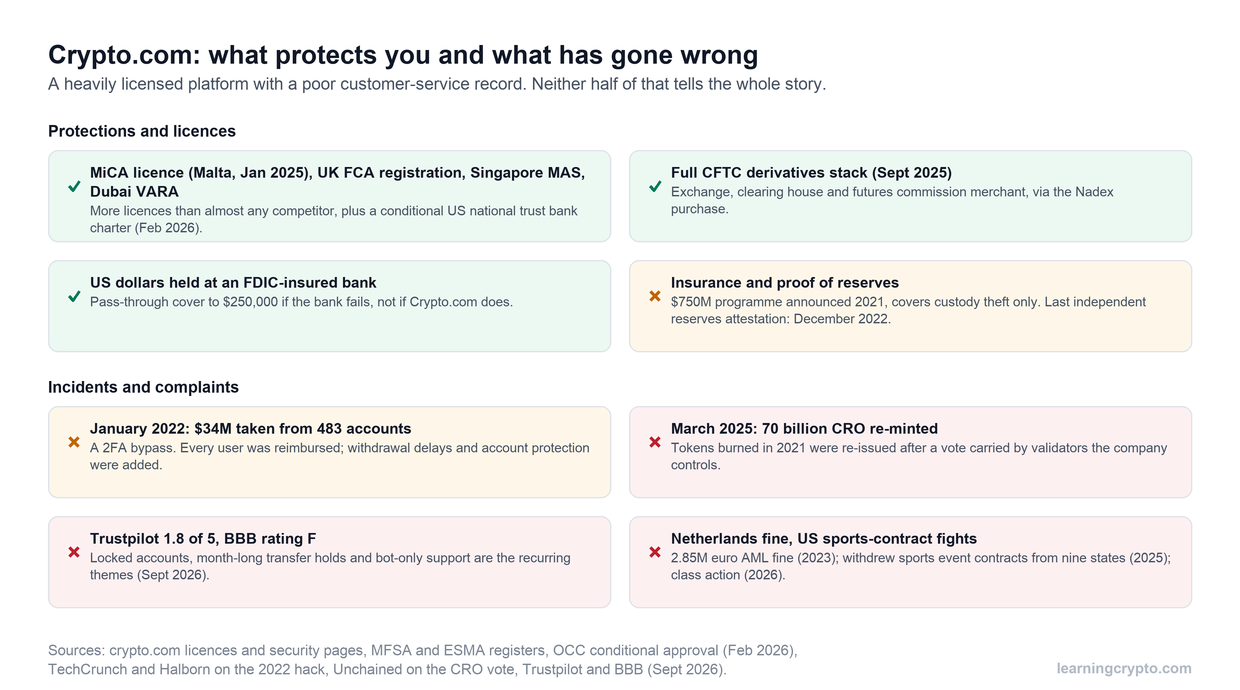
Exchange staking is convenient and the extra points of yield are often real, because the exchange runs validators at scale. What you are paid for is the counterparty risk. If the exchange fails, staked coins are in the estate with everything else, which is how Celsius, BlockFi and Voyager customers learned the difference in 2022. Our guide to liquid staking covers the on-chain version of the same trade-off, where the counterparty is a protocol rather than a company.
Why can't you stake Bitcoin?
Because Bitcoin uses proof of work; there is no staking mechanism and no issuance to share beyond what miners earn. Anyone offering a yield on Bitcoin is lending it to someone, or lending it to themselves, and paying you part of what they hope to make. That is what Celsius and BlockFi were. Some are honest lending businesses with real borrowers; the risk is still that the borrower or the platform does not pay you back, and "6% risk-free on Bitcoin" is the single clearest red flag in the industry. Bitcoin's whole point is that you do not have to trust anyone to hold it. Our guide to what Bitcoin is explains why the design has no yield in it.
What about tax and lock-ups?
In the US, the UK and most of Europe, each staking reward is income at its value on the day you received it, and it starts a new cost basis; Portugal taxes it at 28% when converted. A coin that paid you 10% and then halved can leave you with a tax bill on income you no longer have. Unbonding periods, typically days to weeks, mean you cannot sell in the first hour of a crash. Slashing, where a misbehaving validator loses part of its stake and yours with it, is rare but real, and is why the validator you delegate to deserves more attention than the rate. Our guide to legally reducing crypto taxes covers the income side.
Four questions before you stake anything
- What is the network's inflation rate, and is the reward above it? If not, you are only avoiding dilution, which is fine as long as you know that is all you are doing.
- Where does the yield come from? Fees paid by users, or new coins? If nobody can tell you, assume new coins.
- Am I giving up custody? If the coins leave your wallet, you have a counterparty, and the extra yield is the price of that risk.
- Would I hold this coin at zero yield? If the answer is no, the yield is the bait.
Our comparison of staking and mining explains the two security models side by side, and members can see which coins we hold and stake in the Portfolio Tracker. More guides are in the DeFi hub.
Frequently asked questions
Is staking crypto passive income?
Not in the way a dividend is. Most staking rewards are newly issued coins, so they represent a share of the network's inflation rather than profit from a business. Staking mostly stops your holding being diluted, and the reward is only income if the coin's price holds or rises. Rewards are still taxed as income in most countries, at their value when received.
Can you lose money staking crypto?
Yes, in three ways. The coin can fall by more than the reward, which is the common one. A validator can be slashed for misbehaviour, taking part of your stake. And if you staked through an exchange or lending platform that fails, the coins are in its estate; Celsius, BlockFi and Voyager customers lost staked and lent coins that way in 2022. Staking from your own wallet removes the third risk.
Is staking on Binance or Coinbase safe?
It is convenient, and the yield is usually real, but you hand custody of the coins to the exchange and hold a promise in return. Locked products forfeit interest if you withdraw early, quote annualised rates on 30- or 90-day locks, and are unlikely to be covered by the exchange's insurance fund. Treat exchange staking as lending to the exchange, sized accordingly.
Can you stake Bitcoin?
No. Bitcoin uses proof of work and has no staking mechanism. Any product paying a yield on Bitcoin is lending your coins out or using them as collateral, and the return depends on the borrower and the platform staying solvent. That is the model Celsius and BlockFi ran until 2022. A risk-free yield on Bitcoin does not exist; treat the offer as a warning.
Which cryptocurrencies are worth staking?
The ones you would hold without the yield. Ethereum, Solana and Cardano can all be staked directly from a hardware wallet, keeping custody, with rewards that roughly offset issuance. Judge any candidate by the network's inflation rate, the source of the reward, the unbonding period, whether the rate falls as more people stake, and the volume you would need to sell into, before looking at the percentage.
Are staking rewards taxed?
In the United States, the UK and most of Europe, each reward is taxable income at its market value on the day you receive it, and that value becomes the cost basis for a later sale. Portugal taxes staking income at 28% once converted to fiat. Because the tax is due whether or not the coin later falls, keep records of every reward and its value on receipt.
Keep learning
- Staking vs Mining: What’s the Difference, and Which Is Better for You?
- What is Liquid Staking? Your Guide to Flexible Crypto Rewards
- How to Legally Reduce Your Crypto Taxes: What We Did and What Actually Works in 2026
- What Is Bitcoin? A Complete Guide for Beginners
- More guides in the DeFi hub
- Members: Portfolio Tracker, see all your wallets in one place