
MEV (Miner Extractable Value) or (Maximal Extractable Value) is the profit that block producers can extract by controlling which transactions get included in a block and in what order. It's a structural feature of how blockchains work, not a bug or a hack, and it quietly shapes the experience of every DeFi user, whether they know it or not. |
Blockchain is supposed to be fair. Anyone can participate, every transaction is visible, and the rules are encoded in the protocol. That's the promise.
But underneath that transparent surface, there's a layer most newcomers never see: a competitive, technically sophisticated game being played on every block, by bots that move faster than any human could, with profits coming directly from the gap between what users expect to pay and what they actually pay.
That game has a name: MEV. Understanding what MEV in crypto is is one of those things that fundamentally changes how you see DeFi. It doesn't make the technology worse, but it does make the picture more honest.
What You'll Learn
What MEV actually is and why it exists at the protocol level, not just as a bad-actor problem
How the mempool works and why it's essentially a public bulletin board for sophisticated bots
The mechanics of front-running and sandwich attacks, and what's really happening when your trade gets worse execution than expected
Who benefits and who pays with an honest breakdown of MEV's winners and losers
What MEV protection looks like from private mempools to Proposer-Builder Separation
Whether MEV can ever be fully eliminated and what the research actually says
What is MEV in Crypto? Demystifying Miner Extractable Value

MEV originally stood for Miner Extractable Value. Since Ethereum moved to proof-of-stake, the term has been updated to Maximal Extractable Value to reflect that validators, not miners, are now the relevant actors.
The name change matters less than the underlying concept: MEV is the additional profit that whoever produces a block can extract by controlling the order, inclusion, or exclusion of transactions within that block.
Every blockchain produces blocks on a schedule. Someone has to decide which pending transactions go into each block, and in what sequence.
On Bitcoin, that's miners.
On Ethereum post-merge, it's validators. The ability to make that decision is worth money, sometimes a lot of money, and MEV is the term for how much.
MEV defined: The maximum value that can be extracted from block production in excess of the standard block reward and gas fees by including, excluding, or reordering transactions within a block. |
The concept was formally introduced in academic research around 2019, though the practice is as old as smart contract blockchains themselves.
What made it newly visible was the explosion of decentralized finance: complex on-chain trading, lending, and liquidity provision that created rich opportunities for anyone who could influence the order of events within a single block.
How Does MEV Work? The Mechanics Behind the Value Extraction
MEV starts with two things: how transactions actually get processed, and how much discretion block producers have in that process. Both are more interesting and more exploitable than most people realize.
The Mempool: Where Transactions Await Their Fate
When you submit a transaction on Ethereum or any similar blockchain, it doesn't go straight into a block. It goes into the mempool, short for memory pool, which is essentially a public waiting room for unconfirmed transactions.
Every node on the network can see what's in the mempool. That's a feature of decentralization, not an oversight.
The mempool is transparent by design because decentralized systems need every participant to be able to verify what's happening. But that transparency has a cost: anyone monitoring the mempool can see exactly which transactions are pending, what they're trying to do, and approximately how much they're worth.
Sophisticated actors and the bots they run monitor the mempool in real time, scanning for profitable opportunities the moment a transaction is submitted.
Validator and Miner Power: Ordering and Inclusion
The mempool is basically a glass-walled trading floor. Every order is visible before it executes. In traditional finance, that kind of front-visibility would be illegal. On a public blockchain, it's structural.
Block producers, miners under proof-of-work, and validators under proof-of-stake have the final say on which transactions enter a block and in what order. The standard economic assumption is that they'll prioritize transactions with the highest gas fees. That's generally true. But "generally" leaves a lot of room.
A block producer can also include their own transactions or those of a third party who has paid them directly outside the public fee market. They can place those transactions anywhere in the block: before a specific target transaction, after it, or on both sides.
They can exclude transactions entirely. The protocol doesn't dictate a specific ordering rule in most cases; it just requires that the block be valid.
This discretion is what makes MEV possible. It's not fraud. It's an emergent consequence of giving someone the power to produce a block without fully constraining how they use that power.
Common MEV Strategies: Unpacking the Bots and Attacks
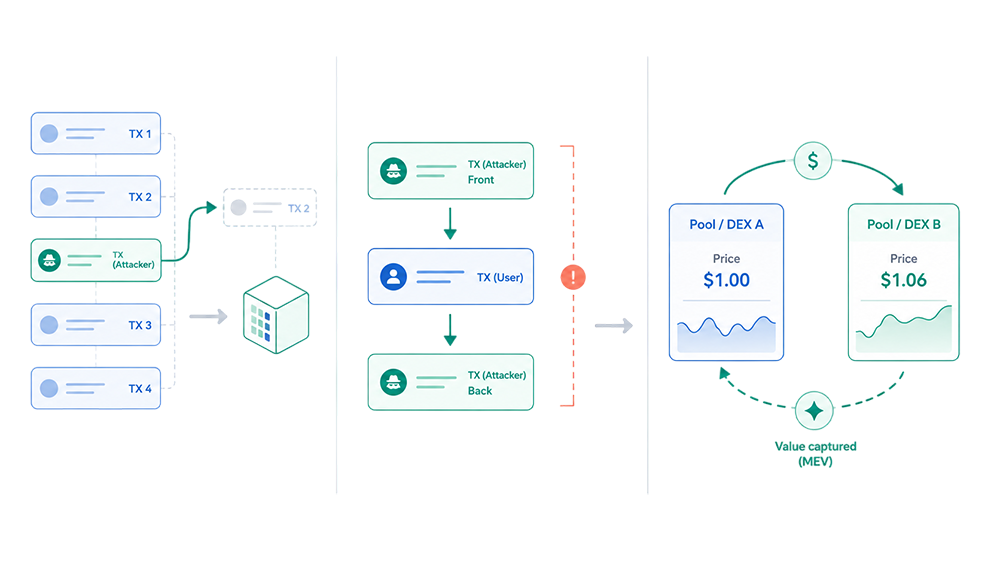
MEV takes several forms. Some are relatively benign from a network perspective. Others come at a direct cost to ordinary users. What ties them together is the use of transaction ordering as a tool and, increasingly, automated software to execute it faster than any human could.
What is a MEV bot? A MEV bot is an automated program designed to detect and execute MEV opportunities on the blockchain, scanning the mempool, identifying profitable transaction sequences, and submitting competing or surrounding transactions at high speed. |
Front-Running: The Race to Be First
Front-running is the simplest MEV strategy to understand, because it has a direct analogy in traditional finance, where it's illegal. A front-runner sees a large pending transaction in the mempool, recognizes that it will move the price of an asset, and inserts their own transaction ahead of it to profit from that price movement.
Here's a concrete example. You submit a large buy order for a token on a decentralized exchange. A MEV bot spots it in the mempool.
The bot places its own buy order with a higher gas fee, ensuring it gets processed first. It buys the token before your transaction executes, the price rises, and by the time your transaction goes through, you're paying more than you expected.
The bot then sells immediately, pocketing the difference.
The bot didn't hack anything. It used publicly visible information and paid for priority. That's what makes MEV so philosophically uncomfortable: it's technically within the system's rules.
Sandwich Attacks: Squeezing Value from Trades
A sandwich attack is front-running with a second step. The attacker places one transaction immediately before the target transaction and another immediately after, creating a "sandwich" that captures value from both sides of the price movement.
The mechanics:
The bot's first transaction buys the asset, pushing the price up.
The user's trade executes at the inflated price.
The bot's second transaction sells at the higher price before the market corrects.
The user gets worse execution. The bot captures the spread. And the larger the trade relative to the liquidity pool, the worse the slippage — and the more profitable the sandwich.
Sandwich attacks are particularly common on automated market makers like Uniswap, where price impact from large trades is predictable from on-chain data. A bot doesn't need to guess; the math is right there in the mempool.
Arbitrage: Exploiting Price Differences
Not all MEV is adversarial from the user's perspective. With arbitrage trading, the practice of profiting from price discrepancies across different exchanges is a legitimate market function that MEV bots have simply automated at blockchain speed.
If ETH trades at slightly different prices on two DEXs, a MEV bot can buy on the cheaper one and sell on the more expensive one within a single block, capturing a risk-free profit.
This is useful for the market: it keeps prices roughly in sync across venues. But it still represents value extracted from the ordering of transactions, and it still uses the mempool as an information advantage.
It's the most defensible form of MEV, but it's worth being clear that "defensible" and "fair" aren't the same thing.
The Impact of MEV: Risks, Rewards, and Network Health
MEV isn't a niche developer problem. Users get worse prices. Validators face pressure to act against the network's interests. The effects are structural, not edge-case.
For the User: Hidden Costs and Unfair Practices
The most immediate impact of MEV on ordinary users is worse trade execution. Sandwich attacks produce higher slippage. Front-running means you pay more for assets you were already committed to buying.
In both cases, the loss is invisible: it shows up as a slightly worse fill price rather than an explicit fee. Most users don't notice it at all, which is precisely what makes it so insidious.
Beyond execution quality, MEV contributes to higher gas fees during periods of competition. When multiple bots are racing to capture the same opportunity, they bid up transaction fees in what's known as a "gas war." The cost of that competition gets socialized across all users on the network, not just the ones involved in the targeted trade.
For Validators and Miners: Incentives and Centralization Concerns
From a validator's perspective, MEV is additional income on top of the base block reward and gas fees. Estimates have varied widely over time, but MEV has at times represented a substantial fraction of total validator revenue on Ethereum, enough to meaningfully affect the economics of running a node.
That income creates a centralization pressure. Validators who are better at capturing MEV, or who partner with sophisticated MEV extraction operations, earn more.
Over time, this could concentrate block production among a smaller number of technically sophisticated participants, which cuts against the decentralization that gives blockchains their value in the first place.
For the Network: Stability vs. Congestion
MEV has a complicated relationship with network health. On one hand, arbitrage bots improve price efficiency across DEXs, functioning like automated market makers for market makers and keeping prices honest.
On the other hand, gas wars drive up fees, and the sheer volume of MEV bot activity adds congestion to already resource-constrained networks.
There's also a subtler concern: if MEV becomes lucrative enough, it creates incentives for validators to behave in ways that technically violate protocol rules, for example, by attempting to reorganize recent blocks to capture a particularly large MEV opportunity.
This kind of "time-bandit" attack is theoretically possible and gets more attractive as MEV grows. It hasn't been a major practical problem to date, but it's a known risk that researchers take seriously.
MEV Protection and the Future: Mitigating the Risks

MEV hasn't been ignored. There's been substantial work at the protocol and application levels, as well as in purpose-built infrastructure, aimed at reducing its negative effects.
None of these solutions are complete, but together they represent genuine progress.
Decentralized Exchanges and MEV Protection
Some DEXs have redesigned their core mechanics to reduce MEV exposure. CoW Protocol, for example, uses batch auctions, grouping trades together and settling them at a single clearing price, which removes the predictable transaction sequence that sandwich attacks depend on.
Others route trades through private relays, shielding pending transactions from the public mempool until they're ready to be included in a block.
Slippage tolerance settings also act as a rough MEV defense. By setting a tight slippage limit, users can effectively instruct the protocol to revert rather than execute at an unacceptable price, which limits how much value a sandwich attack can extract. It doesn't prevent the attack, but it caps the downside.
For newer DeFi users, understanding slippage settings is one of the most practical ways to protect your trades.
Flashbots
Flashbots emerged as a project specifically designed to address MEV's worst consequences. Instead of competing in public gas wars, Flashbots created a private channel, a separate relay, through which searchers (the technical term for MEV hunters) could submit transaction bundles directly to block producers.
This moved the competition off-chain, reduced network congestion from gas wars, and created more transparency around how MEV was being captured.
Proposer-Builder Separation
Proposer-Builder Separation (PBS) goes further. It's a protocol-level architecture being gradually implemented on Ethereum that formally separates the role of building a block (assembling and ordering transactions) from the role of proposing it (adding it to the chain).
The idea is that block builders compete openly to construct the most profitable block, while validators simply choose the highest bid. This doesn't eliminate MEV, but it prevents any single validator from having an exclusive advantage in extracting it, which reduces centralization pressure.
MEV Isn't Just an Ethereum Problem
Ethereum gets most of the attention because it's where MEV was first documented and where its infrastructure is most developed. But the underlying issue is the same on any chain where block producers control transaction ordering. That discretion is worth money. It always will be.
Solana: Speed Over Visibility
Solana's architecture removes the public mempool that makes Ethereum MEV so exploitable. Instead of transactions sitting visible in a waiting room for several seconds, Solana uses a protocol called Gulf Stream, which forwards transactions directly to the next expected validator before it's even their turn to produce a block.
The window for exploitation shrinks to milliseconds. MEV still exists, but winning it isn't about spotting opportunities in a public queue. It's about raw infrastructure. Being physically closer to validators. Running bare-metal hardware. Shaving latency wherever possible.
Solana's architecture was designed to limit exactly this kind of extraction. The numbers suggest otherwise. In Q2 2025, Solana MEV revenue hit $271 million compared to $129 million on Ethereum, despite Ethereum having a much longer history of MEV infrastructure. The problem didn't disappear. It just got faster.
That's partly why Jito exists. It's a piece of infrastructure built specifically for Solana's MEV environment, similar in spirit to Flashbots on Ethereum.
Rather than having searchers spam the network with competing transactions, Jito runs an auction off-chain where searchers bid for block inclusion and submit grouped transactions directly to validators. It reduces congestion, but it doesn't eliminate extraction. It just makes it more orderly.
BNB Chain: Fewer Validators, Different Trade-offs
BNB Chain runs a smaller, more centralized validator set than Ethereum. That changes the power dynamics considerably.
In 2025, the chain's Goodwill Alliance, a coordination effort among builders, managed to cut sandwich attacks by 95%. But concentrating block-building among a small group creates its own problems.
Builders can run their own MEV strategies alongside the searchers they're supposed to be serving, which is a conflict of interest the community is still working through.
Wherever there's a block producer with ordering discretion and a DeFi ecosystem worth extracting from, MEV follows. The mechanics differ. The scale differs. The structural issue doesn't.
The Ongoing Debate: Is MEV Inevitable?
There are researchers who argue that MEV, in some form, is a fundamental property of any system where a single party orders transactions with economic consequences. As long as one entity has the discretion to decide which transaction goes first, that discretion is worth money.
You can redistribute who captures that value, make the capture more transparent, or reduce the opportunities for it, but you can't fully eliminate it without changing something deep in how blockchains work.
Alternative transaction ordering protocols have been proposed: fair ordering based on time of receipt, encrypted mempools that hide transaction details until after ordering is decided, and threshold encryption schemes that reveal transaction content only at the moment of inclusion.
Each approach has trade-offs, including increased complexity, higher latency, and the potential for new attack vectors. The research is active and serious, but there's no consensus solution yet.
The honest answer to the question of whether MEV can be eliminated is: probably not entirely, but it can be made less harmful, and the tools to do that are getting better.
MEV Is the Plumbing. Know How It Works
Most crypto content skips over MEV or buries it in developer docs. That's a problem, because it shapes every trade you make on a decentralized exchange, whether you're aware of it or not. Slippage, execution price, front-running. MEV is underneath all of it.
Knowing this won't make you immune. But it changes how you set trades up, which protocols you trust, and how you read the ongoing debates around Ethereum's architecture.
MEV is also a good reminder of why "don't trust, verify" isn't just a slogan.
Learning Crypto's AI copilot pulls live on-chain data so you can see what's actually happening beneath the marketing spin. Join the Classroom on Discord. Track smart money. Build knowledge that holds up when markets move.
Frequently Asked Questions
What does MEV stand for in crypto?
MEV originally stood for Miner Extractable Value, reflecting the fact that miners controlled transaction ordering under proof-of-work. After Ethereum's transition to proof-of-stake in 2022, the term was updated to Maximal Extractable Value to include validators and any block producer. The mechanics of profiting from transaction ordering remain the same under both names.
Is MEV illegal?
No. MEV extraction is technically within the rules of how blockchains operate. Block producers have legitimate discretion over transaction ordering, and using that discretion profitably isn't prohibited by the protocol. However, some forms of MEV, particularly sandwich attacks, are widely considered unethical, and there's ongoing debate about whether certain extraction strategies might attract regulatory scrutiny in some jurisdictions over time.
How can I protect myself from MEV as a regular user?
The most practical steps are to use DEXs that offer private transaction routing or batch auction mechanics, set a tight slippage tolerance on your trades, and consider using MEV-protected transaction relays offered by some wallets and aggregators. No method is foolproof, but reducing the predictability of your transactions reduces your exposure to sandwich attacks and front-running.
Can Layer 2 networks like Arbitrum reduce MEV?
Partly. L2S like Arbitrum use a centralized sequencer to order transactions, removing the open mempool competition that enables sandwich attacks. But the sequencer itself becomes the extraction point as it controls ordering without competing bots in the picture. Arbitrum has introduced MEV auction mechanisms to address this, with plans to decentralize sequencer control.
Keep learning
- Tokenomics Explained: Master Crypto Project Economies & Value
- What Is Liquidation in Crypto? Understanding Forced Closures in Trading
- What's the Purpose of Cryptocurrency: A Balanced Understanding
- More guides in the Fundamentals hub
- Members: Ask Crypto AI, ask it any beginner question, privately