A DAO (Decentralized Autonomous Organization) is a community-run organization governed by smart contracts instead of executives or boards. Members hold governance tokens, vote on proposals, and collectively control shared treasuries worth billions of dollars. DAOs have gone from a single catastrophic experiment in 2016 to the backbone of DeFi governance, venture investing, and even AI-managed protocol operations. |
A DAO is what happens when you take the idea of a company and strip out the bosses. No CEO. No board. Just code, tokens, and a community making decisions together.
The rules live on a blockchain where everyone can read them. The treasury sits in a smart contract that only moves funds when the community votes to do so. You buy a governance token, you get a say. Simple as that.
Ten years ago, the first attempt ended in a $60 million hack and an existential crisis for Ethereum. Today, DAOs govern protocols managing billions of dollars and are starting to gain legal recognition. The experiment survived. It's growing up.
What You'll Learn About DAOs
→ What a DAO is and how it differs from every organization you've dealt with before
→ The full history from Ethereum's whitepaper through the $60M hack, DAO Summer, and the Agentic Era
→ The technical and social stack powering governance tokens, smart contracts, and voting
→ What people use DAOs for across DeFi, investing, media, and AI
→ Where DAOs keep failing and why code alone can't fix human problems
→ Legal recognition and what Wyoming's DUNA framework changed
→ AI stewards and the emerging fix for voter apathy
What Is a DAO?
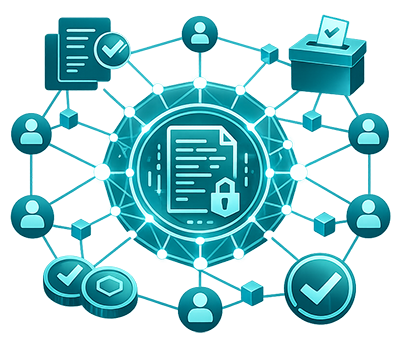
A Decentralized Autonomous Organization is an internet-native entity governed by its members through smart contracts. No middlemen. No central authority. The rules are written in code, deployed on a blockchain, and enforced automatically.
Traditional Company | DAO | |
Who's in charge | CEO, board of directors | Token-holding community |
Transparency | Private. Quarterly reports, if you're lucky | Public. Every transaction on-chain, auditable in real time |
Who can participate | Employees, shareholders | Anyone with governance tokens |
How decisions execute | Legal contracts, human action | Smart contracts, code |
Jurisdiction | Tied to a country or state | Blockchain-native, borderless |
DAO treasuries collectively hold north of $24 billion in assets. More than 13,000 DAOs operate globally. And the biggest ones (Uniswap, Optimism, Arbitrum) control treasuries in the billions individually.
But getting here wasn't clean. It involved one of crypto's most infamous disasters.
From a $150M Hack to a Billion-Dollar Ecosystem: A History of DAOs
The Idea (2014–2016)
Vitalik Buterin floated the concept of decentralized autonomous organizations in the 2014 Ethereum whitepaper. The idea was simple: what if an organization could run entirely on code, with no management layer at all?
In April 2016, developer Christoph Jentzsch and the Slock.it team launched the first real attempt. They called it "The DAO." It was a decentralized venture capital fund built on Ethereum. Investors deposited ETH, received DAO tokens, and could vote on which projects to fund.
It raised $150 million. At the time, that was the largest crowdfunding campaign in history. The original target was $5 to $10 million.
Then it blew up.
On June 17, 2016, an attacker exploited a reentrancy vulnerability in The DAO's smart contract code. They drained roughly 3.6 million ETH, worth about $60 million, into a child DAO they controlled. That was a third of everything the DAO held.
The Ethereum community faced an impossible choice. Reverse the blockchain to return stolen funds (violating the principle of immutability) or let the attacker walk. After weeks of debate, the community voted to hard fork.
That fork created two chains: Ethereum as we know it today, and Ethereum Classic, which kept the original, unaltered history.
The DAO died. But the concept didn't.
The Survival Era (2017–2019)
The years after the hack were quiet. Builders went underground and focused on getting the fundamentals right.
Aragon launched tools for creating and managing DAOs without writing custom smart contracts. DAOstack built modular governance frameworks. And MolochDAO stripped everything back to the bare minimum: pool funds, vote on grants, rage-quit if you disagree. Simple. Secure. Boring on purpose.
These frameworks prioritized security over ambition. Nobody wanted another $60M lesson.
DAO Summer (2020–2022)
DeFi exploded. And with it, DAOs went from infrastructure experiments to the governance layer of some of crypto's biggest protocols.
Uniswap launched its UNI governance token. Compound handed control to COMP holders. Suddenly, billions of dollars in protocol treasuries were being managed by token-voting communities.
Then came the cultural moment.
In November 2021, ConstitutionDAO raised $47 million in ETH from over 17,000 contributors in less than a week. The goal? Buy a rare original copy of the U.S. Constitution at a Sotheby's auction.
They lost the bid to hedge fund billionaire Ken Griffin ($43.2 million), but the point was made. A loose collective of internet strangers had coordinated faster and raised more money than most venture funds could dream of.
DAOs were mainstream. And messy. Governance participation was low, whale voters dominated decisions, and most token holders couldn't be bothered to read a 40-page proposal before voting.
The Agentic Era (2023–2026)
Two things changed the game.
First, legal recognition. Wyoming's DUNA (Decentralized Unincorporated Nonprofit Association) framework, signed into law in March 2024 and effective from July 1, gave DAOs legal personality for the first time in the U.S.
A DAO could now sign contracts, hold assets, appear in court, pay taxes, and give its members limited liability. That was the single biggest unlock for institutional adoption.
Second, AI entered governance. In February 2026, Vitalik Buterin proposed "AI stewards," personal AI agents trained on a user's values and writing history, that could automatically vote on routine DAO proposals.
The agents would use zero-knowledge proofs to keep votes private, flag sensitive decisions for human review, and filter spam proposals through prediction markets.
DAOs stopped being experiments. They became infrastructure.
How DAOs Work: The Technical and Social Stack
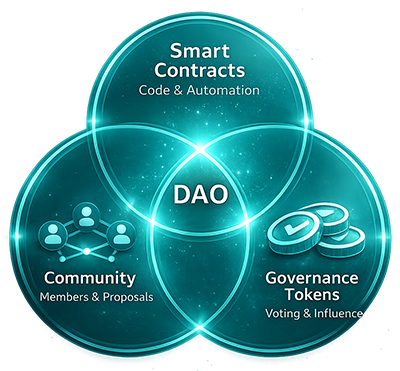
A DAO runs on three interconnected layers: code, governance, and people.
Smart Contracts: The Rules Engine
A DAO's smart contracts get deployed on a blockchain and define how the whole thing operates:
How proposals get submitted and what counts as a quorum
How votes are tallied and weighted
When and how funds leave the treasury
Once live, these contracts execute automatically. A proposal passes the vote threshold, and the smart contract releases the funds. It doesn't pass; nothing moves. Everyone can read the rules. Nobody can quietly change them.
Governance Tokens and Voting Power
Most DAOs default to token-weighted voting. Hold UNI, vote on Uniswap governance. Hold AAVE, vote on Aave proposals. One token, one vote.
The problem is obvious. In some DAOs, fewer than 0.1% of holders control around 90% of votes. So the models are evolving:
Quadratic voting: makes extra votes exponentially more expensive (first vote costs 1 token, second costs 4, third costs 9), amplifying smaller voices
Reputation-based governance: uses Soulbound Tokens (SBTs), non-transferable tokens tied to contributions and expertise rather than capital. You can't buy influence. You earn it.
The Human Layer: Sub-DAOs and Working Groups
Code handles rules. Humans do the work.
Large DAOs like MakerDAO and Aave use specialized working groups (sub-DAOs) instead of putting every operational decision to a community vote. Each group gets autonomy over its domain, risk management, marketing, treasury, and reports back through on-chain metrics.
The tooling has caught up too:
Coordinape: decentralized payroll where contributors allocate rewards to each other based on perceived value
Hats Protocol: manages permissions, defining who can do what within the organization.
What People Use DAOs For
Protocol Governance
The big DeFi protocols (Uniswap, Lido, Aave) are all governed by DAOs. Token holders vote on fee structures, asset listings, technical upgrades, and treasury allocations. These aren't hobby projects. They're managing billions.
Pooled Investing
Investment DAOs like The LAO and MetaCartel Ventures let global members pool capital and vote on early-stage Web3 investments. It's venture capital without the gatekeeping. Anyone with tokens can participate in deal flow.
Community and Media
Social DAOs like Friends With Benefits (FWB) and BanklessDAO coordinate content creation, events, and media production. Members share in the value they create. It's a cooperative model for the internet age.
AI-Managed Operations
This is the new frontier. Some DAOs now use AI agents to optimize protocol parameters or manage treasury positions in real time. The human community sets the strategy. The agents handle execution. It reduces the need for constant human intervention on routine decisions.
Why Most DAOs Struggle
The Governance Paradox
Decentralization is slow. A traditional company can make a decision in minutes. A DAO proposal might take days or weeks to pass through discussion, voting, and execution.
The workaround is optimistic governance. A proposal is assumed to pass unless someone actively challenges it within a set time window. This flips the default. Instead of requiring everyone to vote yes, you only need objectors to speak up. It speeds things up dramatically while preserving the community's veto power.
Voter Apathy
Average participation rates in DAO governance hover between 15% and 25%. Most token holders don't vote. They can't be bothered to read complex technical proposals, and their individual vote feels meaningless against whale-sized positions.
This is what Buterin calls "rational apathy." And it's dangerous. Low turnout means a small group of active voters (or worse, a coordinated attacker) can push through proposals that the wider community would reject if they were paying attention.
The AI stewards concept is the most serious proposed fix. Instead of delegating your vote to a human representative (and losing all influence), you'd deploy a personal AI model trained on your values. It votes on routine proposals automatically. If something sensitive comes up, it pauses and asks you directly.
Social Collapse and Governance Fatigue
Code can be perfect. Communities are human.
Plenty of DAOs have died not from hacks but from burnout, infighting, and governance fatigue. The cost of coordination, voting, and transparency is real. It's an efficiency tax that comes with decentralization, and it grinds people down over time.
The healthiest projects have figured out that not everything needs a community vote. High-stakes, long-term decisions go to the DAO. Day-to-day operations go to specialized teams with delegated authority. But finding that balance is harder than writing the smart contracts.
DAOs and the Law
For years, DAOs existed in a legal grey zone. No legal personality meant no ability to sign contracts, hold property, or defend themselves in court. Worse, without a formal entity structure, regulators could treat a DAO as a general partnership.
That meant every single token holder was potentially on the hook for the organization's debts and legal problems.
Wyoming's DUNA: The U.S. Gold Standard
Wyoming's DUNA (Decentralized Unincorporated Nonprofit Association) framework changed things. Signed into law in March 2024 and effective from July 1, it lets DAOs with at least 100 members register as legal entities.
Here's what that unlocks:
Legal existence to sign contracts and appear in court
Limited liability for members (the DAO is the entity, not the individuals)
Tax compliance and the ability to open bank accounts
Smart contract governance is directly incorporated into the legal structure
It's a nonprofit model, so a DUNA can't distribute profits to members. But it can generate revenue, compensate contributors, and reinvest in its mission. A
16z called it a "major breakthrough" and started directing its portfolio DAOs toward the framework.
International Alternatives
The U.S. isn't the only option:
The Marshall Islands offers a DAO LLC structure with flexible governance rules
Switzerland provides Foundation models popular with larger protocol DAOs
Tax Treatment
Tax authorities are treating DAO activity like any other crypto transaction:
Governance tokens are classed as property. Selling or swapping triggers capital gains tax
Contributor rewards (payment for work done for a DAO) are treated as ordinary income
Treatment varies by jurisdiction, so local rules apply
The shift from "an unregistered grey zone where everyone is personally liable" to "a limited liability entity that pays taxes" has been the single biggest factor in making DAOs viable for institutional participation.
Stop Waiting for Permission
DAOs aren't theoretical anymore. They govern protocols handling billions in value. They've survived hacks, legal uncertainty, and their own governance growing pains. And they're still here, getting more sophisticated every cycle.
You don't need anyone's approval to participate. Buy a governance token. Join a Discord. Vote on a proposal. Or just read the smart contracts and see exactly how the rules work. Everything is on-chain, everything is transparent, and the barrier to entry is a wallet and a bit of curiosity.
The old model of organization required permission, paperwork, and gatekeepers. This one just requires you to show up.
DAOs prove that you don't need permission to participate in the financial system. Learning Crypto was built on the same principle. Verify everything, trust nothing.
Get the tools to back that up: AI-powered crypto education, on-chain analytics, a private Discord community, and monthly strategy webinars that cut through the noise.
FAQs
How do I join a DAO?
Buy the governance token on a DEX or centralized exchange. Then visit the DAO's governance platform (Snapshot, Tally, or their own interface) to review proposals and vote. Most DAOs also have open Discord communities where you can participate in discussions without holding tokens.
What happens if a DAO runs out of treasury funds?
It winds down or finds new revenue. DAOs don't have bailout mechanisms. If the treasury empties, contributors stop getting paid, and development stalls. Some DAOs mitigate this by diversifying treasuries into stablecoins to cover 12 to 24 months of operating costs. Others generate ongoing revenue through protocol fees that automatically replenish the treasury.
Can I be anonymous and still participate in a DAO?
For most DAOs, yes. You typically only need a crypto wallet to hold governance tokens and vote. But if a DAO registers as a legal entity, such as a DUNA, certain roles (e.g., core contributors receiving payroll) may require identification for tax compliance. General token-holder participation usually stays pseudonymous.
What's the difference between a DAO and a multisig wallet?
A multisig is a tool. A DAO is an organization. A multisig wallet requires multiple key holders to approve transactions, which is useful for treasury security. But it doesn't include governance mechanisms like proposals, voting, or quorum thresholds. Many DAOs use multisigs to execute decisions, but the decision-making process itself happens through the DAO's governance layer.
Can DAOs operate across multiple blockchains?
Yes, and many already do. Protocol DAOs like Aave and Uniswap are deployed across Ethereum, Arbitrum, Optimism, and other chains. Cross-chain governance is trickier, though. Voting usually happens on one chain with execution bridged to others. Interoperability protocols like Chainlink's CCIP and LayerZero are making multi-chain treasury management and governance messaging more practical.
Keep learning
- What Are Nodes in Crypto and How Do They Power Blockchain Networks?
- What Is FDV (Fully Diluted Valuation) in Crypto?
- What Makes a Cryptocurrency Successful: A Comprehensive Guide
- More guides in the Fundamentals hub
- Members: Ask Crypto AI, ask it any beginner question, privately