
The EVM is why your MetaMask wallet works on twenty different blockchains. It's why Uniswap exists on Ethereum, Polygon, Arbitrum, and Base with virtually identical interfaces. It's the reason a developer can write a smart contract once and deploy it across multiple networks without changing a line of code.
Ethereum created it, but EVM compatibility has become the de facto standard for smart contract blockchains, even ones that position themselves as Ethereum alternatives.
What You’ll Learn
The core idea behind the EVM and why it became crypto’s default execution engine.
How Ethereum turns code into actions that run identically across thousands of nodes.
Why so many blockchains copy the EVM instead of building their own system.
What makes chains like Arbitrum, Polygon, and BNB Chain different, even though they all run EVM code.
How gas is calculated and why fees vary wildly from chain to chain.
What the EVM means for you, whether you're using dApps, bridging assets, or building your first smart contract.
EVM Basics: The Decentralized Computer
Before the EVM existed, blockchains were mostly limited to simple transactions. Bitcoin could move value securely, but it wasn’t built to run complex applications.
Ethereum changed that in 2015 by introducing programmable smart contracts. Instead of just sending money, blockchains could now execute code. The Ethereum Virtual Machine is the engine that made that shift possible.
What Is the Ethereum Virtual Machine?
The Ethereum Virtual Machine, or EVM, is the computing environment that executes smart contracts across the Ethereum network. It’s called a “virtual machine” because it’s software that simulates a computer running inside thousands of other computers at once.
Every Ethereum node runs its own copy of the EVM. When a smart contract is triggered, the same code runs independently on all of them.
Because the system is deterministic, the same inputs always produce the same outputs. That consistency is what allows the entire network to agree on what happened.
The EVM is also Turing-complete, meaning it can perform any type of computation in theory. That’s a major difference from Bitcoin’s limited scripting system.
How the EVM Works
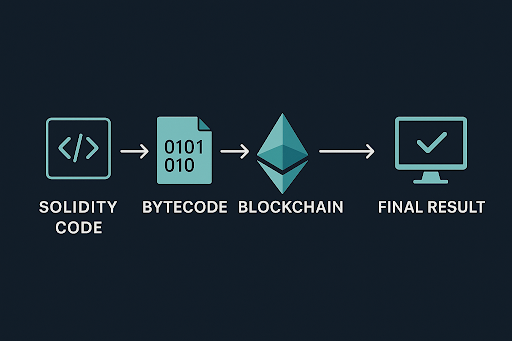
Smart contracts get written in high-level programming languages like Solidity or Vyper. Developers write code that looks fairly readable, with functions and logic that make sense to humans. But the EVM can't read Solidity directly.
Here's how a smart contract goes from code to execution:
1. Code Gets Compiled
The human-readable contract gets compiled into EVM bytecode. Bytecode is a series of low-level instructions the EVM understands. Each operation has a specific opcode: ADD for addition, SSTORE for writing to storage, and CALL for interacting with other contracts. The compiled bytecode is what actually gets deployed to the blockchain.
2. Deployment to the Blockchain
When you deploy a contract, the bytecode gets stored permanently at a specific address on the blockchain. That address becomes the contract's location. Anyone can send transactions to that address to trigger the contract's functions.
3. Transaction Triggers Execution
Someone sends a transaction that calls a function in your contract. That transaction gets broadcast to the network and picked up by nodes. Each node downloads the bytecode from the blockchain.
4. Every Node Executes Locally
Each node runs the bytecode through its local EVM. They all process the same instructions in the same order with the same inputs. The EVM charges gas for every computational operation, making expensive operations costly and preventing infinite loops.
5. Consensus on Results
All nodes reach identical results because they're executing identical bytecode under identical rules. That result gets included in the next block. The outcome is permanent and verifiable. Anyone can replay the transaction and confirm the EVM produced the correct output.
The whole process is deterministic and transparent. No central authority coordinates execution. Thousands of independent machines just follow the protocol rules and arrive at the same answer.
Why the EVM Matters for Crypto
The EVM transformed blockchains from simple payment rails into platforms for building financial infrastructure.
Smart Contracts and Decentralized Applications
Smart contracts are programs that execute automatically when certain conditions are met. They run on the blockchain, so no one can stop them, change them, or prevent them from executing once deployed.
The EVM makes this possible. It turns code into self-executing agreements that operate without intermediaries.
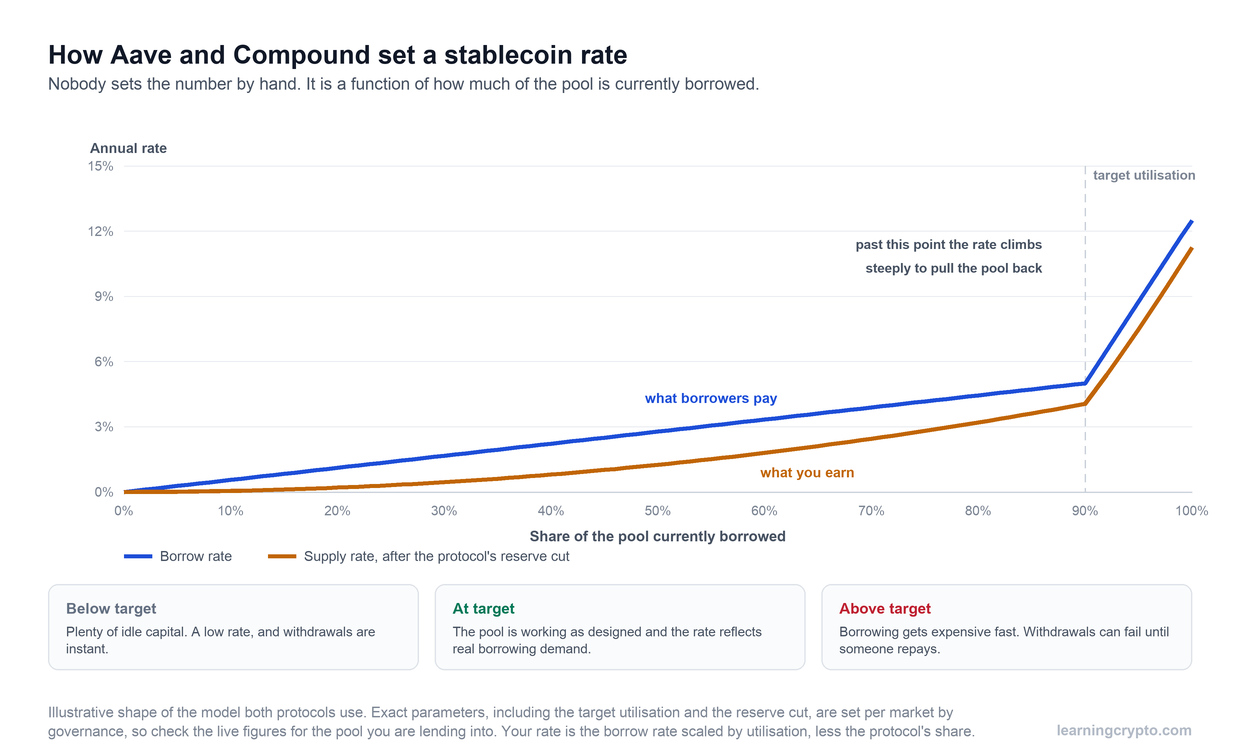
Take DeFi lending as an example. You deposit USDC into a protocol like Aave. The smart contract immediately starts calculating interest. When someone borrows against their collateral, the contract checks the math, enforces the rules, and distributes yields to lenders.
No loan officer approves anything. No bank holds your deposit. The code handles everything.
Yield farming works the same way. You provide liquidity to a decentralized exchange, and smart contracts automatically:
Track your share of the pool
Calculate trading fees you've earned
Distribute reward tokens
Let you withdraw anytime without asking permission
NFT marketplaces use smart contracts to transfer ownership and enforce royalties. DAOs use them for governance, where token holders vote on proposals that execute automatically when they pass.
Bitcoin can handle basic transactions. The EVM can handle complex financial instruments: options, derivatives, automated market makers, and synthetic assets. All of it runs without central servers.
Anyone can read the contract code before interacting with it. Anyone can verify that it executed correctly. This transparency creates trust without requiring trust in any individual or institution.
The Developer Network Effect
The EVM has the largest blockchain developer community by far. More developers means better tools, which attracts even more developers. The cycle reinforces itself.
If you want to build on Ethereum, you have serious infrastructure available:
Hardhat and Foundry for testing and deployment
Web3.js and ethers.js for connecting frontends to contracts
OpenZeppelin for battle-tested contract libraries
Remix for browser-based development
Thousands of open-source contracts exist on GitHub. Need to build a token? Fork an existing ERC-20 implementation. Building a marketplace? Study how OpenSea's contracts work. Almost every pattern has been implemented, audited, and documented.
The educational ecosystem is mature. Blockchain programming courses teach Solidity. Security firms specialize in EVM audits. Job listings require Solidity experience. The path from learning to building to getting hired is well-established.
This creates massive momentum. A new blockchain might offer technical advantages, but if developers need to learn new languages and build tools from scratch, adoption stalls.
Why start over when you already know how to build on the EVM?
New developers follow the path of least resistance. They pick the ecosystem with the best resources, the clearest career opportunities, and the biggest community. Right now, that's the EVM.
If you're learning blockchain development, the EVM is where you start. Solidity skills transfer across dozens of chains. Build on Ethereum, deploy on Arbitrum, fork to Polygon. It's all the same codebase.
What This Means for Your Average Crypto User
The EVM created competition on infrastructure rather than applications. Instead of each blockchain having its own isolated app ecosystem, the same applications run across multiple chains with different performance characteristics.
You can pick networks based on your priorities. Need maximum security for a large transaction? Use Ethereum mainnet and pay the premium. Making frequent small trades? Switch to Arbitrum or Polygon where gas costs a few cents. Minting NFTs? Pick a chain based on where the community and marketplaces are active.
The learning curve stays manageable. You're not juggling five different crypto wallet apps or relearning how DeFi works on each chain. MetaMask connects to dozens of EVM chains. Uniswap works basically the same whether you're on Ethereum or Base. Once you understand how to use one EVM chain, you understand them all.
EVM-Compatible Blockchains Explained
As we just mentioned, the EVM's standardization means applications can run across multiple networks.
But what does "EVM-compatible" actually mean in practice?
A blockchain running its own implementation of the EVM specification can execute Ethereum smart contracts without modification. The contracts work identically because the execution environment follows the same rules, even though the underlying blockchain infrastructure might be completely different.
Major EVM-Compatible Chains
EVM-compatible chains fall into two main categories: Layer 2s that inherit Ethereum's security and alternative Layer 1s that run independently.
Ethereum Layer 2s
These process transactions off Ethereum's main chain but settle final results back to Ethereum for security. Arbitrum, Optimism, and Base are the major players here. They offer near-perfect EVM compatibility because they're designed specifically to be Ethereum extensions.
Block times run 1-3 seconds compared to Ethereum's 12 seconds. Transaction costs drop from dollars to pennies. But you get Ethereum's security guarantees because all the final transaction data gets posted back to the main chain. For most users, Layer 2s feel like using a faster, cheaper version of Ethereum.
Alternative Layer 1s
BNB Chain, Polygon, Avalanche C-Chain, and Fantom run as independent blockchains with their own validator sets and consensus mechanisms. They implement EVM compatibility to attract developers and applications, but they make their own security and decentralization trade-offs.
BNB Chain sacrifices decentralization for speed with only 21 validators. Polygon runs as a sidechain with independent security. Avalanche uses a subnet architecture where the C-Chain handles EVM execution. Each makes different choices about the balance between speed, cost, and security.
Differences from Ethereum
All EVM chains share core functionality but differ on infrastructure:
Block times: 1-3 seconds versus Ethereum's 12 seconds
Gas costs: $0.01-0.10 versus Ethereum's $1-50+ depending on network congestion
Consensus mechanisms: Various proof-of-stake implementations
Validator counts: Anywhere from 21 to thousands
Security models: Inherited from Ethereum (L2s) or independent (L1s)
The EVM execution layer stays consistent. The blockchain infrastructure underneath can vary a lot.
How Gas Works in the EVM

Every action inside the EVM has a measurable computational cost. Gas is the system Ethereum uses to price that work. Instead of letting contracts run freely, every operation consumes a fixed amount of gas. This makes execution predictable, prevents abuse, and ensures that heavy computation is paid for by the user who triggers it.
EVM Gas Costs
Each low-level instruction in the EVM has a predefined gas cost. Simple math operations like addition cost only a few gas units. More complex actions, like writing data to the blockchain’s permanent storage, can cost tens of thousands of gas units in a single step.
When you send a transaction, you are really doing two things at once. You are asking the network to execute some computational work, and you are agreeing to pay for however much gas that work consumes. The total transaction fee is calculated as:
Gas used × Gas price = Transaction fee
This system exists for two reasons. First, it prevents infinite loops. A contract cannot run forever because it will eventually run out of gas. Second, it protects the network from spam and abuse by making large-scale computation expensive by design.
Importantly, the same operation always consumes the same amount of gas across all EVM chains. Writing to storage costs the same number of gas units on Ethereum, Arbitrum, Polygon, and BNB Chain.
Why Gas Costs Vary Across EVM Chains
If gas usage is identical, why do fees vary so much between chains?
The difference comes from the gas price, which is set by supply and demand on each network. The Ethereum mainnet has the highest demand and the strongest decentralization and security guarantees. Block space is scarce, so users bid higher gas prices to get transactions processed quickly.
On Layer 2s and alternative Layer 1s, demand is lower, and block space is more abundant. That pushes gas prices down dramatically. As a result, the same transaction that costs $20 on Ethereum might cost $0.10 on Optimism or a few cents on Polygon.
You’re not paying for raw computation. You’re paying for security, decentralization, and access to limited block space. Cheaper chains achieve lower fees by making different trade-offs in validator count, decentralization, and settlement guarantees.
Security and Trust in the EVM
One of the EVM’s biggest strengths is that security is baked into how execution works. When a smart contract runs, it isn’t trusted to a single server or company. Thousands of independent nodes execute the same code and verify the same result. If even one node tries to cheat, it gets ignored by the rest of the network.
Because everything is deterministic, the outcome is not a matter of opinion. Either the contract executes according to the rules, or it doesn’t execute at all. This removes many of the trust assumptions that exist in traditional financial systems.
Smart contract risk does still exist, but it usually comes from bad code, not bad execution. If a contract has a bug, the EVM will execute that bug exactly as written. This is why audits matter so much in DeFi. Once a contract is deployed, it cannot be modified unless that upgrade logic was built in from the start.
For users, this creates a very different security model from banks and fintech apps. Funds are not protected by customer support or account freezes. They are protected by cryptography, decentralization, and publicly verifiable rules. You gain transparency and censorship resistance, but you also take on more personal responsibility.
EVM vs. Non-EVM Blockchains (Solana, Move, and Others)
Not every blockchain uses the EVM. Some of the biggest competitors took a completely different technical approach.
Quick Comparison | ||
|---|---|---|
Aspect | EVM Chains | Non-EVM Chains |
Primary Language | Solidity, Vyper | Rust (Solana), Move (Aptos, Sui) |
Execution Model | Sequential, single-threaded | Parallel (Solana), object-based (Move chains) |
Transaction Speed | ~15–2,000+ TPS depending on chain and Layer 2 | ~2,000–65,000 TPS (Solana), 10,000+ TPS (Sui under ideal conditions) |
Cross-Chain Compatibility | High within the EVM ecosystem (shared standards, wallets, tooling) | Low natively; relies on bridges or compatibility layers |
Developer Ecosystem | Largest and most mature in crypto | Growing fast, but still smaller |
Wallet Support | MetaMask, Rabby, Trust Wallet work across dozens of chains | Mostly chain-specific wallets (Phantom, OKX, Petra, etc.) |
Security Model | Deeply battle-tested, massive validator sets on Ethereum; strong audit culture | High performance but smaller validator sets; newer security models and tooling |
Solana is the best-known example. Instead of the EVM, it uses its own execution environment built for extreme performance. Transactions are processed in parallel rather than sequentially, allowing Solana to handle far more activity per second than most EVM chains. This is why it’s popular for high-frequency trading, gaming, and consumer-scale apps.
Other ecosystems like Aptos and Sui use the Move programming language instead of Solidity. These chains focus on safer smart contract design and different ways of handling asset ownership and execution.
The trade-off is compatibility. Solana apps do not run on Ethereum. Ethereum apps do not run on Solana. Developers must learn new tools, new languages, and new security models. Users have to use different wallets and different infrastructure.
EVM chains win on composability and ecosystem depth. Non-EVM chains win on performance and custom design. Neither approach is objectively “better.” They optimize for different priorities. The reason the EVM still dominates is not just technology, but the sheer weight of its developer base, applications, and shared standards.
From “EVM-Compatible” to Actually Knowing What It Means
“EVM-compatible” stops being a buzzword once you understand what’s really happening under the hood. It explains why apps feel familiar across chains and why Ethereum’s influence runs so deep.
If this sparked bigger questions about how crypto really works, Learning Crypto is built for exactly that next step, with AI-powered interactive learning, advanced portfolio tracking tools, and real-time insights that help turn curiosity into real competence.
FAQs
Can the same smart contract run on any EVM chain?
Mostly yes. Standard smart contracts deploy identically across EVM chains. But some chains add custom features or precompiles that won't work elsewhere. And contract addresses might differ because deployment order varies between chains. For basic contracts, cross-chain deployment is straightforward.
Why is Ethereum so expensive if other EVM chains are cheap?
Block space scarcity. Ethereum has the highest security and decentralization, which makes its blocks valuable. Other EVM chains achieve lower costs through different trade-offs: fewer validators, different consensus mechanisms, or settling transactions in batches. You're choosing between security guarantees and transaction costs.
Do I need to understand the EVM to use crypto?
No. Most users never think about execution environments. But understanding the EVM helps explain why your wallet works on multiple chains, why some networks feel similar, and what "EVM-compatible" means when researching new blockchains.
What's the difference between EVM-compatible and EVM-equivalent?
EVM-compatible means the chain can run Ethereum smart contracts with minimal changes. EVM-equivalent means the chain replicates Ethereum's execution environment exactly, including all edge cases and quirks. Optimism and Arbitrum aim for equivalence. Other chains settle for compatibility, which works for most use cases but might have subtle differences.
Is Solidity the only language for EVM development?
Solidity is dominant, but Vyper offers an alternative with different design principles. Vyper prioritizes security and readability over flexibility. Some developers prefer it for high-stakes contracts. Both compile to EVM bytecode.
What happens if a vulnerability is found in the EVM itself?
The EVM specification has been stable and secure for years. If a fundamental flaw were discovered, it would require coordinated upgrades across all EVM chains. The bigger concern is vulnerabilities in individual contracts, which is why auditing and testing matter so much.
Disclaimer: This article is for educational purposes only and does not constitute financial advice. Cryptocurrency investments carry risk; you should always do your own research before making any investment decisions.
Keep learning
- What Is ERC-20? The Standard Behind Ethereum Tokens
- What Does Pegging Mean in Crypto? A Comprehensive Guide
- TradFi vs DeFi and The Birth of 'Invisible' Finance
- More guides in the DeFi hub
- Members: Team Portfolio, see what our analysts actually hold