

142 guides by Heidi.
 Analysis
What Is a Crypto Bull Run and When Is the Next One Coming?
A crypto bull run is a sustained, months-long rise in crypto prices driven by growing demand, fresh capital inflows and a shift from fear to greed. Every past bull run peaked 12-18 months after a Bitcoin halving. Bitcoin topped at $126,210 in October 2025, so the next one likely builds toward the 2028 halving unless this is a mid-cycle correction.
Heidi ChakosWallets & Custody Wallets & Custody
What Is a BTC Wallet Address?
A BTC wallet address is the public identifier for receiving Bitcoin; it is derived from your private key and safe to share. Addresses come in four formats: Legacy (starts with 1), P2SH (3), Native SegWit (bc1q) and Taproot (bc1p). Use Native SegWit by default: its transactions are 40-60% smaller than Legacy, so fees are lower, and every major wallet and exchange supports it.
Heidi ChakosDeFi DeFi
DeFiWhat Is ERC-20? The Standard Behind Ethereum Tokens
ERC-20 is the technical standard that defines how fungible tokens work on Ethereum. Six required functions (totalSupply, balanceOf, transfer, transferFrom, approve and allowance) make every compliant token work with the same wallets, exchanges and smart contracts. That shared language is why MetaMask can hold thousands of tokens and why DeFi protocols plug together, though compliance says nothing about whether a token is legitimate.
Heidi ChakosBitcoin Bitcoin
What Are Nodes in Crypto and How Do They Power Blockchain Networks?
A blockchain node is any computer running the network's software. It stores transaction history, checks that new transactions follow the rules, and relays blocks to its peers, so thousands of independent machines replace a central server. Full nodes verify everything (Bitcoin's chain is over 500GB), light nodes keep only block headers, and validators and miners also produce blocks. Most users never need to run one.
Heidi ChakosBitcoin Bitcoin
What Is a Fork in Crypto? Hard Forks vs. Soft Forks Explained
A fork in crypto is a change to a blockchain's protocol rules. A soft fork is backward-compatible, so the network stays on one chain, as with Bitcoin's SegWit. A hard fork is incompatible and can split the chain in two, which is how Bitcoin Cash (2017) and Ethereum Classic (2016) were created. Holders with their own private keys usually get coins on both chains.
Heidi ChakosDeFi DeFi
DeFiWhat Does EVM Mean in Crypto? Ethereum Virtual Machine Explained
EVM stands for Ethereum Virtual Machine, the software environment that executes smart contracts on every Ethereum node so all of them reach the same result. EVM-compatible chains such as Arbitrum, Optimism, Base, Polygon and BNB Chain run the same bytecode, which is why MetaMask and Uniswap work across them. Gas units are identical on every EVM chain; only the gas price differs.
Heidi ChakosScams & Risk Scams & Risk
What Is a Seed Phrase and Why It's Critical to Crypto Security
A seed phrase is a list of 12 to 24 words from the 2,048-word BIP-39 list that encodes your wallet's master private key. Any compatible wallet can rebuild every address and balance from it, making it the only true backup. Anyone who holds it controls your crypto, and no company can reset it. Write it on paper or metal and never store it digitally.
19 min read/Heidi ChakosWallets & Custody Wallets & Custody
What Is a Hot Wallet in Crypto? Benefits and Risks Explained
A hot wallet is a crypto wallet whose private keys live on an internet-connected device such as a phone app, browser extension or desktop program. That gives instant access for trading, DeFi and NFTs, but exposes you to phishing, malware and malicious approvals. Keep only what you actively use, typically 10 to 20 percent of a portfolio, and sweep profits to cold storage.
18 min read/Heidi ChakosReviews & Safety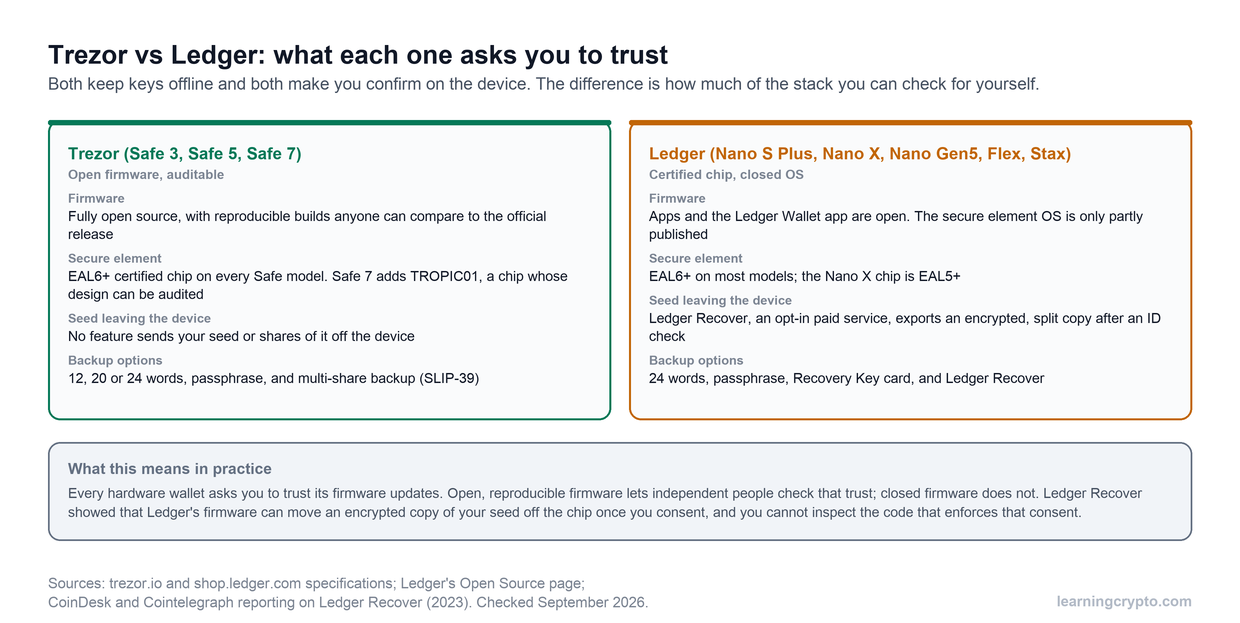 Reviews & Safety
Trezor vs Ledger (2026): Which Hardware Wallet Should You Trust?
Both Trezor and Ledger keep your keys offline, and neither has had customer funds taken through a remote hack of its devices. Where they differ is trust. Trezor's firmware is fully open source. Ledger's secure element software is only partly published and supports Ledger Recover, which can export an encrypted copy of your seed. We moved to Trezor in 2023 for that reason.
Heidi Chakos