

Yield-bearing stablecoins are dollar-pegged crypto tokens that generate passive returns just by being held. Unlike standard stablecoins such as USDT or USDC, where the issuer keeps the interest earned on reserves, yield-bearing versions pass those returns directly to holders through mechanisms such as Treasury bill income, DeFi lending markets, or derivatives strategies. |
Hold a thousand dollars in USDT for a year. You'll still have a thousand dollars. No interest, no return, nothing. The company behind it, Tether, made over $13 billion in profit in 2024, almost entirely from investing the reserves that back your tokens in US Treasury bills. You took the currency risk so they could keep the yield.
That arrangement made sense when stablecoins were a niche tool for traders moving between crypto positions. It makes a lot less sense now that stablecoins are genuinely used as dollar savings, cross-border payments, and DeFi liquidity, and now that protocols have figured out how to share the returns instead.
Yield-bearing stablecoins exist because someone decided holders should get paid. The market went from under $1.5 billion in early 2024 to over $19 billion by late 2025. Sky Protocol's sUSDS alone crossed $10 billion in issuance by mid-2026. This is no longer a niche experiment.
What You'll Learn
Why standard stablecoins don't pay you and where the interest actually goes
The three yield sources powering the biggest tokens in 2026
How yield gets delivered rebasing balances vs. accrual tokens explained
The main tokens to know: sUSDS, sDAI, sUSDe, USDY, and USDM
The real risks are depeg events, smart contract exposure, and regulatory uncertainty
What Makes a Stablecoin "Yield-Bearing"?

All stablecoins are backed by something. USDC holds cash and short-term Treasuries. USDT holds a mix of Treasuries, money market instruments, and other assets. The backing earns interest. Standard stablecoins keep that interest. Yield-bearing versions pass it on.
That's the core distinction. The token still tracks $1. But instead of the issuer pocketing the returns, holders earn them automatically, just by holding.
The mechanics of how yield is generated and distributed vary a lot between tokens. Three main approaches dominate in 2026.
How Yield-Bearing Stablecoins Generate Returns
Real-World Assets: Treasury-Backed Yield
The most straightforward model. The protocol holds US Treasury bills or money market instruments as reserves and routes the interest income back to holders.
USDY from Ondo Finance works this way. Backing is short-term Treasuries and bank deposits. Yield runs around 5% APY, tracking Fed rate decisions closely. When rates fall, the return falls. When rates are high, this is among the most predictable yield sources in the category.
USDM from Mountain Protocol takes the same approach, but delivers yield through daily rebasing, your token balance literally increases each day to reflect accumulated interest.
Treasury-backed tokens are clean conceptually, but come with a catch: several restrict US retail access because the underlying exposure may qualify them as securities under current regulatory interpretations. That's still being worked out, particularly under the GENIUS Act framework, moving through US Congress.
DeFi Lending Markets
Some tokens deploy capital directly into lending protocols, such as Aave, Compound, or MakerDAO, where borrowers pay interest to use the funds. That interest flows back to stablecoin holders.
sDAI is the original version of this. Deposit DAI into MakerDAO's savings contract, receive sDAI, earn the DAI Savings Rate. In early 2026, it was running around 4–5% APY, funded by stability fees paid by borrowers on the protocol.
sUSDS is the upgraded successor after MakerDAO rebranded to Sky. It earns the Sky Savings Rate, funded by the protocol's full collateral pool, including RWA integrations and lending activity. By mid-2026, it was the largest on-chain yield wrapper by total value locked, over $2 billion in deposits, and deeply integrated across Aave, Morpho, Curve, and Uniswap V4 pools.
Both tokens use the accrual model: your balance stays fixed, but each token slowly becomes redeemable for more of the underlying asset over time. If you held sDAI through all of 2025, you'd redeem more DAI at the end of the year than you deposited at the start, without doing anything.
Derivatives and Delta-Neutral Strategies
This is where yields get higher and considerably more complex.
Ethena's sUSDe is the main example. The underlying token, USDe, is backed by staked ETH and other crypto assets paired with short perpetual futures positions. The short positions cancel out the price exposure, keeping the dollar peg stable regardless of where ETH moves.
Yield comes from two sources: staking rewards on the ETH long position, and perpetual funding rates paid by leveraged long traders to holders of the short side.
In bull markets with strongly positive funding rates, this has produced 15–20% APY. Ethena averaged around 19% on sUSDe through much of 2024. By early 2026, as the bull market cooled and funding rates compressed, sUSDe was running closer to 3–4% APY. The yield is real, but genuinely variable; it can move fast in either direction.
USDe now holds over $5 billion in supply and is integrated across major DeFi and CeFi platforms, including Aave, Pendle, Morpho, and several centralized exchanges.
How the Yield Reaches You
Two delivery mechanisms exist, and they behave differently.
Rebasing tokens increases your actual balance. Hold 1,000 USDM in January, come back in December, and you might have 1,050 USDM all still priced at $1. Simple to track, easy to verify at a glance.
Accrual tokens keep your balance fixed but increase each token's redemption value over time. Hold 1,000 sUSDS, and a year later each sUSDS redeems for slightly more USDS than it did when you received it. Your balance still shows 1,000 tokens, but the underlying value has grown.
Accrual tokens dominate in DeFi because they're easier to compose. A lending protocol can handle a token that gradually appreciates against the underlying more cleanly than one constantly adjusting everyone's balances. That composability is why sDAI and sUSDS show up as collateral across so many other protocols.
The Main Tokens in 2026
Token | Issuer | Yield Source | Mechanism | Approx. APY |
sUSDS | Sky (MakerDAO) | Lending / RWAs | Accrual | 4–7% |
sDAI | Sky (MakerDAO) | DAI Savings Rate | Accrual | 4–5% |
sUSDe | Ethena Labs | Derivatives + ETH staking | Accrual | 3–15% (variable) |
USDY | Ondo Finance | US Treasuries | Accrual | ~5% |
USDM | Mountain Protocol | US Treasuries | Rebasing | ~5% |
APY figures shift with market conditions. Check live protocol data before depositing.
What Are the Risks?
Yield-bearing stablecoins may look like savings accounts but they're not. Every token in this category carries a stack of distinct risks and the stacks differ between tokens, so they're worth evaluating separately rather than treating the category as one thing.
Depeg Risk
Even assets designed to hold $1 can lose the peg under stress. During a sharp Bitcoin flash crash in October 2025, USDe briefly depegged as circular collateral structures in exchange yield programs created forced selling pressure. Ethena's reserve fund absorbed the impact, and sUSDe holders came through intact but the episode showed that derivatives-backed stability behaves differently from T-bill backing when markets move hard.
For historical context: Terra's UST algorithmic stablecoin collapsed from $1 to near zero in May 2022. Yield-bearing stablecoins backed by real assets or established lending protocols have very different structures, but the category isn't immune.
Smart Contract Risk
Your funds sit inside protocol code. That code can have bugs, upgrades can introduce new vulnerabilities, and oracle failures can trigger unexpected outcomes. Even well-audited protocols carry this exposure. It's part of the deal with any DeFi product.
Yield Source Risk
The yield is only as reliable as the mechanism producing it. Derivatives-based tokens like sUSDe depend on funding rates staying positive in flat or bear markets those rates compress or flip, and yield effectively disappears.
Treasury-backed tokens track the Federal Reserve: rate cuts mean lower APY directly. Neither source is guaranteed, and both can change faster than most holders expect.
Regulatory Uncertainty
Several yield-bearing stablecoins already restrict US retail access because of how their underlying assets may be classified. The GENIUS Act, moving through Congress in 2026, will shape the legal framework for the whole category. Some token designs may require restructuring to stay compliant. This is live and evolving.
Liquidity and Exit Risk
Redemptions work cleanly under normal conditions. Under stress, queues form. Secondary market prices can trade 1–5% below redemption value while those queues clear. If you need to exit fast during a panic, that discount is real. Diversifying across multiple tokens reduces exposure to any single protocol's redemption mechanics.
Yield-Bearing vs. Standard Stablecoins
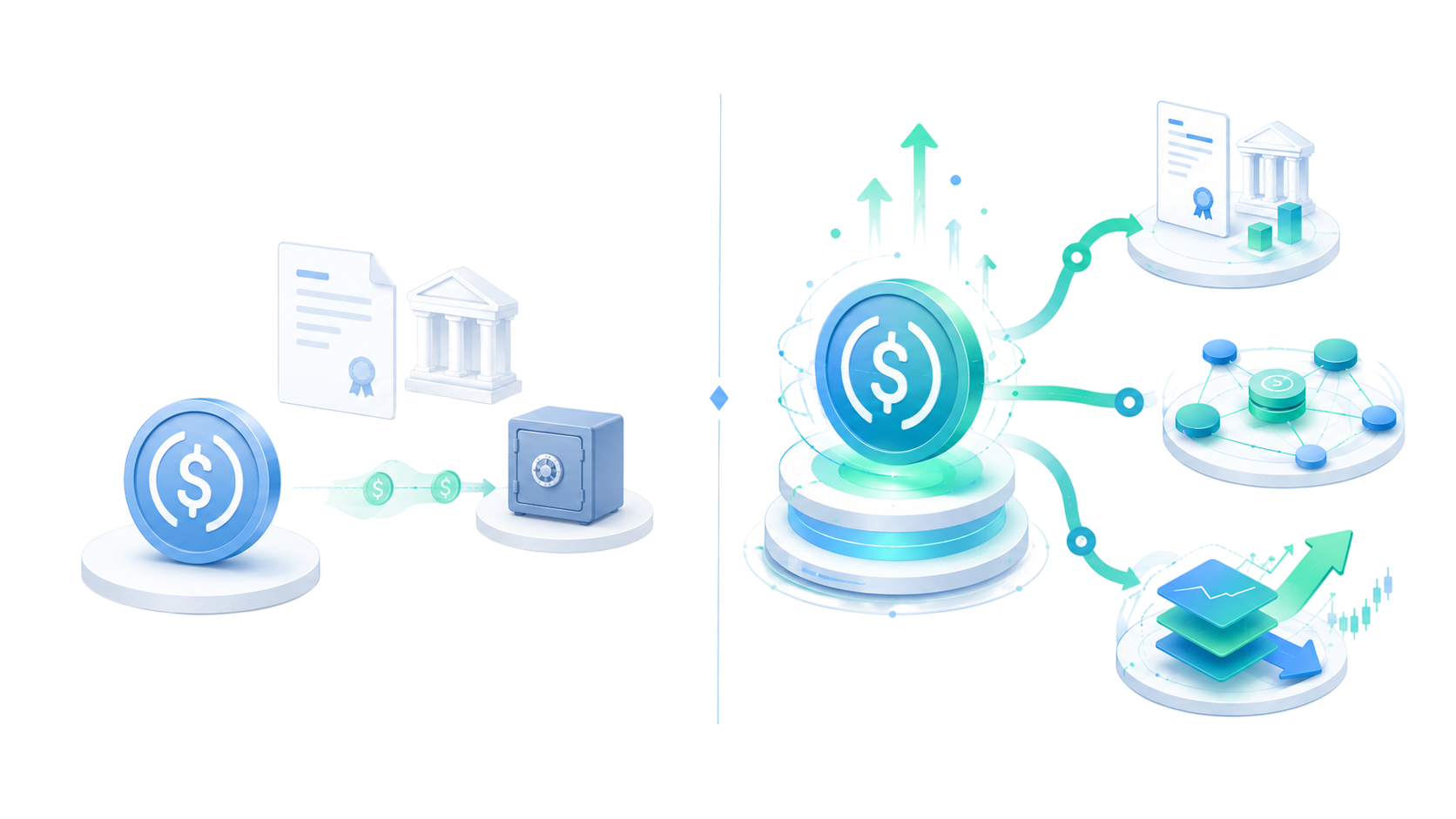
The fundamental difference is who gets the interest. USDT and USDC are backed by interest-earning assets, but holders receive nothing. The issuers keep the spread. Yield-bearing stablecoins are built on the premise that holders should participate in those returns.
For anyone already holding stablecoins for savings, payments, or DeFi activity, the upgrade to a yield-bearing version isn't a dramatic leap. The added complexity is real smart contract exposure, yield variability, and regulatory restrictions but for users who understand what they're holding, the category provides genuine utility that standard stablecoins don't.
There's also an overlap worth understanding with liquid staking. Ethena's sUSDe partially derives yield from staked ETH positions, which is a liquid staking concept embedded in a stablecoin wrapper. The key difference: yield-bearing stablecoins maintain a dollar peg; liquid staking tokens track the underlying asset price. They serve different purposes, even when they share yield infrastructure.
Build Knowledge That Holds Up
Yield-bearing stablecoins are one of the fastest-growing corners of DeFi for a reason they solve a real inefficiency. But making good decisions here means understanding the mechanisms, not just the APY number.
LearningCrypto gives you the tools to do exactly that: live on-chain analytics, an AI copilot that pulls verifiable data, and a community of independent learners who care about fundamentals over hype. Join the Classroom on Discord. Track smart money. Build knowledge that holds up when markets move.
Frequently Asked Questions
What is a yield-bearing stablecoin in simple terms?
A yield-bearing stablecoin is a dollar-pegged token that earns passive returns just from being held. Instead of the issuer keeping the interest generated by its reserves as Tether and Circle do with USDT and USDC yield-bearing tokens pass those returns to holders automatically, without requiring separate staking or lending steps.
Are yield-bearing stablecoins safe?
They carry real risks, including smart contract vulnerabilities, depeg events, variable yield, and regulatory uncertainty. Treasury-backed options like USDY are structurally simpler and more predictable. Derivatives-based tokens like sUSDe offer higher potential yields but with more moving parts and more ways things can go wrong. Understanding the specific mechanism behind each token matters more than treating the category as one thing.
What's the difference between rebasing and accrual tokens?
Rebasing tokens increase your actual balance over time while keeping the price at $1. Accrual tokens keep your balance fixed but increase each token's redemption value. Both deliver yield the difference is in how it appears in your wallet. Accrual tokens are generally more composable in DeFi, which is why most major yield-bearing stablecoins use the accrual model.
Can US users access yield-bearing stablecoins?
Access depends on the specific token. Some Treasury-backed tokens like USDY restrict US retail access due to how the underlying assets may be classified under securities law. Protocol-native tokens like sUSDS and sDAI generally have fewer geographic restrictions. This area is evolving the GENIUS Act and broader US stablecoin regulation will affect the landscape going forward.
How do yield-bearing stablecoins differ from just staking USDC on a platform?
When you deposit USDC into a lending platform to earn yield, you're taking a separate action, and your USDC isn't itself yielding anything. Yield-bearing stablecoins have the yield mechanism built into the token design. Holding sUSDS earns the Sky Savings Rate automatically, with no extra steps, because the yield accrual is part of how the token works, not an external service you've opted into.
Keep learning
- Crypto ETFs Explained: What Are They and How Do They Work?
- What Are Nodes in Crypto and How Do They Power Blockchain Networks?
- What Are Privacy Coins and Are They Legal?
- More guides in the Stablecoins hub
- Members: Daily Brief, pre-market context every weekday