
Hunter Biden's $LAPTOP token went live on Base at noon UTC on 9 September 2026, and within the hour it had done what political memecoins do: a vertical spike, a collapse, a flood of copycats, and a wave of people asking what it actually is. This guide is for anyone who has been sent a link, seen the ticker on social media, or been told they might be owed an airdrop. By the end you will know what the token is, how the supply is split, who can claim, and how to tell the real contract from the several hundred fakes.
Read this first. Learning Crypto is not recommending $LAPTOP, does not hold it, and is not suggesting anyone buy it. This is a memecoin. Its own issuer describes it as a digital collectible with no utility whose price can fall to zero. Everything below is educational, not financial advice, and nothing here should be read as an endorsement of any kind.
What is the $LAPTOP memecoin?
$LAPTOP is an ERC-20 token on Base, the Ethereum layer-2 network built by Coinbase, co-founded by Hunter Biden and issued by two offshore entities, a Cayman Islands foundation and a British Virgin Islands company, which are covered in their own section below. It is a memecoin in the plainest sense. The project's own disclosure document states that the token has "no utility or plans for future utility, cannot be staked, and does not confer ownership, voting, yield, or profit-sharing rights" in any entity.
That sentence is worth reading twice, because it is the issuer's own description. There is no product, no protocol, no revenue and no roadmap. The same document says the token "is best viewed as a digital collectible whose value is derived solely from community sentiment", and that there is "no price floor, buyback, or redemption mechanism." Biden himself said before launch that holders "should not expect me or anyone else to make this token more valuable."
If you have read our guide to how tokenomics work, you will recognise the category. This is a token whose entire market is other people's willingness to pay for it, and nothing else.
Who is behind the company that issues $LAPTOP?
Not Hunter Biden personally, and not any US company. The token is issued through a two-layer offshore structure laid out in the disclosure document and in the MiCA white paper the project filed for European trading. Both are worth reading, because the structure tells you who holds the money, who makes the decisions, and who you would have a claim against if something went wrong.
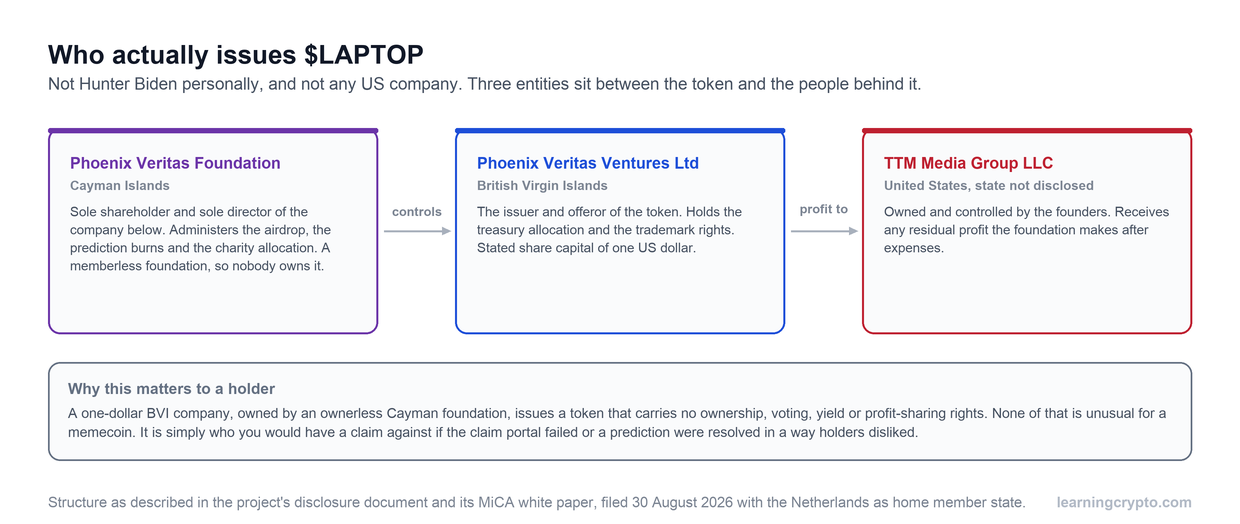
A one-dollar BVI company, owned by a Cayman foundation that legally nobody owns, issues the token. Any profit left after expenses goes to a company the founders control. This is who a holder would have a claim against.
| Entity | Where | Role |
|---|---|---|
| Phoenix Veritas Ventures Ltd | British Virgin Islands. Registered office at a Road Town chambers address. Incorporated 26 March 2026 | The issuer and "offeror" of the token. Holds the foundation treasury allocation and the trademark rights. Stated share capital of one US dollar |
| Phoenix Veritas Foundation | Cayman Islands. Care of a corporate services firm in Camana Bay, Grand Cayman | Sole shareholder and sole corporate director of the BVI company. Administers the airdrop, the prediction burns and the charity allocation, and resolves unclear prediction outcomes at its "sole discretion" |
| TTM Media Group LLC | United States. State not disclosed | "An entity owned and controlled by the Founders." Receives any residual profit the foundation makes after expenses |
The Cayman entity is a memberless foundation company, a structure the Cayman Islands introduced in 2017 that has since become the standard vehicle for crypto token issuers. A foundation company has no shareholders. It is run by a director, here named as Bryce Howarth, under the oversight of a supervisor, here Luis Powery, and it exists to carry out the objects written into its constitution. The practical effect is that nobody legally owns the issuer of $LAPTOP. That is presented as a feature, since the foundation cannot be captured by any single person, but it also means the entity holding the treasury and the decision-making power has no owners with their own capital at stake.
The natural persons the white paper lists as "involved in the implementation" of the project are Hunter Biden and Hervé Larren, both given a registered-agent suite address in Cheyenne, Wyoming rather than a business address, plus the two Cayman officers. The MiCA filing was notified on 30 August 2026 with the Netherlands as home member state, and carries the standard statement that it "has not been approved by any competent authority in any Member State of the European Union." The same filing records that the BVI company "may become insolvent through lack of funding, loss of key personnel, or absence of commercial success, which could end all activity connected to $LAPTOP."
Put those pieces together. A one-dollar BVI company, owned by an ownerless Cayman foundation, issues a token with no rights attached, and any profit the structure produces is contractually routed to a US company the founders own. None of this is unusual. $TRUMP was issued by Delaware entities affiliated with the Trump Organization that held 80% of the supply, and most large memecoins since 2024 have used some version of the Cayman foundation model. It is simply the arrangement you are dealing with, and it should shape your expectations about accountability if the claim portal fails, a prediction is resolved in a way holders dislike, or the token is delisted.
Why is it called LAPTOP?
The name refers to the laptop Hunter Biden reportedly left at a Delaware computer repair shop in April 2019. The New York Post published emails from it on 14 October 2020, three weeks before the presidential election, and the device became one of the most argued-over objects in American politics for years afterwards. Major outlets later authenticated portions of its contents, and federal prosecutors introduced the laptop as evidence in Biden's June 2024 firearms trial, which ended in a conviction. He pleaded guilty to federal tax charges in September 2024 and was pardoned by his father on 1 December 2024.
The token is a deliberate reference to all of that. Biden's launch video compiled news clips about the laptop, and his announcement framed the coin as turning a weapon used against him into something he owned. Whatever you make of the politics, it matters for one practical reason. The project's own risk section says that "negative publicity, controversy, changes in public sentiment, or objection from referenced or associated parties could trigger delistings" and "sharply reduce the value of the token." A token built on a political controversy carries that controversy as a permanent risk factor.
What is the official $LAPTOP contract address?
The official contract, published on laptoptoken.com and verified on BaseScan, is 0xB095274743941e953c746F9C228DA9c18Bb6ec29 on Base. Any LAPTOP token at a different address, or on any other network, is not the official token as of launch day.
A few technical facts from the verified source and the disclosure document:
- Fixed supply of 1,000,000,000 tokens with 18 decimals, and no inflation.
- The contract has no mint, pause, freeze, blacklist or upgrade functions, which rules out several of the tricks used by scam tokens.
- It includes a LayerZero Omnichain Fungible Token component, meaning the team can later expand it to other chains through a burn-and-mint bridge. As of launch, no other chain is official.
- Hacken audited the contract on 23 April 2026, months before the public knew the token existed, and reported no critical findings.
- The contract owner is a multi-signature account operated by the foundation.
Be careful with the address even in news coverage. At least one outlet reporting on launch day printed a different Base address, and a token using the LAPTOP ticker had been trading on Base since late June, weeks before the official announcement. Take the address from the official site or from the verified BaseScan page, never from a social media post or a reply. Our guide to doing your own research covers how to check a contract before you interact with it.
How is the 1 billion supply split?
Only 35% of the supply was unlocked at launch. The rest is locked or vesting over up to three years, and that overhang is one of the most important facts about the token. The disclosure document gives the following allocation.
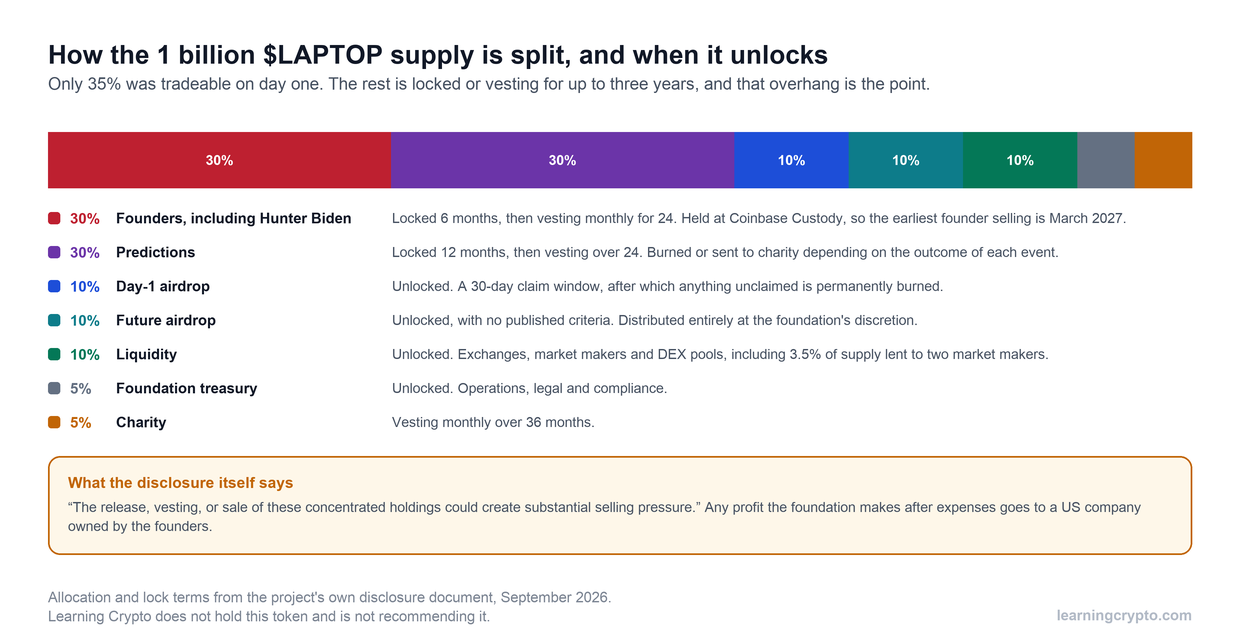
Only thirty-five percent could trade on day one. The founders' thirty percent begins vesting in March 2027 and continues monthly for two years, which is the overhang the project's own disclosure warns about.
| Allocation | Share | Tokens | Unlocked at launch | Lock and vesting |
|---|---|---|---|---|
| Founders (including Hunter Biden) | 30% | 300,000,000 | None | 6-month lock, then 24 months of monthly vesting |
| Predictions | 30% | 300,000,000 | None | 12-month lock, then 24 months of vesting; burned or sent to charity by event |
| Day-1 airdrop | 10% | 100,000,000 | All | 30-day claim window, then unclaimed tokens are burned |
| Future airdrop | 10% | 100,000,000 | All | At the foundation's discretion |
| Liquidity | 10% | 100,000,000 | All | Exchanges, market makers and DEX pools |
| Foundation treasury | 5% | 50,000,000 | All | Operations, legal, compliance |
| Charity | 5% | 50,000,000 | None | Vests monthly over 36 months |
Three details in the fine print deserve attention. First, the founders' 30% is custodied by Coinbase Custody and starts vesting six months after launch, so the earliest founder selling arrives in March 2027 and continues monthly for two years. Second, the foundation has lent 35,000,000 tokens, 3.5% of supply, to the market makers G20 and GSR. Third, the disclosure states that any profit the foundation makes after expenses "will be transferred to TTM Media Group LLC, an entity owned and controlled by the Founders." The charity and burn language is real, but so is the line showing where residual money goes.
The disclosure itself warns that "the release, vesting, or sale of these concentrated holdings could create substantial selling pressure." That is the structure of nearly every celebrity token, and it is why our guide to exit liquidity exists.
Who gets the $LAPTOP airdrop and how does the claim work?
Two cohorts can claim from the day-one allocation, and the rules are narrower than the headlines suggested.
- People who lost money on $TRUMP: 2% of supply. This is not a blanket refund. The tokens go to "participating exchanges and retail apps", and each venue decides at its own discretion how to distribute them to users with a negative profit and loss on the Official Trump token. If your exchange is not participating, or chooses different criteria, you get nothing. The project has not published which venues are taking part.
- Subscribers to Biden's "Where's Hunter?" Substack: 8% of supply. You needed to be subscribed before 6 September 2026, and allocations are weighted by subscription tier. Claims are made to a self-custodied wallet.
The claim portal is linked from laptoptoken.com. Claimants can create a Coinbase embedded wallet with an email address, in which case gas fees are covered, or use their own wallet and pay their own gas. The window is 30 days from launch. After that, unclaimed tokens are permanently burned.
The remaining 10% "future airdrop" has no published criteria and is distributed entirely at the foundation's discretion. Anyone promising you eligibility for it is guessing or lying.
One structural point the disclosure raises about the claim itself: the portal uses a "back-end-signed authorization model rather than a fixed onchain Merkle root", which "concentrates trust in the signing service." In plain terms, eligibility is decided by the project's server rather than by an immutable list on-chain, and a compromise of that server could block or misdirect claims. That is unusual for an airdrop of this size and worth knowing before you connect a wallet holding anything you care about.
What is the predictions burn-or-charity mechanism?
This is the novel part of the design and the part most likely to be misunderstood. 30% of supply is tied to 30 binary real-world events. If an event happens within its timeframe, the tokens assigned to it are burned. If it does not, they go to the charity allocation instead. The listed events are mostly political, with some crypto and culture entries. Examples on the project's predictions page include whether President Trump is impeached during his term, whether Democrats win the House or Senate in 2026, whether a Democrat wins in 2028, whether the Clarity Act becomes law by 2028, whether Bitcoin sets a new all-time high, and whether $LAPTOP's fully diluted valuation ever exceeds $TRUMP's.
Several of these mirror markets on Polymarket, and the project describes the events as "outside the control of the Founders." Note, though, that the disclosure also says resolution criteria are set by the foundation and that in unclear cases "resolutions will occur at the Phoenix Veritas Foundation's sole discretion." Holders have no vote.
Two things a burn does not do. It does not put money in your pocket, and it does not create demand. Burning supply reduces the number of tokens that exist, but a smaller supply of something nobody wants is still worth nothing. Treat the mechanism as what it is, a marketing device that ties the token to the news cycle. If the prediction-market angle interests you, our guide to how crypto prediction markets work explains the real thing.
What happened when $LAPTOP launched?
Trading opened on decentralised exchanges on Base at 12:00 UTC on 9 September with no fixed offering price. According to launch-day coverage citing DEXScreener data, the price spiked to a few hundred dollars per token in the opening minutes on very thin liquidity and had fallen by more than 95% from that high within about forty minutes, with roughly $10 million traded in the first hour. That is not a malfunction. It is the standard shape of a hyped launch: bots and insiders trade the first seconds, the headline price is set on almost no depth, and everyone arriving from a news article buys into the drop.
It is the same shape as January 2025, when $TRUMP and $MELANIA launched days before the inauguration. One on-chain analysis cited by Fortune estimated that close to a million wallets lost a combined $3.81 billion on $TRUMP after its debut. The $LAPTOP airdrop to $TRUMP losers is a joke at those buyers' expense as much as a gift to them. Our earlier guide to the $TRUMP memecoin records what that structure looked like at the time.
The launch also drew distancing from the platforms involved. Base creator Jesse Pollak said the team had approached Base beforehand and that Base "deliberately chose not to participate in its design or amplification", noting that anyone can deploy a token on a permissionless network. Kraken and Pump.fun deleted promotional posts after user backlash. Video journalist Andrew Callaghan's Channel 5, named in early reports as an airdrop partner, said it had no role and does not consider crypto a legitimate investment. None of this is unusual for a celebrity token, but it tells you how much institutional backing to expect: none.
How do you spot fake $LAPTOP tokens and claim sites?
This is the section most likely to save someone money. Because Biden's announcement gave only a ticker, a date and a chain, scammers had days to fill the gap. An investigation by the analytics firm Bitquery counted 351 tokens carrying the LAPTOP ticker created across Base, BNB Chain and Ethereum within 14 hours of the announcement, with dozens more on Solana, and the first fake was minted less than a minute after the news broke. Most showed enormous "volume" that turned out to be a single wallet trading against its own pool thousands of times to fabricate a chart.
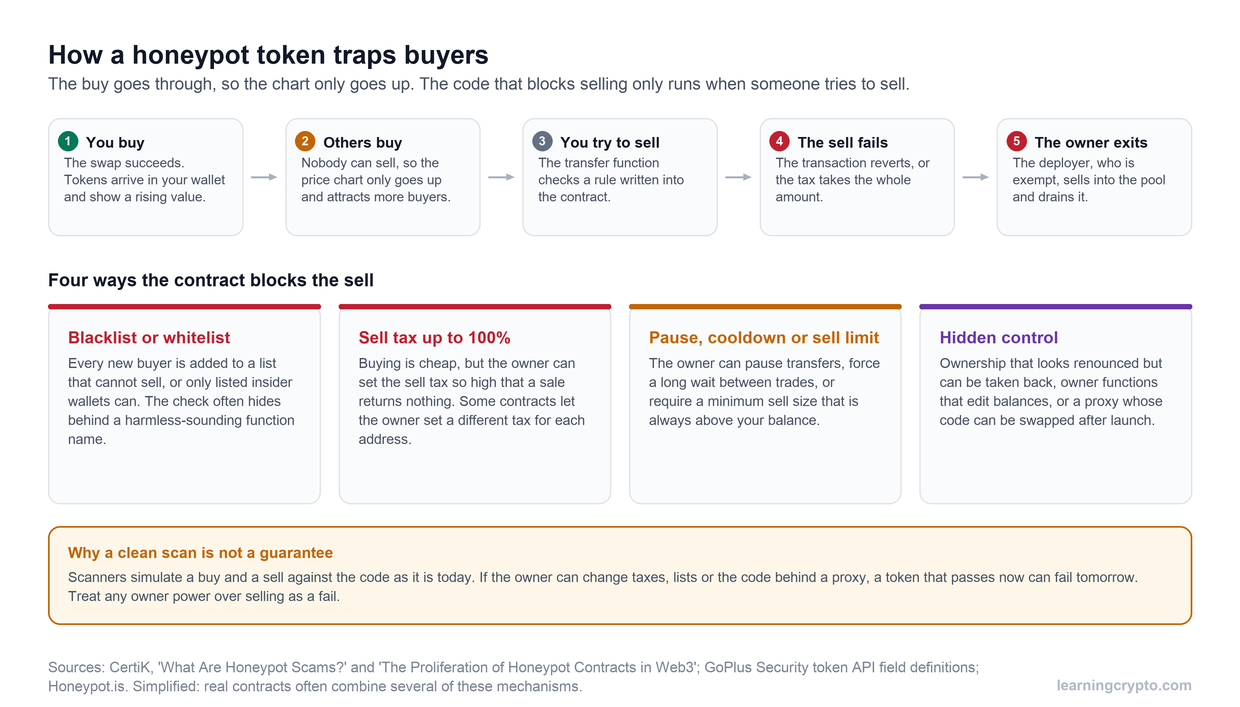
Alongside the fake tokens came fake eligibility checkers, whitelist pages and claim portals, pushed through replies and promoted posts on X. These sites ask you to connect a wallet and sign a transaction, or to enter a seed phrase. The signature is a token approval that lets the site drain your wallet. The seed phrase is your wallet.
The rules are the same ones we give for every launch:
- Get the contract address from laptoptoken.com or the verified BaseScan page only. Not from a reply, a Telegram group or a screenshot.
- The official project says it "will never contact you first" and will never ask for private keys, a seed phrase or personal information. Any direct message about $LAPTOP is a scam.
- Do not use an "eligibility checker" that asks you to sign anything. Checking eligibility never requires a signature.
- If you do claim, use a wallet that holds nothing else. Approval phishing empties whatever wallet you connect, and it is the mechanism behind most drains we see. Our guide to token approval phishing shows exactly what the malicious prompt looks like.
- A token with the right name on the wrong chain is the wrong token. The official contract exists only on Base at launch.
The broader playbook for this kind of event is in our no-nonsense guide to crypto scams and, for the trading pattern itself, in how pump and dump schemes work. Members can also paste a contract address or a claim link into Ask Crypto to sanity-check it before touching it.
What risks does the project itself disclose?
The disclosure document's risk section runs to several pages, and it is more candid than most of the coverage. The points that matter most for someone deciding whether to touch this at all:
- No utility, protocol, revenue, governance or claim on any entity. Price is "driven entirely by meme-culture sentiment."
- No price floor, buyback or redemption mechanism. "Digital assets are volatile, and prices can fall to zero."
- 65% of supply is locked or vesting, and its release "could create substantial selling pressure."
- Reputation risk is "inherent to the token's premise" and could trigger delistings or platform restrictions.
- The foundation decides unclear prediction outcomes at its sole discretion, and holders have no veto.
- The claim portal depends on a centralised signing service, and the embedded wallets depend on Coinbase's infrastructure continuing to exist.
- Regulatory treatment "may vary by jurisdiction and change over time." The project is issued from the Cayman Islands and the BVI and has published a MiCA white paper for Europe.
Read those as the issuer telling you, in writing, that you are buying sentiment about a political controversy from an offshore foundation whose residual profits flow to a company the founders own. That is an accurate description of the product.
Is Learning Crypto recommending $LAPTOP?
No. We are not recommending it, we do not hold it, and we are not suggesting anyone buy it, claim it as an investment, or trade the volatility. We have watched this exact structure play out repeatedly since 2017, and the outcome for late buyers has been consistent. A launch like this moves money from people who arrive after the headline to people who were positioned before the pool opened. The spike and collapse in the first hour are the product working as designed.
If you are eligible for the airdrop and want to claim it, do so from an empty wallet, from the official site, and understand that what you receive may be worth nothing by the time you can sell it. If you are not eligible, there is nothing here that requires your attention or your money. Our guide to fully diluted valuation explains why a headline market cap on 35% of supply tells you very little about what the other 65% will do to the price. For everything else in this category, start at our Scams and Risk hub.
Frequently asked questions
Who owns the company behind $LAPTOP?
No individual does. The issuer, Phoenix Veritas Ventures Ltd, is a British Virgin Islands company with one dollar of share capital, and its sole shareholder and director is the Phoenix Veritas Foundation, a Cayman Islands foundation company with no members or shareholders. Hunter Biden is named as a co-founder, and residual profit is contractually paid to TTM Media Group LLC, which the founders own.
What is the official $LAPTOP contract address?
The official contract on Base is 0xB095274743941e953c746F9C228DA9c18Bb6ec29, published on laptoptoken.com and verified on BaseScan. As of launch day it exists only on Base. Hundreds of tokens using the same name have been created on Base, BNB Chain, Ethereum and Solana, and none of them are connected to the project.
Who is eligible for the $LAPTOP airdrop?
Two groups: subscribers to Hunter Biden's Substack before 6 September 2026, who share 8% of supply weighted by tier, and users with losses on the $TRUMP token, who share 2% distributed at the discretion of participating exchanges. Claims run for 30 days from launch through the official site, and unclaimed tokens are burned.
Can Hunter Biden sell his $LAPTOP tokens?
Not immediately. The founders' 30% is locked for six months from launch, then vests monthly over 24 months and is fully unlocked 30 months after launch, according to the disclosure document. The tokens are held with Coinbase Custody. Once vesting begins, nothing prevents founders from selling, and the disclosure warns this could create substantial selling pressure.
Is $LAPTOP endorsed by Coinbase or Base?
No. Base is a permissionless network, so anyone can deploy a token on it. Base creator Jesse Pollak said the team approached Base before launch and Base chose not to participate in the token's design or promotion. Coinbase's custody and wallet products are used by the project as service providers, which is not an endorsement.
Why did the $LAPTOP price crash right after launch?
Because the launch opened on decentralised exchanges with very thin liquidity, so the first buyers and bots set a headline price on almost no depth, and everyone who arrived afterwards sold into or bought into the drop. Launch-day coverage reported a fall of more than 95% from the opening spike within about forty minutes. This is the normal pattern for hyped memecoin launches.
Should I buy $LAPTOP?
Learning Crypto does not recommend it and this article is not an endorsement. The token has no utility, no price floor, 65% of supply still locked, and an issuer that says the price can go to zero. If you choose to gamble on it anyway, use money you can afford to lose entirely, buy only the verified contract, and never connect a wallet holding your main funds.