
Ledger Recover is the feature that ended our years of recommending Ledger. This guide is for Ledger owners deciding whether to switch it on, and for anyone choosing a hardware wallet who has heard the word "backdoor" and wants to know what is actually true. It sets out how the service works, what independent experts and reporters found, where we think the risk sits, and what to use instead.
Disclosure: we earn affiliate commission from both Ledger and Trezor through links in our videos. This article is education, not financial or security advice for your specific situation. Service details were checked on 17 September 2026.
What is Ledger Recover?
Ledger Recover is an opt-in subscription that backs up your Ledger wallet with three companies instead of relying only on the words you wrote down. It was announced on 16 May 2023, delayed after a backlash, and launched on 24 October 2023 at $9.99 a month, according to Cointelegraph's launch report.
It is still sold in 2026. Ledger now offers a free trial inside the Ledger Wallet app and lists the Nano X, Flex and Stax as supported, with the Nano S Plus supported on desktop only. The original Nano S cannot use it.
The pitch is aimed at a real fear. New holders worry about losing their recovery words, and a service that promises to get their coins back if that happens sounds sensible. The trouble is what has to happen for that promise to work.
How does Ledger Recover work?
Your device makes an encrypted copy of the secret behind your 24 words, splits it into three shards, and sends one each to Ledger, Coincover and EscrowTech. Any two of the three can rebuild it. To use the service you first verify your identity with a government ID and a selfie, checked by the provider Onfido.
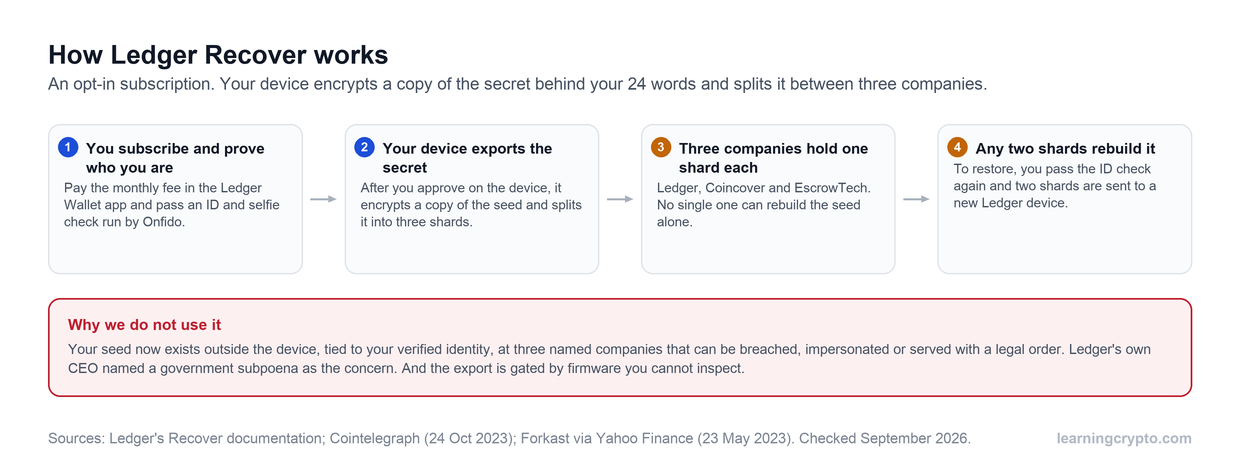
Each step is reasonable in isolation. Together they mean a copy of your wallet's secret now sits, encrypted, with three companies that also know exactly who you are.
- You subscribe in the Ledger Wallet app and complete the identity check.
- You approve the backup on the device with your PIN. Ledger says nothing leaves the secure element without this step.
- The device encrypts the secret and splits it using a verifiable secret-sharing scheme, according to Ledger's own documentation.
- Each company stores its shard. Ledger's design means one shard on its own reveals nothing.
- To restore, you pass the identity check again, and two shards are combined on a new Ledger device.
Why was there such a backlash in May 2023?
Because it contradicted what Ledger had told customers for years. The core promise of a hardware wallet is that your seed never leaves the chip, and in November 2022 Ledger had said a firmware update could not extract private keys from its secure element.
Then, the day after the announcement, Ledger's support account wrote: "Technically speaking it is and always has been possible to write firmware that facilitates key extraction." A follow-up said users had always trusted Ledger not to ship such firmware "whether you knew it or not." Both posts were deleted, and Ledger later blamed confusing wording. CoinDesk and Cointelegraph both reported the exchange.
A week later, chief executive Pascal Gauthier said on a podcast that "the only concern is if we get subpoenaed by a government", as Forkast reported. For an audience that buys hardware wallets to get away from third parties, that was the sentence that stuck.
Heidi made this video on 17 May 2023, before most of those statements had landed. Ledger had been the hardware wallet she used most, and it is a useful record of how the announcement read to long-time users at the time.
Heidi's first reaction: the identity check, the three custodians, two-of-three recovery, and why she began looking at Trezor. Watch it on our CryptoTips channel.
On 23 May 2023 Ledger paused the launch and promised to publish more of its code first. It released a whitepaper on the Recover protocol and a public repository of parts of its secure operating system. That repository still says only a few pieces of the OS are available, under Ledger's own licence rather than a standard open-source one.
Does Ledger Recover mean Ledger has a backdoor?
Not in the sense of a secret way in that Ledger has used. There is no evidence Ledger has taken anyone's seed, and no reported case of a Recover backup being breached. What Recover did prove is that an export path exists in shipping Ledger firmware, and that the only thing standing between your seed and that path is code Ledger controls and you cannot read.
Independent voices split along a clear line. Pavol Rusnak of SatoshiLabs, the company behind Trezor, said sending the seed or shares of it off the device fundamentally changes the security model, and other developers objected that nobody outside Ledger could review the firmware updates that enforce the consent step, as CoinDesk's expert round-up set out. Others argued Ledger had simply exposed a weakness every hardware wallet shares, since you always trust the maker's updates to some degree.
Both points are fair, and they lead to the same place for us. Every device needs some trust. Open firmware with reproducible builds lets independent people check that trust; closed secure element code does not. Recover turned a theoretical capability into a feature, on a platform where you cannot verify the safeguards.
What are the risks if you subscribe?
The encryption may well be sound. The risks sit around it.
- Your identity is attached to your keys. The service works because three companies can confirm who you are and link that to a backup of your wallet. That is the opposite of what most people buy a hardware wallet for.
- Legal orders. Ledger's own chief executive named a government subpoena as the concern. Three named companies in known jurisdictions are a clear target for one.
- Breaches and impersonation. Ledger's customer database was breached in 2020 and its contact data leaked again through a payment partner in January 2026. Scammers already pose as Ledger and Coincover; a lawsuit filed in New York in August 2026 alleges one such scheme cost a customer about $1.95 million, as crypto.news reported. Those are allegations, not findings.
- Consent you cannot audit. Ledger says the export only happens after you approve it on the device. That depends on firmware you cannot inspect.
- No public independent audit of Recover itself. Ledger publishes some third-party reports on its operating system, but we found no public audit that covers Recover specifically.
If you are already worried about impersonation, read our guide to fake crypto support scams. Nobody from Ledger, Coincover or any wallet company will ever ask for your recovery words.
If I own a Ledger and never subscribed, am I exposed?
You carry no shard, identity or custodian risk, because nothing was ever exported. You still carry the same firmware trust every Ledger owner carried before 2023: that Ledger will not ship an update that moves your seed without real consent. If that trust is acceptable to you, keep using the device and simply decline Recover whenever the app offers it.
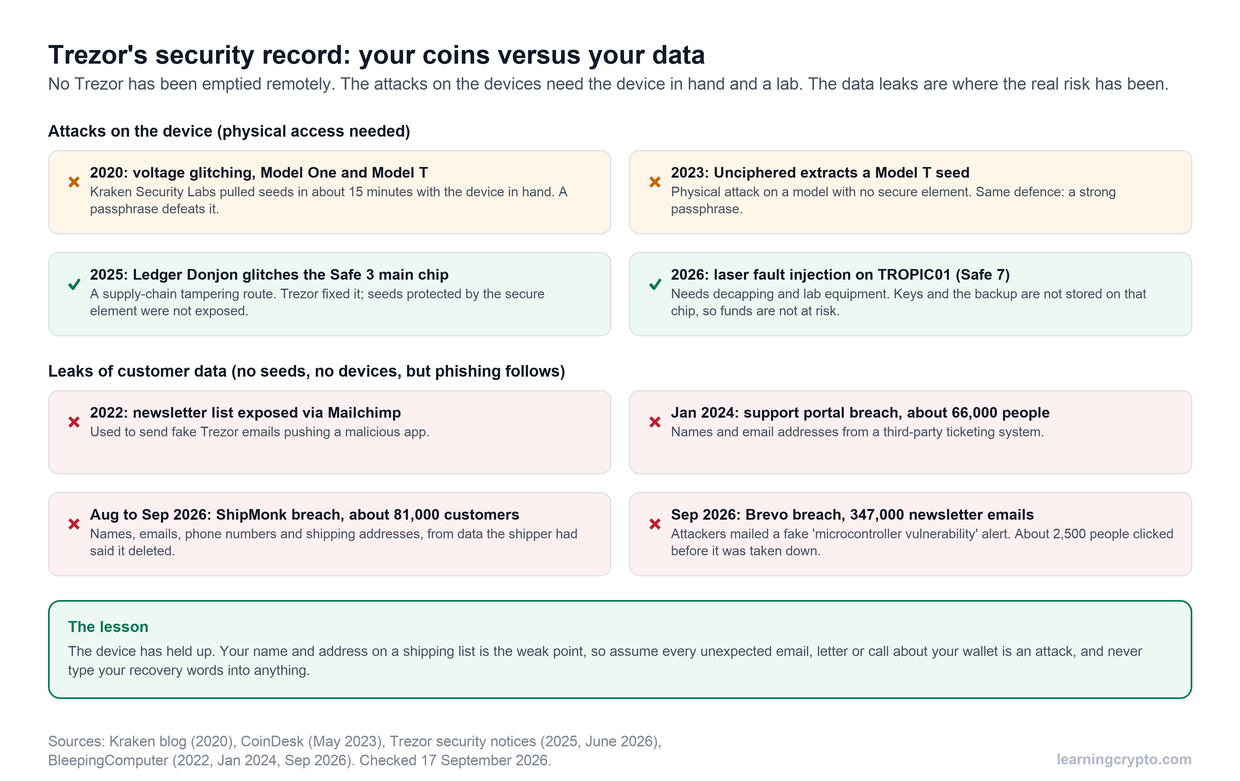
If it is not, move your coins rather than your words. Set up a new wallet on a device with open firmware, write down the new recovery words it generates, then send your funds across in small test amounts first. Restoring your old Ledger words onto another device keeps the same secret that has lived on the Ledger. Our guide on how to use a cold wallet covers the transfer steps, and is Trezor safe covers the device we moved to.
Is Ledger Recovery Key the same thing?
No. Ledger Recovery Key is an offline NFC card announced in June 2025 for the Flex and Stax and now paired with other touchscreen models. It stores a PIN-protected copy of your wallet's master secret and wipes itself after three wrong PIN attempts, as Decrypt reported at launch.
Two points get confused. Recovery Key was added alongside Recover, not in place of it, and Recover is still on sale. And although the card does not hold your 24 words, it does hold the secret they come from, so treat it with the same care as the words themselves. Unlike Recover, no company and no identity check is involved.
What should you use instead?
A backup you hold and understand. In order of how much protection they add:
- Write the words on metal or paper and store them away from the device. Our guide to what a seed phrase is explains why the words are the wallet.
- Add a passphrase, stored separately. The words alone then open an empty wallet.
- Split the backup yourself. Trezor's multi-share backup lets you create, say, three shares and need any two, with no company holding any of them.
- Use multisig for larger sums, with keys on devices from different makers. See our multisig operational playbook.
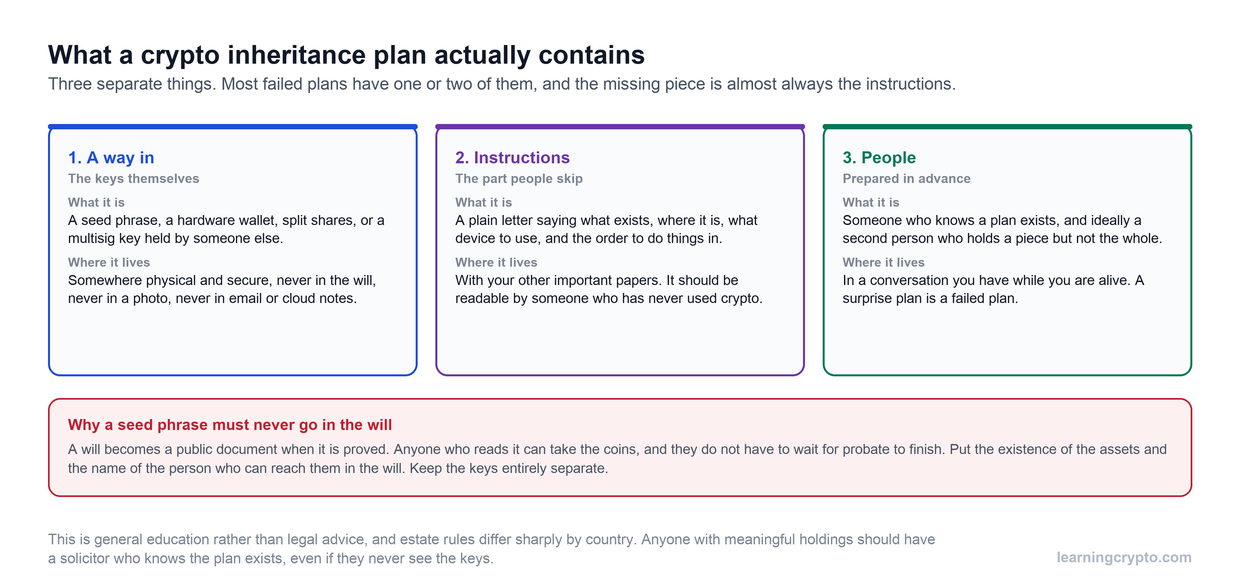
- Plan for your family. The real problem Recover tries to solve is often inheritance, and our crypto inheritance plan guide solves it without handing a copy to anyone.
For the wider choice between brands, read Trezor vs Ledger. Once your coins sit in more than one wallet, the members' Portfolio Tracker shows them together using public addresses only, so no keys or words are ever involved. More guides are in the Wallets and Custody hub.
Frequently asked questions
Is Ledger Recover safe?
The encryption and the two-of-three design may be sound, but the service adds risks a plain backup does not have. A copy of your wallet's secret is held by three companies that also hold your verified identity, which exposes you to breaches, impersonation and legal orders. The consent step also relies on closed firmware you cannot inspect. We recommend against it.
Is Ledger Recover mandatory?
No. Ledger Recover is an optional subscription. Nothing is exported unless you sign up, complete the identity check and approve the backup on your device with your PIN, according to Ledger. You can use any Ledger without it. The Ledger Wallet app does promote it, including a free trial, so decline the offer if you do not want it.
How much does Ledger Recover cost?
Ledger Recover launched in October 2023 at $9.99 a month, and Ledger now offers a free trial period inside the Ledger Wallet app. Pricing and availability vary by country, so check Ledger's own page for the current figure. A metal backup plate and a passphrase cost far less and involve no ongoing subscription or identity check.
Can the government access my Ledger Recover backup?
Nobody has reported a case, but Ledger's chief executive said in 2023 that a government subpoena was the main concern. The shards sit with three named companies that also hold your identity documents, so a legal order to two of them is the scenario critics worry about. Ledger says shards are encrypted and held separately.
Did Ledger discontinue Ledger Recover?
No. Ledger Recover is still sold in September 2026. In 2025 Ledger added Ledger Recovery Key, an offline NFC backup card, but it sits alongside Recover rather than replacing it. Some older articles describe Ledger as having pivoted away from Recover, which is not accurate. Check Ledger's shop for the current supported devices.
Does Ledger Recover store my seed phrase?
It stores an encrypted copy of the secret your 24 words are derived from, split into three shards held by Ledger, Coincover and EscrowTech. No single company holds a usable copy, but any two shards together can rebuild your wallet after an identity check. In practice that is a copy of your seed held outside your device.
Keep learning
- Trezor vs Ledger (2026): Which Hardware Wallet Should You Trust?
- Is Trezor Safe? The Honest Record for the Safe 3, Safe 5 and Safe 7
- What Is a Seed Phrase and Why It's Critical to Crypto Security
- Crypto Inheritance: How to Pass On Your Crypto Safely
- More guides in the Wallets & Custody hub
- Members: Portfolio Tracker, see all your wallets in one place