
Telegram is where a large share of crypto news, communities and projects live, which is why it is also where a large share of crypto scams start. The app lets anyone create a channel with any name and picture, message strangers who share a group, and run bots that look official. None of the scams below needs a technical exploit. Each one needs you to trust a message you did not ask for.
This guide covers the seven patterns we see most often, the single check that defeats each, and how to confirm you have found a genuine channel, including ours.
Education, not financial or legal advice. If you have already sent funds or shared a seed phrase, skip to the last section.
Why Telegram suits scammers
Three features make it easy. Channel names and pictures are not unique, so a copy of a real channel can look identical except for its handle. Group members can see each other and message each other, so joining a busy group exposes you to anyone in it. And bots can post buttons, links and "verification" steps that look like part of the app. Telegram does verify some large public figures and organisations with a blue tick, but most real crypto channels have none, so the absence of a tick tells you little and a lookalike badge in a bio tells you nothing.
The seven most common Telegram crypto scams
1. The cloned channel
A copy of a well-known channel, with the same name, picture and pinned message, and a handle that differs by a letter or an underscore. It reposts the real channel's news to look active, then slips in a fake airdrop, a presale or a "wallet sync" link. Some copies simply occupy an obvious handle: when we checked on 18 September 2026, @coindesk belonged to a channel named "Crypto news feed", not to CoinDesk. The check: open the channel from the publisher's own website, never from search or a forwarded link.
2. The admin who messages you first
You join a group or post a question, and within minutes someone with the project's logo and "Admin" or "Support" in their name sends a private message offering help. A real channel is a one-way broadcast, and real admins do not open private conversations to fix your wallet. The check: any unrequested private message is a scam until proven otherwise. Our guide to fake crypto support scams walks through the script they follow.
3. The fake verification bot
To join a group you are asked to "verify you are human" with a bot, often named to look like the popular Safeguard bot. In early 2025, Cointelegraph reported on bots that told users to paste a command into their computer, which installed malware that stole wallet keys; victims were drawn in by fake X accounts of well-known figures. The check: no genuine verification asks you to run code, connect a wallet or enter a seed phrase.
4. The signal or pump group
A channel promises calls that "10x" and sells a VIP tier. The organisers buy a small coin first, announce it, and sell into the rush of buyers they created. Paid promotion is common and rarely disclosed. The check: ask for a complete, timestamped record of every call, winners and losers; you will rarely get one. See pump and dump schemes for how the timing works.
5. The airdrop or giveaway
"Claim your tokens" or "send 0.1 ETH, get 0.2 back." Claim links lead to drainer sites that ask you to sign a transaction granting access to your tokens; giveaways simply keep what you send. The check: nobody doubles your money, and a real airdrop is announced on the project's own site, not in a direct message. Read what a signature approves before signing, as our MetaMask safety guide explains.
6. The investment mentor
A friendly stranger, often met in a group or after a "wrong number" message, shares screenshots of their profits and invites you to a private trading platform. Early withdrawals work; later ones need a "tax" or "release fee". This is the pattern often called pig butchering, and it can run for months. The check: if you cannot find the platform independently and withdraw to your own wallet, it is not a platform.
7. The fake recovery service
After a loss, someone offers to trace and recover your funds for an upfront fee. It is the same people, or people who bought the victim list, coming back for more. The check: no legitimate recovery service contacts victims first or demands payment in crypto before doing anything.
Red flags in one list
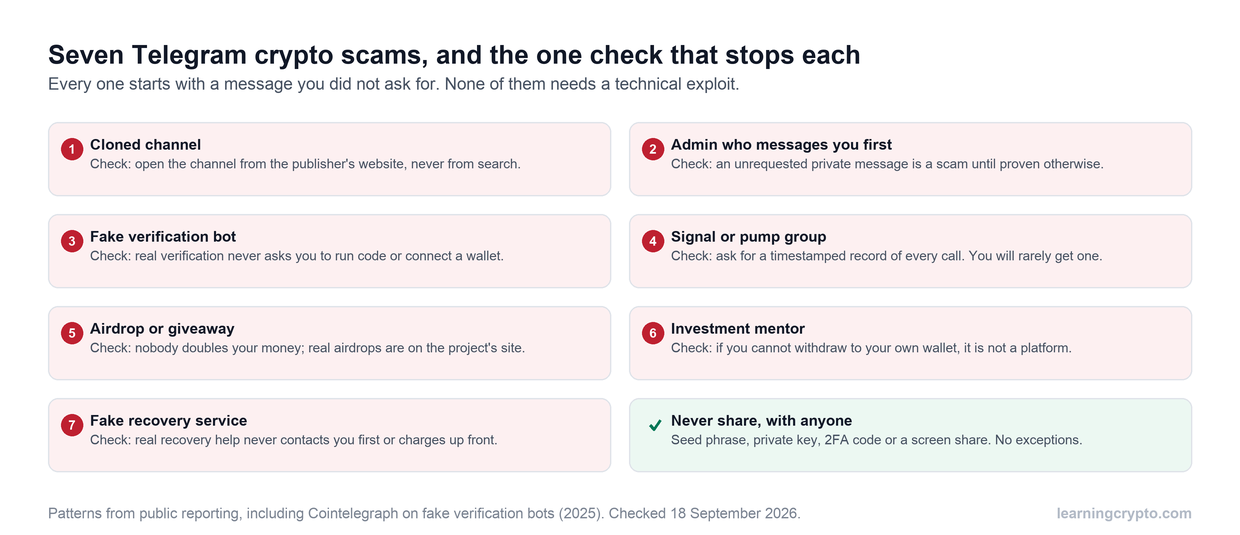
Every scam here starts with a message you did not ask for, and every check comes down to going to the source yourself.
- Someone contacted you first.
- You are asked for a seed phrase, private key, 2FA code or screen share.
- You are asked to connect a wallet, sign a transaction or run a command to "verify", "sync" or "claim".
- Returns are guaranteed, or there is a deadline measured in minutes.
- The handle differs from the one on the official website, even by one character.
- Payment is required up front, in crypto, to release or recover funds.
The same rules apply beyond Telegram; our no-nonsense guide to crypto scams covers email, X, YouTube and fake apps.
How to check a Telegram channel is genuine
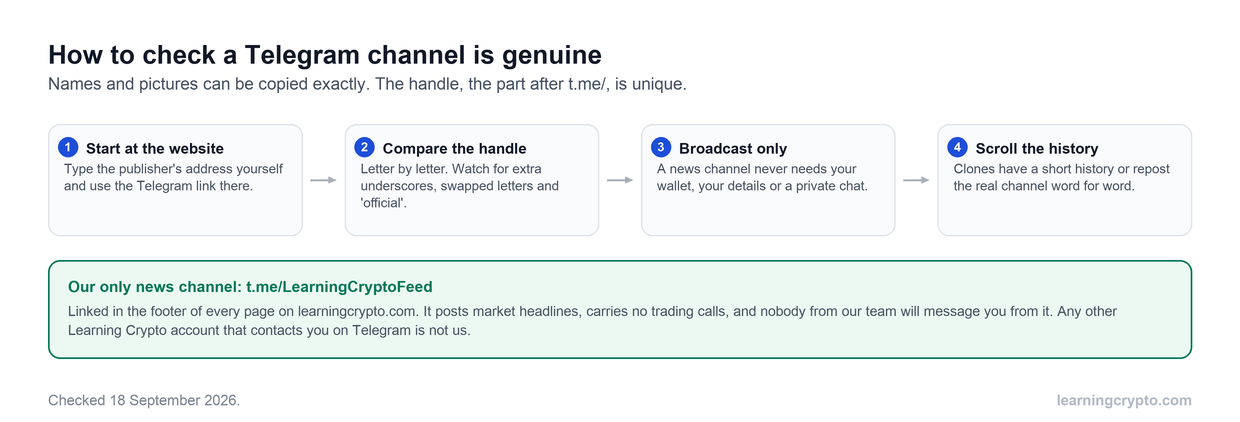
Four checks, under a minute in total. The handle is the only part of a channel a scammer cannot copy.
- Find the link on the official website. Go to the publisher's site by typing the address, and use the Telegram link there.
- Compare the handle letter by letter. The handle is the part after t.me/ or the @ sign. Names and pictures can be copied; a handle cannot.
- Check that the channel only broadcasts. A news channel should not need your wallet, your details or a private conversation.
- Look at the history. Scroll back. A cloned channel usually has a short history or reposts the real one word for word.
Here is how that looks for us. The genuine Learning Crypto news channel is @LearningCryptoFeed, at t.me/LearningCryptoFeed. It is linked in the footer of every page on learningcrypto.com. It posts market headlines with a short note on what to watch next, it carries no trading calls, and nobody from our team will message you from it or ask you for anything. If an account called Learning Crypto messages you on Telegram offering help, investments or support, it is not us; please report it and let us know.
What to do if you have been scammed
- If you shared a seed phrase or ran a command, assume every wallet on that phrase and that computer is compromised. From a clean device, create a new wallet and move whatever is left immediately. Our crypto security best practices cover setting up again safely.
- If you signed an approval, revoke it with a token approval tool and move remaining funds.
- Report the account in Telegram (open the profile, then Report) and to the platform you sent funds from.
- Report the crime to the police and, in the US, to the FTC and the FBI's IC3; in the UK, to Action Fraud. Keep transaction hashes, handles and screenshots.
- Ignore anyone offering recovery for a fee. See scam 7 above.
Members can put a suspicious project or message to Ask Crypto before acting, and the Daily Brief flags major hacks and scams as they happen. For free headlines, follow the Learning Crypto feed on Telegram, and see our list of the best crypto news Telegram channels for others we trust. More guides are in the Scams and Risk hub.
Frequently asked questions
How do I know if a Telegram crypto channel is fake?
Compare its handle, the part after t.me/, with the one linked on the publisher's official website. Names, pictures and pinned messages can be copied exactly, but a handle is unique. Also be suspicious of channels with a short history, posts that push airdrops or wallet connections, and any account from the channel that messages you privately.
Will a Telegram admin ever message me first?
Treat it as a scam. Channels broadcast one way, and genuine project teams and support staff do not open private chats to help with wallets or investments. Scammers copy admins' names and pictures and message people who have just joined a group or asked a question. If you need help, go to the project's website and use the support route listed there.
Is the Safeguard bot on Telegram a scam?
The real Safeguard bot is a common tool for verifying group members, which is why scammers copy it. A fake version may ask you to connect a wallet, enter a seed phrase or paste a command into your computer. Genuine human verification never needs any of those. If a bot asks, leave the group and do not run anything it gave you.
Can I get my crypto back after a Telegram scam?
Usually not, because crypto transfers cannot be reversed. Report it to the police and your national fraud agency with transaction hashes and screenshots, since exchanges sometimes freeze funds that reach them. Be very wary of anyone who offers to recover your funds for a fee; recovery scams target people who have just lost money.
What is the official Learning Crypto Telegram channel?
Our only news channel is @LearningCryptoFeed at t.me/LearningCryptoFeed, linked in the footer of learningcrypto.com. It is free, posts market headlines and never sends private messages, asks for funds or offers trading calls. Any other account using our name on Telegram, especially one that contacts you directly, is not us.
Are crypto signal groups on Telegram legitimate?
Some are honest, but most cannot show a complete, verifiable record of every call, and many are paid to promote the coins they mention or sell into the buying they create. A group that charges for VIP access is making its money from subscribers, not from trading. We recommend following news channels and making your own decisions instead.
Keep learning
- A No-Nonsense Guide to Spotting Crypto Scams
- Fake Crypto Support Scams: How the Con Works
- Pump and Dump Schemes in Crypto: How to Spot and Avoid Them
- The Best Crypto News Telegram Channels in 2026 (No Signal Groups)
- More guides in the Scams & Risk hub
- Free headlines: the Learning Crypto news feed on Telegram