

142 guides by Heidi.
Internet Computer Protocol (ICP) Review: What Is It?
Internet Computer Protocol (ICP) is a blockchain for hosting apps and data on a decentralized network rather than cloud servers. The ICP token pays fees, converts into cycles that power canister smart contracts, is staked to secure the network, and gives holders a vote via the Network Nervous System. Its weak spot: a few groups run many nodes, and DFINITY still steers the project.
Heidi ChakosFundamentalsFundamentalsSmart Contracts Explained Simply (Beginner Guide for 2026)
Smart contracts are self-executing digital agreements written as code on a blockchain, most commonly Ethereum. They run on if/when...then logic: once the predefined conditions are met, the contract enforces its terms automatically with no intermediary. That makes them useful for supply chains, real estate escrow and DeFi, but they still face regulatory uncertainty, scalability limits and the risk of coding bugs.
6 min read/Heidi ChakosMiningMiningWhat Do You Need to Mine Cryptocurrency? Your Essential Guide
To mine cryptocurrency you need mining hardware matched to the coin (an ASIC for Bitcoin, a GPU or CPU for smaller coins), mining software, a wallet you control for payouts, a mining pool account and, above all, cheap electricity with enough cooling. Power cost is what decides whether you make or lose money, so work that out before buying anything.
Heidi ChakosStablecoinsStablecoinsBest Stablecoin Interest Rates (2025) – Compare Top Platforms
The best stablecoin interest rates come from a mix of centralised lenders like Nexo, DeFi protocols like Aave and Compound, and exchange reward programs like Coinbase's USDC rewards. Rates move with borrowing demand and are not guaranteed. Higher advertised yields almost always mean higher platform or issuer risk, so compare the source of the yield, not just the number.
Heidi ChakosBitcoinBitcoinWhy Bitcoin Was Created: An Introduction To Bitcoin
Bitcoin was created in response to the 2008 global financial crisis, when trust in banks and governments collapsed. Satoshi Nakamoto designed it as decentralized, peer-to-peer money that no central authority controls, with a transparent public ledger, cryptographic security, and a fixed supply of 21 million coins as a hedge against inflation. Those founding goals still shape how Bitcoin is used today.
Heidi ChakosBitcoinBitcoinHow Long Does It Take To Send or Receive Bitcoin? - Understanding Crypto Transactions
Sending Bitcoin usually takes 10 minutes to an hour. The first confirmation arrives in about 10 minutes and the 6 confirmations most exchanges treat as final take roughly 60 minutes. Low fees and a congested mempool can stretch that to hours or, rarely, days. A stuck transaction can be sped up with replace-by-fee or child-pays-for-parent, and Lightning payments settle in seconds.
Heidi ChakosWallets & Custody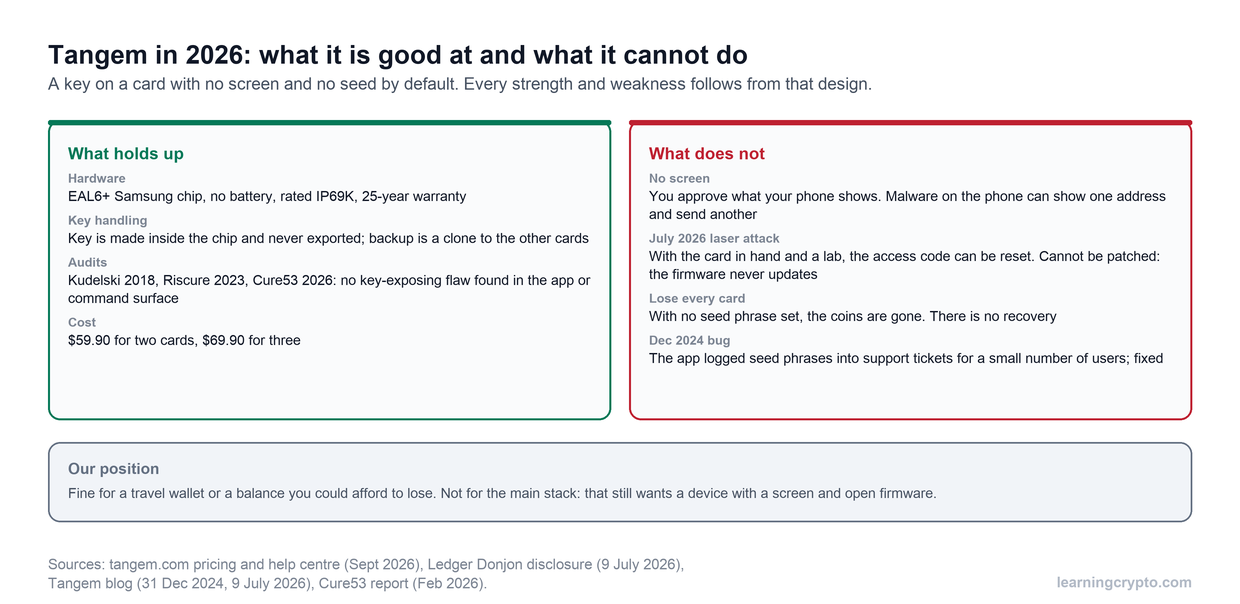 Wallets & Custody
Tangem Wallet Review (2026): Tough, Cheap, and Not for Your Main Stack
Tangem is a $59.90 NFC card that makes the key inside an EAL6+ chip and backs it up by cloning to a second card; no seed phrase unless you choose one. It survived our hammer test, but it has no screen, its firmware cannot be updated, and a July 2026 laser attack showed a stolen card can be reset in a lab. Travel money only.
Heidi Chakos