
Archer, who researches for us and moderates our Discord, bought a Tangem set with his own money in 2023, froze it, dropped it and hit it with a hammer, and concluded it was a fine travel wallet and a poor place for serious money. Three years and two security disclosures later, that is still our view, for slightly different reasons. This review is for anyone drawn to Tangem's price and simplicity who wants to know what the seedless design gives up.
Not sponsored. Tangem offered a promotional card in 2023 and we declined it. We have no affiliate arrangement with Tangem. This is education, not advice. Prices and facts were checked against tangem.com, the audit reports and the Ledger Donjon disclosure on 17 September 2026.
What is a Tangem wallet?
A credit-card-sized NFC card with a Samsung secure element chip, certified EAL6+, and nothing else: no battery, no screen, no buttons, no USB port. You tap it to your phone, and the Tangem app, which is open source, sends transactions to the card to sign. The key is generated inside the chip by a hardware random number generator and never leaves it. Sets cost $59.90 for two cards and $69.90 for three, and the Tangem Ring, a ceramic ring with two backup cards, is $160. Tangem claims the card is rated IP69K and gives a 25-year warranty.
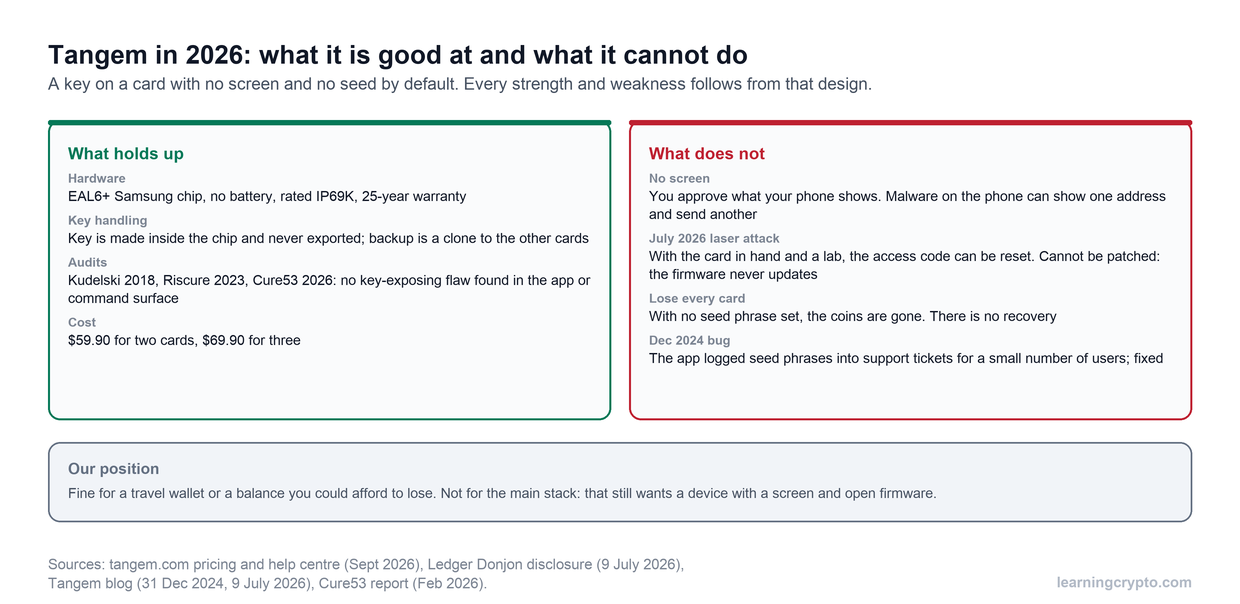
Every entry on the right follows from the design choices on the left. A card with no screen and no updatable firmware is simple to use and impossible to patch.
How does backup work without a seed phrase?
By cloning. During setup the cards open an encrypted channel and copy the key to each backup card, once; you cannot add a card later without a factory reset. The backups are then your only recovery. Lose every card and, in Tangem's own words, losing your devices results in losing your funds. Tangem cannot identify or block a lost card because it never registers who owns one.
Since September 2023 the app has also offered a seed-phrase mode: generate or import 12 or 24 BIP39 words, with passphrase support added in 2024. That gives you a conventional backup and lets you move the wallet to another brand, at the cost of the thing Tangem was built to avoid: a piece of paper that can be copied. Tangem's own documentation says a seed phrase is a single point of failure. We think that trade-off is right for anyone holding more than pocket money, and it removes the strongest objection in Archer's review. Our guide to what a seed phrase is explains the standard.
Archer's August 2023 hands-on review: durability tests, support responsiveness, the unverifiable card firmware, and why he would not use it for long-term or high-value storage. Recorded a month before Tangem added the seed-phrase option. Watch it on our CryptoTips channel.
What has been found wrong with it?
- December 2024, the logging bug. A new logging feature in the app wrote the seed phrase into diagnostic logs during seed-phrase wallet creation, and those logs were attached to support tickets. Tangem said fewer than 0.1% of users were affected, that no funds were lost, that all support logs were erased and that logging was disabled, in its 31 December 2024 statement. Affected users were told to move funds to a new wallet. Users on Reddit criticised how quietly it was handled.
- July 2026, the laser attack. Ledger's security lab showed that a single laser pulse on the decapped chip flips the recovery-mode check, letting an attacker set a new access code and take control of a card they physically hold, in a disclosure on 9 July 2026. It needs the card, a lab and around two hours per card once calibrated, and it does not extract the key. Because Tangem firmware is loaded once and never updated, no shipped card can be patched. Tangem's response called the practical risk near zero and noted the researchers work for a competitor. Both things can be true; the practical mitigation is to move funds with a backup card the moment a card is lost.
Independent audits have not found key-exposing flaws: Kudelski reviewed the firmware in 2018, Riscure the NFC command surface in 2023, and Cure53 the app SDKs in early 2026, with no critical or high findings. The card firmware itself remains closed, which is what Archer could not verify in 2023 and still cannot be verified today.
What does no screen actually cost you?
Verification. A hardware wallet with a screen shows you the address and amount on a device malware cannot reach, and you approve there. Tangem shows them on your phone. If the phone is compromised, it can display one address and send the card another to sign, and the card will sign it. There is no documented case of this happening to a Tangem user, and the access code plus the physical tap stop a remote attacker outright, but the protection you get from a screen is exactly the protection that is missing here. It is the same reason we tell people to verify on the device in our Trezor versus Ledger comparison.
The other cost is the access code. After six wrong attempts the delay between tries grows, to a maximum of 45 seconds; the card does not wipe. That is deliberate, because a seedless wallet that wiped itself would destroy the only copy of the key, and it is why the 2026 attack matters.
What else has changed since 2023?
- Coins. Tangem's pages give figures between 14,000 and 16,000 tokens across 85 to 90 networks, with staking in the app for Solana, Tron, Polygon, BNB, Cosmos and TON, and swaps through eight aggregated providers.
- Tangem Pay. A self-custodial USDC account with a virtual Visa card, launched November 2025, requires identity verification and is available in 38 jurisdictions, with Europe and the UK still listed as planned when we checked.
- Scale. Tangem reports six million cards sold and $61 million of revenue for 2025. The company is Swiss, founded in 2017, with a Russian subsidiary that it has said it is winding down; no sanctions or regulatory action have been reported.
Our verdict: who is Tangem for?
A traveller who wants a wallet that survives a pocket, a beach and a border without looking like a hardware wallet, and a balance they could lose without changing their life. It is the cheapest secure-element wallet we have tested and the toughest. It is not for the main stack, for three reasons that have not changed since 2023 and one that has: no screen to verify on, firmware that cannot be audited or updated, a design where losing the cards loses everything unless you opt into a seed, and, since July 2026, a demonstrated lab attack on a stolen card. If you use one, set a seed phrase and store it on metal, set the access code, and keep the backup card somewhere else. We rate it 3.5 out of 5.
Our reviews of the Trezor Safe 7 and the record in is Trezor safe cover the alternative for the main stack, and how to use a cold wallet covers setup. Members can track a Tangem balance alongside every other wallet in the Portfolio Tracker. More in the Wallets and Custody hub.
Frequently asked questions
Is Tangem wallet safe?
For modest balances, yes. The key is generated inside an EAL6+ chip and never leaves it, three independent audits found no key-exposing flaw, and a remote attacker cannot use a card without the access code and a physical tap. Its limits are a phone screen for verification, firmware that can never be updated, and a July 2026 lab attack that can reset a card an attacker physically holds.
What happens if I lose my Tangem cards?
With the default seedless setup, losing every card in the set loses the funds permanently; Tangem cannot identify or restore a lost card. Losing one card is fine, because the backup cards hold a clone of the key, and you should move funds to a new wallet as a precaution. Setting a seed phrase at setup gives you a backup that works on any BIP39 wallet.
Was Tangem hacked?
Two issues have been disclosed. In December 2024 the app logged seed phrases into support tickets for a small number of users, which Tangem fixed and said caused no losses. In July 2026 Ledger's security lab demonstrated a laser attack that resets the access code on a card the attacker physically holds, which cannot be patched. No remote hack or theft through the card itself has been reported.
Does Tangem have a seed phrase?
Not by default. The key is created in the chip and backed up by cloning to the other cards, so there is nothing to write down and nothing to lose except the cards. Since September 2023 the app can generate or import a 12- or 24-word BIP39 seed phrase, with passphrase support since 2024, for users who want a conventional backup. We recommend using it for anything beyond small balances.
Is Tangem better than Ledger or Trezor?
It is cheaper, tougher and simpler, and worse at the one thing that matters most: showing you what you are signing on a screen malware cannot reach. Trezor and Ledger have screens, updatable firmware and, in Trezor's case, fully open code. For a travel or spending wallet Tangem is a reasonable choice; for long-term storage of meaningful sums we recommend a device with a screen.
How much does a Tangem wallet cost?
As of September 2026, $59.90 for a two-card set and $69.90 for three cards on tangem.com, with a family pack of two wallets at $129.80 and the Tangem Ring, sold with two backup cards, at $160. There is no subscription. Buy only from Tangem or an authorised reseller, since a card set up by someone else before it reaches you cannot be trusted.
Keep learning
- Trezor Safe 7 Review - Is It Worth It?
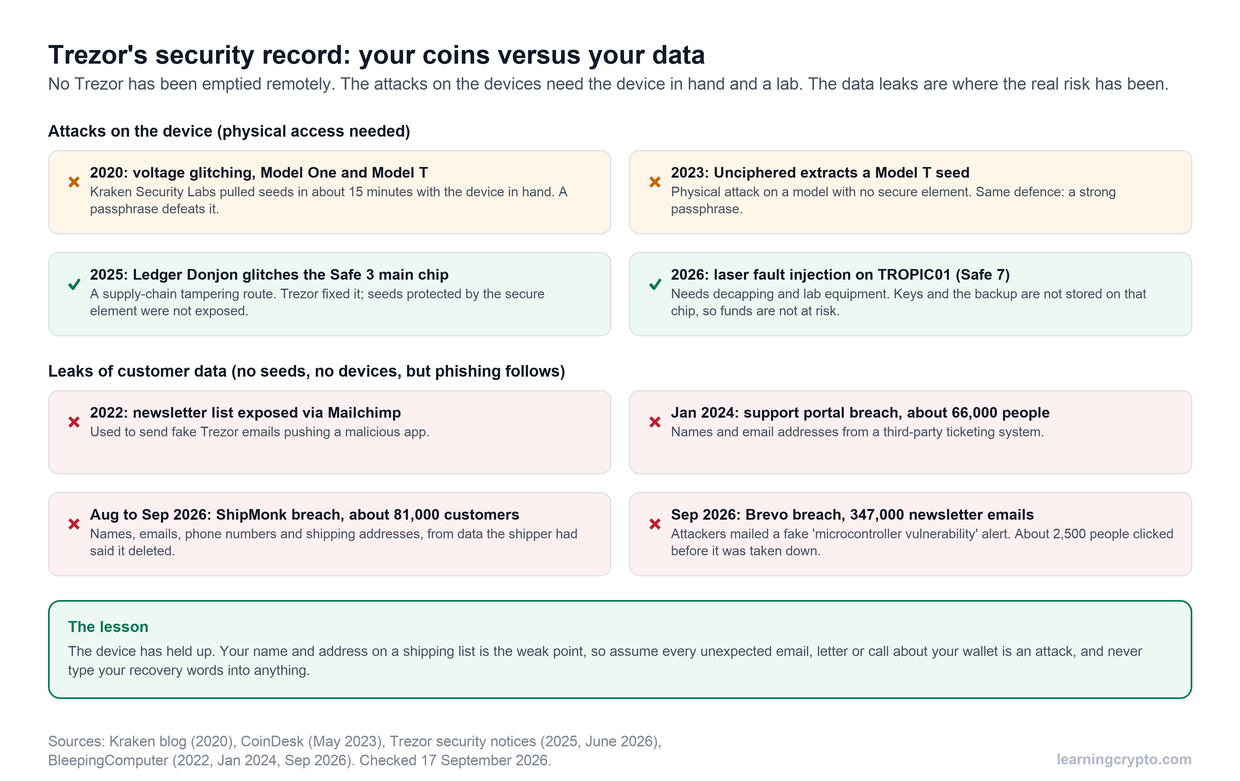
- Is Trezor Safe? The Honest Record for the Safe 3, Safe 5 and Safe 7
- Trezor vs Ledger (2026): Which Hardware Wallet Should You Trust?
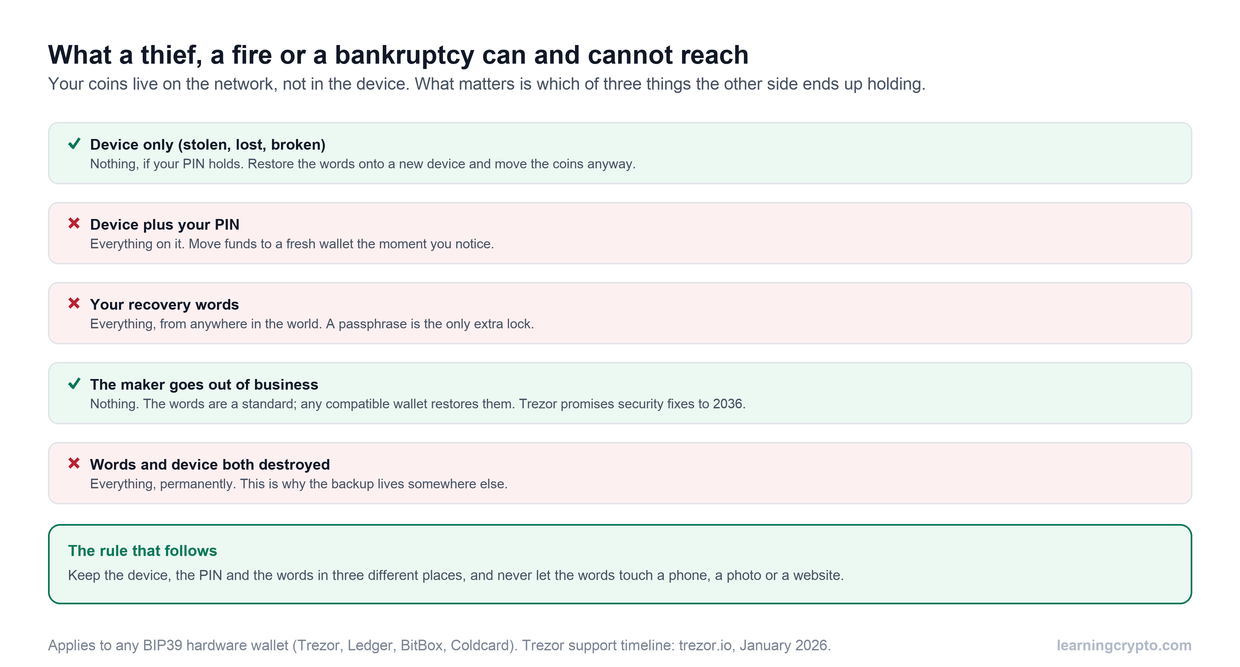
- Lost or Stolen Hardware Wallet, or the Maker Goes Bust: What Happens to Your Crypto
- More guides in the Wallets & Custody hub
- Members: Portfolio Tracker, see all your wallets in one place