
Privacy coins are cryptocurrencies that use advanced cryptography to hide transaction details like sender, receiver, and amount. They're legal to own in most countries, but exchanges worldwide are dropping them under pressure from regulators. The trend isn't toward outright bans. It's toward tighter control of the on-ramps and off-ramps. |
Bitcoin gets called anonymous a lot. It isn't.
Every transaction ever made on the Bitcoin network sits on a public ledger, visible to anyone with an internet connection. Pseudonymous is the correct word. Your name isn't attached to your wallet address, but your wallet address is attached to everything you do..
Privacy coins exist because some people looked at that setup and decided it wasn't good enough. Monero, Zcash, Dash, and a growing list of newer projects use cryptographic techniques to obscure who sent what to whom. The goal is financial privacy that actually holds up under scrutiny. Not just a fig leaf of pseudonymity.
That privacy has made them useful. It's also made them controversial. Regulators worry about money laundering, tax evasion, and ransomware payments vanishing into untraceable wallets. So the legal picture depends heavily on where you live and which exchange you use.
So here's how they actually work, and what the legalities are about owning them.
What You'll Learn About Privacy Coins
→ The cypherpunk roots behind the whole movement and how it got to where it is today
→ Ring signatures, stealth addresses, zk-SNARKs and what each one actually does in plain English
→ Monero vs Zcash vs Dash and the newer projects gaining ground
→ Which countries have banned them, which ones haven't, and where the grey areas are
→ The real arguments on both sides of the privacy coin debate
→ Where the industry is heading with compliant privacy and selective disclosure
A Brief History of Privacy Coins
From Cypherpunks to Crypto
Privacy coins didn't appear out of nowhere. The cypherpunk movement had been arguing about financial privacy since the early 1990s, back when most people were still figuring out email. Cryptographer David Chaum was actually building digital cash prototypes through his company DigiCash. It went bankrupt in 1998. The world wasn't ready. But the core idea survived: privacy isn't a feature you bolt on. It's a right.
Then Bitcoin showed up in 2009 and proved decentralised money could actually work. Brilliant. Except it also put every single transaction on a public ledger for anyone to read. For people who'd spent a decade arguing that financial surveillance was the problem, a fully transparent blockchain was only half the answer.
So they started building the other half.
How We Got Here
Year | What Happened |
2012 | Bytecoin launches as the first privacy coin, introducing the CryptoNote protocol. Promising stuff, but suspicions of pre-mining tanked its credibility early |
2014 | Monero forks from Bytecoin with a clean launch and a community-first approach. Ring signatures, stealth addresses, and later RingCT made it the gold standard for on-chain privacy |
2014 | Dash shows up with optional privacy through PrivateSend, a CoinJoin-based mixing feature. Privacy as a choice rather than a default |
2016 | Zcash enters with zk-SNARKs, letting users choose between transparent and shielded transactions. A different bet: give people the option, let them decide |
2018 | Pirate Chain launches with mandatory privacy on every transaction. No optional mode. No transparent fallback. All or nothing |
2024+ | A new wave of "privacy-enhancing blockchains" arrives. Projects like Aleph Zero, Iron Fish, and protocol layers like Railgun and Aztec start building privacy into existing chains rather than starting from scratch |
Every new project basically looked at what came before and thought, "close, but not quite." That's still happening now. The difference is that the newer crowd is less interested in building separate private chains and more focused on bolting privacy onto infrastructure that already exists.
What Do Privacy Coins Actually Do?
Strip away the jargon, and privacy coins do one thing: they hide the details of a transaction.
On a standard blockchain, three pieces of information are visible to everyone. Who sent it. Who received it. How much was sent. Chain analysis tools can follow that trail, link wallet addresses to real identities, and build a full picture of someone's financial activity. It's not even particularly difficult anymore.
Privacy coins break that chain. Depending on the coin, they obscure the sender, the recipient, the amount, or all three. Some do it automatically on every transaction. Others give you the choice.
The money still moves. The transaction still gets validated. But the details stay between the people involved.
How Privacy Coin Technology Works
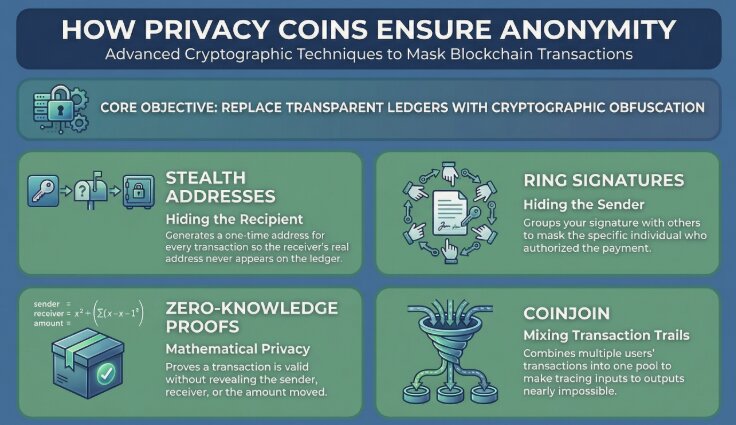
Four main techniques show up across most privacy coins. They all attack the same problem from different angles, and some coins stack more than one together.
Stealth Addresses
Say someone sends you crypto. Normally, that payment lands at your public wallet address, sitting right there on the blockchain for anyone to see. Do it enough times and a pattern forms pretty quickly.
Stealth addresses get around this by generating a fresh one-time address for every single transaction. Your real address never touches the ledger. Two payments to the same person look completely unrelated to an outside observer. Monero does this automatically on every transaction.
Ring Signatures and RingCT
When you send a transaction on Monero, your digital signature gets thrown into a group with several other users' signatures. The network can confirm that someone in the group authorized the payment. But figuring out who? That's the point. You can't. RingCT adds to this by hiding the transaction amount as well. Unknown sender, unknown amount, verified as legitimate.
Zero-Knowledge Proofs (zk-SNARKs)
A zero-knowledge proof lets you prove something is true without revealing any of the data behind it. A transaction gets confirmed as valid on the network, but nobody can see who sent it, who received it, or how much moved. The maths checks out. The details stay hidden. Zcash built its privacy model around this. Iron Fish uses the same approach, and zk-based privacy layers are starting to show up across Ethereum.
CoinJoin
The least complex of the four. A group of users combine their transactions into one, so everything comes out the other side mixed together. Tracing which input matches which output becomes genuinely difficult for anyone trying to follow the money. Dash built this into its PrivateSend feature.
Bitcoin users can access it too through wallets like Wasabi, though it takes some effort, and it's entirely optional.
Quick Comparison
Technology | What It Hides | Used By |
Stealth Addresses | Recipient identity | Monero |
Ring Signatures / RingCT | Sender identity + amount | Monero |
zk-SNARKs | Sender, receiver, and amount | Zcash, Iron Fish |
CoinJoin | Transaction origin and destination | Dash, Bitcoin (optional) |
Major Privacy Coins Compared
Monero (XMR)

Monero launched in April 2014 as a fork of Bytecoin. The Bytecoin project had promise but the pre-mining scandal left a bad taste, so a group of developers took the CryptoNote codebase and started fresh. Clean launch. No pre-mine. No corporate sponsor. Community-run from day one.
It's the only major privacy coin where privacy is mandatory. Every transaction uses stealth addresses, ring signatures, and RingCT by default. You can't accidentally send a transparent transaction because the option doesn't exist. That's a deliberate design choice, and it's the reason Monero has the strongest privacy reputation in crypto.
It's also the reason regulators don't like it much. Monero has been delisted from most major centralised exchanges over the past few years. Binance dropped it. Kraken dropped it in certain regions. If you want to buy or sell XMR today, you're mostly looking at decentralised exchanges and peer-to-peer platforms. The coin itself is fine. Getting fiat in and out is the hard part.
None of that has killed demand. Monero still has one of the most active development communities in crypto and consistently high transaction volumes on the networks where it trades.
Interested in Mining Moreno Read More Here.
Zcash (ZEC)
Zcash arrived in October 2016, founded by cryptographer Zooko Wilcox and backed by some serious academic firepower. It was the first cryptocurrency to implement zk-SNARKs, which was a genuine technical milestone at the time.
The big difference from Monero is choice. Zcash lets users pick between transparent transactions and shielded ones. You can send funds that look exactly like a Bitcoin transaction, fully visible on the ledger. Or you can shield them, and nobody sees anything except that a valid transaction occurred.
That flexibility has turned out to be a smart bet for surviving the regulatory crackdown. Because Zcash can support transparent transactions, exchanges have an easier time listing it. Some users see optional privacy as a weakness compared to Monero's all-or-nothing approach. Others see it as pragmatism. Zcash had a massive resurgence in 2025, with its value jumping over 600%.
Dash (DASH)
Dash has been around since January 2014, originally launched as XCoin, then rebranded to Darkcoin (subtle), then finally Dash. It offers optional privacy through a feature called PrivateSend, which is basically a built-in CoinJoin mixer.
Calling Dash a privacy coin in the same breath as Monero or Zcash is a stretch at this point though. Privacy is a side feature, not the main selling point. Dash has spent years positioning itself as a fast, low-cost payments coin. The privacy function exists, but most users don't bother with it.
That positioning has actually helped it avoid the worst of the exchange delistings. Because PrivateSend is optional and the vast majority of Dash transactions are fully transparent, regulators tend to treat it differently from coins where privacy is the whole point.
Newer Projects Worth Watching
The privacy coin space didn't stop evolving after the big three. A newer wave of projects is approaching the problem differently.
Iron Fish launched as a Layer 1 blockchain using zk-SNARKs on every transaction. Mandatory privacy, similar to Monero's approach, but built on zero-knowledge proof technology instead of ring signatures. It's positioning itself as a privacy layer for Web3 rather than a standalone currency.
Aleph Zero is betting on what it calls "compliant privacy." It combines zero-knowledge proofs with secure multi-party computation, and the pitch is aimed squarely at institutions that need confidentiality but can't afford to ignore regulators.
Secret Network took a different path entirely. Instead of just hiding transaction data, it built privacy into smart contracts. Developers can build applications where the data inside the contract stays encrypted. That opens up use cases beyond simple payments.
Then there are protocol-level layers like Railgun and Aztec that bolt privacy onto Ethereum rather than building separate chains. The idea is you shouldn't need a whole new blockchain just to make a private transaction.
Side by Side
Coin | Privacy Model | Privacy by Default? | Core Tech | Exchange Availability |
Monero (XMR) | Full privacy | Yes, mandatory | Ring signatures, stealth addresses, RingCT | Mostly DEXs and P2P |
Zcash (ZEC) | Selective privacy | No, optional | zk-SNARKs | Available on some CEXs |
Dash (DASH) | Optional mixing | No, optional | CoinJoin (PrivateSend) | Widely available |
Iron Fish | Full privacy | Yes, mandatory | zk-SNARKs | Limited listings |
Aleph Zero (AZERO) | Compliant privacy | No, configurable | ZKPs + sMPC | Available on some CEXs |
Secret Network (SCRT) | Private smart contracts | Yes, for contract data | Encrypted contracts (TEE) | Available on some CEXs |
Are Privacy Coins Legal?
This is the question most people actually want answered.
The Short Answer
In most countries, owning privacy coins in a private wallet is perfectly legal. The restrictions almost everywhere target exchanges and service providers, not individual holders.
But there's a growing gap between "legal to own" and "easy to actually use." If you can't buy or sell through a regulated exchange, your options narrow to decentralised platforms and peer-to-peer trading. Legal? Yes. Convenient? Less and less.
Where the Restrictions Are
Japan moved first. The Financial Services Agency ordered registered exchanges to delist Monero, Zcash, Dash and similar coins back in 2018. Still in place. Other countries took notes.
South Korea did the same thing. Domestic exchanges can't list privacy coins. You can hold them, but you just can't trade them through a Korean platform.
Australia never passed a formal ban, but it didn't need to. Under pressure from AUSTRAC, most major exchanges voluntarily pulled privacy coins from their listings.
India went further in early 2026. The Financial Intelligence Unit prohibited exchange dealings in privacy coins. Monero and Zcash disappeared from KYC-compliant Indian exchanges overnight.
UAE introduced restrictions within the Dubai International Financial Centre in January 2026. Zone-specific rather than nationwide, but the direction is clear.
The European Union is the big one. MiCA regulation is already enforceable. But the real blow lands on 1 July 2027 when the Anti-Money Laundering Regulation (AMLR, Regulation 2024/1624) kicks in.
Article 79 bans crypto-asset service providers from handling privacy-enhancing cryptocurrencies or maintaining anonymous accounts. The European Crypto Initiative has confirmed the framework is final. Most EU exchanges aren't waiting around.
The United Kingdom is writing its own rules post-Brexit. The FCA's new crypto regime comes into force on 25 October 2027 under the Cryptoassets Regulations 2026. No specific ban on privacy coins, but AML compliance requirements make listing them a headache most exchanges don't want. Try finding Monero on a UK exchange right now. You won't.
The United States is messier. No federal ban on ownership. FinCEN cares about AML/KYC compliance for anything that touches privacy tech, and the SEC and CFTC keep tightening scrutiny on "anonymity-enhanced" protocols. Owning XMR is fine. The legal risk sits with the people building and operating the infrastructure around it.
Quick Reference
Jurisdiction | Ownership Legal? | Exchange Trading | Key Regulator / Law |
United States | Yes | Restricted (varies by exchange) | FinCEN, SEC, CFTC |
European Union | Yes | Banned on CASPs from July 2027 | MiCA, AMLR (Reg. 2024/1624) |
United Kingdom | Yes | No ban, but largely unavailable | FCA (new regime Oct 2027) |
Japan | Yes | Banned on exchanges since 2018 | FSA |
South Korea | Yes | Banned on exchanges | FSC |
Australia | Yes | Largely delisted | AUSTRAC |
India | Yes (grey area) | Prohibited on exchanges | FIU |
UAE (DIFC) | Restricted | Banned on DIFC platforms | DFSA |
What All This Means for You
Same pattern everywhere. Regulators aren't making privacy coins illegal to hold. They're squeezing the access points. Exchanges need licences. Licences require AML compliance. AML compliance requires traceability. Privacy coins make traceability difficult. So exchanges drop them.
If you already hold privacy coins in self-custody, nothing changes legally in most places. If you're trying to buy them for the first time, your regulated options are shrinking fast.
Privacy Coins vs Privacy Tools: What's the Difference?
Privacy coins and privacy tools get lumped together a lot, but they're not the same thing. And the difference has real consequences.
Privacy Coins: The Architecture
Privacy coins have privacy built into the protocol itself. It's how the blockchain works. Privacy is the product. There's no company behind them. No office. No CEO. Just open-source code maintained by a decentralised community of developers. Try shutting that down. Seriously. Regulators have been trying for years. The coins are still here.
Privacy Tools: The Service Layer
Privacy tools are a different animal. Coin mixers, tumbling services, specialised wallets. They bolt privacy onto transparent blockchains like Bitcoin and Ethereum, taking your transactions and scrambling them so they're harder to follow. They work. But they come with a problem privacy coins don't have.
Someone built them. Someone runs them. And that someone has a name and a front door.
The People Who Found Out the Hard Way
Tornado Cash was an Ethereum mixing service. Pretty popular one too. In May 2024, co-founder Alexey Pertsev was convicted of money laundering by a Dutch court. Sixty-four months in prison. The judge called the platform "a tool intended for criminals." Pertsev's defence? He built a legitimate privacy solution and had no control over who used it or what they put through it. The court wasn't interested.
Fellow developer Roman Storm got convicted in the US in August 2025. Conspiracy to operate an unlicensed money transmitting business. The jury couldn't agree on the heavier money laundering and sanctions charges, so those are still hanging over him. He's appealing.
And then Samourai Wallet. Bitcoin privacy wallet with built-in mixing. Both founders pleaded guilty to operating an unlicensed money transmitting business. Prosecutors said the service handled over $2 billion in transactions, $100 million of it linked to criminal activity. Keonne Rodriguez got five years.
So What Does This Tell Us?
Build a privacy tool, run it as a service, and if criminals use it, prosecutors will come knocking on your door. Not the criminals' door. Yours.
Privacy coin developers haven't faced the same thing. You can't arrest a protocol. You can't raid a decentralised network. But you absolutely can arrest the guy who built the mixer sitting on top of one.
One is architecture. The other is a service with a human being attached to it. And right now, being that human being is a pretty risky gig.
The Case For and Against Privacy Coins
Why Privacy?
Financial privacy isn't some fringe idea. It's something most people take for granted in the rest of their lives. You don't post your bank statements on social media. You don't hand your payslip to strangers on the bus. But on a transparent blockchain, that's basically what's happening. Your balance, your transactions, your entire financial history sitting there for anyone who knows your wallet address.
Privacy coins fix that. And the reasons people want them aren't all shady.
Personal safety. A publicly visible wallet holding serious money makes you a target. Extortion, phishing, even physical threats. It's happened.
Business confidentiality. Companies can't have competitors watching their supply chain payments and treasury movements on a public ledger.
Fungibility. Without privacy, coins that have passed through a wallet flagged for illicit activity can get "tainted" and refused by exchanges. That breaks a pretty basic requirement of money: one coin should be worth the same as any other.
Institutional demand. Big players won't move treasury operations on-chain if everyone can see what they're doing. Privacy isn't a nice-to-have for them. It's a prerequisite.
The Other Side
None of this means privacy coins don't have problems. Pretending otherwise would be dishonest.
Money laundering. If transactions can't be traced, dirty money becomes easier to clean. That's not theoretical. It happens.
Tax evasion. No visible trail means authorities have a harder time verifying what you owe. Some people take advantage of that.
Ransomware. Attackers love Monero for a reason. It works exactly as advertised, and from a law enforcement perspective, that's the problem.
Compliance issues. When a regulator asks an exchange to demonstrate transaction traceability and the answer is "we can't," that conversation tends to end with a delisting.
Accountability. Complete financial opacity removes oversight. Financial systems need some degree of transparency to function. Even people who support privacy in principle tend to agree that zero accountability creates risks nobody wants to live with.
Both sides have a point. Privacy matters. So does accountability. The question is whether you can have both.
What's the Future for Privacy Coins?
You Don't Need a Crystal Ball
The direction is already visible if you look at what's being built right now. The old argument was binary. Total privacy or total transparency. Pick a side.
That argument is basically over. Neither side won.
What's replacing it is something the industry calls "compliant privacy" or "selective disclosure." The idea is simple enough: you control your data, and you choose who sees it.
Zero-knowledge compliance. A regulator needs to verify you're not on a sanctions list? You can prove it without handing over your transaction history.
Viewing keys. Tax authority wants confirmation that you've reported your gains? You share a key that shows exactly what they need. Nothing more.
Selective disclosure. You decide what gets shared, with whom, and when.
Zcash already supports viewing keys. Aleph Zero is building its entire model around this concept. Newer protocol layers like Railgun are adding selective disclosure features to Ethereum.
The Regulatory Pandora's Box
The tension is that regulators have opened a box they can't easily close.
The EU's AMLR bans privacy coins on regulated platforms. Japan shut the door years ago. Exchange after exchange has delisted Monero and Zcash under pressure.
But the coins haven't disappeared. They've moved to decentralised exchanges and peer-to-peer platforms. Transaction volumes are still healthy. The technology keeps getting better.
Pushing privacy coins off regulated platforms like Coinbase and Binance doesn't kill demand. It just pushes it somewhere harder to monitor. Whether that outcome is what regulators actually wanted is an open question.
What We'd Hope For vs What We'll Probably Get
In a perfect world, privacy and regulation would meet somewhere sensible. Users would have genuine financial privacy by default, with clear and proportionate mechanisms for compliance when the law requires it.
The technology exists. Zero-knowledge proofs can verify compliance without exposing personal data. Viewing keys can grant access to specific parties without making everything public.
What we'll probably get is messier.
A patchwork of rules that vary by country. Some jurisdictions banning access through regulated platforms. Others allowing compliant privacy solutions. Users caught in between trying to figure out what's legal where.
And a growing split between the regulated world, where privacy coins are harder to access, and the decentralised world, where they never went away.
The projects that figure out how to offer real privacy with real compliance options will probably define the next chapter of this space. The ones that refuse to engage with regulation at all won't disappear. But they'll exist further and further from the mainstream.
Privacy Isn't Dead - It Just Left the Exchange
Privacy coins aren't going anywhere. The technology works, the demand is real, and exchange delistings haven't managed to kill either. What's changing is how and where people access them.
If you care about financial privacy, understand the terrain before you step into it. Know what's legal where you live. Know the difference between a coin and a tool. Know what compliant privacy actually means and why it matters.
The debate isn't really about whether financial privacy should exist. It's about who gets to control it. That question hasn't been answered yet.
Go Further With Learning Crypto
Learning Crypto gives you AI-powered on-chain analytics, smart-money tracking, and a community that would rather verify the data than trust someone else's opinion.
If that sounds like your kind of approach, we built this for you.
FAQs
Are privacy coins completely anonymous?
Not exactly. They're designed to make transactions extremely difficult to trace, but "completely anonymous" is a strong claim. Monero's privacy is mandatory and considered very robust. Zcash depends on whether you actually use shielded transactions. No system is theoretically unbreakable, but the best privacy coins make chain analysis impractical for most purposes.
Can I legally hold privacy coins in my country?
In most major jurisdictions, yes. The restrictions typically target exchanges and service providers, not individual holders. But rules vary widely, and they're changing fast. Always check your local regulations before buying, holding, or transacting.
Why do exchanges keep delisting privacy coins?
Regulatory pressure. Exchanges need operating licences, and those licences increasingly require transaction traceability for AML compliance. Privacy coins make that traceability difficult or impossible. Rather than risk losing their licence, exchanges remove them. It's a business decision more than a philosophical one.
Are there legitimate uses for privacy coins?
Plenty. Protecting personal financial data from surveillance. Keeping business transactions confidential. Maintaining fungibility so every coin is treated equally. Protecting physical safety by keeping wallet balances private. Most people who use privacy coins aren't doing anything illegal. They just don't want their financial lives on a public ledger.
What is "compliant privacy"?
A growing approach where privacy tools let users prove compliance without revealing everything. Technologies like zero-knowledge proofs and viewing keys make it possible to verify identity, confirm tax reporting, or pass sanctions checks without handing over your full transaction history. It's the direction most serious projects are heading, and it's probably the only version of privacy that survives long-term in regulated markets.
Keep learning
- How to Sell Pi Coins in 2026? [An Expert Guide]
- Why Bitcoin Was Created: An Introduction To Bitcoin
- What is a Lightning Wallet? [Explained] - How it Works?
- More guides in the Bitcoin hub
- Members: Satoshi Indicator, a daily Bitcoin DCA signal for members