
Toby and I moved to Portugal in 2021 on the Golden Visa, and I have made videos with our immigration lawyer, Maria Pescadinha, ever since. This guide is for a crypto holder considering the same move in 2026. It sets out the tax rules as they stand, the residency routes that still exist, the citizenship change that caught many of us out this year, and the things you only learn by living here.
This is our experience and education, not legal or tax advice. Portuguese law changed in 2023, 2024 and 2026 and will change again; every figure was checked on 17 September 2026 against the law or a Portuguese firm's summary of it. We work with a citizenship and residency concierge service and may be paid if you engage them through this page.
How does Portugal tax crypto in 2026?
Better than almost anywhere in Europe for a long-term holder, and the rules have held since the 2023 budget introduced them.
- Coins held 365 days or more: the gain is excluded from tax when you sell for euros.
- Coins held under 365 days: 28%, or you can add the gain to your other income and pay progressive rates if that works out lower.
- Crypto-to-crypto swaps: not a taxable event, and not reported. Rebalancing does not trigger anything; only the exit to fiat does.
- Staking, lending and other yield: taxed as investment income at 28%, deferred until you convert to fiat if the reward was paid in crypto.
- Mining and professional trading: business income, with separate rules.
- Leaving Portugal: treated as a sale of your crypto at that day's value. Plan the exit as carefully as the entry.
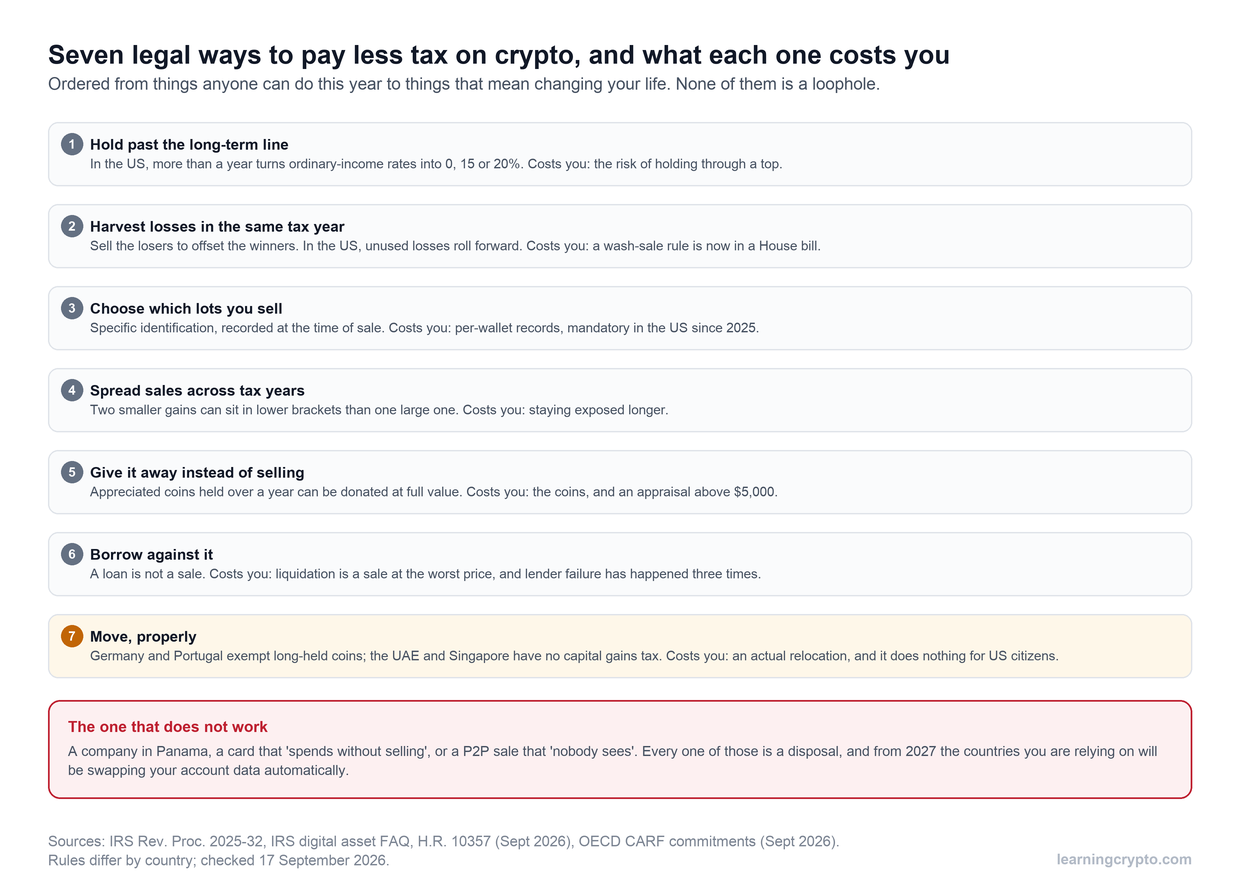
The exemption can be lost if the counterparty or platform sits in a jurisdiction with no tax agreement with Portugal, which is a reason to use a European exchange for the final sale. A proposal in the 2026 budget to scrap the 365-day exemption was rejected, so it stands for now. Our guide to legally reducing crypto taxes puts these rules next to Germany's, Switzerland's and the UAE's.
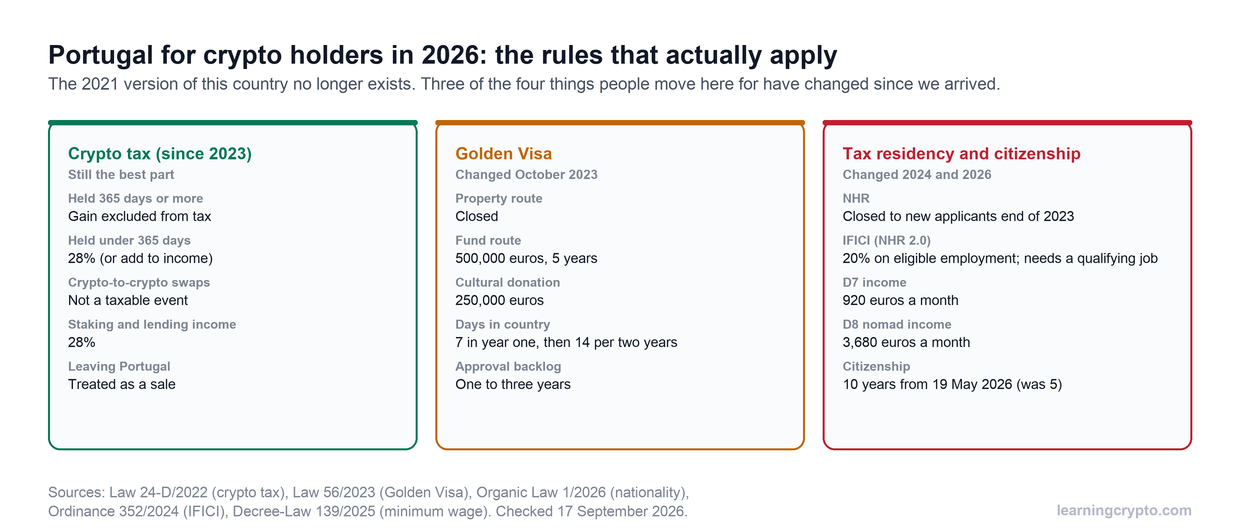
Green is why people still come. The other two columns are why the 2021 advice you may have read no longer applies.
Is the Golden Visa still available?
Yes, but not the version we used. We qualified in 2021 by buying property, which was then the standard route; that route closed in October 2023 under the "Mais Habitação" housing law. What remains:
| Route | Minimum | Notes |
|---|---|---|
| Investment fund | 500,000 euros | Regulated fund, five-year term, no real estate exposure allowed |
| Research or company capital | 500,000 euros | Company route also requires five jobs |
| Cultural or heritage donation | 250,000 euros | 200,000 euros in low-density areas |
| Job creation | No capital minimum | Ten jobs, or eight in low-density areas |
The stay requirement is light: seven days in the first year and fourteen in each following two-year period. The queue is not. Approvals now take one to three years, an ombudsman complaint was filed in 2026 on behalf of more than a thousand applicants, and hundreds are preparing litigation, according to Global Citizen Solutions. Budget for the wait, and for the funds' own fees. Maria's 2021 conversation with me below describes the programme as it was; treat it as history.
My April 2021 interview with Maria Pescadinha, recorded before the 2023 crypto tax law and the closure of the property route. Useful for how the process feels; the numbers are out of date. Watch it on our CryptoTips channel.
What replaced NHR, and does it help crypto holders?
Not much. The Non-Habitual Resident regime that made Portugal famous closed to new applicants at the end of 2023. Its replacement, IFICI, sometimes called NHR 2.0, offers a 20% flat rate for ten years on Portuguese employment or self-employment income from eligible activities: researchers, academics, qualified roles at exporting or innovation companies, startups. Foreign-source capital gains are exempt under it, but nobody has yet defined what "foreign source" means for a coin sold on an exchange, and the regime is built for people with a qualifying job, not for someone living off a portfolio. If you have such a job, apply by 15 January of the year after you become resident. If you do not, the ordinary rules above are your regime, and for long-held coins they are good ones.
Which visa do most people actually use?
The two income-based ones, because they are cheap and fast compared with the Golden Visa.
- D7, for passive income: show income of at least 920 euros a month for the main applicant, plus 460 for a spouse and 276 per child, and around a year of savings. It suits retirees and people with rental or dividend income. You must actually live here: roughly six months a year in a row or eight with gaps.
- D8, for remote workers: four times the minimum wage, so 3,680 euros a month in 2026, from work for clients or employers outside Portugal.
Both lead to the same permanent residency after five years. Neither treats crypto income as qualifying income on its own, which surprises people; a bank statement showing crypto sales is not the same as a salary or pension in the eyes of the consulate. Since 2025 you must obtain the residence visa at a consulate before entering, rather than switching status after arrival.
What happened to the five-year path to citizenship?
It ended on 19 May 2026, and we were wrong about it on camera. Through the spring, Maria's view, and mine, was that the proposal to double the residency requirement would not survive. The Constitutional Court did strike out parts of the bill in December 2025, but not the residency period, and after a revised text passed, Organic Law 1/2026 took effect in May. Naturalisation now requires ten years of legal residence, seven for citizens of EU or Portuguese-speaking countries, counted from the date your first residence permit was issued. Anyone who filed a citizenship application on or before 18 May 2026 stays under the old five-year rule. My April 2026 conversation with Maria is below; watch it for how residency renewals and permanent residency work, and read this section for the law that arrived three weeks later.
Recorded 26 April 2026 with Maria Pescadinha, before Organic Law 1/2026 passed. The advice on permanent residency, tax numbers on receipts and proving ties still stands; the conclusion that the five-year rule would survive did not. Watch it on our CryptoTips channel.
Citizenship processing itself has slowed to around three and a half years, so the practical timeline for someone arriving in 2026 is well over a decade. Permanent residency after five years is unaffected and gives you almost everything citizenship does except the passport and the vote. The law itself is on the Portuguese legislation database.
What did living here teach us?
- Say yes to the tax number on receipts. Every time a shop asks "NIF?", say yes. It is how you prove you live here when a renewal or an application asks for ties, and it gives you deductions. I said no for years out of habit.
- Renew early and, when eligible, renew to permanent. The immigration agency has been reorganised twice since we arrived and a backlog of tens of thousands built up in 2025. A residency that has expired is a problem; a permanent one is not.
- Use a registered lawyer and check the number. Every Portuguese lawyer has a bar registration you can look up. We have watched people pay "consultants" for applications that were never filed.
- Banks are conservative, exchanges are regulated. Portugal implemented MiCA in December 2024 and the transition ended in July 2026; the first Portuguese bank became a licensed crypto provider that month. Opening an account with a history of large crypto deposits still takes patience and paperwork.
- Do not assume today's rules are permanent. We assumed the five-year rule was. Keep a lawyer who reads the Diário da República, not the headlines.
If you want a residency-first plan rather than a passport, the concierge service we work with coordinates Portuguese lawyers and fund providers; our guide to citizenship by investment covers the passport route. Members can track a portfolio across exchanges and wallets with the Portfolio Tracker, which helps when the 365-day clock on each lot matters. More in the Regulation and Tax hub.
Frequently asked questions
Is crypto tax-free in Portugal?
Partly. Since 2023, gains on crypto held for 365 days or more are excluded from tax when sold for euros, and crypto-to-crypto swaps are not taxed at all. Coins held under a year are taxed at 28%, staking and lending income is taxed at 28%, and mining or professional trading is business income. Leaving Portugal counts as a sale. You must be a Portuguese tax resident for any of this to apply.
Can I still get the Portugal Golden Visa by buying property?
No. The property route closed in October 2023. The remaining routes are a 500,000 euro investment in a qualifying fund, a 500,000 euro research or company investment, a 250,000 euro cultural donation, or creating ten jobs. Stay requirements remain seven days in the first year and fourteen per two years, but approvals currently take one to three years.
How long does it take to get Portuguese citizenship now?
Ten years of legal residence under Organic Law 1/2026, in force since 19 May 2026, or seven years for EU and Portuguese-speaking-country citizens, counted from your first residence permit. Applications filed on or before 18 May 2026 keep the old five-year rule. Processing after applying currently takes around three and a half years, so plan on well over a decade in total.
Does NHR still exist in Portugal?
Not for new arrivals; it closed at the end of 2023. Its replacement, IFICI, gives a 20% flat rate for ten years on Portuguese income from eligible jobs in research, academia, startups and exporting or innovation companies, with foreign-source gains exempt. It requires a qualifying job, so a crypto investor living off a portfolio generally falls under the ordinary rules instead, which still exempt long-held coins.
What income do I need for the Portugal D7 or D8 visa in 2026?
The D7 requires at least 920 euros a month of passive income for the main applicant, plus 460 for a spouse and 276 per child, with around a year of savings in a Portuguese account. The D8 digital nomad visa requires four times the minimum wage, 3,680 euros a month, from work outside Portugal. Crypto sales are not usually accepted as qualifying income on their own.
Do US citizens in Portugal still pay US tax?
Yes. The United States taxes its citizens on worldwide income wherever they live, so Portugal's exemption on long-held crypto does not remove a US citizen's federal capital gains bill, though a tax treaty prevents double taxation of the same income. Only formally renouncing US citizenship ends the obligation, and that can carry an exit tax. Get advice on both sides before moving.
Keep learning
- How to Legally Reduce Your Crypto Taxes: What We Did and What Actually Works in 2026
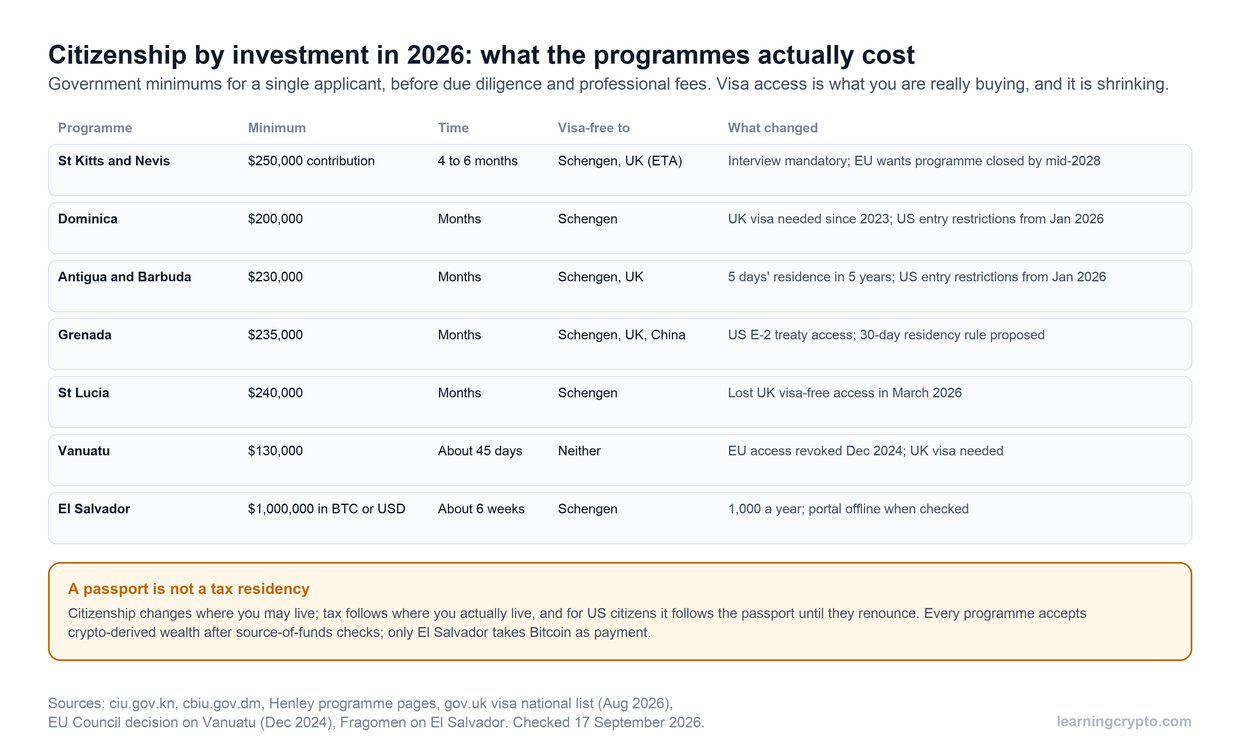
- Second Citizenship by Investment for Crypto Holders: What It Costs in 2026 and What We Learned Doing It
- A Complete Guide to Cryptocurrency Taxes
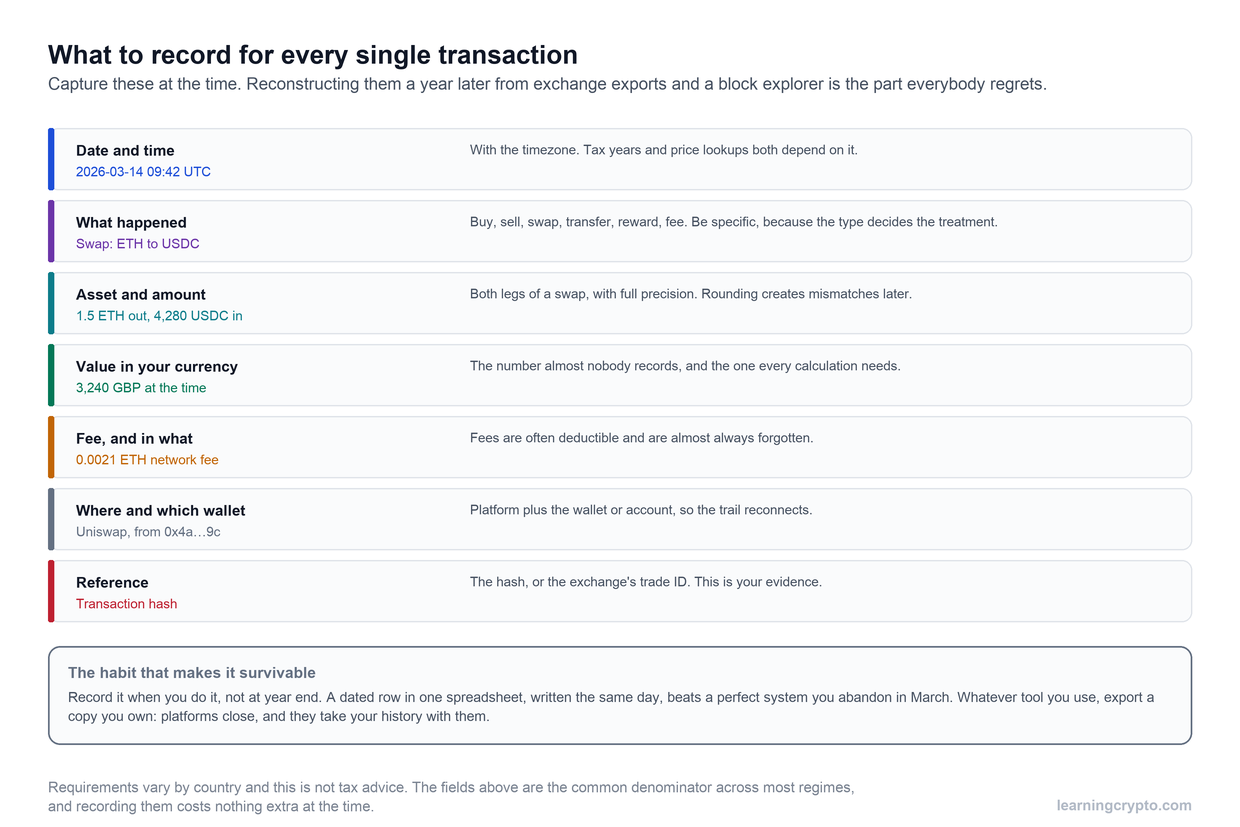
- Crypto Record Keeping: What to Track for Tax
- More guides in the Regulation & Tax hub
- Members: Portfolio Tracker, see all your wallets in one place