
This guide is general education about holding your own bitcoin, not financial, legal or tax advice. Product prices and features change, so check the maker's own site before you buy.
If your bitcoin sits on an exchange or inside an ETF and you know, deep down, that you don't really hold it, start here. By the end you will have a setup you can buy for about $100 and finish in an afternoon, a clear idea of when to move up to two devices or multisig, and a once-a-year routine that keeps the whole thing working.
Heidi builds the full self-custody stack on camera: the four layers, the three budget tiers, the ETF question and the yearly maintenance day. Watch it on our CryptoTips channel.
Why does self-custody matter more in 2026?
Because buying bitcoin has never been easier, and holding it yourself has never been more optional. The financial system didn't reject bitcoin. It wrapped it. Your uncle can buy bitcoin exposure in his brokerage account between coffee and lunch, but that wrapper strips out everything bitcoin was built to do: you can't verify it, you can't move it, and censorship resistance simply isn't part of the product.
Meanwhile the big players are taking the real thing. Strategy, the company formerly called MicroStrategy, holds more than half a million bitcoin. The 20 millionth bitcoin was mined in March 2026, so roughly 95% of all the bitcoin that will ever exist is already out there. Millions of those coins are believed to be lost for good because someone lost their keys. Institutions are consolidating hard money at record scale while most retail holders keep a login page. That's what we mean by smart money versus dumb money.
The pressure is coming from the rules too. In the EU, the MiCA rules for crypto service providers took full effect at the end of 2024, and several exchanges have restructured or pulled services since. In the US, custodial brokers now report your gross proceeds to the IRS on Form 1099-DA, starting with 2025 transactions, with cost basis reporting phased in after that. Every centralized touch point is now a reporting touch point. We cover the European side in our MiCA explainer.
What does a self-custody setup actually include?
Four layers: the wallet that holds your keys, the backup that lets you recover them, the privacy habits that stop your holdings being mapped, and the monitoring that tells you if something moves. Most people stop after the first layer, and that's where the losses happen.
Each layer has a beginner, intermediate and advanced version. You don't have to start at the top. Sovereignty is a spectrum, and you move up the tiers as your stack, your knowledge and your comfort grow.
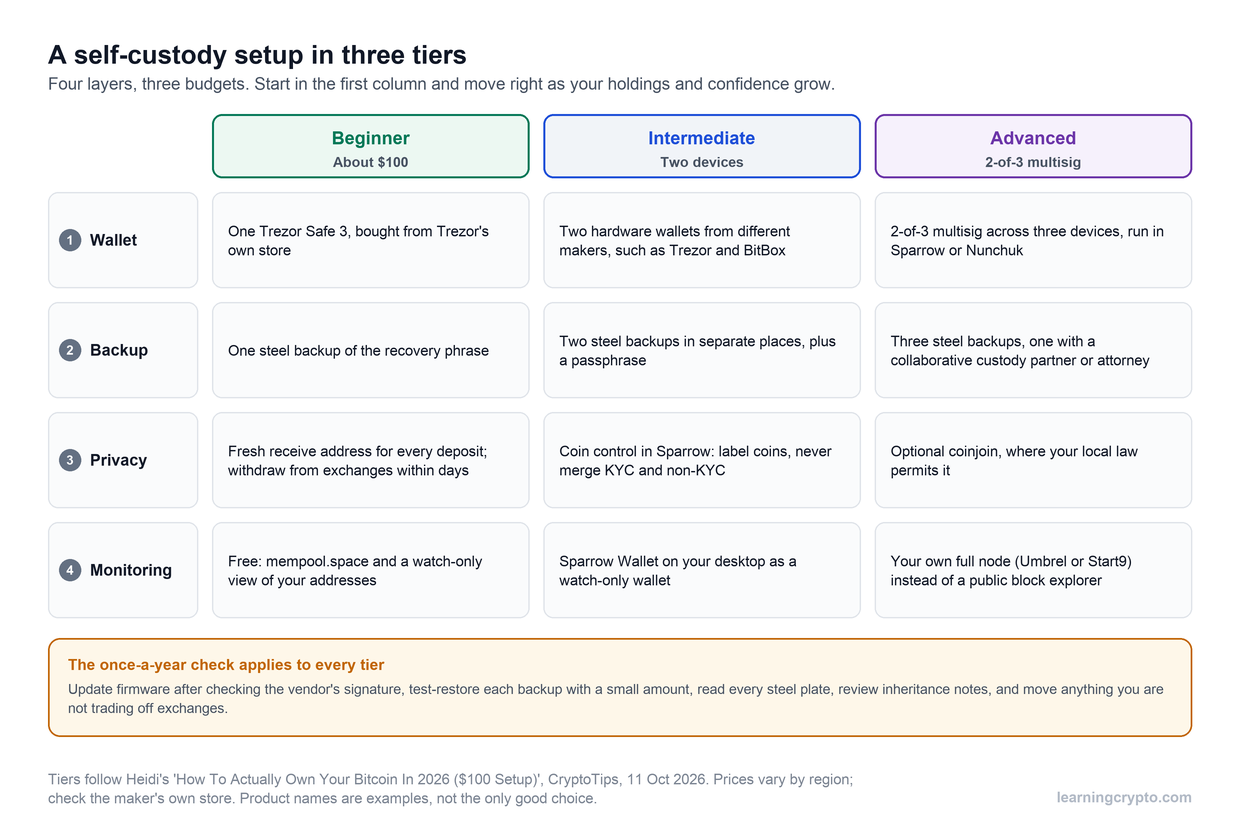
The whole stack on one page. Most people only ever need the first column; the other two are there when the amount you hold justifies them.
Which hardware wallet should you start with?
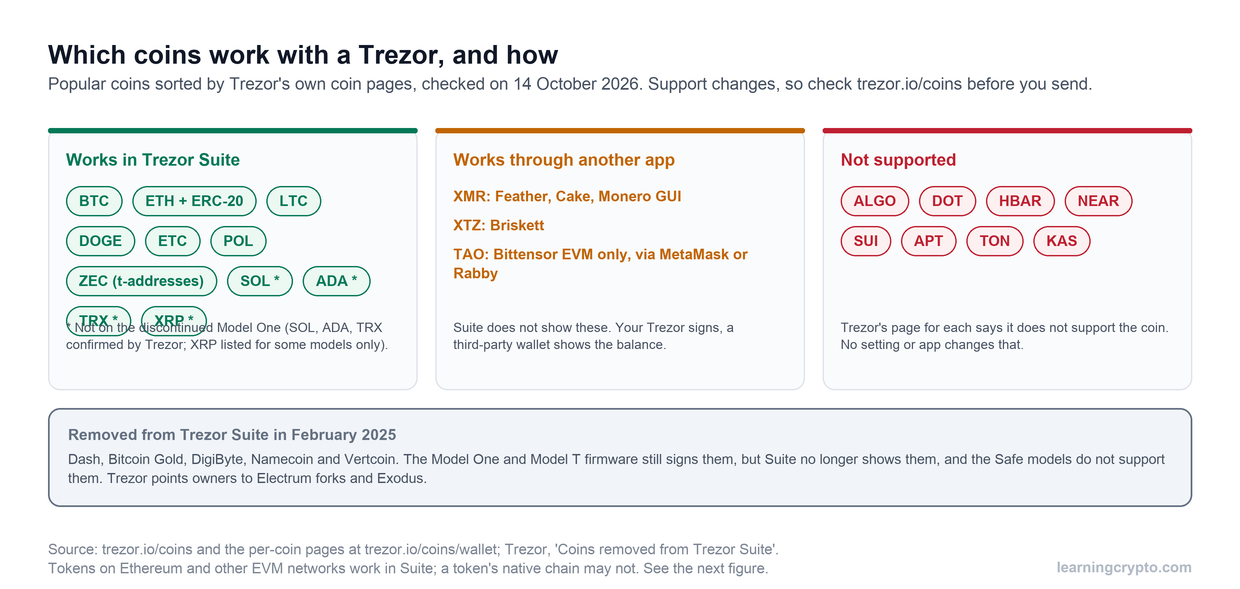
We use and recommend Trezor, and for a first device the Trezor Safe 3 is the one to buy. It lists for under $80 in Trezor's own store, its firmware is open source so independent researchers can check it, and it supports a passphrase. Buy it from Trezor's own store; that is our referral link and it costs you nothing extra. The newer Safe 7 adds an open-source secure element and a design meant to stay upgradeable as post-quantum cryptography arrives, which matters if you think in decades. If you hold bitcoin, ten years is the minimum horizon.
Ledger is the other big name. The Nano X wins on convenience and coin support, but its firmware is closed source. Ledger's history matters here as well. In 2020 its customer database leaked, and the names, phone numbers and home addresses of more than 270,000 customers were later dumped online. Those leaks didn't expose a single private key. They exposed where known bitcoin holders live, which turns a digital problem into a physical one.
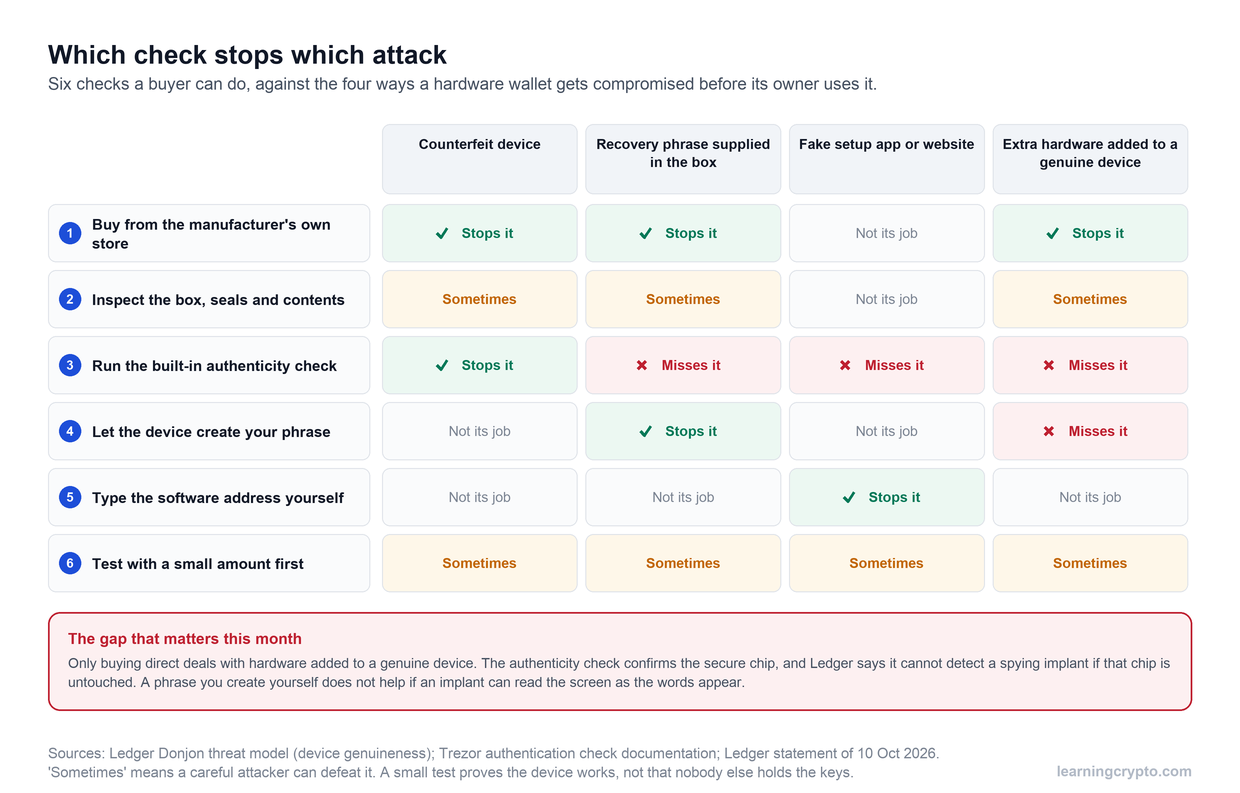
That's the reason to always buy direct from the maker, never from Amazon, a marketplace or a reseller. It's also worth remembering that the identity checks you pass on an exchange collect far more about you than any wallet maker ever did. Our Trezor vs Ledger comparison goes through the two brands in detail, and our checklist for spotting a tampered device covers what to inspect when the box arrives.
How should you back up your recovery phrase?
On steel, not paper. This is where most people quietly fail. Paper burns, floods and fades, and a wallet with no reliable backup is one dropped device away from being gone forever. Stamp or engrave the words onto a steel plate or capsule; some, such as Cryptosteel's capsules, are built to survive house-fire temperatures.
At the intermediate tier, make two steel backups and keep them in two separate, secure places: a home safe and a bank deposit box, or a home safe and a trusted family member's house. That way one fire or burglary can't wipe you out.
Here's the trade-off, and think about it carefully. Two backups halve the chance that one event destroys your only copy, but they double the number of places a thief can find your whole key. The fix is a passphrase, sometimes called the 25th word. It's an extra word or phrase you choose, which never gets stored with the seed. Done right, anyone who finds your steel plate finds an incomplete key, and that's the difference between mathematical security and hoping nobody opens the safe.
Be careful with one popular piece of advice: "keep the passphrase only in your head". If you forget it, or something happens to you, the coins are gone, and nobody can recover them. Keep a written copy of the passphrase too, stored somewhere completely separate from the seed backups. Our guide to how seed phrases work explains the 12 and 24 word standard behind all of this.
What can you still do for bitcoin privacy?
Less than you could two years ago, and we'd rather be honest about that. The toolkit got thinner. US prosecutors shut down Samourai Wallet in April 2024, and in November 2025 its two founders were sentenced to five and four years in prison. zkSNACKs, the company behind Wasabi Wallet, shut down its coinjoin coordinator on June 1, 2024, citing legal uncertainty.
What survives is Wasabi running with independent coordinators, plus community-maintained forks of Samourai's tools. The prosecutions we know of have gone after the people running the services rather than individual users, but that is not legal advice, and the rules depend entirely on where you live. If you're in the US or the EU and considering coinjoin, a conversation with a crypto-specialised lawyer or accountant is a sensible first step. It's your money and your call.
The basic habits need no special tools. Use a fresh receive address for every deposit, which every hardware wallet app does by default. Move coins off exchanges promptly so your balance isn't sitting in someone else's database. Label your coins and don't merge coins you bought with ID checks with coins you got without them. Privacy is a basic human right, not a shield for criminals, and pretending the tools are as good as they were would be dishonest. For more, see our guide to buying bitcoin without KYC.
How do you monitor your bitcoin without giving up your keys?
With a watch-only view. A stack you can't watch is a stack you can't trust, and watching needs only your public addresses, never your recovery phrase. For free, mempool.space shows any bitcoin transaction and the current fee levels, Glassnode publishes a free weekly on-chain newsletter, and Arkham lets you explore wallets and entities.
Sparrow Wallet on your desktop gives you a proper watch-only wallet, and you can also add your public addresses to our Portfolio Tracker to see your balance next to everything else you hold. Paid tools such as Glassnode's full plans or Nansen are good, but the free tier is enough for anyone building a first stack. Don't let a paid subscription become another excuse not to start.
One detail most guides skip: every time you paste your address into a public block explorer, that site learns which addresses you care about. That's fine at the beginner tier. At the advanced tier, running your own node fixes it.
What do the three setups cost?
From about $100 for the beginner tier to a few hundred dollars plus some evenings of learning for full multisig. The table shows what goes into each one.
| Tier | Wallet | Backup | Monitoring | Who it suits |
|---|---|---|---|---|
| Beginner, about $100 | One Trezor Safe 3 | One steel plate | mempool.space and the Glassnode newsletter | Most people. This is genuine self-sovereignty. |
| Intermediate | Two hardware wallets from different makers, for example Trezor and BitBox | Two steel backups in separate places, protected by a passphrase | Sparrow Wallet on your desktop | Larger holdings, or anyone worried about one maker's supply chain |
| Advanced | 2-of-3 multisig across three devices, coordinated in Sparrow or Nunchuk | Three steel backups, one held by a collaborative custody partner such as Casa or by your attorney | Your own full node on Umbrel or Start9 | Serious holdings and anyone planning inheritance |
Two makers at the intermediate tier means a flaw or a supply chain attack at one company can't take everything. At the advanced tier, any two of three keys can move the coins, so losing one device or one backup is an inconvenience instead of a disaster. A full node lets you verify the chain yourself instead of trusting a block explorer, and helps you judge fees. Our multisig guide explains how 2-of-3 works, and the crypto inheritance plan covers how your family gets access if you can't.
Is a bitcoin ETF the same as owning bitcoin?
No. A spot bitcoin ETF is a fund share, not a wallet. When you buy one, you own a share of a fund, the fund holds a custody account, and the custody account holds the bitcoin. That's three parties between you and your coins, and each one is a counterparty that can say no.
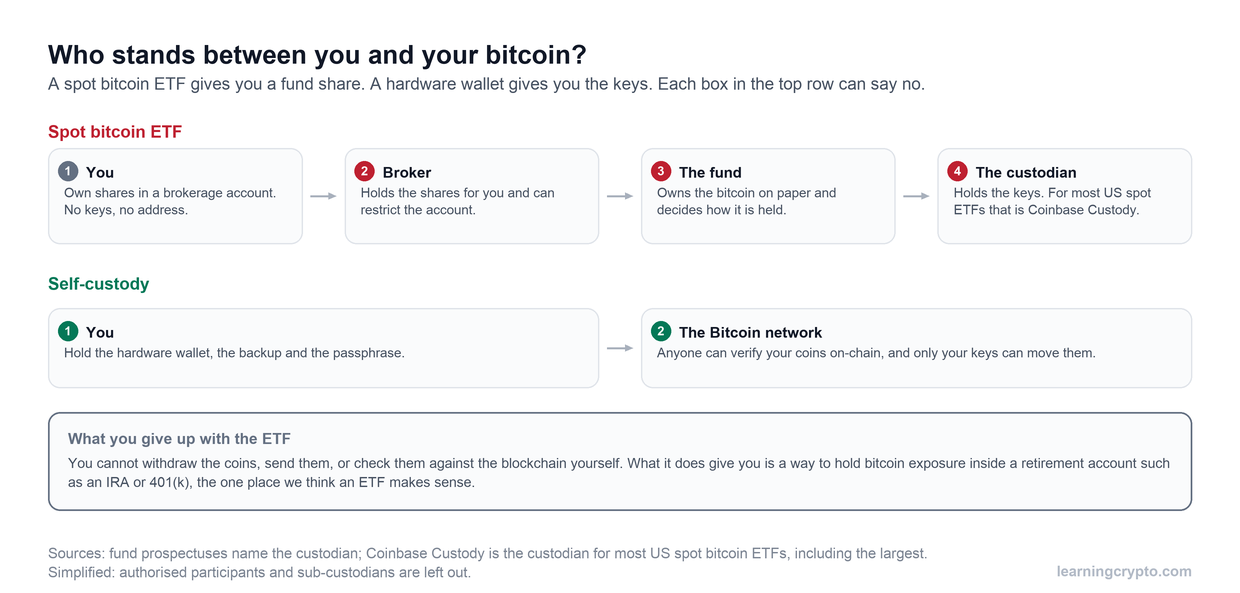
Each red box is a party that can freeze, delay or decide for you. In self-custody, the only other party is the network itself.
You can't move ETF bitcoin on-chain, because you don't have any bitcoin. You can't verify it against the blockchain either. Most US spot bitcoin ETFs, including the largest, use Coinbase Custody, which means a huge slice of institutional bitcoin sits behind one custodian. A single point of custody is a single point of control, and a single point of failure.
There is one legitimate use: retirement accounts such as an IRA or a 401(k), where holding the coins directly isn't practical. For every other dollar, buy on a reputable exchange, withdraw to your hardware wallet within minutes or days, and check the transaction on-chain. Our guide to crypto ETFs covers how they work in more detail.
What should you check once a year?
Block off one Saturday a year and run through this list. A setup you set and forget is a setup that fails the day you actually need it.
- Update firmware on every hardware wallet, using only the maker's own app, which checks the vendor's signature before installing.
- Test-restore each backup on a spare or reset device, and confirm it shows the same addresses before you trust it. Use a small amount if you want to test a send.
- Inspect the steel backups and make sure every word is still legible.
- Check the passphrase copy is where you left it, and change where it lives if anyone has learned that location.
- Review your inheritance notes so someone you trust can follow them without you.
- Audit your exchange balances and move anything you are not actively trading into cold storage.
- Refresh your monitoring so any new addresses are in your watch-only view.
That's one day a year, and you stop pretending to have sovereignty and actually have it. You don't need to be in the top 1% of technical users. You need a hardware wallet, a steel backup, a passphrase and one Saturday. If you're starting from scratch, our step-by-step cold wallet setup guide walks through the first transfer, and more custody guides sit in the Wallets and Custody hub. Don't trust, verify.
Frequently asked questions
How much does it cost to self-custody bitcoin?
About $100 for a solid starting setup. A Trezor Safe 3 lists for under $80 in Trezor's own store, and a basic steel backup plate costs roughly $20 to $40 depending on the brand. Monitoring can be free with mempool.space and a watch-only wallet. Prices vary by country, so check the maker's store. Spending more only makes sense once your holdings grow.
Is it safe to keep bitcoin on an exchange?
It is a risk you don't need to take for coins you are not trading. On an exchange you hold a claim on the company, not bitcoin, and if it is hacked, freezes withdrawals or goes bankrupt you can become an unsecured creditor waiting in line. Buy on a reputable exchange if you need to, then withdraw to a hardware wallet you control within days.
What is a bitcoin passphrase and do I need one?
A passphrase is an extra word or phrase you add to your recovery phrase, creating a separate wallet that the seed alone cannot open. It means someone who finds your seed backup still cannot take your coins. It is worth adding once you keep more than one backup. Store a copy of the passphrase separately from the seed, because forgetting it means losing the coins.
Should I use one hardware wallet or two?
One is enough to start. Two hardware wallets from different makers, such as a Trezor and a BitBox, reduce your exposure to one company's supply chain or firmware problem. At the top end, three devices in a 2-of-3 multisig mean any two can move the coins, so losing one device or one backup does not cost you anything.
Can I move the bitcoin in my ETF to a hardware wallet?
No. A spot bitcoin ETF gives you shares in a fund, not bitcoin, so there are no coins to withdraw. To hold bitcoin yourself you would sell the ETF shares, buy bitcoin on an exchange and withdraw it to your wallet. Selling may create a taxable gain in a taxable account, so check the tax position where you live first.
Is coinjoin legal?
It depends on your country, and this is not legal advice. As far as we know, enforcement so far has targeted the companies and developers running coinjoin services, such as Samourai Wallet's founders, rather than individuals using coinjoin for their own privacy. The rules are moving, especially in the US and EU, so speak to a crypto-specialised lawyer before relying on it.
How often should I test my bitcoin backup?
Once a year, and every time you create a new one. Restore the backup on a spare or reset device and confirm it shows the same receive addresses as your main wallet before you trust it. Check that steel plates are still legible and that the passphrase copy is where you left it. A backup you have never tested is a hope, not a plan.
Keep learning
- How to Use Cold Wallets for Crypto Like a Pro (Step-by-Step)
- What Is a Seed Phrase, and How Do You Secure It?
- How to Check a Hardware Wallet Is Genuine, and What the Checks Miss
- How to Set Up a Multisig Wallet: Bitcoin and Ethereum, Step by Step
- Crypto Inheritance: How to Pass On Your Crypto Safely
- More guides in the Wallets and Custody hub
- Free headlines: the Learning Crypto news feed on Telegram