
This guide is general education, not financial advice. It does not say whether any meme coin is worth buying, and nothing here is a prediction. Rules, platforms and data change, so check the sources linked below.
If you have been tempted by a meme coin, or have a relative who has, this guide is for you. By the end you will know what the label means, what protection you do and do not have, how the usual traps work, and a short set of checks to run before any money moves.
What is a meme coin?
A meme coin is a crypto token inspired by an internet meme, character, current event or trend, where the promoter tries to attract an enthusiastic online community to buy it and trade it. That is the definition used by the staff of the US Securities and Exchange Commission in its February 2025 statement on meme coins.
The same statement describes the usual traits. People buy them for entertainment, social interaction and cultural reasons, the value is driven mainly by market demand and speculation, the staff call them akin to collectibles, and they have limited or no use or functionality. They are also very volatile, and the projects often say so themselves in their disclaimers. Dogecoin is the best-known example. Dogecoin's own history page says it launched on 6 December 2013 and was originally created as a joke.
A joke can still carry real money. Every meme coin trades for whatever the next buyer will pay, and with no business or cash flow behind it, that price rests on attention alone. Attention is quick to arrive and quick to leave.
Are meme coins securities, and who protects you?
SEC staff concluded that transactions in the types of meme coins described in their statement do not involve the offer and sale of securities. The staff's reasoning is that buyers do not pool their money for a promoter to deploy, and the value comes from speculation and market mood, not from anyone's management effort. The statement adds that neither purchasers nor holders of those meme coins are protected by the federal securities laws.
Three limits matter. First, the view covers only coins that match the description, not coins that depart from it or products labelled as meme coins to avoid securities rules. The staff say they will look at the economic reality of each transaction. Second, it is a staff statement, and the statement itself says it has no legal force and that the Commission has not approved it. The SEC page was last updated on 5 May 2025, and we did not find a later change on that page, but we cannot rule out one elsewhere. Third, the statement says fraud tied to meme coins may still be pursued by other federal or state agencies under other laws.
In plain terms: if a promoter lies to you, other law may apply. If the price simply collapses, you have no securities-law protection that comes with having bought a security. Our guide to common crypto scams covers the fraud side.
How many meme coins fail?
Nobody publishes a clean failure rate for meme coins alone, but the nearest public dataset is stark. CoinGecko's research team found that 53.2% of the tokens listed on its GeckoTerminal service between July 2021 and the end of 2025 had stopped trading. That is 13.4 million of more than 25.2 million tokens. In its report, CoinGecko counts a token as failed when it is no longer actively traded.
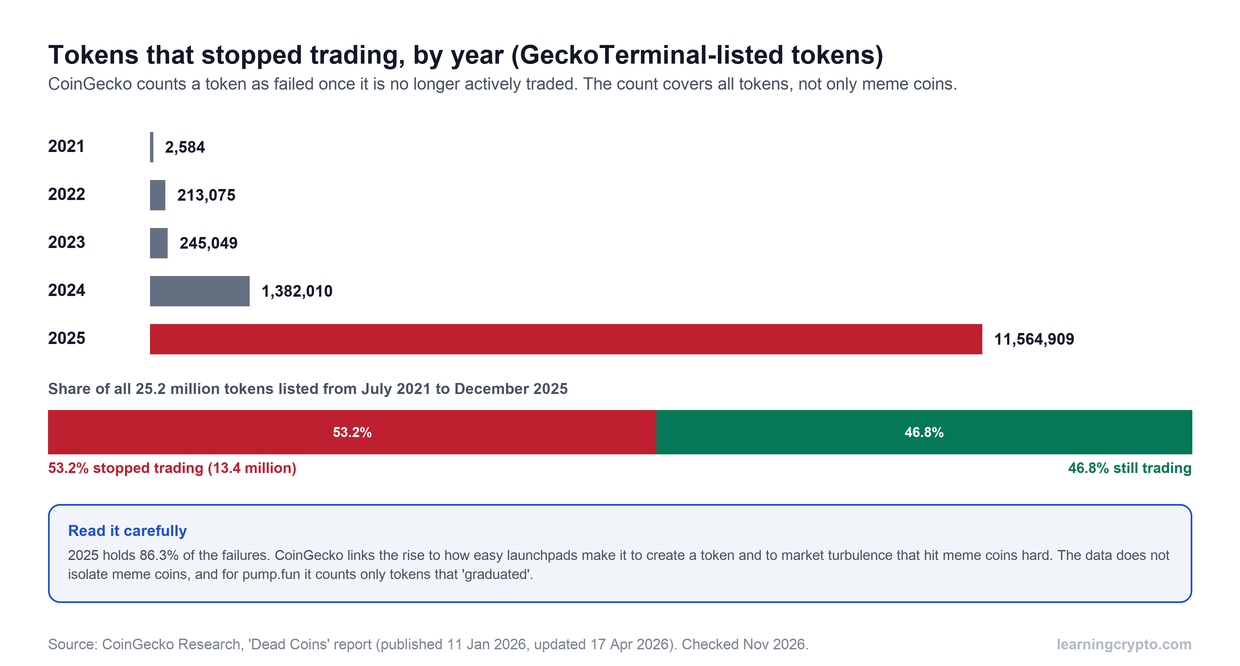
Note the sharp rise in 2025. It is CoinGecko's count of every token it tracks, not only meme coins. For pump.fun, only tokens that 'graduated' are included.
The report says 2025 alone held 86.3% of all the failures it counted. CoinGecko ties the surge to launchpads that make it easy to create a token, which brought a wave of low-effort meme coins, and to market turbulence that hit the meme coin sector hard. Its causal language is hedged ("may be linked"), and the data does not isolate meme coins, so read it as a sign of how crowded and short-lived this corner is, not as an exact meme coin failure rate. The page also gives two different totals for how many tokens were listed, which it does not reconcile.
How does a meme coin pump-and-dump work?
A pump-and-dump is organised price manipulation. The US Commodity Futures Trading Commission describes it as an old penny-stock fraud that has moved to little-known virtual currencies, coins and tokens. Anonymous organisers run chat groups or message boards, some with thousands of members, and count down to a "pump". At the signal they name the coin and the exchange. Members are urged to recruit others.
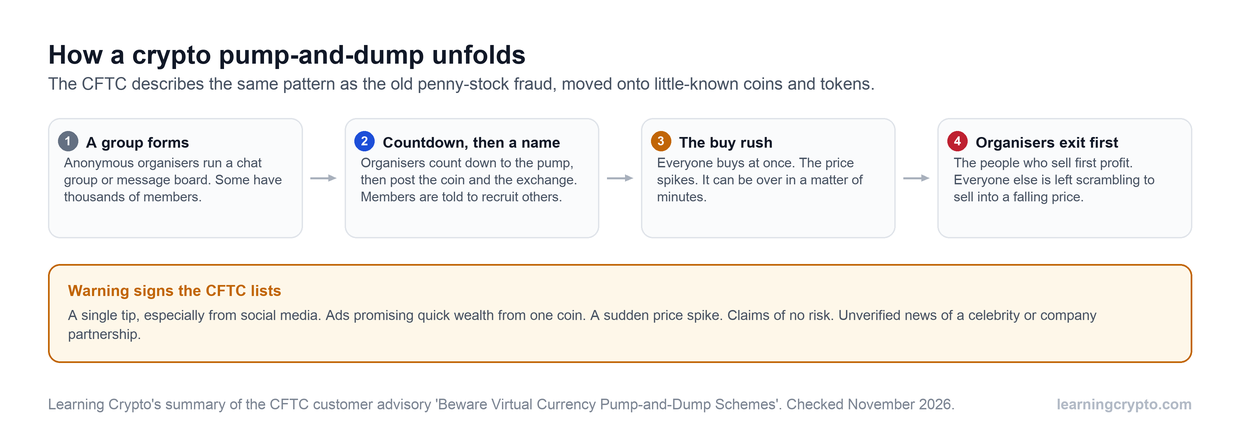
Per the CFTC, the people who exit first profit, and everyone who bought on the signal is left holding a coin with no buyers.
The CFTC says the pump can be over in a matter of minutes, and that some schemes add false stories, such as a famous investor backing a small coin or a major company partnering with it. Its customer advisory tells people not to buy coins because of a single tip, particularly one that arrives over social media, and not to take part in pump-and-dump trades, because manipulation is illegal and many participants lose money. The advisory page carries no date, so we cannot say when it was written. Our guide to pump-and-dump schemes in crypto goes deeper on the mechanics.
What other ways do meme coin buyers lose money?
Pump-and-dumps are not the only trap. These are the ones worth knowing, and the first two are not unique to meme coins:
- Rug pulls. The people who control a token's supply or its trading pool sell or withdraw and leave. Nothing about the coin needs to be fake for this to happen. The controllers simply exit.
- Honeypot contracts. The code lets you buy but blocks or penalises selling, so a rising price you cannot cash out is worth nothing. We explain the mechanism in our honeypot scam guide.
- Thin markets. A coin with few buyers can fall sharply on one large sale, and you may not be able to sell at the price on the screen.
- Chasing the move. Buying after a spike, because everyone is talking about it, is the pattern our guide to FOMO in crypto describes.
- Malicious approvals. A new token site can ask your wallet for permissions that later drain it. See our guide to token approval phishing.
How do you check a meme coin before you buy?
A block explorer lets you check the basics yourself, and a few minutes of looking removes the cheapest traps. Work through these in order:
- Get the contract address from the project's own official channel. Copycat tokens reuse names and tickers, so never rely on a search result or a link in a reply.
- Look at who holds the supply. If a handful of addresses hold most of it, a few sales can crush the price. Our blockchain explorer guide shows where to find the holder list.
- Check whether the code is published and what it can do. Can an owner create more tokens, pause trading, block certain wallets or change fees? Those powers are not always malicious, but you need to know who holds them.
- Check for a way out. Can you actually sell, and is there enough trading depth that a normal sale would not move the price much?
- Ask where the hype came from. One tip, an influencer, a celebrity link or an anonymous group is a reason to slow down, not speed up.
None of this tells you a coin will go up. It only screens out some of the ways to lose money before the market has a say. For the on-chain steps in practice, our on-chain analysis guide is a good next read.
How do you limit the damage if you still want to try one?
If you decide to hold a meme coin, treat it as money you could lose entirely, because with no cash flow behind it that outcome is on the table. These habits reduce harm without pretending to remove the risk:
- Decide the size first. Pick an amount you could lose without it changing your life, and do not add to it because it falls or rises.
- Use a separate wallet. Keep experimental tokens away from the wallet that holds your long-term savings, and keep your seed phrase offline.
- Write down an exit. Decide in advance what you will do if the price doubles or halves. Our guide to how to take profits in crypto covers the thinking.
- Be wary of anything urgent. A countdown, a limited window or a "last chance" is a pressure tactic.
- Revoke permissions you no longer need. Connecting a wallet to a new site can grant spending approvals that outlast the visit.
Members can ask Ask Crypto to explain a contract term or a tokenomics page, and the Scams and Risk hub collects our other warnings. If the case for a coin rests on a countdown, that is your answer.
Frequently asked questions
What is a meme coin in simple terms?
A meme coin is a crypto token themed on an internet joke, character or trend, sold mainly through online hype rather than a product or business. SEC staff describe them as akin to collectibles, with limited or no use, and with value driven by demand and speculation. They are bought for fun and for the chance of a price rise, and they can be extremely volatile.
Are meme coins securities?
SEC staff said in February 2025 that the types of meme coins they described are not securities, so purchasers and holders do not get federal securities-law protection. The statement has no legal force, does not cover coins that differ from the description, and says fraud may still be pursued by other agencies under other laws. Check the SEC's current position if it matters to you.
Is Dogecoin a meme coin?
Dogecoin is widely described as the original meme coin. Its own history page says it launched on 6 December 2013 and was originally created as a joke. How a coin began does not tell you how it will trade now, so the same checks and the same risk apply to it as to a coin launched last week.
How can you tell if a meme coin is a scam?
No single sign proves it, but warning signs add up: supply held by a few addresses, code you cannot read, owner powers to mint or block sales, a hype campaign led by anonymous accounts, and countdown or urgency language. The CFTC also warns against buying on one tip, a sudden price spike, or a promise of no risk. If you cannot sell a small test amount, stop.
Why do so many meme coins go to zero?
A meme coin has no cash flow or use that supports a price when attention fades, so demand can vanish while supply stays. Launching one is also cheap, which floods the market. CoinGecko counted 53.2% of tokens it tracked on GeckoTerminal as no longer trading by the end of 2025, though that dataset covers all tokens, not only meme coins.
Can you get your money back from a meme coin scam?
Often not. Blockchain transactions are generally irreversible, and organisers of pump-and-dumps and rug pulls are frequently anonymous. SEC staff note that fraud may still be pursued by other agencies, and the CFTC invites reports of suspected manipulation. Report quickly to the platform and the authorities, and be cautious about anyone offering to recover funds for a fee.
Keep learning
- Pump and Dump Schemes in Crypto: How to Spot and Avoid Them
- Honeypot Crypto Scams: How to Check a Token Before You Buy
- FOMO in Crypto: What It Is, Why It Costs Money and How to Stop Chasing Pumps
- How to Avoid Crypto Scams in 2026: The Common Scams and the Red Flags
- How to Take Profits in Crypto: The Ladder We Use Instead of Guessing the Top
- More guides in the Scams and Risk hub
- Free headlines: the Learning Crypto news feed on Telegram