
This guide is general education about investment fraud, not financial or legal advice. Regulators' warning lists change, so check your own country's list before you deal with any trading platform.
If you have seen an advert for an AI trading robot that a famous person supposedly uses, or someone close to you has signed up to one, this guide is for you. By the end you will know how the Quantum AI scam and its clones work, what regulators have said about them, the checks that expose one in minutes, and what to do if money has already gone.
Is Quantum AI a scam?
Yes. Quantum AI is a scam brand, not a trading product. The UK's Financial Conduct Authority lists it as an unauthorised firm that may be targeting people in the UK, the Central Bank of Ireland calls it a fraudulent entity, and Ontario's securities regulator and Germany's BaFin have issued warnings about it since 2022. None of them lists it as authorised.
What makes it hard to pin down is that "Quantum AI" is a name, not a company. The same sales funnel runs under new websites as soon as the old ones are reported, and it rotates through sibling names. Australia's securities regulator, ASIC, said reports to Scamwatch made Quantum AI the most prolific online investment trading platform scam brand in the country, alongside names such as Immediate Edge, Immediate Connect, Immediate X3 and Quantum Trade Wave. If the pitch matches what follows, the name on the website does not matter.
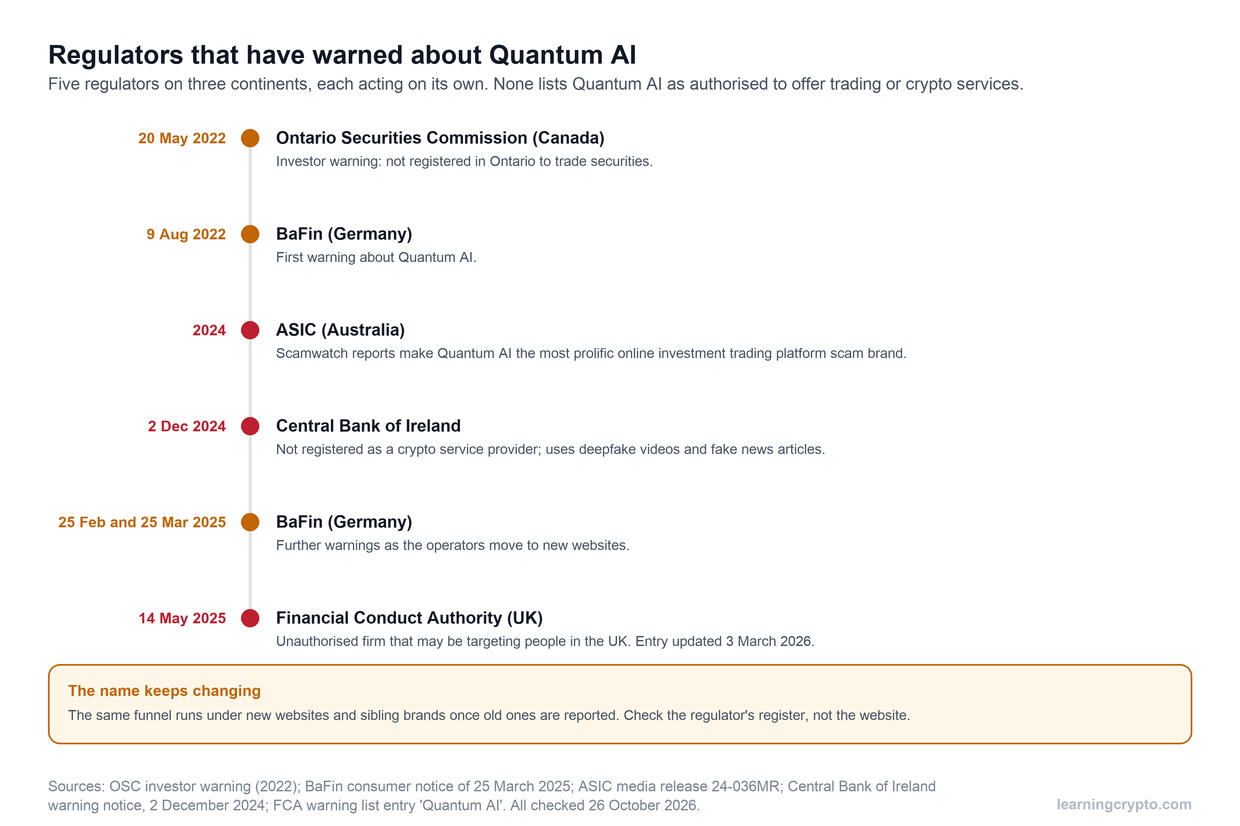
Every one of these regulators reached the same conclusion independently. None of them lists Quantum AI as authorised to offer trading or crypto services.
How does an AI trading bot scam work?
An AI trading bot scam works as a funnel with six steps, and the "bot" is only the bait in the first one. Each step is designed to move you to the next, and the money only ever flows one way.
- The advert. A sponsored post, video or fake news article shows a celebrity, a business founder or a national broadcaster "revealing" an AI system that made them rich. The Central Bank of Ireland's warning describes exactly this: AI-generated deepfake videos, fake newspaper articles and photos of high-profile people spread through social media.
- The form. The link leads to a slick page with a sign-up box asking for your name, email and phone number. That form is the real product. It turns you into a lead that is passed to a call centre.
- The account manager. Within hours someone calls, friendly and patient, to "activate" your account. ASIC describes victims being asked for a small first deposit of around $250, often by card.
- The dashboard. You get a login, or are told to download a trading app, and the balance climbs. Some victims are allowed a small early withdrawal to build trust.
- The upsell. With profits on screen, the account manager persuades you to invest more, often for a "premium" strategy or a bigger account tier.
- The exit. When you ask for your money, ASIC says the scammers ask for withdrawal fees or cite tax to get more money out of you, and some victims are simply locked out of the account.
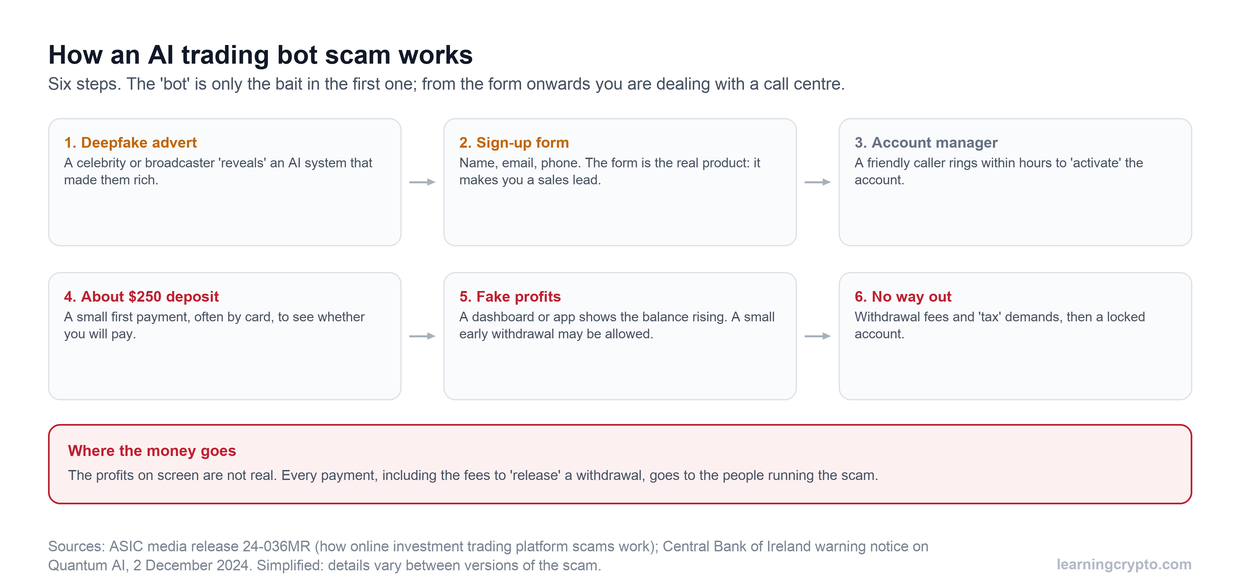
The bot is only the bait in step one. From step two onwards you are dealing with a call centre, and the profits on screen are not real.
Can an AI trading bot really make you money?
Not in the way these adverts describe. Genuine trading software exists, but it cannot promise steady profits, because no program can predict sudden market moves. The US Commodity Futures Trading Commission put it plainly in its advisory on AI trading bots: fraudsters exploit public interest in AI to sell schemes that promise unreasonably high or guaranteed returns, and AI technology cannot predict the future.
The CFTC's own case study shows the scale. Mirror Trading International, run by Cornelius Johannes Steynberg, sold a "proprietary bot trading program" that guaranteed at least 10% a month. Very little was ever traded. It was a Ponzi scheme, and the CFTC says he took more than $1.7 billion in bitcoin from at least 23,000 people. A real fund that could make 10% a month would not need to advertise on social media, and it would not need your $250.
Any product that guarantees returns, shows a win rate near 100% or promises a fixed daily or monthly profit is describing a fraud, whatever technology it claims to use. Our review of crypto trading bots covers what real automated tools can and cannot do.
What are the red flags of a fake AI trading platform?
The red flags are consistent across every brand name, which is good news: you do not need to know the name to spot the scam. One of these is enough to walk away; most scams show five or six.
| Red flag | Why it gives the scam away |
|---|---|
| A celebrity or public figure endorses it | The endorsements are fabricated, often with deepfake video. ASIC suggests checking whether the public figure has warned about being impersonated. |
| Guaranteed or fixed returns | Markets do not pay fixed returns. A promise of one is the single clearest sign of fraud in every regulator's guidance. |
| A phone call after you fill in a form | Genuine brokers do not cold-call you within hours to take a deposit. The call centre is the business. |
| Small deposit to "activate" the account | The first payment tests whether you will pay. Larger requests follow. |
| Pressure to decide today | ASIC's first piece of advice is not to feel pressured to invest. Urgency exists to stop you checking. |
| Fees, taxes or "verification" before a withdrawal | A real platform deducts fees from the balance. Asking for new money to release old money is the exit step. |
| Not on a regulator's register | Anyone offering investment services needs authorisation. A missing entry, or a name on the warning list, settles it. |
If any of this sounds familiar from other scams, it should. The same playbook drives the schemes in our guide to avoiding crypto scams, and the "friendly account manager" is a cousin of the scripts in crypto Telegram scams.
How do you check whether a trading platform is legitimate?
You check a trading platform in about ten minutes by looking it up on your regulator's register and warning list, then checking how old its website is and who is really behind it. Do this before you fill in any form, because the form alone puts you on a call list.
- Search the regulator's register by the exact firm name. In the UK use the FCA Register, and check the FCA's warning list too. Elsewhere use your national securities or financial regulator. No entry means no protection.
- Read the warning entry if there is one. The FCA's entry for Quantum AI is a good example of what a warning looks like.
- Check the domain's age. The CFTC suggests looking up the website's registration date at lookup.icann.org. A "platform with years of results" on a domain registered last month is a fake.
- Reverse-search the faces. The CFTC also suggests a reverse image search on the people shown as staff or traders. Stock photos and stolen profiles turn up quickly.
- Search the name plus "warning" and "scam". Look for results on regulators' own websites, not review sites, some of which are run by the scammers or by "recovery" firms.
- Ask someone you trust. Regulators repeat this advice for a reason: a second person who is not under the account manager's pressure sees the pattern straight away.
The same habit protects you when you buy crypto at all. Our guide to checking a crypto exchange's safety applies the same register-first approach to exchanges.
What should you do if you sent money to an AI trading scam?
Stop paying, cut contact, and report it straight away. Money already sent is rarely recovered, so the priority is to stop the second and third payments, which are often larger than the first.
- Call your bank or card provider now. Card payments and recent bank transfers can sometimes be disputed or stopped, and the bank can watch the account.
- Remove any app or software they asked you to install, change your banking and email passwords from a different device, and turn on two-factor authentication.
- Report it. In the UK report to the FCA and Action Fraud, in Australia to Scamwatch and ReportCyber, in the US to the FBI's Internet Crime Complaint Center and the CFTC. Reports are how regulators add new websites to their warning lists.
- Expect a second wave. Victims are often contacted by "recovery" firms or fake lawyers who promise to get the money back for an upfront fee. That is the same scam again. The FBI has warned about fund-recovery schemes that charge up-front fees and then disappear.
- Talk to family. These schemes rely on secrecy and embarrassment. They have taken in experienced, careful people. Saying it out loud is often what stops the next payment.
Members can ask our Ask Crypto AI privately whether a platform or a message matches a known scam pattern before they reply. More guides are in the Scams and Risk hub.
Frequently asked questions
Is Quantum AI legit?
No. Quantum AI is a scam brand. The FCA lists it as an unauthorised firm, the Central Bank of Ireland calls it a fraudulent entity that uses deepfake videos and fake news articles, and Ontario's securities regulator and Germany's BaFin have also warned about it. It runs on new websites whenever old ones are reported, so check the regulator, not the website, before trusting any version of it.
Is Quantum AI endorsed by celebrities or public figures?
They are fabricated. The Central Bank of Ireland says the scheme uses AI-generated deepfake videos, fake newspaper articles and photos of high-profile people to look legitimate, and ASIC describes fake news stories about well-known figures getting rich from trading platforms. Treat any advert where a famous person reveals a trading system as a scam, whatever the brand name.
How much money do AI trading bot scams ask for?
The first request is usually small. ASIC describes a first deposit of around $250, often by credit card, to activate an account. That figure is a hook: once the dashboard shows profits, the requests grow to larger deposits, then withdrawal fees and claimed taxes before any money can come out. The first payment is rarely the last, which is why stopping early matters.
Can I get my money back from Quantum AI?
Rarely, but act fast. Call your bank or card provider immediately, since card payments and very recent transfers can sometimes be disputed. Report the scam to your regulator and police fraud unit. Ignore anyone who contacts you offering to recover the money for a fee: the FBI has warned that fund-recovery offers charge upfront fees and disappear, and they are often run by the same people.
Are all crypto trading bots scams?
No. Legitimate automated trading tools exist, usually as software that places orders on an exchange account you control, under rules you set. What they cannot do is guarantee profits. The CFTC warns that claims of huge or guaranteed returns from AI algorithms are a hallmark of fraud. A real tool never needs you to send money to a stranger or to an account manager.
How do I check if a trading platform is regulated?
Search your national regulator's register by the firm's exact name, and check its warning list as well. In the UK that is the FCA Register and the FCA Warning List; other countries publish similar lists. Then check the website's registration date at lookup.icann.org, as the CFTC suggests. A missing register entry, a warning, or a newly registered domain each mean walk away.
Keep learning
- How to Avoid Crypto Scams in 2026: The Common Scams and the Red Flags
- Crypto Scams on Telegram: How to Spot a Fake Channel, Admin or Bot
- Fake Crypto Support Scams: How the Con Works
- How to Tell If a Crypto Exchange or Wallet Is Safe
- How AI & Bots Are Reshaping Crypto Trading in 2026
- More guides in the Scams and Risk hub
- Free headlines: the Learning Crypto news feed on Telegram