
This guide is general education, not financial advice or a trading signal. Trading crypto can lose you money quickly, including more than you put in if you use leverage. Tax examples refer to US federal rules and may not apply to you.
If you have heard the term swing trading and wondered whether it is a sensible middle ground between day trading and simply holding, this guide is for you. By the end you will know how a swing trade is put together, what it costs once fees and tax are counted, where the risks hide, and how to decide whether it belongs anywhere near your money.
What is swing trading in crypto?
Swing trading is trying to profit from one price move that plays out over days or weeks, then exiting. Fidelity's learning centre describes it as trying to profit from market swings of a minimum of one day and as long as several weeks. The same idea applies to Bitcoin, Ether or any other coin you can buy and sell on a spot market.
A swing trader is not betting on where a coin will be in five years. The question is narrower: is this coin likely to move from here to there in the next couple of weeks, and where is the idea proved wrong? That narrowness is the appeal, and it is also the problem, because short-term moves in crypto are noisy.
How is swing trading different from day trading and long-term holding?
Mainly in how long you hold and how often you have to act. The table sets the three approaches side by side.
| Approach | Typical holding time | What you are trying to catch | Main drag on results |
|---|---|---|---|
| Day trading | Minutes to hours, nothing held overnight | Intraday moves | Costs on many trades, stress, leverage |
| Swing trading | About a day to several weeks | One leg of a move | Fees and slippage, overnight gaps, short-term tax |
| Long-term holding or DCA | Months to years | The long-run trend | Deep drawdowns you have to sit through |
The SEC's investor guide to day trading, written in 2005 for stocks, says true day traders hold nothing overnight because prices can change radically from one day to the next. Swing traders accept exactly that overnight risk in exchange for fewer trades. If the long-term end of the table suits you better, our guide to dollar cost averaging covers that approach.
How does a swing trade work, step by step?
Every swing trade worth the name is a written plan before it is a click. The plan has five parts.
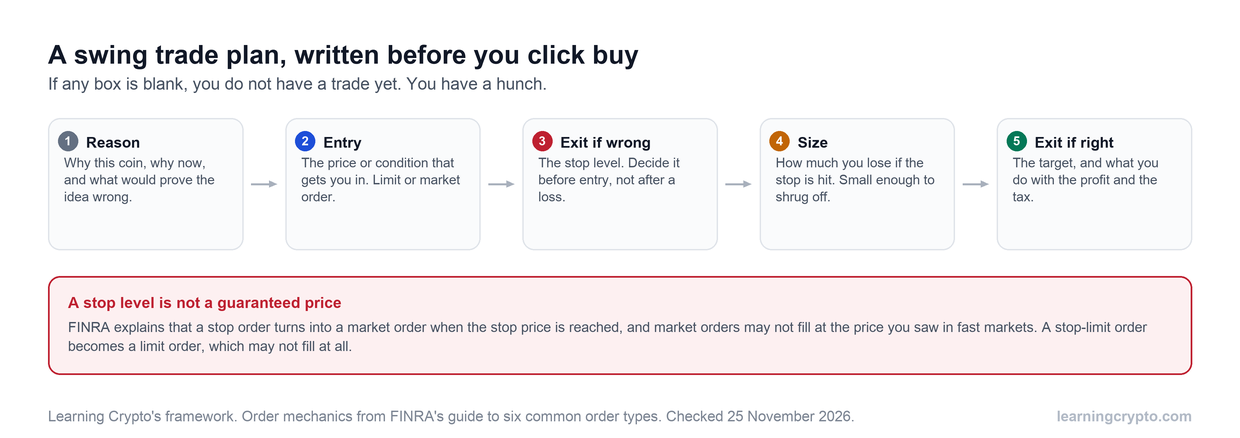
If you cannot fill in all five boxes before you buy, the trade is a guess. The red box is the one most people leave blank.
- Reason. Why this coin, why now, and what would prove the idea wrong.
- Entry. The price or condition that gets you in, and whether you use a limit or market order.
- Exit if wrong. The level where you accept the idea failed and sell.
- Size. Work backwards from the loss you can take. If the stop is 10% below your entry and you are willing to lose $100, the position is $1,000. These numbers are an illustration, not a recommendation.
- Exit if right. Where you take profit, and what you do with it afterwards.
Afterwards, write down what happened and why. Without a record of every trade you cannot tell skill from luck, and you will need the same record for tax. A lot of traders use chart patterns and indicators to pick entries; our guide to spot trading crypto covers the basic order types you will use on an exchange.
What does a swing trade really cost?
More than the fee on the screen. Every round trip pays a fee to get in and another to get out, loses something to the spread between buy and sell prices, and can fill at a worse price than expected. In a taxable account a winning trade then owes tax.
The chart below shows why costs matter so much for short-term trading. R is your planned gain divided by your planned loss. With no costs at all, a trade aiming to make as much as it risks (R of 1) must win half the time just to break even. If costs eat the equivalent of 20% of the amount you risk on each round trip, the break-even win rate rises to 60%.
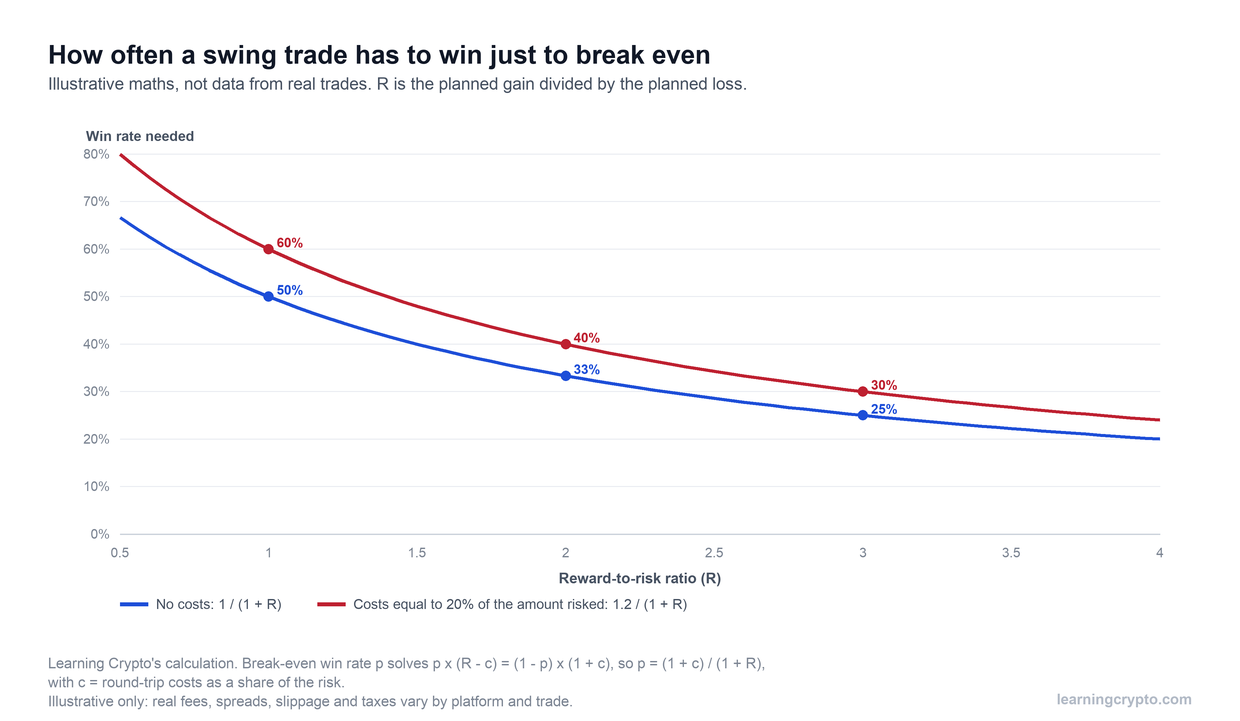
Illustrative maths, not real trade data. Costs push the whole curve up, and the effect is largest on trades with small targets.
Two things follow. Small targets are expensive, because costs are a bigger share of a small move. And a high win rate is not the goal in itself: a strategy that wins 60% of the time can still lose money if the losers are bigger than the winners. Neither line includes tax.
Why doesn't a stop-loss always protect you?
Because a stop level is a trigger, not a guaranteed price. FINRA's guide to common order types explains that when a stop price is reached, the order turns into a market order. It also warns that a market order might not get the price you saw, especially in fast-moving markets.
A stop-limit order trades one risk for another. FINRA describes it as a stop that triggers a limit order instead, and a limit order only executes at your limit price or better, so there is a chance it does not execute at all. In a sharp drop, a stop-limit can sit unfilled while the price keeps falling.
Crypto adds its own twist. The CFTC's advisory on virtual currency trading lists volatile price swings and flash crashes among the risks of crypto cash markets. A swing trader holds through nights and weekends, so a stop placed at a sensible level can still fill well below it after a sudden move.
What are the biggest risks of swing trading crypto?
The same advisory is a useful checklist. Beyond volatility, it warns that most crypto cash markets are not regulated or supervised by a government agency, that platforms may lack customer protections, that hacking and phishing are real risks, and that there is no assurance of recourse if your crypto is stolen. Its plainest line is that there is no such thing as a guaranteed investment or trading strategy.
Active trading also means leaving coins on an exchange, because you cannot trade quickly from a hardware wallet. That is custody risk on top of market risk. Check any platform first with our guide to checking crypto exchange safety, and keep long-term holdings off it.
Then there is the human side. The SEC's day trading guide says day traders typically suffer severe financial losses in their first months, pay high expenses, and describes it as extremely stressful. Swing trading is slower, but the same pressures apply in milder form: watching positions overnight, moving stops after the fact, and chasing a loss back. Our piece on FOMO in crypto covers the impulse that ruins most plans.
Should you use leverage for swing trades?
For most people, no. The CFTC advisory says leverage amplifies the underlying risk and that traders may lose more than their initial investment. Holding a leveraged position for days also means exposure to liquidation on any overnight spike, and margin or funding costs while you wait.
If you want to understand the mechanics before deciding, our guide to crypto margin trading explains margin calls and liquidation in detail. A swing trade that only works with borrowed money is usually a trade that is too large.
How are swing trading profits taxed?
In the US, almost always as short-term gains. The IRS Topic 409 page says an asset held one year or less produces a short-term gain or loss, and net short-term gains are taxed as ordinary income. By definition, swing trades rarely reach a year.
Many trades also mean many lines on your return. Since 2025, US brokers report crypto sales on a new form, which we explain in Form 1099-DA explained. Other countries treat trading gains in their own ways, so check your own tax authority's rules before you start, not after.
Is swing trading crypto right for you?
Ask yourself honestly before risking a dollar:
- Can you write the five-part plan for every trade, and stick to the exit when it is hit?
- Is the money you trade money you could lose entirely without changing your life?
- Do you have time to check positions most days, including after bad news?
- Will you keep a record of every trade for performance and tax?
- Would a simple long-term plan beat your results after costs?
If the answer to the last question is probably yes, that is useful information, not a failure. Members can ask Ask Crypto to explain an order type, an indicator or a term before they use it, and the Analysis hub has more on reading markets. Whatever you decide, decide it before the market is moving.
Frequently asked questions
What is swing trading in crypto?
Swing trading is holding a crypto position for roughly a day to several weeks to profit from a single price move, then selling. It sits between day trading, where nothing is held overnight, and long-term holding. A swing trade is planned around an entry, a stop level where the idea is proved wrong, a position size and a profit target.
Is swing trading crypto profitable?
It can be for some people, but there is no guarantee, and costs make it harder than it looks. Each round trip pays fees, the spread and possible slippage, and in the US short-term gains are taxed as ordinary income. A strategy needs a high enough win rate or large enough winners to clear those costs. The CFTC warns there is no guaranteed trading strategy.
How long do swing traders hold crypto?
Usually from about one day to several weeks. Fidelity's definition of swing trading uses the same range for any market. The holding period is long enough that positions stay open overnight and over weekends, which exposes the trader to sudden price gaps, but short enough that gains are almost always short-term for tax purposes in the US.
Is swing trading better than day trading?
It is slower and involves fewer trades, so it usually carries lower total costs and less screen time than day trading. It swaps intraday noise for overnight risk, because positions stay open while you sleep. Neither approach is safe. The SEC says day traders typically suffer severe losses early on, and the same pressures apply to swing traders in milder form.
Does a stop-loss guarantee my exit price?
No. FINRA explains that a stop order becomes a market order once the stop price is reached, and market orders may fill at a worse price in fast markets. A stop-limit order becomes a limit order instead, which protects the price but may not fill at all. In a sudden crypto crash either type can leave you worse off than planned.
How are crypto swing trades taxed in the US?
The IRS treats crypto as property, so each sale is a capital gain or loss. Assets held one year or less give short-term results, and net short-term gains are taxed at ordinary income rates. Since 2025, US brokers report crypto sales on Form 1099-DA, but you report every trade yourself on Form 8949 whether or not you receive one.
Keep learning
- Spot Trading in Crypto: What It Is and How It Works
- A Complete Guide to Crypto Margin Trading
- What Is DCA in Crypto? Your Complete Guide to Dollar Cost Averaging
- How to Take Profits in Crypto: The Ladder We Use Instead of Guessing the Top
- Form 1099-DA Explained: What the New Crypto Broker Tax Form Shows for 2025 and 2026
- More guides in the Analysis hub
- Free headlines: the Learning Crypto news feed on Telegram