
This guide is general education, not financial advice. It does not tell you what to buy or sell.
If you have ever opened a chart, seen a coin up sharply, and felt you had to buy before it was too late, this guide is for you. By the end you will recognise the signs of FOMO, understand what it has cost buyers before, and have a short routine that gives you time to decide calmly.
What is FOMO in crypto?
FOMO, short for fear of missing out, is the anxiety that others are gaining from something you are not part of. In crypto it is the urge to buy an asset because its price has jumped and everyone seems to be talking about it, rather than because it fits your plan.
The idea is not unique to crypto. Wikipedia's entry on fear of missing out describes it as a general worry about missing something that could improve your life, and notes that it plays a major role in crypto investing, where people fear missing the next get-rich-quick coin. Crypto trades around the clock and prices can move fast, so the pressure never switches off.
What are the signs of FOMO?
A reason to buy that rests on what other people are doing, or on what the price just did, is the clearest sign. If you cannot explain the purchase without mentioning someone else's gains, it is probably FOMO.
- The urge to act now. A deadline, real or imagined, such as "before it breaks out".
- An amount decided in a rush. Larger than you would pick on a calm day.
- The idea came from a feed. A post, a reply or a stranger with an urgent tone.
- No exit. You have not written down when you would sell, or when you would admit you were wrong.
- Checking the price again and again, and feeling worse each time it rises without you.
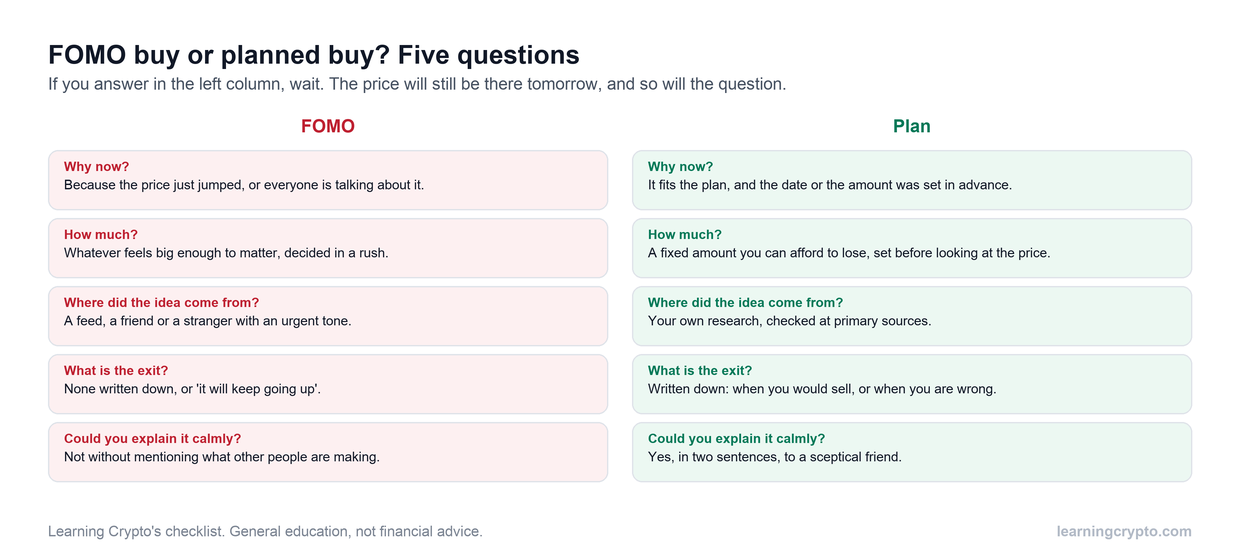
Answer these five questions before any purchase. If most answers fall in the FOMO column, wait. The price will still be there tomorrow, and so will the question.
Why does FOMO make people lose money?
FOMO makes people buy after a move has already happened, in a hurry, with no plan to sell. That combination means they often buy near a short-term top and then sell in fear when the price falls back, locking in the loss.
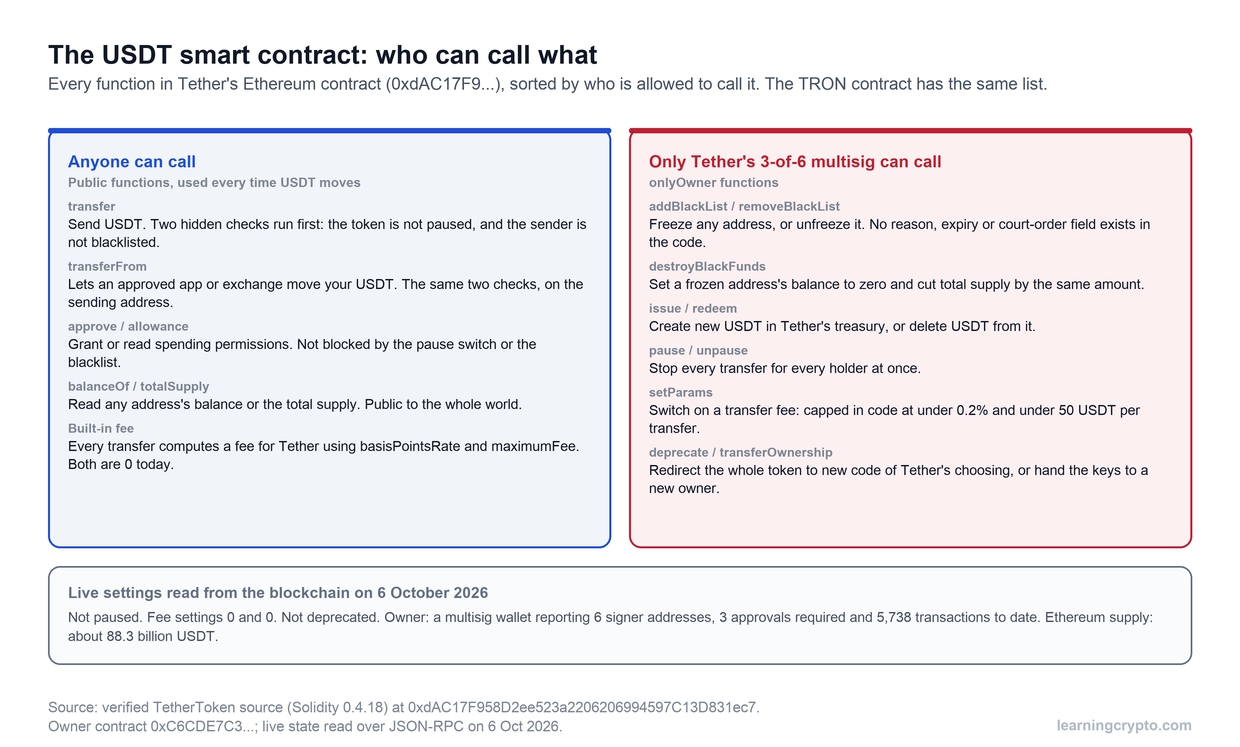
It is also what scams feed on. Wikipedia's article on FOMO links it to pump-and-dump schemes in crypto, and our guide to pump and dump schemes shows how organisers use a sudden price spike and loud promotion to bring in late buyers. Urgency is a tactic. A genuine opportunity does not disappear in the next ten minutes, and the crypto scams guide lists other lines that rely on the same pressure.
What did chasing the 2017 peak look like?
Buying near the December 2017 high was one of the costliest FOMO episodes in Bitcoin's history. According to the price table in Wikipedia's History of bitcoin, Bitcoin reached an all-time high of about $19,783 on 17 December 2017. By 7 December 2018 it had briefly dipped below $3,300.
That is roughly 83% lower in under a year, by our arithmetic from those two prices. Someone who bought at the peak needed a gain of about six times from that level just to get back to even. Anyone who sold into that slump locked the loss in. The lesson is about the entry and the plan, not about what Bitcoin did afterwards.
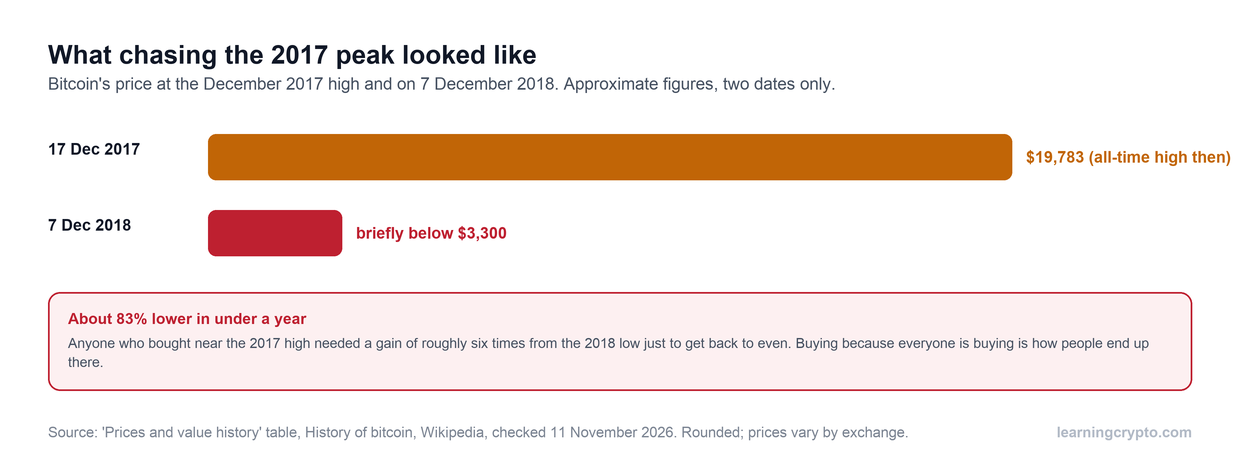
Two dates only, approximate figures from Wikipedia's History of bitcoin. Prices vary by exchange. Past prices say nothing about what happens next.
How do you stop FOMO buying?
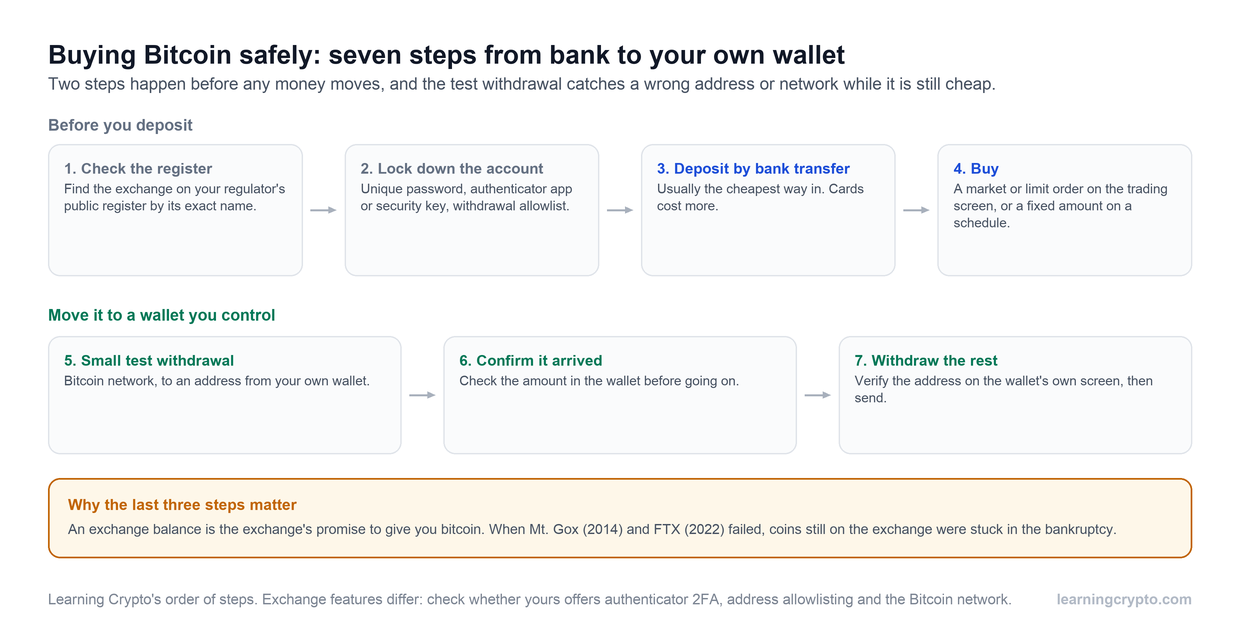
Decide before you look at the price. A rule written on a calm day beats willpower in the middle of a rally. These five steps are a routine, not a guarantee.
- Set a fixed amount in advance. An amount you could lose without it changing your life. Our guide to how much to invest in crypto per month helps you pick one.
- Buy on a schedule, not on a headline. Regular, equal purchases, known as dollar-cost averaging, take the "is it too late?" question out of each buy.
- Write down why, and what proves you wrong. One or two sentences, before you buy. If you cannot, wait.
- Use a cooling-off period. Sleep on it. One simple rule is 24 hours between spotting an idea and acting; the exact length matters less than having one.
- Plan the exit. Decide when you would take profits. Our guide to how to take profits in crypto covers common approaches.
Is FOMO worse in a bull run?
It is usually stronger when prices have been rising for a while, because gains are visible everywhere and the cost of waiting feels high. That is also when late buyers are most exposed, since the move may be well advanced. Our article on what a crypto bull run is explains the usual stages and why no one can time the end of one.
The same pressure shows up in reverse during a crash, as the urge to sell everything at the bottom. Both are emotion making the decision for you, and the same fixes apply: a plan written in advance and an amount you can live with.
What should you do instead of chasing a coin?
Do the research you would do on a calm day, and treat the rally as information, not an instruction. Check what the asset does, who controls it, and whether you can sell it easily. Our guide to honeypot tokens shows one way a hyped token can trap buyers.
If you track your holdings in one place, your actual allocation is easier to compare with your plan, and the Learning Crypto Portfolio Tracker is one option. More guides on the basics are in the Fundamentals hub.
Frequently asked questions
What does FOMO mean in crypto?
FOMO stands for fear of missing out. In crypto it means feeling pressure to buy an asset because its price is rising and others seem to be profiting, rather than because it fits your plan. It often leads to buying late, in a hurry, with no exit. Recognising the feeling is the first step to pausing before you act.
Is FOMO a scam tactic?
It is a lever scammers pull. Pump-and-dump organisers and fake investment promoters create urgency, such as a countdown or a claim that a price is about to jump, so people buy before they think. Wikipedia links FOMO to pump-and-dump schemes in crypto. A genuine opportunity will survive a day of checking; a scam depends on you not checking.
How do I stop FOMO buying crypto?
Decide before you look at the price. Set a fixed amount you can afford to lose, buy on a schedule rather than a headline, write down why you are buying and what would prove you wrong, wait a set time such as 24 hours, and plan your exit. If you cannot explain the purchase calmly in two sentences, wait.
Does dollar-cost averaging help with FOMO?
It can help, because regular purchases of equal size remove the decision about whether now is the right moment. You buy on a set date whatever the price is doing. It does not guarantee a profit or protect against falling prices, but it makes it harder to pour in a large sum at a peak because the market feels exciting.
Is it too late to buy after a big rally?
Nobody can say, and "too late" is the FOMO talking. A rally does not tell you what happens next, and prices can fall as fast as they rose. The better question is whether the purchase fits your plan, your amount and your exit. If it does not, missing it costs nothing, and another opportunity will arrive.
What happened to people who bought Bitcoin at the 2017 peak?
Bitcoin reached about $19,783 on 17 December 2017, according to Wikipedia's History of bitcoin, and briefly dipped below $3,300 on 7 December 2018, roughly 83% lower by our arithmetic. Buyers near the peak faced large paper losses within a year, and those who sold into the slump locked them in. This is history, not a forecast, and past prices do not predict future ones.
Keep learning
- Pump and Dump Schemes in Crypto: How to Spot and Avoid Them
- What Is DCA in Crypto? Your Complete Guide to Dollar Cost Averaging
- How Much To Invest In Crypto Monthly? [A Quick Complete Guide]
- How to Take Profits in Crypto: The Ladder We Use Instead of Guessing the Top
- What Is a Crypto Bull Run and When Is the Next One Coming?
- More guides in the Fundamentals hub
- Free headlines: the Learning Crypto news feed on Telegram