
This guide is general education about US federal reporting rules, not tax or legal advice. Rules and forms change, and your situation may differ, so check the current IRS pages linked below or ask a qualified tax professional. Nothing here applies outside the United States.
If a crypto exchange has sent you, or is about to send you, a Form 1099-DA and you want to know what it means, this guide is for you. By the end you will know what the form reports for 2025 and 2026 sales, why parts of it may be blank, what it never covers, and how to check it against your own records before you file.
What is Form 1099-DA?
Form 1099-DA is the information return US digital asset brokers use to report customers' sales to the IRS and to the customer. The IRS page for the form says it is used to report digital asset proceeds from broker transactions. One copy goes to the IRS and one to you, so the IRS can compare what your broker reported with what you file.
The IRS instructions define a broker as anyone who, in the ordinary course of a trade or business, stands ready to effect sales of digital assets for others. That covers the custodial exchanges and apps most people buy through. Generally only a US broker files the form, so an account with an offshore platform may not produce one, which does not change whether you owe tax.
When did brokers start sending 1099-DA forms?
With sales made in 2025. The IRS digital assets page says broker reporting applies to transactions on or after 1 January 2025. The first forms covered the 2025 tax year, and the IRS general instructions for information returns set 17 February 2026 as the date brokers had to furnish those statements to customers.
For 2025 sales the form centres on one number: gross proceeds. The Instructions for Form 1099-DA tell brokers to enter the gross proceeds in box 1f, reduced by transaction costs such as fees and commissions. Brokers were not required to report what you originally paid for those coins.
That is the gap that caught people out. A form showing large proceeds and no cost basis can look, at a glance, as though the whole amount is profit. It is not. Your gain or loss is still proceeds minus your basis, and the basis comes from your own records.
What changes for sales in 2026?
Cost basis starts to appear. The IRS digital assets page says brokers must report basis on certain transactions effected on or after 1 January 2026. The instructions explain which ones: covered securities, meaning digital assets acquired after 2025 and held in a custodial account the broker runs.
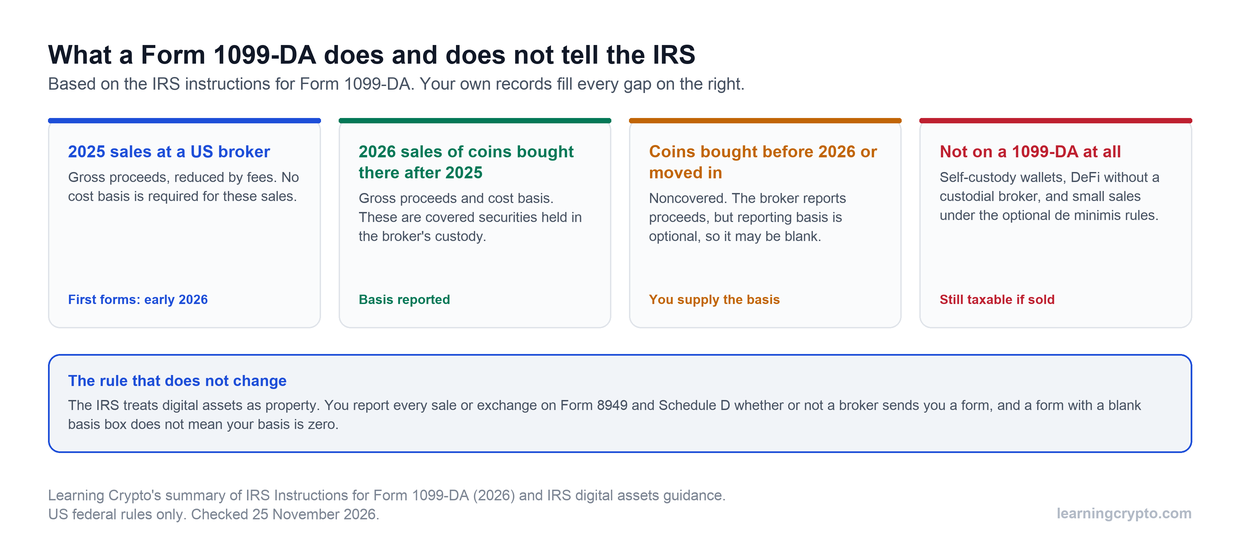
The further left a sale sits, the more the form tells the IRS. Anything in the right two cards depends on the records you kept yourself.
So a coin you buy on an exchange in 2026 and sell there later in 2026 should arrive on your next form with both numbers filled in. The holding period still matters for the rate: the IRS Topic 409 page says a gain on an asset held one year or less is short-term, and net short-term gains are taxed as ordinary income.
Why does my 1099-DA show no cost basis?
Usually because the coins are noncovered. The instructions list several kinds: assets acquired before 2026, assets the broker did not hold in custody when they were acquired, and assets transferred in from somewhere else. For noncovered sales, reporting basis is optional for the broker.
Transfers are the common trap. Say you bought Bitcoin on one exchange in 2021, moved it to a hardware wallet, then sent it to a second exchange to sell. The second exchange has no record of what you paid, so it can report the proceeds and leave the basis blank. That blank is not a zero. Your purchase records from 2021 are what prove the real gain.
Our guide to crypto record keeping sets out what to keep and for how long, and our guide to crypto taxes covers which moves count as a sale in the first place.
Which sales are left off a 1099-DA?
Some small ones, under optional rules the broker can choose to use. The instructions describe three thresholds:
| Type of sale | Broker may skip reporting when |
|---|---|
| Qualifying stablecoins (optional method) | Your total gross proceeds for the year are $10,000 or less |
| Specified NFTs | Your total gross proceeds for the year are $600 or less |
| Payment sales through a processor | Your total for the year is $600 or less |
None of this changes what is taxable. A sale the broker did not report is still a sale. The IRS digital assets page says transactions must be reported whether or not they result in a taxable gain or loss. If you use stablecoins often, our explainer on what a stablecoin is covers why swapping into one can still be a disposal of the coin you gave up.
Does 1099-DA cover DeFi and self-custody wallets?
No. The IRS digital assets page says the final regulations do not include reporting requirements for brokers commonly known as decentralised or non-custodial brokers that do not take possession of the digital assets. A separate rule written for some DeFi front ends was overturned by Congress: according to the House Ways and Means Committee, the President signed H.J.Res.25, a Congressional Review Act resolution repealing it, on 10 April 2025.
That means trades you make from your own wallet generally produce no 1099-DA. It does not make them invisible or untaxed. The tax rules apply to the trade, not to whether someone sent you a form. People who hold their own Bitcoin have every reason to keep their own records, because nobody else is keeping them.
Moving coins between wallets you own is a different matter. The IRS digital assets page says you can answer "No" to the digital asset question on your return if you only moved assets between your own wallets, unless you paid a fee in digital assets for the transfer. FAQ 53 on the IRS digital asset FAQs adds that fees for moving between your own wallets or accounts are not treated as transaction costs of a sale.
What do you still have to report yourself?
Everything. The form is a cross-check for the IRS, not your tax return. The core rules from the IRS pages:
- Property, not currency. The IRS says digital assets are property for US tax purposes, so selling, swapping or spending them can create a capital gain or loss.
- Form 8949 and Schedule D. Sales of capital assets go on Form 8949, which feeds Schedule D. The 1099-DA box codes point to those forms.
- The digital asset question. Every Form 1040 filer answers yes or no. Receiving crypto as payment, rewards or airdrops, or disposing of it, means yes.
- Holding period. FAQ 50 says the period starts the day after you acquired the asset. One year or less is short-term; more than one year is long-term.
- Fees. FAQ 52 says the amount realised is reduced by transaction costs, and FAQ 56 says purchase costs add to basis.
- Losses. Topic 409 limits a net capital loss to $3,000 a year ($1,500 if married filing separately) against other income, with the rest carried forward.
Mining, staking and other income go elsewhere on the return. Our guide to crypto mining taxes covers the mining side.
How do you check a 1099-DA against your own records?
Match it line by line before you file, and start early. If the form and your return disagree, the IRS sees the form first.
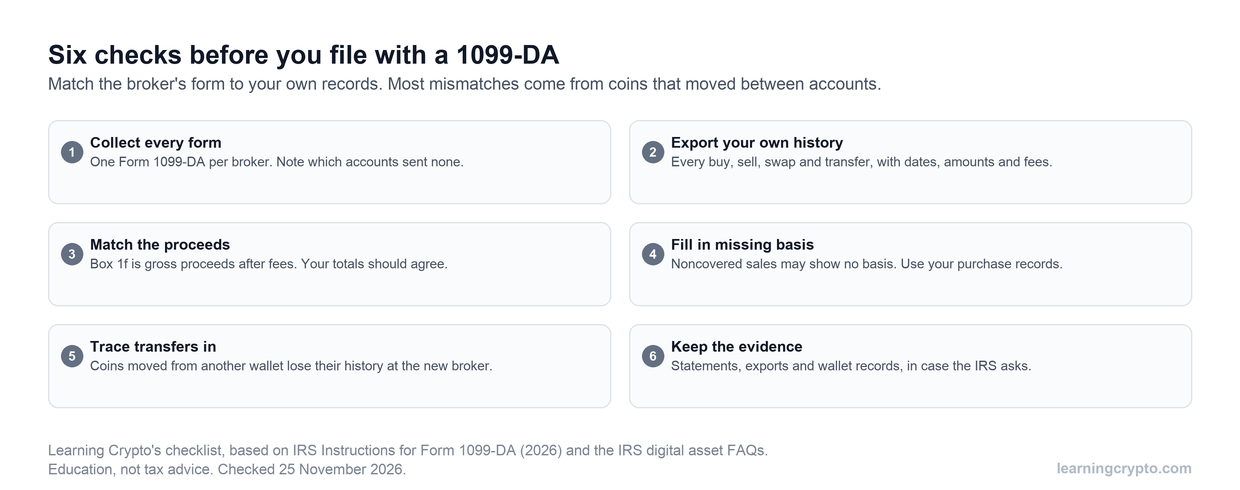
Steps four and five are where most of the work sits for anyone who has moved coins between exchanges and wallets over the years.
- Collect one form per US broker, and list any accounts that sent nothing.
- Export your full history from each platform and wallet: buys, sells, swaps, transfers, dates, amounts and fees.
- Check that the broker's gross proceeds agree with your own totals for the same sales.
- Add the basis for any sale where the box is blank, using your purchase records.
- Trace every coin that arrived from another wallet back to where you first bought it.
- Keep the exports and statements with your return.
Members can keep holdings and buy prices in one place with our portfolio tracker, which makes step four far less painful. If you are planning sales, our guide to cashing out crypto to a bank walks through the practical side, and the Regulation and Tax hub collects the rest. The people who struggle with these forms are rarely the ones with big gains. They are the ones who never wrote down what they paid.
Frequently asked questions
What is Form 1099-DA used for?
Form 1099-DA is the IRS information return that US digital asset brokers use to report customers' sales of crypto and other digital assets. The broker sends one copy to the IRS and one to the customer. It reports gross proceeds and, for some sales from 2026, cost basis. It helps the IRS cross-check your return but does not replace the Form 8949 and Schedule D you file.
When do brokers have to report cost basis on Form 1099-DA?
According to the IRS, brokers must report basis on certain transactions effected on or after 1 January 2026. The requirement covers covered securities, which are digital assets acquired after 2025 and held in a custodial account at that broker. Coins bought earlier, or transferred in from another wallet or exchange, are noncovered, and reporting basis for them is optional for the broker.
Why is the cost basis box blank on my 1099-DA?
A blank basis box usually means the sale was noncovered: the coins were bought before 2026, were not held by that broker when acquired, or were transferred in. The broker may simply not know what you paid. A blank box does not mean your basis is zero. Use your own purchase records to report the correct basis on Form 8949.
Do I have to report crypto sales if I did not get a 1099-DA?
Yes. Under US rules, digital assets are property, and sales or exchanges are reported whether or not they produce a gain or loss and whether or not a broker sends a form. Trades from self-custody wallets, on platforms outside the US, or below the optional de minimis thresholds may produce no form, yet they still belong on your return.
Does Form 1099-DA cover DeFi trades?
Generally no. The IRS says the final broker regulations do not include reporting for decentralised or non-custodial brokers that never take possession of your assets. A separate rule aimed at some DeFi front ends was repealed when the President signed H.J.Res.25 on 10 April 2025. The trades can still be taxable, so record them yourself.
Are transfers between my own wallets reported on a 1099-DA?
Moving crypto between wallets you own is not a sale. The IRS digital assets page says such transfers alone let you answer "No" to the digital asset question, unless you paid the transfer fee in digital assets. The catch comes later: when you sell transferred coins at a new broker, that broker may report the proceeds without your original cost basis.
Keep learning
- A Complete Guide to Cryptocurrency Taxes
- Crypto Record Keeping: What to Track for Tax
- Crypto Mining Taxes in 2025: A Comprehensive Guide for U.S. Traders
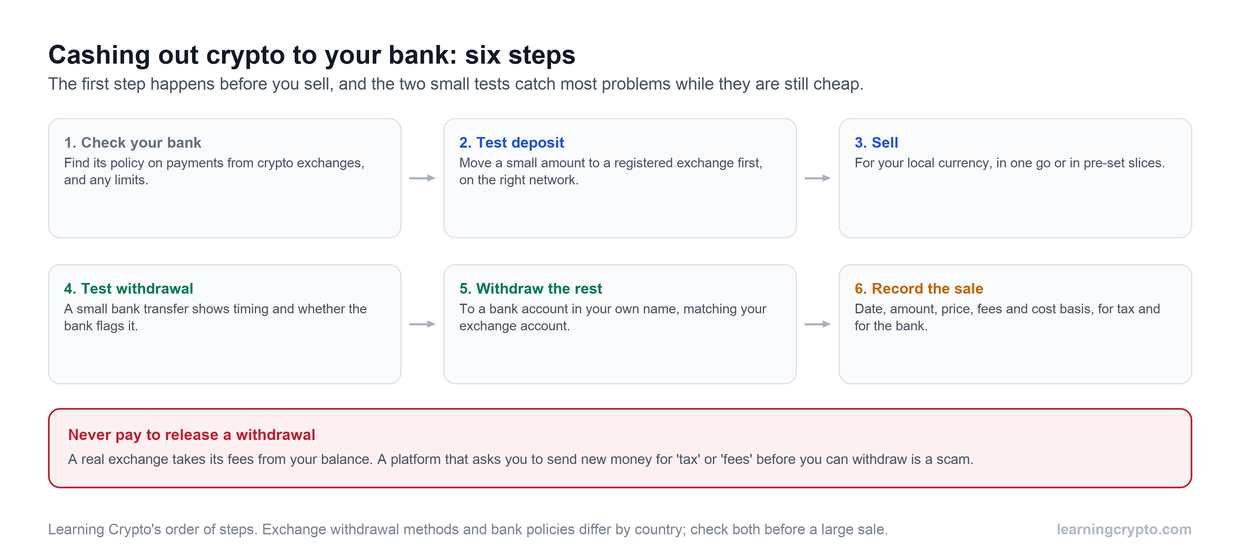
- How to Cash Out Crypto to Your Bank Account, and Find a Crypto-Friendly Bank
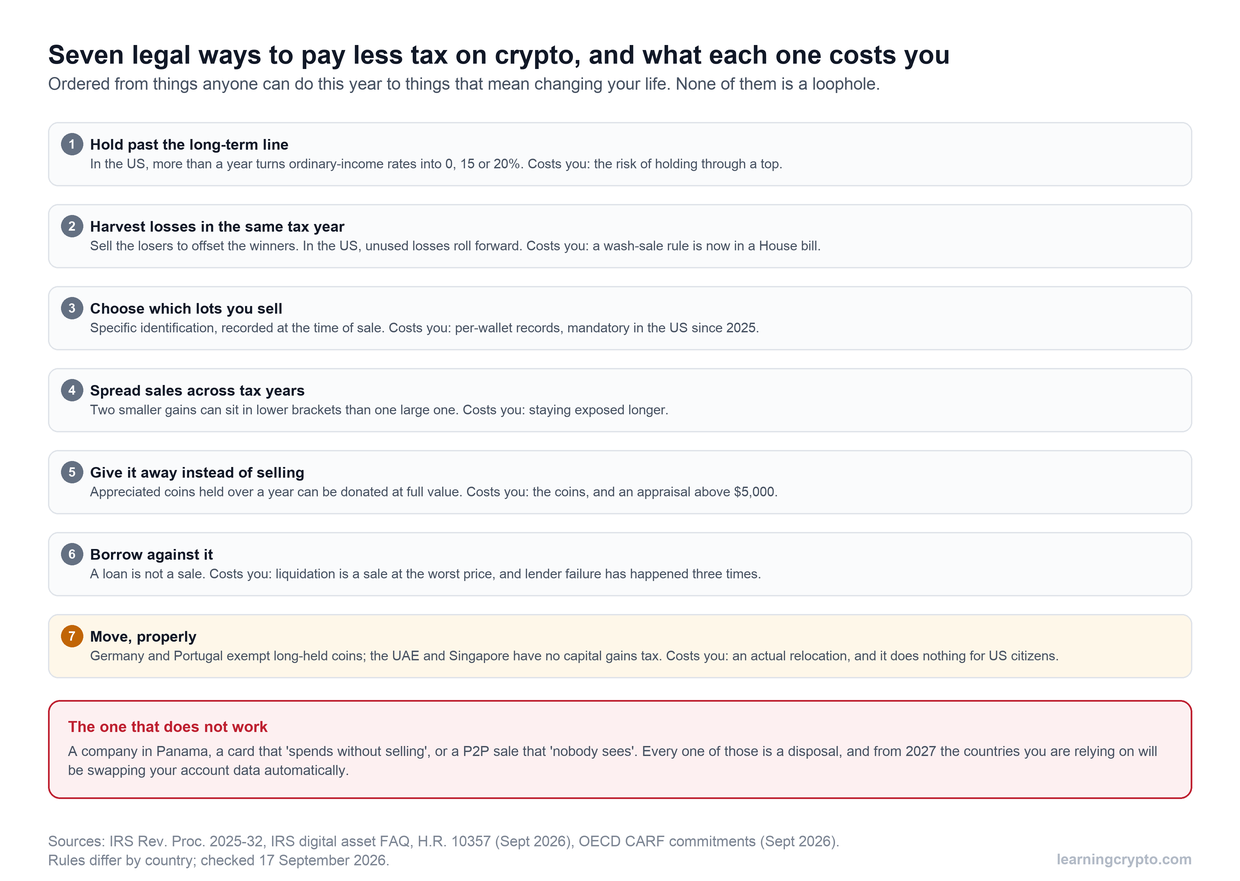
- How to Legally Reduce Your Crypto Taxes: What We Did and What Actually Works in 2026
- More guides in the Regulation and Tax hub
- Free headlines: the Learning Crypto news feed on Telegram