
This guide is general education, not financial advice. The token used as an example is there to show a method. Nothing here is a view on its price or a reason to buy or sell it. Explorer data changes constantly, so the numbers below are a snapshot.
If you have read about on-chain analysis and never seen it done on a real token, this is for you. By the end you will be able to take any ERC-20 token, open a free block explorer and answer five questions about it in a few minutes, without an account or a paid tool.
What does it mean to analyse a token on-chain?
It means reading the token's public records on the blockchain instead of relying on what a website or a social account says about it. Every token transfer, balance and contract rule is recorded in public, so you can check supply, who holds it and what the code allows. The method fits an ERC-20 token, the standard format for fungible tokens on Ethereum, and ethereum.org's ERC-20 page explains that such a token is a contract that keeps track of the created tokens.
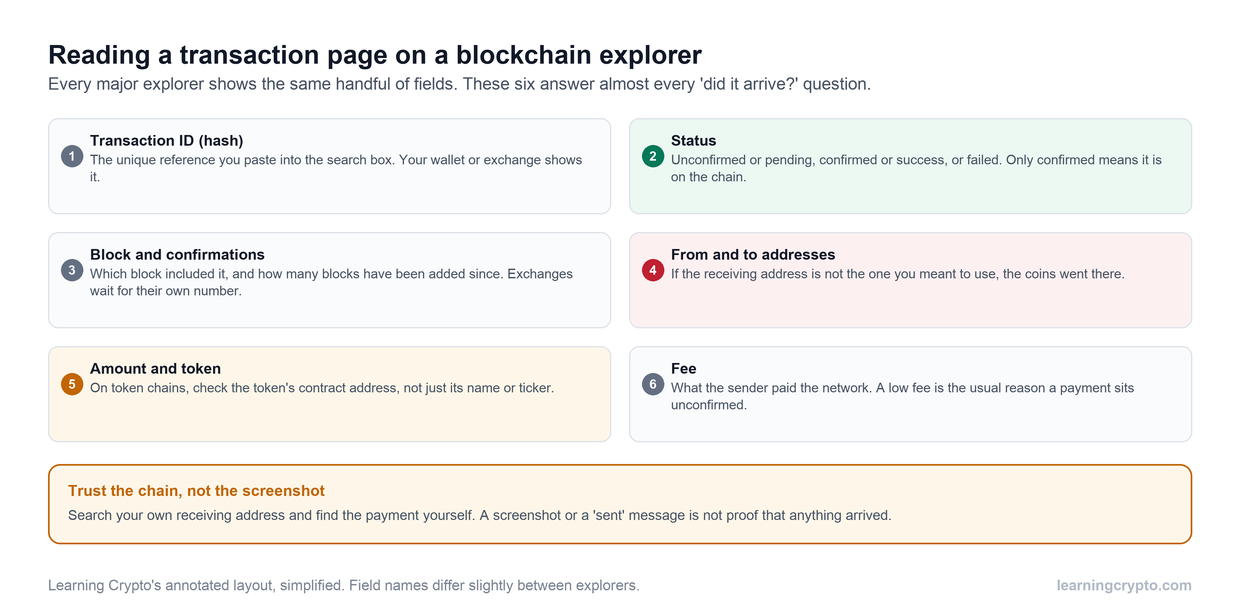
Two limits come first. On-chain data shows what happened and what is possible. It does not show who is behind an address, or what the price will do next. If you have not used an explorer before, start with our guide on how to use a blockchain explorer, then return here.
Which token do we use, and where does the data come from?
We use SHIB (Shiba Inu), a token on Ethereum that is widely described as a meme coin, because it is old, widely held and fully public. It is a teaching example only. The data comes from its token page on Blockscout, an open explorer for Ethereum, and Learning Crypto read the token record, its holder list and its contract record on 18 November 2026. All percentages are our own arithmetic on those figures.
Blockscout is a third-party service, and we did not cross-check every figure against a second explorer. Check any number that matters to you on two explorers before you rely on it.
Step 1: How do you find the right contract address?
Start from the project's own official website or channel and copy the contract address from there. Do not search the ticker. The ERC-20 standard defines name and symbol as functions that return plain text, and any contract can return the same text as another, so a copycat can carry a famous name. The address is the only identifier that is unique to one token.
For SHIB, the address on the Blockscout page begins 0x95aD and ends C4cE. Paste the address you copied into the explorer's search box, confirm the page shows the same address in full, and confirm the name and symbol are what you expected. If you reached the explorer from a link someone sent you, treat that as unverified, because lookalike sites exist.
Step 2: What do supply, holders and transfers tell you?
They give you scale. On 18 November 2026 Blockscout showed SHIB with a total supply of about 999,982,324,697,637 tokens (just under one quadrillion), 1,850,664 holders and 19,355,110 transfers. The raw supply field is a number with 18 extra digits, because the token uses 18 decimals. The explorer converts it for you on the page.
Read each figure with care:
- Total supply counts every token that exists, including ones sitting in addresses no one can use.
- Holders are addresses, not people. One person can hold many addresses, and an exchange may hold millions of customers' coins at one.
- Transfers count movement, which can be real use, or one wallet shuffling coins to look busy.
The contract also tells you how supply has changed. SHIB's deployment record shows a starting supply of exactly one quadrillion tokens. Today's total is about 17.68 billion tokens lower. The contract's only supply-reducing function is called burn, so that gap is tokens holders destroyed on chain. Compared with the starting supply, it is a small change, which is why the next step matters.
Step 3: How concentrated is ownership?
Open the token's holders tab and read the top ten. The question is how much of the supply a few addresses control, because a few large sellers can move a thin market. On 18 November 2026 the top ten SHIB holders looked like this:
| Rank | Address (shortened) | Tokens (trillions) | Share of total supply |
|---|---|---|---|
| 1 | 0xdEAD…2069 | 410.4 | 41.04% |
| 2 | 0x02E2…481e | 64.1 | 6.41% |
| 3 | 0x40B3…E489 | 39.3 | 3.93% |
| 4 | 0x5a52…Efcb | 35.1 | 3.51% |
| 5 | 0xA023…947e | 27.1 | 2.71% |
| 6 | 0x1d48…0270 | 17.1 | 1.71% |
| 7 | 0xa706…1FA9 | 16.7 | 1.67% |
| 8 | 0x47ac…D503 | 9.2 | 0.92% |
| 9 | 0x611f…B09d | 7.6 | 0.76% |
| 10 | 0xF977…aceC | 7.5 | 0.75% |
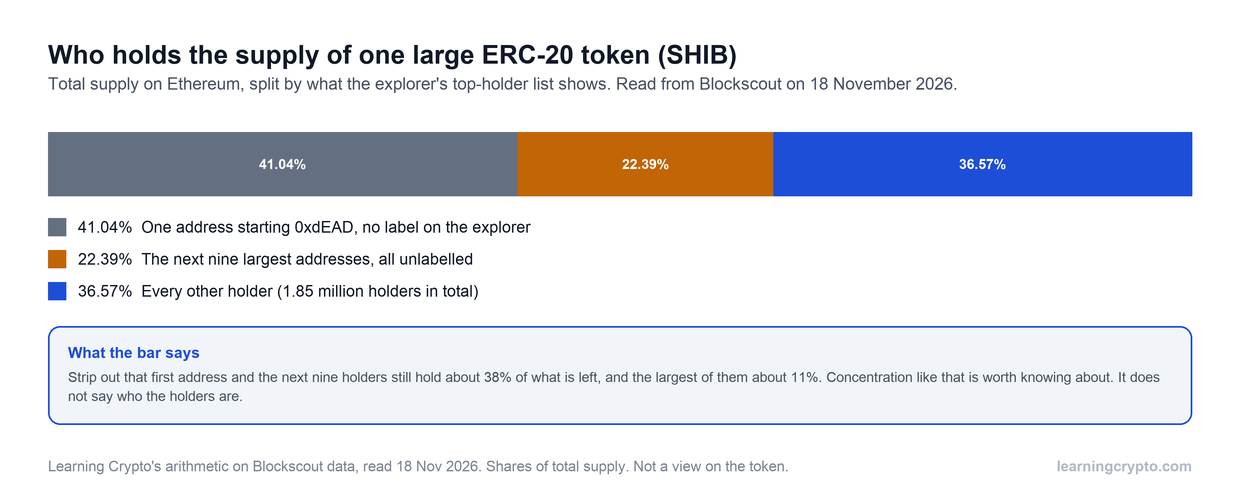
Two readings from one bar: the first address is a special case, and the next nine still hold a large block between them. The explorer labels none of these addresses.
The first address is a special case. It begins 0xdEAD and ends 42069, a pattern people choose for addresses that are meant to be unspendable, and it holds about 41% of the supply. That is a pattern, not proof, because the explorer shows no label on it. To be sure what it is and how the coins got there, you would check the project's own statements and the address's transaction history. Note too that those tokens still count inside total supply, which is why the supply figure in step 2 barely moved.
Remove that address and the picture is the next nine holders. Together they hold about 22% of the total, which is roughly 38% of the supply left outside the first address, and the largest of them alone holds about 11% of that. None of the nine carries a label on Blockscout, so you cannot tell from the list whether they are exchanges, funds, project wallets or individuals. An unlabelled address is a question to chase, such as by looking at where its tokens came from and where they go, not a finding. Our on-chain analysis guide covers how to follow flows like that.
Step 4: What can the contract actually do?
Open the contract tab. First check whether the source code is published and verified. Blockscout shows SHIB's code as verified, though it flags the verification as partial, with source compiled under an old Solidity version (0.5.0) and verified on 5 November 2021. Verification means the published source matches the deployed code. It does not mean the code is safe, or that the people behind it are honest.
Next read the function list. SHIB's contract exposes the standard ERC-20 functions plus a burn function, and nothing named mint, owner, pause, blacklist or fee. In plain terms, the contract as listed cannot create new tokens, freeze trading or block a particular wallet. A new token that does have such functions is not automatically a scam, but you must find out who holds those powers and whether they have been given up. That is the single most useful check on a new meme coin.
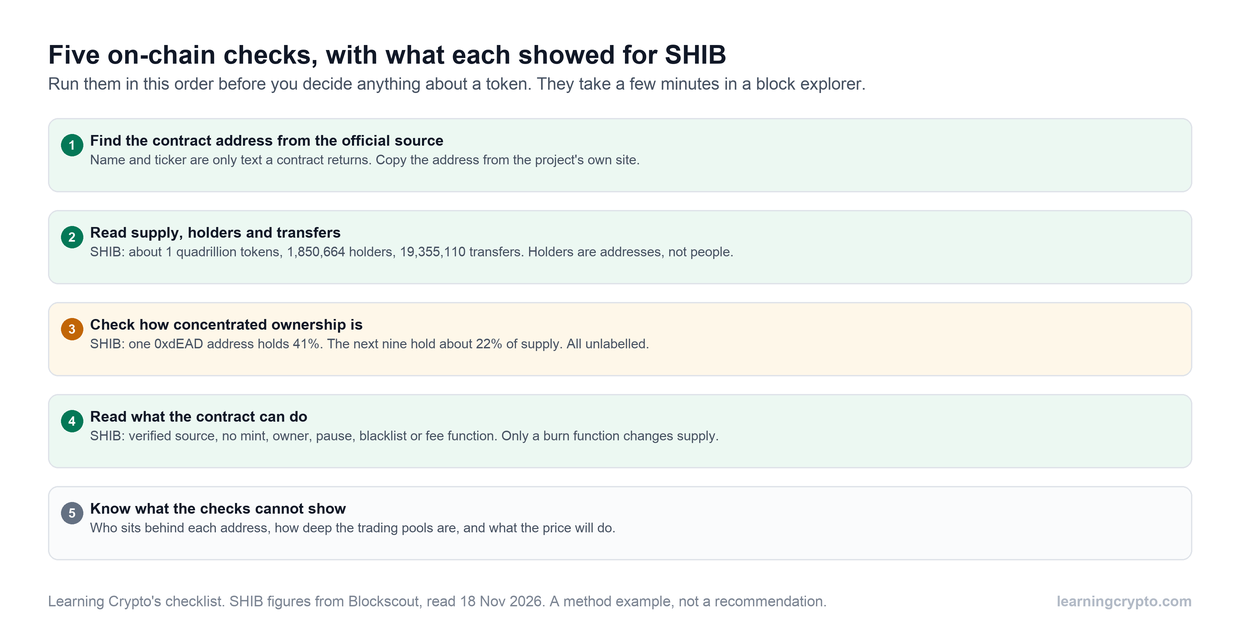
The same five checks work for any ERC-20 token. The SHIB results show what a long-lived, widely held token looks like. A brand-new token usually looks different.
What can on-chain checks not tell you?
Quite a lot, and it is worth saying plainly. The five checks do not show who controls each large address. They do not show how much real trading depth exists, so you cannot tell from them whether you could sell a given amount without moving the price. They do not cover risks outside the token contract, such as a pool or a bridge, and they say nothing about price or value. A clean result is a reason to keep looking, not to buy.
Think of on-chain analysis as a way to rule things out cheaply. It catches obvious traps such as hidden owner powers and extreme concentration, and it replaces trust in a promoter with something you can verify. For the scam patterns the checks help screen, read our honeypot scam guide and our guide to meme coins and their risks.
How would a brand-new token look different?
Often in the same four places. Supply may be held by one or two addresses, often the deployer's. The holder count may be small, or inflated by many fresh wallets. The code may be unpublished or may carry owner powers. The transfer history may show a few addresses trading among themselves. None of these proves a scam alone, and a mature token like SHIB can show concentration too, as step 3 did. What you are looking for is a pattern across several checks.
Members can use Ask Crypto to explain a term or function name you meet in an explorer. For more guides of this kind, browse the Analysis hub. If a check turns up something you do not understand, treat that as an answer for now and keep your money where it is.
Frequently asked questions
How do you analyse a token on-chain?
Take the contract address from the project's official source and open it in a block explorer. Read the total supply, holder count and transfers, check how much of the supply the largest addresses hold, then read whether the contract's code is published and what functions it exposes. These checks take minutes and need no account. They show what is possible, not what will happen to the price.
What does on-chain analysis show?
It shows public blockchain records: balances, transfers, contract code and the addresses involved. From them you can see how supply is distributed, whether a token's contract has powers such as minting or blocking, and how coins move between addresses. It does not show who owns an address, what people intend, or where a price is heading, so it works best alongside other research.
How do you check who holds a token?
Open the token's page in a block explorer and select the holders tab. It lists the largest addresses with their balances. Work out each one's share of total supply, and check whether the explorer labels any as exchanges, contracts or burn addresses. Unlabelled addresses need more digging, because the list alone cannot tell you whether an address belongs to a person, an exchange or a project.
Is a verified contract safe?
No. Verified means the source code published on the explorer matches the code deployed on the chain. It lets you read what the contract does, but safe code and honest people are separate questions. A verified contract can still contain owner powers, fee changes or sell restrictions. Read the function list and find out who controls any special functions.
What is a holder in a block explorer?
A holder is a blockchain address with a non-zero balance of the token, not a person. One person can control many addresses, and one exchange address can hold coins for many customers. That makes the holder count a rough measure of spread. Concentration among the top addresses usually tells you more than the headline number of holders.
Can on-chain analysis predict price?
No. On-chain data records what has already happened and what the contract allows. It can flag risks such as heavy concentration or hidden owner powers, but it cannot say what a market will pay tomorrow. Anyone who claims a single on-chain metric predicts price is selling certainty that the data does not provide.
Keep learning
- How to Use a Blockchain Explorer: Check Any Transaction, Address or Token
- On-Chain Analysis: Reading Blockchain Data to Understand Markets
- Honeypot Crypto Scams: How to Check a Token Before You Buy
- Token Approval Phishing: How Wallet Drainers Empty Wallets
- Meme Coins Explained: What They Are, How Pump-and-Dumps Work and How to Protect Yourself
- More guides in the Analysis hub
- Free headlines: the Learning Crypto news feed on Telegram