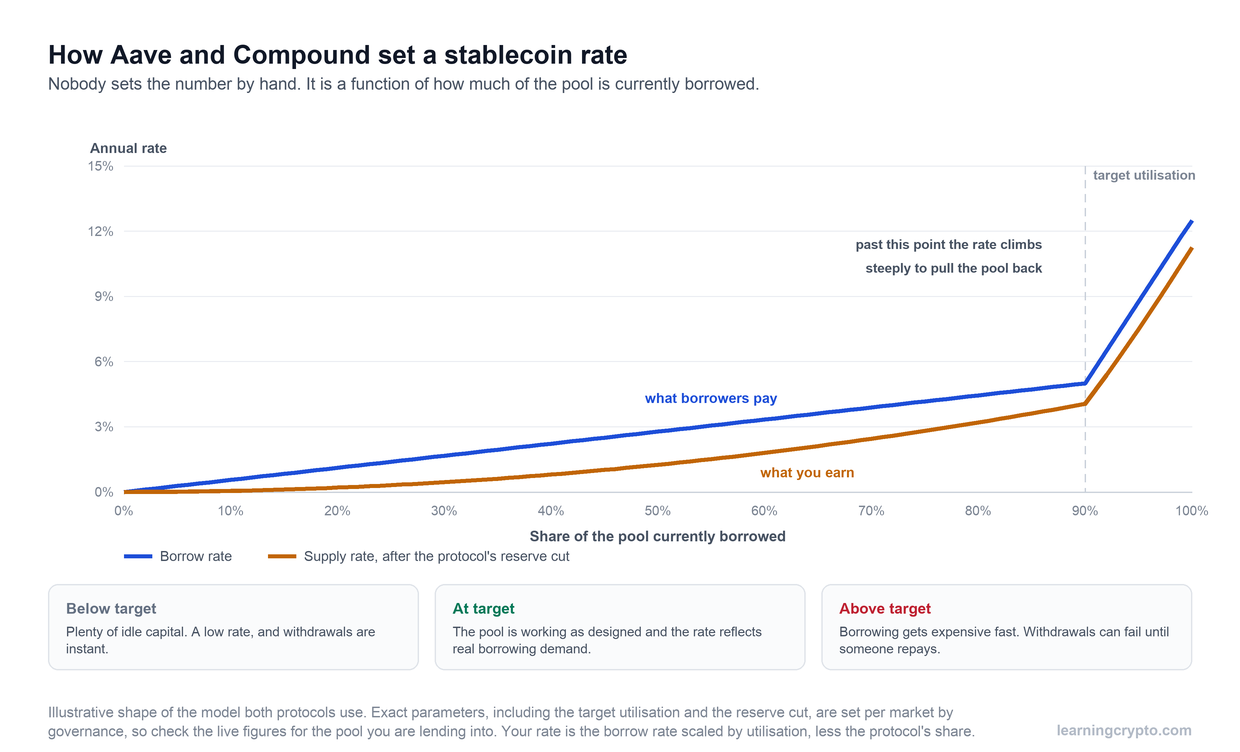

This guide is general education, not financial advice. It explains how a piece of infrastructure works and does not say whether any token is worth buying. Product features, supported networks and settings change, so check the provider's current documentation.
If you have seen Chainlink mentioned in a DeFi app, an exchange listing or a headline and wanted a plain explanation of what it does, this guide is for you. By the end you will know why blockchains need oracles, how Chainlink's main services work, and the questions to ask before you trust a protocol that depends on one.
What is a blockchain oracle?
A blockchain oracle is a service that sends data from outside a blockchain onto it, so a smart contract can act on that data. The most common example is a price: a lending app needs to know what your collateral is worth, and the price lives on exchanges, not on the chain. ethereum.org's oracle guide describes oracles as applications that source, verify and transmit off-chain data to contracts.
Chainlink's own education page makes the same basic point. Without an oracle, a smart contract can only use information that is already on the chain. A contract that pays out on a match result, a flight delay or an interest rate needs something to carry that fact in. Oracles can also work the other way and push information from a chain to outside systems.
Why can't a blockchain just look up the price itself?
Because every node must reach exactly the same result. ethereum.org explains that Ethereum nodes can only rely on data that is already on the chain. If a contract could call a price website directly, two nodes asking a second apart might get different answers, and the network could not agree on what happened.
The fix is to have an oracle write the outside value onto the chain first. From then on every node reads the same stored number. That solves agreement, but it creates a different problem, which ethereum.org calls the oracle problem. You now have to ask whether the data came from the right source without being tampered with, and whether it is always available and kept up to date. A blockchain can be extremely hard to alter, yet one wrong number fed into it is accepted and acted on exactly as a correct one would be.
A centralised oracle, meaning one party reporting the data, is the obvious weak point. ethereum.org lists three weaknesses: low guarantees that the data is correct, poor availability if that provider shuts down or is attacked, and poor incentives, because paying an oracle does not guarantee it is honest. Chainlink's education page describes a single oracle as a single point of failure. If it goes offline, contracts run on stale data or stall. If it is corrupted, contracts can act on wrong data, and on-chain transactions generally cannot be reversed.
It is the same trade-off you meet elsewhere in crypto. If you rely on one custodian, one bridge or one exchange, you have swapped a technical trust problem for a human one. Decentralised oracle networks are an attempt to spread that trust across several independent operators. They are not a way to remove it.
How does Chainlink work?
Chainlink is a network of independent node operators that reports data to smart contracts. According to Chainlink's Decentralized Data Model documentation, each data feed is updated by multiple independent oracle operators. Each node watches one or more data providers for that feed. An aggregator contract on the blockchain then combines the nodes' reports into a single answer, and applications read that answer.
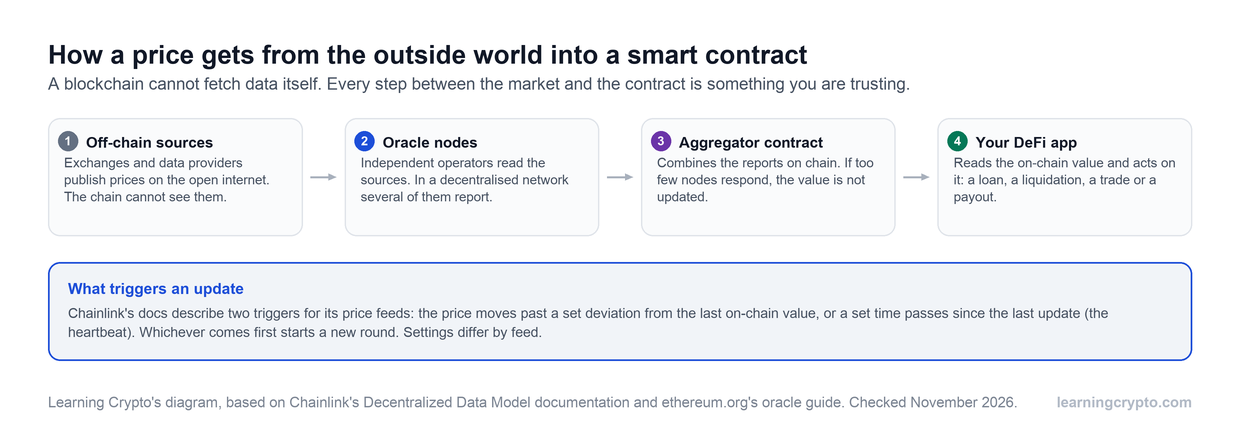
Every box is a trust point. The off-chain sources and the app that reads the result sit outside the oracle network, so a decentralised network does not cover them.
Two details from the docs are worth knowing. First, each feed has a minimum number of oracle responses, and if too few nodes respond the stored value is not updated. Second, the node operators are paid for publishing the data. The docs do not say how many sources sit behind every feed, so do not assume it. Our guide to using a blockchain explorer shows how to look at the contracts and transactions involved yourself.
How often does a feed update? Not continuously. The docs describe two triggers: a deviation threshold and a heartbeat. A new round starts when a node sees the off-chain value differ from the on-chain value by more than the feed's deviation threshold, or when a set amount of time has passed since the last update. Whichever happens first triggers the update.
The reason is cost. Chainlink's explainer on deviation thresholds describes the trade-off between update frequency and gas cost, and says nodes push an update only when the price moves past the threshold from the last on-chain value. The settings differ by feed. A stable asset can carry a tight threshold, and a more volatile pair a wider one.
In practice, the number a contract reads can lag the market by up to the threshold, and by the heartbeat if the market is quiet. That is usually fine. In a fast move it is a reason to ask how a protocol protects itself, which we come back to below.
What else does Chainlink do besides price feeds?
Several things, and it helps to know which is which because they carry different risks. The table summarises what each service does according to Chainlink's own pages.
| Service | What it does | What to remember |
|---|---|---|
| Data Feeds | Publish values such as prices on chain for contracts to read | Updates on a deviation or timer trigger |
| Data Streams | Pull-based: a signed report is requested when an app needs it, for example when a trade is placed | Different model from the push-style feeds |
| VRF | Verifiable randomness: a random value plus a proof checked on chain | Used where fairness matters, such as games and NFT draws |
| CCIP | Cross-chain messaging and token transfers | A bridge-style service, so it carries bridge-style risk |
| Proof of Reserve | Reports the reserves behind a token, such as a wrapped or tokenised asset | Only as good as whoever supplies the reserve data |
On VRF, Chainlink's documentation says no single party, including the oracle operators, can manipulate the result, with one stated caveat: an attacker who compromised the secret key used to generate the randomness and could also construct blocks could strongly bias the output. The same page carries a shutdown notice. As of 20 November 2026 it says VRF version 1 shut down on 18 November and version 2 is due to shut down on 30 November, after which neither will fulfil randomness requests, and developers are told to move to version 2.5. For CCIP, Chainlink's page describes cross-chain messages and token transfers, and its docs banner announces CCIP 2.0. If you are weighing bridges generally, our guide to how blockchain bridges work covers the risks.
What is Proof of Reserve, and can you trust it?
Proof of Reserve is a feed that reports the reserves behind a token, so a contract or a user can check that the backing exists. It is aimed at assets such as wrapped tokens, where one token claims to be backed by an asset held elsewhere. Our guides on wrapped Bitcoin and stablecoins explain why that backing matters.
The name promises more than the mechanism may deliver. Chainlink's SmartData documentation describes three ways offchain reserve data arrives: reported by a third-party auditor, pulled from a custodian, or self-reported by the token issuer through an API it hosts. For self-reported data the docs say Chainlink Labs is not responsible for its accuracy. The docs also carry a caution that many of these feeds rely on a single source such as an issuer, fund administrator, custodian or auditor, and that the user is responsible for reviewing the quality of the data.
In plain terms: a reserve feed can be a useful, public, always-on signal, and it can also be a number the issuer typed in. Which one you have depends on how that specific feed is configured, so read who reports it before you treat it as an audit.
What goes wrong when an oracle fails?
The best-documented case is the Mango Markets incident. In a January 2023 press release, the US Commodity Futures Trading Commission described its first oracle manipulation case. It alleged that on 11 October 2022 a trader used two accounts to take large leveraged positions on Mango Markets, then bought the MNGO token rapidly on the exchanges that fed the platform's oracle. The release says the reported price rose more than 13-fold in 30 minutes. That inflated the value of the positions, which were then used as collateral to withdraw more than $110 million in digital assets.
Nobody should read that as proof that oracles are broken. The point is that a price feed is only as strong as the markets behind it. A token with thin trading can be pushed around cheaply, and a contract that trusts the resulting number will treat it as real. The release does not say which oracle provider Mango used, and this guide does not claim it was Chainlink. We also do not report the outcome of the legal cases, because we could not verify it from primary sources today.
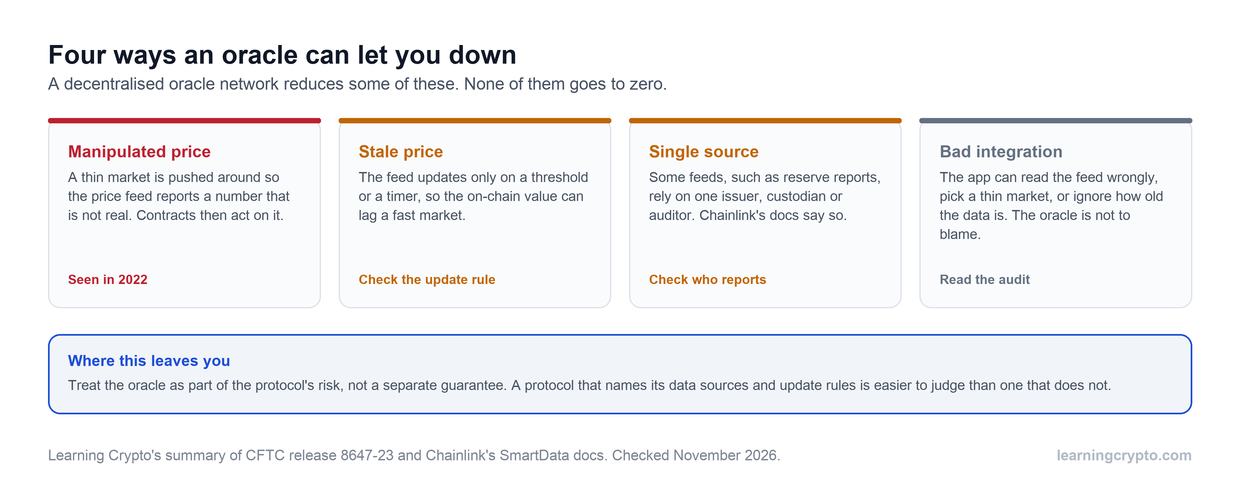
Two of the four, a stale price and a single source, are written into the update rules and the docs of real feeds. The other two depend on the market and on how well the app was built.
Stale data and single-source reporting are quieter failures. They come from the design choices described above, and Chainlink's documentation states both openly. Bad integration is the fourth: the feed can be fine while the protocol uses it carelessly. If you hold tokens that approve contracts, our guide to token approval phishing covers a separate risk worth knowing.
Is the LINK token the same thing as Chainlink?
No. Chainlink is the network and its services. LINK is a token that goes with it, and Chainlink's token documentation describes it as an ERC-677 token, an extension of ERC-20 that lets a transfer carry a data payload. The docs add that LINK bridged to BNB Chain is not ERC-677 compatible and cannot be used with Chainlink services, which is a good example of why you check which version of a token you hold. The VRF docs say requests can be paid in LINK or in a chain's native token.
We are not covering the token's price or investment case here, and nothing on this page is a reason to buy or sell it. Whether an oracle network is useful and whether its token is a good investment are separate questions. If you want to follow the money in any protocol, our guide to on-chain analysis is a starting point.
How do you judge a protocol that depends on an oracle?
Treat the oracle as part of the protocol's own risk. Before you put money into an app that relies on external data, ask these questions, most of which the project's own documentation should answer:
- Which oracle and which feed? A protocol that names its data source is easier to judge than one that does not.
- Which market does the price come from? Thin markets are easy to move, as the 2022 case showed.
- How often does it update? Look for the deviation threshold and heartbeat, or the equivalent for other providers.
- What happens if the data is stale or missing? A careful protocol pauses or limits actions. A careless one carries on.
- Who reports the data? For reserve and similar feeds, check whether it is an auditor, a custodian or the issuer itself.
- Has the integration been audited? The oracle can be sound while the app that reads it is not.
Members can ask Ask Crypto to explain an oracle term or a protocol's data setup. For a worked lending example, see our guide on what Aave is, and for more fundamentals browse the Fundamentals hub. If a protocol cannot tell you where its numbers come from, that is your answer.
Frequently asked questions
What is Chainlink in simple terms?
Chainlink is a network that carries outside information, such as asset prices, onto blockchains so smart contracts can use it. Independent node operators report the data and an on-chain contract combines their answers. It also offers verifiable randomness, cross-chain messaging and reserve reporting. It is infrastructure that other apps build on rather than an app most people use directly.
What is a blockchain oracle?
A blockchain oracle is a service that brings off-chain data onto a blockchain, or sends chain data out, because smart contracts cannot fetch outside information themselves. Typical data includes asset prices, sports results and random numbers. The oracle matters because a contract acts on whatever number it is given, so the quality and honesty of that data is a core risk.
Why do smart contracts need oracles?
Blockchain nodes must all reach the same result, so contracts can only rely on data already stored on the chain. A price on an exchange website changes from moment to moment and could differ between nodes. An oracle writes the value onto the chain first, so every node reads the same number. That keeps the network consistent while still letting contracts react to real events.
Is Chainlink decentralised?
Chainlink's documentation says each data feed is updated by multiple independent oracle operators and combined by an on-chain aggregator. That spreads trust compared with one provider. Decentralisation is a matter of degree, though, and some services depend on a single data source, such as an issuer or custodian, as the docs themselves note for certain reserve feeds.
Can oracles be manipulated?
Yes. If a feed takes its price from thin markets, someone can push those markets and the feed will report the result. The US CFTC described such a case on Mango Markets in October 2022, where it said the reported token price rose more than 13-fold in 30 minutes. Decentralised networks reduce some risks but do not remove market manipulation.
Is LINK the same as Chainlink?
No. Chainlink is the oracle network and its services, while LINK is the token associated with it. Chainlink's docs describe LINK as an ERC-677 token, an extension of ERC-20. Understanding what the network does is separate from deciding whether its token is a sensible investment, and this guide takes no view on that second question.
Keep learning
- What Is Crypto Bridging and How Do Blockchain Bridges Work?
- What Is Wrapped BTC (WBTC)
- How to Use a Blockchain Explorer: Check Any Transaction, Address or Token
- On-Chain Analysis: Reading Blockchain Data to Understand Markets
- How to Make Money with DeFi: Comprehensive Guide for Beginners
- More guides in the Fundamentals hub
- Free headlines: the Learning Crypto news feed on Telegram