
This guide is general education about a US bill, not legal, tax or financial advice. Bills change and stall, so check the official record before relying on any provision. Status checked 18 October 2026.
If you hold crypto and keep hearing that the CLARITY Act will "finally" settle the rules in the US, this guide is for you. By the end you will know what the bill would do, how the Senate rewrote it, exactly where it stands today, and the parts that matter most if you hold your own keys.
What is the CLARITY Act?
The CLARITY Act is the US crypto market structure bill: H.R.3633, the Digital Asset Market Clarity Act, introduced in May 2025 by Representative French Hill. It sets out which crypto assets the SEC oversees and which the CFTC oversees, makes exchanges, brokers and dealers register, and writes a right to self-custody into federal law. It is not law.
Status as of 18 October 2026: the House passed it 294-134 on 17 July 2025. The Senate Banking Committee replaced the text with its own version, reported on 1 June 2026. On 15 September 2026 a Senate vote to begin debate failed 49-50, and a motion to reconsider that vote was entered the same day. No further action appears in the official record, which was last updated on 17 September 2026.
The bill is the second half of a plan. The first half, the GENIUS Act, regulates dollar stablecoins and became law in July 2025; our GENIUS Act guide explains why we read it as a step toward a digital dollar. The CLARITY Act deals with everything else: Bitcoin, Ethereum, the tokens of other networks, and the businesses that trade and hold them.
Where does the CLARITY Act stand today?
It is stuck on the Senate floor. In the Senate, most bills need 60 votes to end debate on even starting to consider them, a step called cloture. The September vote did not get close, so the bill cannot move until its supporters find more votes or change the text.
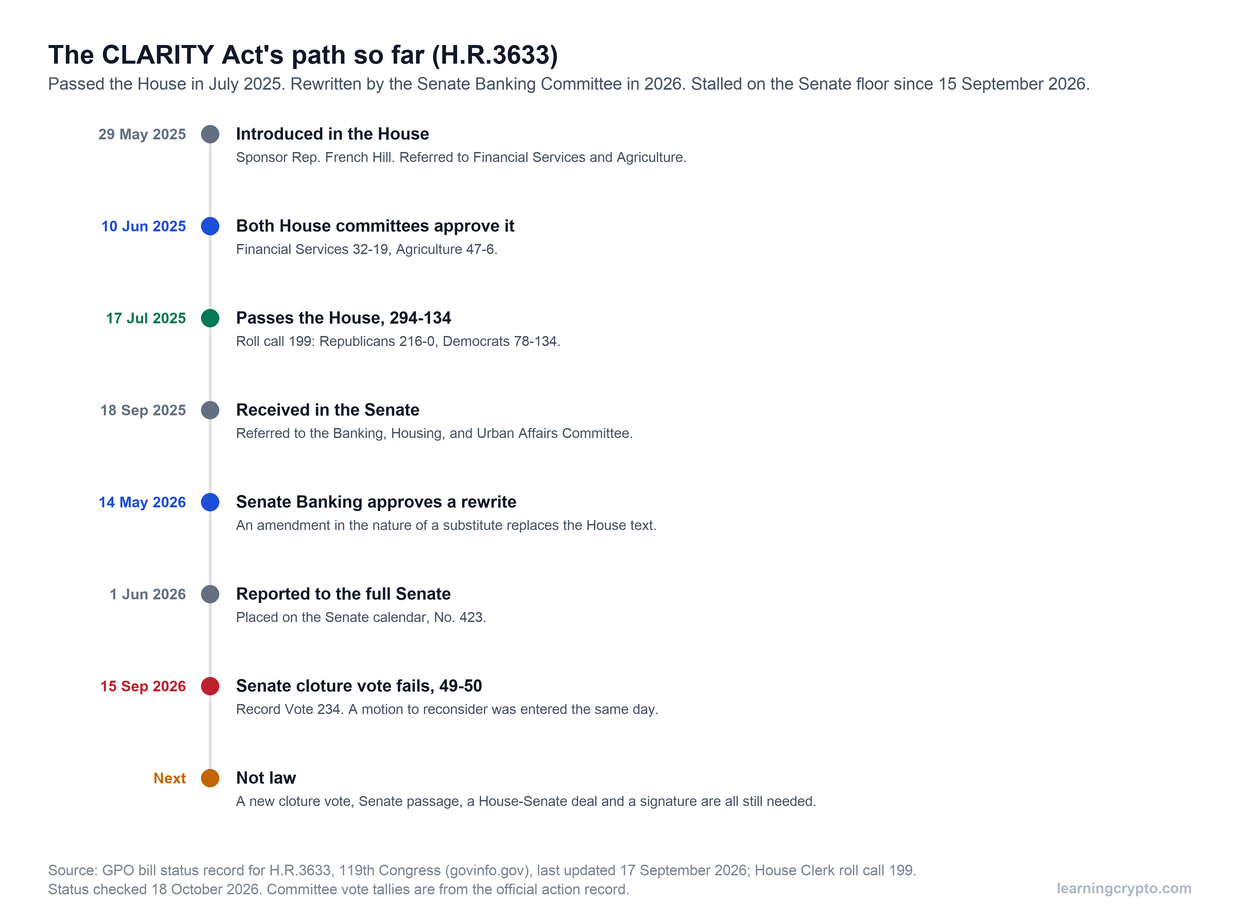
Every step comes from the official bill status record and the House roll call. The last row is what still has to happen, not a prediction that it will.
The House vote was bipartisan but lopsided: according to the House Clerk's roll call 199, every Republican who voted backed it, along with 78 Democrats, while 134 Democrats voted against. The Senate is a different arithmetic. To become law the bill still needs a successful cloture vote, passage by the full Senate, an agreed text between the House version and the Senate version, and the President's signature. The Senate Agriculture Committee, which shares jurisdiction over commodity markets, has its own bill, the Digital Commodity Intermediaries Act (S.4064), which is also waiting on the Senate calendar.
People also search for the CLARITY Act on Polymarket, where there is a market on whether it is signed in 2026. A prediction market tells you what traders are betting, not what the Senate will do. The official record on congress.gov is the only source that settles it.
What would the CLARITY Act actually do?
The House-passed version answers the question that has dogged the US market since 2017: is a token a security or a commodity? Its answer runs through four ideas.
- Digital commodities go to the CFTC. The CFTC gets authority over trading in digital commodities, the tokens that are tied to a working blockchain rather than to a company's promises.
- Tokens sold to raise money start under the SEC. A token sold as part of an investment contract is treated as an "investment contract asset", with disclosure rules for the people who issue and sell it.
- A test for when a network is decentralised. The bill defines a mature blockchain system as one that no person or group under common control controls. Issuers and others can certify to the SEC that a network is mature, and if the SEC does not rebut the certification within 60 days, it stands.
- Exchanges, brokers and dealers register. They register with the CFTC as digital commodity exchanges, brokers and dealers, with an expedited process so existing firms can come in.
Beyond those four, the House text says that running a node, validating, publishing software, providing a wallet that lets people hold their own assets, or providing liquidity to a decentralised trading protocol does not on its own bring a person under the new commodity rules. It applies the Bank Secrecy Act to the new intermediaries, and its Title VI folds in the Anti-CBDC Surveillance State Act, which bars the Federal Reserve from issuing a central bank digital currency directly or through banks. Our explainer on CBDCs versus cryptocurrency covers why that title mattered to so many holders.
How did the Senate change the CLARITY Act?
Rather than amend the House bill, the Senate Banking Committee replaced it with an amendment in the nature of a substitute, whose first title is the Lummis-Gillibrand Responsible Financial Innovation Act of 2026, and kept the House bill's number. The two texts differ in ways that matter.
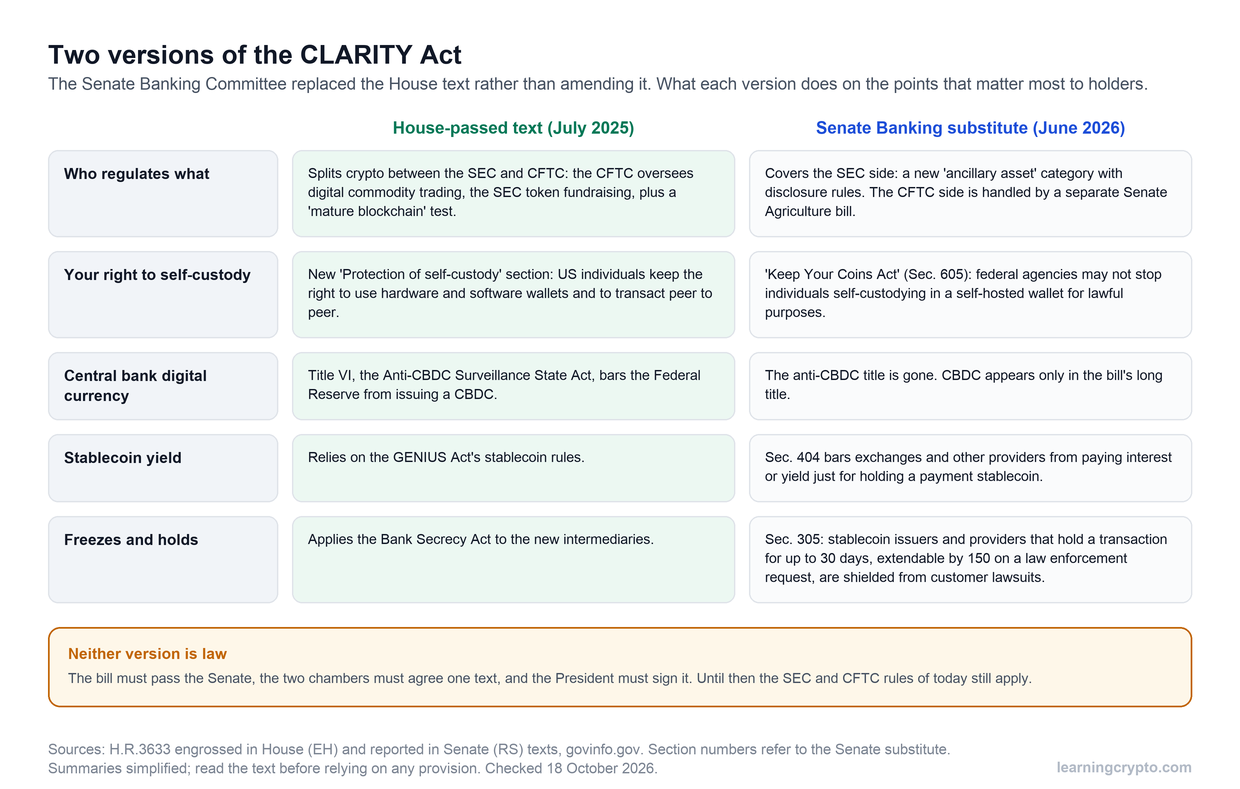
In short, the Senate version keeps the self-custody protection but drops the anti-CBDC title and adds a stablecoin yield ban and legal cover for transaction holds.
- A different token category. The Senate text uses "ancillary assets": network tokens whose value depends on the efforts of the people behind them, with disclosure duties for those originators. It covers the SEC side; the CFTC side is left to the Agriculture Committee's bill.
- No anti-CBDC title. The Anti-CBDC Surveillance State Act is not in the Senate substitute. Central bank digital currency appears only in the bill's long title, carried over from the House.
- A ban on stablecoin yield from exchanges. Section 404 bars exchanges and other providers, and their affiliates, from paying interest or yield just for holding a payment stablecoin. The GENIUS Act already bans issuers from doing so; this closes the route through the exchange.
- Legal cover for freezes. Section 305 protects stablecoin issuers and service providers from customer lawsuits when they hold a transaction, conversion or withdrawal for up to 30 days on suspicion of illegal activity, extendable by a further 150 days on a written law enforcement request.
- Protection for node operators and developers. Section 601 says that validating, relaying transactions or running a node does not, on its own, make a person subject to the securities laws.
You can read both versions in full on govinfo.gov, where the Senate-reported text prints the House version followed by the substitute.
What does the CLARITY Act mean for self-custody?
Both versions protect it, which is the most important line in the bill for anyone who holds their own keys. The House text says a US individual keeps the right to hold digital assets in a hardware or software wallet and to transact peer to peer, for personal, lawful use. The Senate's Keep Your Coins Act says a federal agency may not prohibit, restrict or otherwise impair an individual's ability to self-custody in a self-hosted wallet for any lawful purpose.
Read the limits as carefully as the promise. The House version applies to personal use, and its peer-to-peer protection does not cover transactions with a financial institution or involving sanctioned property. The Senate version says nothing in it limits enforcement under the Bank Secrecy Act or sanctions law. So the protection is real but narrow: it stops an agency banning your wallet, not the reporting and freezing that happens wherever your coins touch an exchange, a stablecoin issuer or a bank.
That is why the practical advice does not change with this bill. Coins on an exchange live under whatever rules the exchange is given, including the Senate version's 30-day holds. Coins in your own wallet, with a seed phrase you control, sit outside that. If you have not made the move yet, our guide to cold and hot wallets is the place to start.
How does the CLARITY Act relate to the GENIUS Act?
The GENIUS Act (S.1582) became Public Law 119-27 when it was signed on 18 July 2025, the day after the House passed the CLARITY Act. It created the federal regime for payment stablecoins: 1:1 reserves, issuer licensing, Bank Secrecy Act duties and a ban on issuers paying interest. The CLARITY Act builds on it. The House text writes digital commodities and permitted payment stablecoins out of the definition of a security, and gives regulators anti-fraud authority over those stablecoins. The Senate version goes further on yield, extending the interest ban from issuers to the exchanges and apps that distribute stablecoins.
Taken together, the two bills would put stablecoins, tokens and the firms in between into one licensed system with the SEC, the CFTC and the banking regulators at the gates. For the rest of the world's rulebook, compare Europe's approach in our MiCA explainer, and see our guide to how stablecoins work for the basics.
What does the CLARITY Act mean for you as a holder?
For now, nothing has changed. The SEC and CFTC are working under the laws and guidance that already exist, and US exchanges are licensed the way they were. If the bill passes in something like its current form, expect three things: US exchanges registering with the CFTC, clearer labels on which tokens are securities, and more of the stablecoin and exchange world operating under formal reporting and freezing rules.
Our view is the one we gave on the GENIUS Act. Clear rules for custodians are better than regulation by lawsuit, and the self-custody sections are worth defending. But a bill that drops its anti-CBDC protections while adding legal cover for transaction holds is moving the system toward more control at the intermediaries, not less. The answer is the same as it has been since 2016: use regulated exchanges as on-ramps, check how safe yours is with our exchange safety checklist, and keep your savings in a wallet you control. We track every vote as it happens in the Daily Brief, and more guides on the rules sit in the Regulation and Tax hub.
Frequently asked questions
What is the CLARITY Act in crypto?
The CLARITY Act, H.R.3633 or the Digital Asset Market Clarity Act, is the US bill that would set the rules for the crypto market beyond stablecoins. It splits oversight of tokens between the SEC and CFTC, requires exchanges, brokers and dealers to register, sets a test for when a blockchain is mature, meaning no person or group controls it, and protects the right to self-custody.
Has the CLARITY Act passed?
Not into law. It passed the House 294-134 on 17 July 2025. The Senate Banking Committee reported a rewritten version on 1 June 2026, but on 15 September 2026 a Senate cloture vote to start debate failed 49-50. As of 18 October 2026 it still needs Senate passage, an agreed House and Senate text, and the President's signature.
Does the CLARITY Act protect self-custody?
Yes, in both versions. The House text protects a US individual's right to use a hardware or software wallet and transact peer to peer for lawful personal use. The Senate's Keep Your Coins Act bars federal agencies from restricting self-custody for lawful purposes. Neither limits Bank Secrecy Act or sanctions enforcement, so coins held at exchanges still face reporting and freezes.
What is the difference between the CLARITY Act and the GENIUS Act?
The GENIUS Act is law: signed on 18 July 2025 as Public Law 119-27, it regulates dollar payment stablecoins and their issuers. The CLARITY Act is still a bill and covers the rest of the market: which tokens are commodities or securities, and how exchanges, brokers and dealers register. The CLARITY Act refers to the GENIUS Act's definitions rather than replacing them.
Does the CLARITY Act ban a CBDC?
Yes, the House-passed version does. Its Title VI includes the Anti-CBDC Surveillance State Act, which bars the Federal Reserve from issuing a central bank digital currency directly or indirectly. The Senate Banking Committee's substitute removed that title, so whether a final law contains any CBDC ban depends on what the House and Senate agree, if they agree at all.
Who regulates crypto under the CLARITY Act?
In the House version, the CFTC oversees trading in digital commodities and registers the exchanges, brokers and dealers that handle them, while the SEC oversees token fundraising, where tokens are sold as part of an investment contract. Banking regulators keep authority over stablecoins under the GENIUS Act, and the Bank Secrecy Act applies to the new intermediaries in both versions.
Keep learning
- Genius Act Full Guide: Control, Not Freedom, in the Digital Dollar Era
- CBDCs vs Cryptocurrency: Central Control vs Financial Freedom
- MiCA: Europe's Crypto Regulation Framework Explained
- Cold Wallet vs Hot Wallet: Key Differences Explained
- What Is a Stablecoin? How They Work and the Risks
- More guides in the Regulation and Tax hub
- Free headlines: the Learning Crypto news feed on Telegram