
After our weekly report on 21 November, several readers wrote back with the same problem. One put it in a sentence: you can get your money out of crypto, but you can't get it in. This guide is for anyone whose bank has blocked, capped or bounced a transfer to a crypto exchange. By the end you will know why it happened, how to tell who stopped the payment, and which ways round it are safe and which will cost you.
Why won't my bank let me send money to a crypto exchange?
Because most large UK banks now treat any payment to a crypto exchange as a likely scam, and either cap it or refuse it outright. Their help pages say so directly. NatWest's page says the limits exist to keep your money safe from scams. Santander points to the FCA's 2021 warnings about crypto.
There is a money reason behind the safety language. Since October 2024, UK banks have had to reimburse most victims of authorised push payment scams, where someone is tricked into sending money themselves, and investment scams often end at a crypto exchange. A blanket cap is cheaper for a bank than judging each customer. The result is that the honest buyer, who has used the same exchange for years, gets the same treatment as someone being coached down the phone by a fraudster.
It is not only the bank. The exchange runs its own checks on every deposit, and a payment that leaves your bank can still be bounced at the other end. We cover how to tell the two apart below.
Which UK banks limit or block payments to crypto exchanges?
Almost all of the big ones. The table shows each bank's position as of 23 November 2026, taken from the bank's own help page where one exists and from press reports where it does not. Policies change without notice, so check your bank's page before you plan a large purchase.
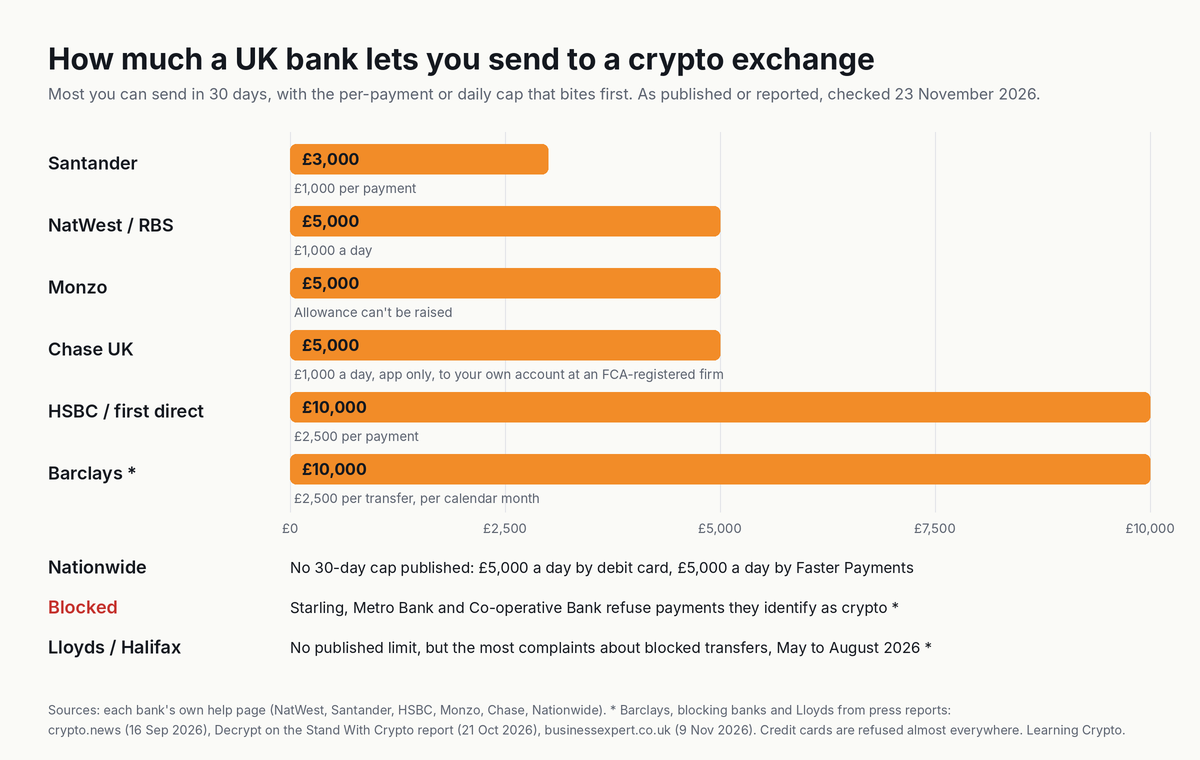
Each bank's 30-day maximum for payments to an exchange, and the smaller cap that usually stops you first. Credit cards are refused for crypto at almost every UK bank.
| Bank | Limit on payments to exchanges | Source |
|---|---|---|
| Santander | £1,000 per payment, £3,000 in any rolling 30 days. Payments to Binance stopped | Bank help page |
| NatWest and RBS | £1,000 a day, £5,000 in any 30 days, applied to each account. Credit cards blocked since 2018 | Bank help page |
| Monzo | £5,000 in a rolling 30 days, which Monzo says it can't change | Bank help page |
| Chase UK | App only, to an account you hold with an FCA-registered UK company: £1,000 a day, £5,000 in 30 days. Card purchases declined | Bank help page |
| HSBC UK and first direct | £2,500 per payment, £10,000 in any rolling 30 days, per customer | Bank help page |
| Nationwide | £5,000 a day by debit card and £5,000 a day by Faster Payments. Card payments to Binance declined | Bank help page |
| Barclays | £2,500 per transfer, £10,000 per calendar month. Barclaycard blocked | Press reports |
| Starling, Metro Bank, Co-operative Bank | Refuse payments they identify as crypto | Press reports |
| Lloyds and Halifax | No published limit, but the most complaints about blocked transfers | Stand With Crypto report |
The Lloyds line matters. A bank with no published policy can still stop a payment on a case-by-case basis, and you only find out when it fails. Readers in Ireland and the rest of Europe describe the same pattern with their own banks, though the rules vary more from bank to bank there and fewer of them publish a number.
Why can you get money out of an exchange but not in?
Because the banks' rules only point one way. HSBC's page states plainly that you can still receive payments from crypto exchanges into your account, and Santander says payments coming in from Binance are not restricted, even though it blocks payments going to Binance. Money arriving is not a scam risk the bank has to refund, so it gets waved through.
That is the asymmetry our readers spotted. A cap of £3,000 or £5,000 a month means building a position takes months, while selling one takes an afternoon. For anyone buying regularly in small amounts the caps may never bite. For anyone moving a lump sum, such as savings or an inheritance, they are the whole problem.
The scale is not small. A report published in October 2026 by the advocacy group Stand With Crypto counted 10,092 complaints about blocked transfers from 9,803 people in just 90 days, with Lloyds, Barclays, NatWest and HSBC named most often (Decrypt's write-up has the breakdown). An earlier survey of ten large UK exchanges by the UK Cryptoasset Business Council found around 40% of payments to them were blocked or delayed.
Did my bank block the deposit, or did the exchange reject it?
Look at where the money is. If it never left your account, or the bank's app showed a warning or a decline, the bank stopped it. If it left your account and came back days later, or is sitting as "pending" on the exchange, the exchange is holding or returning it.
Exchanges reject deposits for a short list of reasons, and nearly all of them are fixable:
- The name does not match. Kraken's deposit checklist says the name on the sending account must match the name on your exchange account. A joint account works if one name matches. A partner's or a company's account does not.
- It came through a third party. Payments routed through another person, an app wallet or a pooled account are held until the exchange can verify where the money came from, and Kraken refuses transfers sent from other exchanges.
- The reference was missing. If the deposit instructions show a reference code, the payment has to carry it, or the exchange cannot match it to you.
- Your account is not fully verified. Many exchanges accept the payment but freeze it until identity checks are finished.
- They want to know where the money came from. Larger deposits can trigger a request for bank statements or other proof of funds before they are credited.
The travel rule, which many readers mentioned, is a separate thing. It applies to crypto moving between exchanges and wallets, not to your bank deposit. Since 1 September 2023, UK exchanges have had to collect and share sender and recipient details for crypto transfers, which is why you may now be asked who owns the wallet you are sending to or receiving from.
How do I get money onto an exchange when my bank blocks it?
Work through these in order. Each one keeps you inside the rules, so nothing comes back to bite you later.
- Find out exactly what was stopped and why. Call the bank, not the chat bot, and ask whether it was a policy cap, a fraud flag on this payment or a block on that exchange. A fraud flag can sometimes be cleared on the call. A policy cap cannot.
- Check the exchange is registered with the FCA. Several banks treat registered firms differently, and Chase only allows transfers to FCA-registered UK companies. If your exchange is not on the FCA register, the bank is unlikely to budge, and that is worth knowing for its own sake. Our guide to checking whether an exchange is safe walks through it.
- Plan around the cap. If your bank allows £5,000 a month, a purchase you planned as one payment becomes several months of regular buys. Many long-term buyers already work this way on purpose.
- Use a bank account that allows more. Opening a current account with a bank whose published limit suits you, in your own name, is legitimate. Do not move money to another bank purely to dodge a block on a payment your first bank has flagged as a possible scam: NatWest's own page asks customers not to, and the second bank may stop it too.
- Keep the payment simple. Send from a personal account in the same name as your exchange account, include any reference shown, and avoid sending the same amount twice in quick succession, which Kraken says can delay crediting.
- Consider buying bitcoin peer to peer. Platforms such as Bisq and RoboSats let you pay another person directly, so no exchange deposit is involved. It is slower and has its own risks, which we cover in our guide to no-KYC bitcoin options.
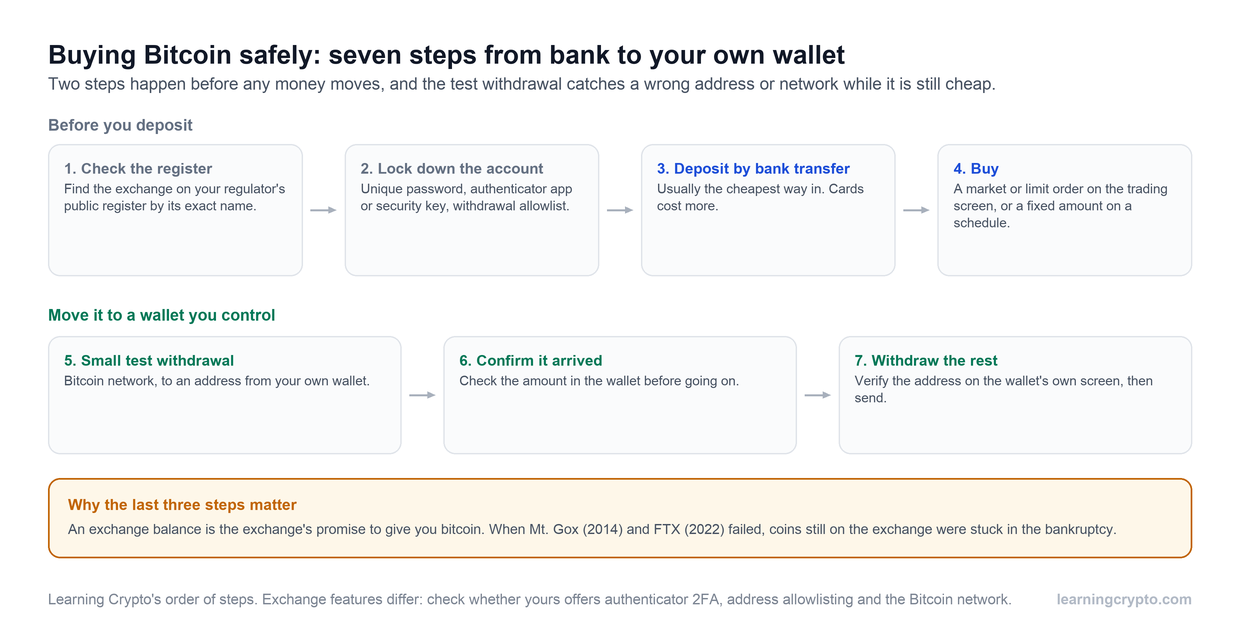
Whatever route you use, move what you buy into your own wallet once it lands. An exchange that is hard to pay into can be just as hard to get out of when it has problems of its own, as readers who were locked out of their accounts this year found.
What should you never do to get around a bank block?
Never let anyone else send money to the exchange on your behalf, and never send it from someone else's account. The deposit will be held or returned because the name does not match, and you may have to explain the transfer to both the bank and the exchange.
Be wary of any person or service that offers to get your money onto an exchange for a fee, especially one that contacts you first. Telling you how to get past your bank's checks is exactly what investment scammers do, and it is the pattern the banks' rules were written to catch. The same goes for anyone who coaches you on what to say if the bank calls.
Avoid crypto cash machines in the UK. The FCA has warned that crypto ATM operators in the UK are not registered with it and are operating illegally (its warning explains why), so you have no protection if a transaction goes wrong.
Finally, do not give your bank a false reason for a payment. Misdescribing a transfer can lead to the account being closed, and a closure is far harder to undo than a cap.
Can I complain if my bank blocks a crypto payment?
Yes, though you should expect the bank to win on a published policy. Start with the bank's own complaints process and ask for its final response in writing. If you are not happy with the answer, you can take it to the Financial Ombudsman Service, or the Financial Services and Pensions Ombudsman in Ireland.
Banks' terms generally allow them to refuse payments they consider risky, and published caps are applied to everyone, so a complaint about the limit itself rarely succeeds. Complaints have a better chance where the bank made a mistake: it stopped a payment it says it allows, gave you no reason, or took an unreasonable time to release a held payment. Keep dates, amounts and the names of anyone you spoke to.
Will the new FCA crypto rules make it easier?
Possibly, but nobody can promise it. The UK is bringing crypto firms under full FCA authorisation. The application window for firms opened on 30 September 2026 and closes on 28 February 2027, and the new regime is due to start on 25 October 2027. Both industry reports ask banks to replace blanket limits with checks based on the individual payment, and to treat registered firms differently.
Until banks actually change their published policies, plan on the limits staying. If you want help working out a sensible buying plan around them, members can ask our Ask Crypto AI, and our guide to KYC in crypto explains the identity checks you will meet on the exchange side. More beginner material sits in the Fundamentals hub.
This guide is general information, not financial or legal advice. Bank and exchange rules change often and differ by country, so check the current terms with your own bank and exchange before you move money.
Frequently asked questions
Why does my bank block payments to crypto exchanges?
Most UK banks say they cap or block payments to crypto exchanges to protect customers from scams. Since October 2024 UK banks have had to refund most victims of authorised push payment fraud, and many investment scams end at an exchange. A blanket limit is simpler for the bank than judging each customer, so honest buyers get the same caps as scam victims.
How much can I send to a crypto exchange from a UK bank?
As of November 2026, Santander allows £3,000 in 30 days, NatWest, Monzo and Chase £5,000, and HSBC and Barclays £10,000. Nationwide caps payments at £5,000 a day. Starling, Metro Bank and the Co-operative Bank refuse crypto payments altogether. Limits change without notice, so check your bank's own help page before a large purchase.
Why was my deposit returned by the crypto exchange?
The most common reason is a name mismatch: exchanges such as Kraken require the sending bank account to be in the same name as your exchange account. Deposits are also held or returned when they come through a third party, miss a required reference code, arrive before identity checks are complete, or are large enough to trigger a request for proof of funds.
Does the travel rule apply to bank deposits to an exchange?
No. The travel rule covers crypto moving between exchanges and wallets, not money you send from your bank. Since 1 September 2023 UK crypto firms have had to collect and share information about the sender and recipient of crypto transfers. Bank deposits face separate anti-money-laundering checks, such as matching names and asking where larger sums came from.
Is it legal to use a different bank to buy crypto?
Yes. Opening a current account in your own name with a bank whose crypto policy suits you is legitimate. What causes problems is sending money through someone else's account, moving money to a second bank to push through a payment your first bank flagged as a possible scam, or giving a false reason for the payment. Those can lead to held deposits or account closure.
Can I complain to the ombudsman about a blocked crypto payment?
You can. Complain to your bank first and ask for its final response in writing, then take it to the Financial Ombudsman Service in the UK or the Financial Services and Pensions Ombudsman in Ireland. Complaints about a published limit rarely succeed. Your chances are better if the bank broke its own policy, gave no reason, or held your money for an unreasonable time.
Keep learning
- How to Tell If a Crypto Exchange or Wallet Is Safe
- What Is KYC in Crypto? Know Your Customer Explained
- No-KYC Bitcoin in 2026: How to Buy, Swap, and Cash Out Without Handing Over Your ID
- Centralized vs Decentralized Exchanges: Which is Best for Your Crypto?
- Coinbase vs Kraken: Key Differences for Crypto Traders
- More beginner guides in the Fundamentals hub
- Free headlines: the Learning Crypto news feed on Telegram